
Latvia Country Profile:
The Estonian Tax Model Without the Estonian Reputation
Latvia copied Estonia's zero-tax-until-distribution corporate system in 2018 and offers the same EU and euro access at a lower cost of living. It has a higher personal tax, a banking sector still living down 2018, and a language law that shapes daily life; it is a functional alternative, not a clone.
🇱🇻 Key Facts (2026):
Currency: Euro (EUR); roughly USD 1.17 per euro
Personal income tax: progressive. 25.5% on annual income up to EUR 105,300 (about USD 123,000); 33% above that; plus an additional 3% on the portion of total annual income above EUR 200,000 (about USD 234,000), giving an effective top rate of about 36%. A fixed non-taxable minimum of roughly EUR 510–550 a month applies
Capital income: dividends, interest and capital gains taxed at 25.5%; dividends from Latvian companies that paid corporate tax on distribution are exempt
Corporate tax: 0% on retained and reinvested profits; distributed profits taxed at a nominal 20% on a base grossed up by dividing by 0.8, an effective 25% of the net distribution. In force since 1 January 2018
Micro-enterprise tax: 25% of turnover up to EUR 40,000, for sole traders only
VAT: 21% standard; 12% and 5% reduced. Registration mandatory above EUR 50,000 turnover
Social insurance: 23.59% employer and 10.5% employee on salary up to an annual ceiling of EUR 105,300; a solidarity tax of 25% applies to earnings above the ceiling
Wealth tax: none
Estate/inheritance tax: none; a notarial state fee applies on inheritance and gifts within families are exempt
Real estate tax: 0.2%–3% of cadastral value annually, set by municipality
Tax residency trigger: declared place of residence in Latvia, or 183 days or more in any 12-month period
Headline visa thresholds: residence by investment on EUR 250,000 in property plus a 5% state duty, EUR 50,000–100,000 in a Latvian company's equity plus a EUR 10,000 fee, EUR 250,000 in government bonds plus EUR 38,000, or a EUR 280,000 subordinated bank deposit plus EUR 25,000; Digital Nomad Visa on 2.5 times the Latvian average wage, roughly EUR 4,300 a month; Startup Visa on Startup Latvia approval; EU Blue Card at 1.5 times the average wage
Corporate setup: SIA with EUR 2,800 share capital or a reduced-capital SIA from EUR 1; USD 600–1,700 all-in. Annual maintenance: USD 1,750–4,100
Personal bank account minimum: nil for residents; non-residents are largely declined rather than charged
Private banking threshold: roughly EUR 250,000–500,000 investable at Citadele, Signet, Swedbank and SEB
Cost of living, comfortable professional family of four in Riga: EUR 3,500–5,000 a month (USD 4,100–5,850)
CRS: participating; early adopter, first exchanges 2017 on 2016 data
FATCA: Model 1 IGA, signed June 2014
Treaties: roughly 63 comprehensive; no treaty with Panama, and Panama is on the low-tax jurisdiction list Latvia applies
Population: ~1.85 million and falling
Time zone: UTC+2 (UTC+3 summer)
Last edited: 11 July 2026 by Joe Martin Hanson (Director & Global Partner) with advice from FTR’s Latvian Tax Partners
Why Latvia Matters
Latvia matters as the second address for the distribution-tax model. Since 2018 a Latvian SIA pays nothing on profits it keeps and 25% effective on profits it pays out, the same mechanism as Estonia with a slightly higher bill. For a business that reinvests, the deferral is real, and Riga offers a cheaper office, cheaper staff and a larger city than Tallinn to put it in. The v2 profile called it a less well-known but functional alternative, and that is right: nobody chooses Latvia over Estonia for the tax rate, but plenty choose it for the cost base, the Russian- and Latvian-speaking workforce, and the fact that it is not full.
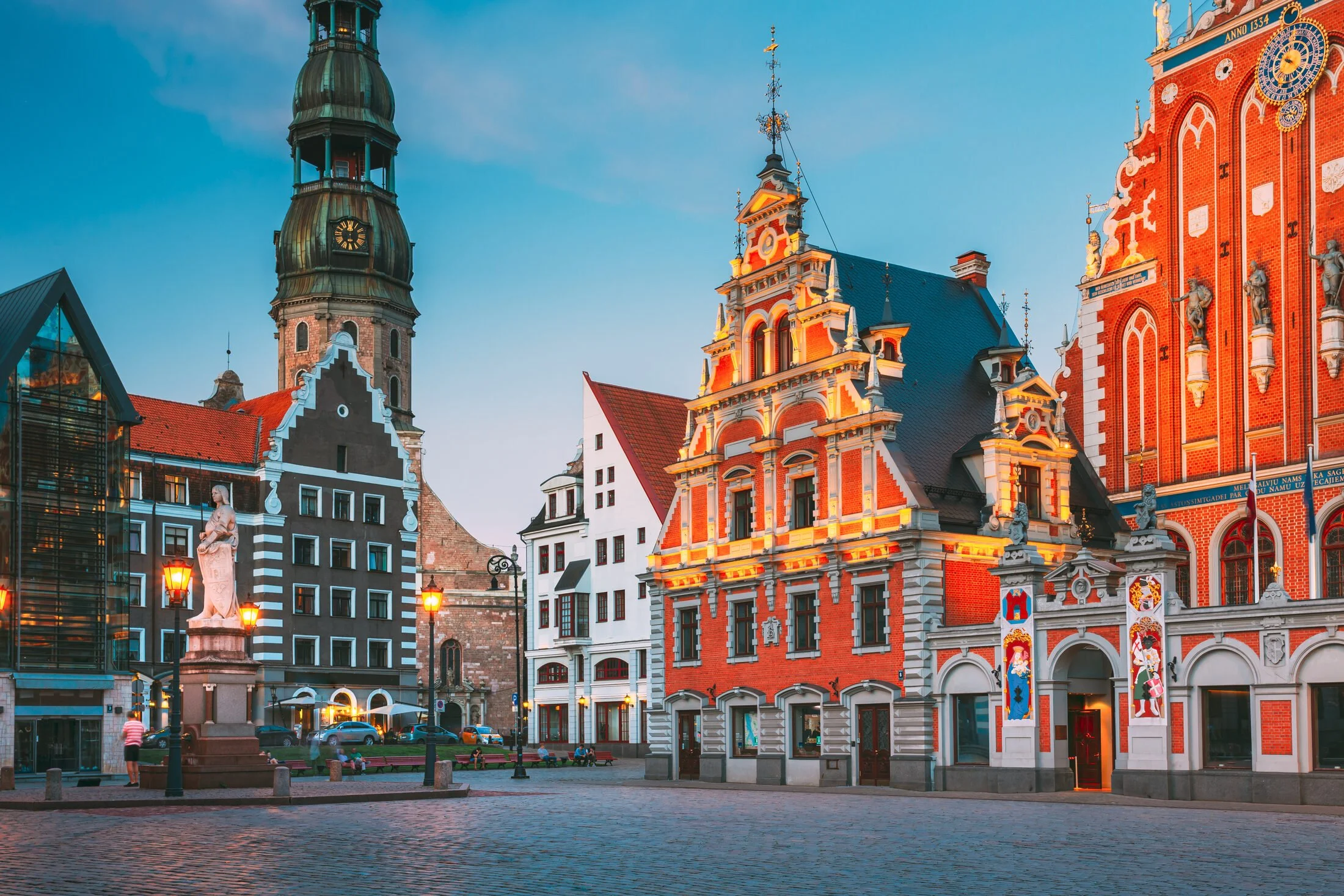
It matters second as a place to live inside the EU and the euro at a modest cost. Riga is a handsome, walkable city of 600,000 with an Art Nouveau centre, a beach resort at Jūrmala, an international airport with the best connections in the Baltics, and a cost of living a third below Western Europe. A family can live comfortably on what would be tight in Munich or Amsterdam.
It matters third, and only slightly, as a source country. A large diaspora in the UK, Ireland, Germany and Scandinavia, and a small class of Riga business owners and property holders, have international affairs to organise; Latvia's absence of exit tax and inheritance tax makes their departures clean.
What Latvia does not offer is the personal tax that makes Estonia and Bulgaria attractive. The top personal rate is 33% plus a 3% surcharge, capital income is taxed at 25.5%, and social contributions are high. Latvia is a place to run a company cheaply, and to live pleasantly, not a place to be a highly paid individual.
Visa and Residency Routes
EU, EEA and Swiss nationals register with the Office of Citizenship and Migration Affairs within 90 days and receive a registration certificate; permanent residence follows after five years. Non-EU nationals need a temporary residence permit, usually issued in one to three months.
Residence by investment was for a decade Latvia's most-used route, mainly by Russian and Chinese buyers, before the property threshold rose to EUR 250,000 in 2014 and demand collapsed. It still exists in four forms: a property purchase of at least EUR 250,000 with a cadastral value above EUR 80,000 plus a 5% state duty; an equity investment of EUR 50,000 in a Latvian company with fewer than 50 employees that pays at least EUR 40,000 a year in tax, or EUR 100,000 in a larger one, plus a EUR 10,000 fee; EUR 250,000 in government bonds plus a EUR 38,000 fee; or a EUR 280,000 five-year subordinated bank deposit plus a EUR 25,000 fee. Each gives a five-year temporary residence permit with annual re-registration, no minimum stay, and a path to permanent residence after five years with A2 Latvian. Russian and Belarusian citizens have been excluded since 2022. FTR would use the company-equity route for a client building a real Latvian business anyway; the property route buys a Riga flat and a permit, fine if the client wants both and poor value for the permit alone.
The Digital Nomad Visa, from 2022, is for someone employed by, or owning, a company registered in an OECD country, on income of at least 2.5 times the Latvian average wage, for a year, extendable once. It does not lead to permanent residence and is a trial tool.
The Startup Visa gives a founder approved by the Latvian Investment and Development Agency a three-year temporary residence permit with no capital floor and a reduced tax regime for the startup's employees. It is small and genuine.
Employment permits need a salary at least equal to the Latvian average; an EU Blue Card needs 1.5 times the average. Intra-corporate transfers and highly qualified specialists move faster.
Permanent residence comes after five years of continuous temporary residence and an A2 Latvian test. Citizenship requires five years of permanent residence, a Latvian language test, and a history and anthem exam. Latvia permits dual citizenship with EU, EFTA and NATO states, Australia, Brazil and New Zealand, so a Western applicant need not renounce; it is a ten-year project.
What fails: the investment residence permit treated as a golden visa, which it is not, since the permit is temporary and permanence needs the language test; and any route for a Russian or Belarusian passport holder, which is closed.
Tax Peculiarities and Traps
The 0.8 coefficient. A distribution of EUR 80,000 net is grossed up to EUR 100,000 and taxed at 20%, so the company pays EUR 20,000 and the effective rate on cash to the shareholder is 25%. Every plan modelled at 20% is wrong by a quarter.
Conditionally distributed profits. The corporate tax base includes not only dividends but deemed distributions: expenses unrelated to business, bad debts not meeting the statutory tests, loans to related parties, interest above the thin-capitalisation limits, transfer pricing adjustments and the liquidation quota. The company pays 25% effective on all of these as if they had been paid out. A shareholder who borrows from the SIA has triggered the tax.
The board member's deemed salary. Where a company has turnover above a monthly threshold tied to the minimum wage and pays no one at least the minimum wage, its board member is deemed to have received the minimum wage and the company owes personal tax and social insurance on it. It catches single-owner companies that run on dividends alone.
The 3% surcharge and the progressive bands. The 33% rate above EUR 105,300 and the additional 3% above EUR 200,000 are assessed on total annual income, including capital income, in the annual return, so a good year in salary plus dividends can move a taxpayer into both.
Solidarity tax. Above the social insurance ceiling of EUR 105,300 the employer's and employee's contributions continue as a solidarity tax; part of it is redistributed to the pension system and part is treated as personal income tax. A senior salary in Riga does not get cheaper above the ceiling in the way it does in Bulgaria.
Low-tax jurisdictions and Panama. Latvia applies the EU list of non-cooperative jurisdictions as its list of low-tax or tax-free jurisdictions, and Panama is on it. Payments from a Latvian company to a Panamanian entity are subject to a 20% withholding tax on the gross amount, other than purchases of goods and securities at market prices, and a Latvian resident individual who holds a quarter or more of a company in a listed jurisdiction has that company's income attributed to them. Latvia also has corporate CFC rules under ATAD.
Residence and departure. A declared residence address in Latvia is a residency indicator on its own, so emigrating Latvians who keep the registration are residents on paper. There is no exit tax.
The Structural Layer
For a client resident in Latvia, FTR's default of a Panamanian Private Interest Foundation owning a Panamanian SA, with a modest director's salary paid locally, does not fit. Panama's place on the list Latvia applies means the SA's income is attributable to the resident owner at 25.5% or the progressive rates as it arises, and any payment a Latvian company makes to the SA is subject to 20% withholding. The Panamanian foundation is not itself the problem, but its subsidiary is.
The structure that works is a Latvian SIA as the operating and holding company: 0% on retained profits, 25% effective on distributions, dividends exempt in the resident owner's hands because the company has paid, and a participation exemption on dividends the SIA receives from taxed subsidiaries. For succession a Panamanian foundation, or a Liechtenstein or Maltese one, can hold the SIA's shares, since Latvia has no inheritance tax and the foundation does not trade with the SIA; counsel should confirm that a foundation in a jurisdiction not on the list is outside the attribution rule. Where the client is a highly paid individual rather than a company owner, Latvia's personal rates make the structure academic and the honest advice is to be resident elsewhere.
For a client resident elsewhere using a Latvian SIA as an EU operating company, the analysis is the same as Estonia's: the 0% retained-earnings regime is real in Latvia and irrelevant if the owner's home country applies CFC rules to individuals or treats the SIA as locally managed. The SIA works for owners resident in territorial or no-CFC countries and for multinational groups that want a cheap euro subsidiary with a Baltic and Nordic-facing workforce.
Info-Sharing Reality (CRS and FATCA)
Latvia has exchanged CRS data since 2017 and reports to over a hundred jurisdictions, including Russia's former partners in the EU, the UK, Germany, Scandinavia, China and Panama. Latvian banks report non-resident account holders and controlling persons to the State Revenue Service, which sends the data home; under the Model 1 IGA, US persons' accounts go to the IRS via Riga. The commercial register is public and the beneficial ownership register is accessible.
Latvia was, until 2018, the Baltic jurisdiction where privacy was sold: roughly half of bank deposits belonged to non-residents, mostly from the former Soviet Union, held through shell companies. The 2018 collapse of ABLV Bank, after the US Treasury named it a primary money laundering concern, ended that model in months. Parliament banned banks from servicing shell companies, the regulator forced the sector to shed non-resident business, and Latvia has spent the years since demonstrating to Moneyval and the FATF that the old Riga is gone. It is. Anyone arriving with the pre-2018 picture of Latvian banking in mind will be refused at the door.
For Chinese HNW families the investment residence route was, before 2014, a cheap EU foothold; it is now expensive for what it gives, fully reported to Beijing, and offers no privacy. As a Plan-B it has nothing Portugal or Greece do not do better.
Banking Reality
The retail and corporate market is Swedbank, SEB, Citadele, Luminor and, for domestic business, BluOr, Signet and Industra; Rietumu, once the largest non-resident bank, still operates under a domestic-focused model. Residents open personal accounts in a day or two on a passport, permit and address. Non-residents without a Latvian connection are generally declined, and corporate accounts for an SIA with a foreign owner take three to eight weeks, an in-person or video interview, a business plan and source-of-funds evidence to Nordic standards; owners from outside the EU face more scrutiny, and owners from CIS countries a presumption of refusal.
Latvia is not on any FATF or EU list, having avoided grey-listing in 2020 after an intensive Moneyval process. SEPA and SWIFT access are unrestricted. Russian and Belarusian nationals face near-blanket refusal; US citizens are accepted with FATCA processing. Fintech accounts with Lithuanian or Estonian IBANs are a common bridge for new SIAs.
Cost of Doing Business
A standard SIA needs EUR 2,800 of share capital, of which half can be paid later; a reduced-capital SIA for up to five individual shareholders starts at EUR 1. State fees, notary and a lawyer come to USD 600–1,700. Annual accounting, annual report and filings run USD 1,750–4,100, rising with VAT and payroll. Riga office and salary costs are 10%–20% below Tallinn and well below Warsaw.
Against the set: a Panamanian SA runs USD 1,500–2,500 to establish and USD 1,000–1,800 a year; Singapore roughly three times the Panamanian setup at USD 4,500–7,500 and USD 4,000–8,000 a year; Estonia USD 400–1,200 to set up and USD 1,200–3,000 a year on the same model with fully digital filing. Latvia is cheaper than Panama to set up and comparable to run, and charges 25% effective on distribution where Estonia charges 22/78 and Panama charges nothing on foreign-source profits.
Cost of Living
Monthly figures for Riga; Jūrmala runs level or above on rent in summer, and everywhere else in the country runs a third below.
Lean, single or couple: EUR 1,400–1,900 (USD 1,650–2,200): a one-bedroom in the Centre or Āgenskalns at EUR 500–800, groceries EUR 300–450, public transport EUR 30, and top-up private cover of EUR 40–90 alongside public healthcare funded by social contributions.
Comfortable, family of four: EUR 3,500–5,000 (USD 4,100–5,850): a three-bedroom flat or house in Mežaparks, Teika or Jūrmala at EUR 1,000–1,800, one car, family private cover EUR 150–300, and international school fees at the International School of Latvia, King's College Riga or Exupéry of roughly EUR 9,000–20,000 a year per child amortised monthly.
HNW: EUR 7,500 and up (USD 8,800 and up): a house in Mežaparks or a Jūrmala villa, two international school places, staff, and a city where money runs out of uses quickly.
Cultural and Practical Considerations
Language. Latvian is the sole state language and the State Language Law is enforced: officials, courts, notaries and the State Revenue Service operate in Latvian, public-facing jobs require certified proficiency, and the State Language Centre issues fines. Banks and larger firms handle English well; e-services are partly in English. English is good among the young and in business, Russian is spoken by about a third of the country and nearly 40% of Riga, and a foreigner who speaks Russian but not Latvian will be understood in shops and misunderstood in politics. Permanent residence and citizenship need Latvian, and daily life outside Riga needs it too.
Integration and the Russian question. Latvia's politics and identity are shaped by its Russian-speaking minority, the non-citizen status still held by a shrinking group of Soviet-era residents, and the border with Russia and Belarus. Since 2022 the state has removed Soviet monuments, required Russian citizens to pass a Latvian test to keep residence, and phased Russian out of schooling. A foreign resident is not a party to this, but will feel it in the atmosphere, the news and occasionally the neighbours. Latvians are reserved, courteous and slow to befriend, somewhat warmer than Estonians; integration takes years and the expat community in Riga is small.
Bureaucracy. Good e-services through the state portal and the tax authority, less seamless than Estonia's, and an immigration office that works to its deadlines. Things mostly happen on time.
Women. Full legal equality, safe streets and no constraint on women travelling, residing or doing business alone. Latvia ratified the Istanbul Convention in 2024 after a long political fight.
LGBT residents. A civil union law took effect on 1 July 2024, giving registered partners most of the rights of marriage short of the name and joint adoption; the president elected in 2023 is openly gay. Society outside Riga is conservative; Riga is tolerant.
Religion and diet. Lutheran, Catholic and Orthodox traditions, lightly held. No dietary or dress constraints.
Climate and health. Long, dark, wet winters and short bright summers; daylight in December is under seven hours. Public healthcare is underfunded with long waits; private clinics in Riga are good and inexpensive. Seasonal low mood is a real feature of the latitude.
Security and politics. Coalition governments are fragmented and noisy but the state is stable, a NATO and eurozone member with conscription reintroduced in 2023 and a fortified Belarus border. Residents feel the security situation as policy and mood, not as danger. Violent crime is low; the economy is the weakest of the three Baltic states and the population is shrinking, which is felt as slow growth and a tight labour market rather than crisis.
Schooling. State schools teach in Latvian only from 2025 and are decent; Riga's international schools are good and a fraction of Western prices.
For Retirees
Not a retirement destination: no pension route, pensions taxed as ordinary income at 25.5% and up, and a hard winter.
For Digital Nomads and Remote Professionals
The Digital Nomad Visa above for a year or two; anyone staying moves to a work or company route and becomes resident with Latvian personal rates.
For Online Business Owners and Entrepreneurs
A Latvian SIA at 0% retained and 25% distributed for an owner resident in a no-CFC country, or the SIA-plus-foundation structure above for one resident in Latvia. Estonia does the same thing more cheaply and digitally; Latvia wins on office and staff cost.
For Multinational Business Owners
A Riga subsidiary for Baltic, Nordic and Eastern European operations, with a bilingual workforce and the distribution model's deferral; the holding layer sits elsewhere.
For High Net Worth (HNW) Families and Investors
The investment residence route exists but is a temporary permit needing a language test for permanence, with no privacy and full reporting. A pleasant EU base, not a Plan-B.
Common Traps
Coming for a personal tax rate: 33% plus 3% at the top, 25.5% on capital income and high social contributions make Latvia a poor place to be a highly paid individual. Coming with the Panamanian default: Panama is on the list Latvia applies, with 20% withholding and personal attribution. Coming for the old Riga banking: it ended in 2018 and the banks will say so.
Coming for a golden visa: the investment permit is temporary, re-registered annually and needs A2 Latvian for permanence. Coming with a Russian or Belarusian passport. Coming as an owner resident in Western Europe or North America expecting the 0% to survive home-country CFC rules. Coming for warmth, sociability or daylight in winter, or for a life in English outside Riga.
Next Steps
If Latvia is the EU operating company in your plan, or the Baltic base for a business that needs Riga's cost base, book a scoping call. The SIA is quick; the distribution arithmetic, the low-tax-list exposure and the question of where the owner lives are where the work is.
Important note: General information. Not personal tax, legal, or financial advice. Speak to a qualified adviser at FTR or elsewhere before acting.
Continue reading
Suggested next, chosen by our partners.


