05. Ongoing Compliance
Most structures don't fail at setup. They fail at year three.
An international structure that's clean at incorporation can drift out of compliance within eighteen months if the ongoing work isn't done. Annual filings missed, beneficial-ownership updates skipped, economic-substance requirements ignored, residency tests quietly failed — none of these are dramatic individually, but together they're how good structures become exposed structures. Ongoing compliance is the unglamorous capability that keeps everything else working.

What annual maintenance actually includes:
Every jurisdiction in which you hold an entity, a residency, or a tax registration carries an annual maintenance load. The specific obligations vary, but the categories are broadly consistent:
Annual filings. Corporate annual returns in the jurisdiction of incorporation. Tax filings in the jurisdiction of tax residency for the entity and for you personally. Filings in any jurisdiction where the entity carries on activity or holds property. Late or missed filings carry penalties that range from nominal in some jurisdictions to severe in others (the UK and Australia in particular are increasingly aggressive about late lodgement).
Beneficial ownership registers. Most jurisdictions now require disclosure of beneficial ownership to a central register, with updates within thirty to sixty days of any change. Missed updates are increasingly treated as substantive breaches rather than administrative ones.
Economic substance. Jurisdictions that offer favourable corporate tax treatment — Cayman, BVI, Bermuda, Jersey, Guernsey, Isle of Man, and increasingly Singapore and the UAE for certain activities — require annual demonstration of substance: management presence, employees or contractors in the jurisdiction, and activity proportional to the income claimed. The annual substance return is a real compliance obligation.
Residency reviews. Your personal tax residency position needs to be tested annually against the rules of both your departed jurisdiction (to confirm you remain non-resident) and your destination jurisdiction (to confirm you remain qualifying). Day-count records, evidence of substance, and supporting documentation need to be maintained — not assembled retrospectively when a tax authority asks.
CRS and FATCA reporting. Common Reporting Standard and (where applicable) FATCA reporting happen automatically between financial institutions and tax authorities. Your job isn't to report — it's to ensure that what's being reported is what you intend.
How we structure it:
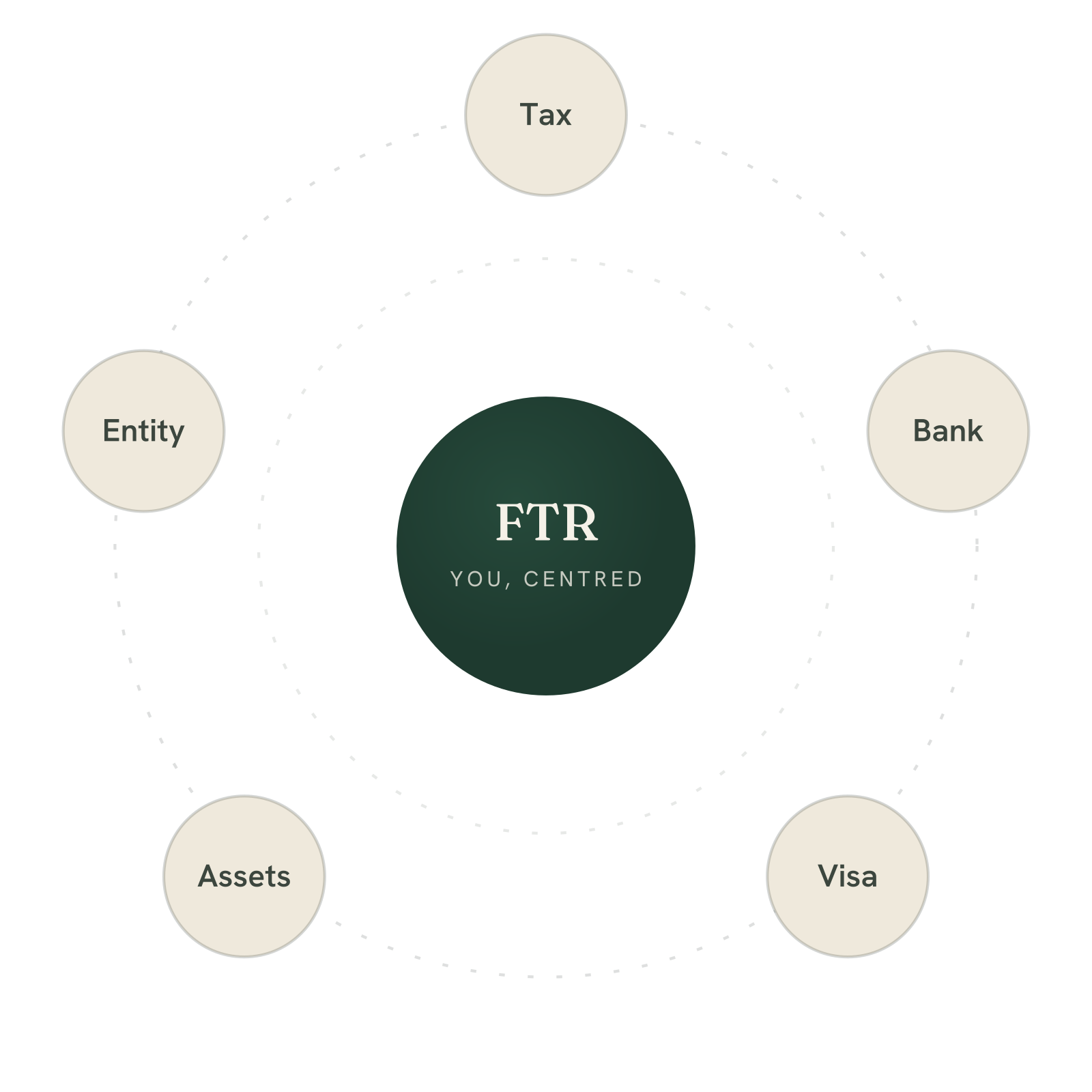
Free to Roam structures ongoing compliance as a single coordinated programme rather than a series of disconnected obligations. The work runs on an annual cycle with a known calendar — clients receive a schedule of what's due, when, in which jurisdiction, and what's required from them. Each filing or update is prepared by the relevant specialist partner and reviewed by FTR before going out.
The document vault holds the supporting evidence in one place: corporate documents, identity documents, residency certificates, tax filings, beneficial ownership records, substance evidence. When a bank, a regulator, or a new partner asks for documentation, the answer is one folder rather than a frantic search across seven jurisdictions.
The annual cadence includes a structural review — a deliberate conversation, usually in the same month each year, about whether the structure still fits the client's situation. Lives change. Revenue patterns shift. Family circumstances evolve. A structure that was right at year one may be over-engineered or under-engineered by year three. The annual review catches that before it becomes a problem.
Why this the difference between a structure and an exposure:
The patterns we see in clients who come to FTR from other providers are consistent. The original structure was sound. The first year of operation went fine. The second year, an annual filing got missed because nobody had clear ownership of it. The third year, an economic-substance return failed because the original setup didn't anticipate the substance requirement. The fourth year, a CRS report flagged an inconsistency that triggered a tax-authority enquiry.
None of this was a problem at incorporation. All of it was a problem because no one was holding the picture across years. The structure existed; the maintenance didn't.
Compliance work isn't a profit centre for most advisory firms — it's lower-margin than setup work, and the temptation is to offer setup and then leave the client to manage the rest. We approach it the opposite way: setup is the entry to a multi-year relationship, and the ongoing compliance is where the real value of FTR's coordination model lives.