
08. Inheritance, Succession, and Asset Protection Planning
A structure that protects you now, and your loved ones in the future.
Cross-border wealth faces two distinct categories of risk over time. The first is the gradual erosion that comes from poorly-designed succession — assets that pass to the wrong people on the wrong terms, or that lose meaningful value in transit through inefficient tax treatment or contested probate. The second is the more dramatic risk that wealth simply doesn't survive — claims, judgments, political instability, currency controls, expropriation, economic collapse in the wrong jurisdiction at the wrong time. Structures designed for both are different from structures designed for either alone.
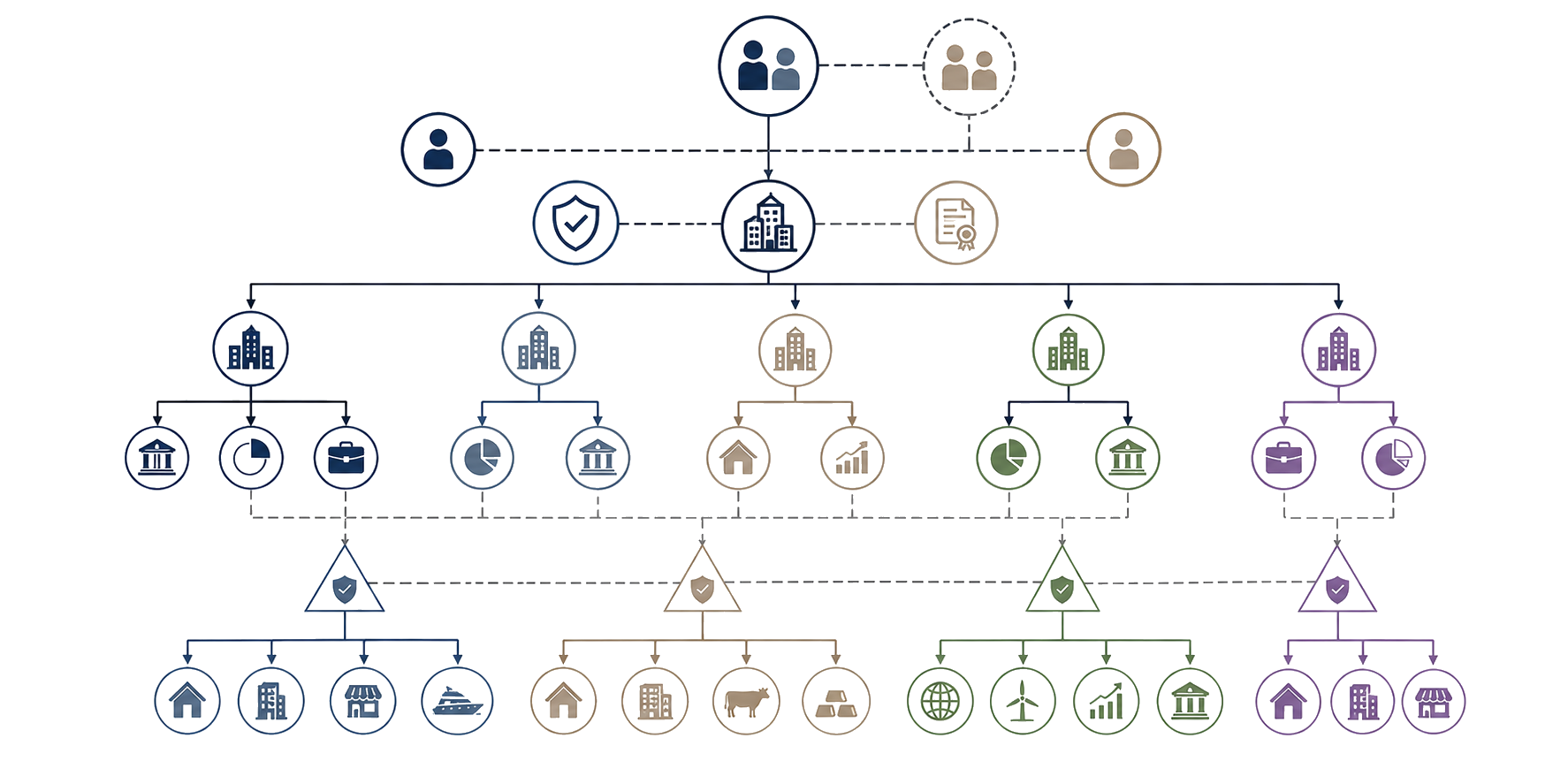
The two related disciplines:
Succession planning and asset protection share most of the same vehicles — trusts, foundations, holding companies, wills — but they're aimed at different problems. Understanding the distinction matters, because structures designed only for one purpose often fail at the other.
The two disciplines pair naturally because the same structural separation that achieves clean succession (assets held outside the personal estate, in vehicles with clear governance) also achieves meaningful asset protection (assets held outside the reach of personal claims, in jurisdictions with strong protective regimes). A well-designed structure does both at once.

Succession planning is about how wealth passes across generations. It addresses questions like: Who inherits, and on what terms? How is forced-heirship handled where it applies? How are minor or vulnerable beneficiaries protected? How is family business ownership transitioned? How are tax inefficiencies at the transfer event minimised? The decisions here are about future events and the rules that govern them.
Asset protection is about whether wealth survives the present. It addresses questions like: How is wealth shielded from foreseeable legal claims (commercial disputes, professional liability, divorce, contested business sales)? How is it protected from political risk in jurisdictions where the rule of law is uncertain? How is currency, banking, and asset concentration diversified against country-specific economic risk? The decisions here are about defensible separation between the wealth and the events that could otherwise erode it.

Why cross-border situations need deliberate design:
Single-jurisdiction wealth structuring is hard enough. Cross-border structuring is materially harder, for reasons that mostly aren't intuitive. Different jurisdictions apply different conflict-of-laws rules to determine which country's inheritance law applies to which assets — sometimes based on the deceased's domicile, sometimes nationality, sometimes the asset's location. Civil-law countries (most of Europe) apply forced-heirship rules that override testamentary intent and reserve specific portions of an estate for specific family members. Common-law countries preserve testamentary freedom but introduce their own procedural and tax complexities.
Asset protection across borders is similarly nuanced. A protective structure that's robust against creditor claims in one jurisdiction may be vulnerable in another. Recognition of foreign trusts varies. Forced repatriation regimes exist in some countries (foreign-exchange controls being the most prominent contemporary example, but not the only one). Sanctions regimes can freeze assets held in particular jurisdictions or in particular currencies. The protective design that works against domestic commercial litigation isn't necessarily the same design that works against political instability or against the gradual closing of capital accounts.
The result, in practice, is that an internationally mobile family with assets in three countries, heirs in two more, and exposure to litigation, political, or economic risk in any of them can end up in a structural position where the wealth is effectively unprotected and the succession is effectively unplanned — even when the family thought it had handled both. Most of this is preventable with deliberate, coordinated design. The structures aren't exotic; they need to fit the specific family situation rather than being borrowed from someone else's plan.
The vehicles our clients utilise:
Asset protection and succession structures come in several distinct shapes, each with different characteristics and appropriate use cases. The same vehicle can serve both purposes when designed with both in mind:
-
The classic common-law vehicle for both succession and asset protection. Assets are transferred to trustees who hold them for the benefit of named beneficiaries on terms specified by the settlor. Once properly settled, the assets are legally separated from the settlor's personal estate — which achieves both succession objectives (the assets pass under the trust's terms rather than under the settlor's will or under intestacy rules) and asset protection objectives (the assets are typically outside the reach of subsequent personal claims against the settlor). The most-used jurisdictions for international family trusts are the Cayman Islands, Jersey, Singapore, and (for specific protective use cases) the Cook Islands, which has historically had one of the strongest creditor-resistant trust frameworks.
-
The civil-law equivalent of a trust, with separate legal personality. Panama's Private Interest Foundation (PIF) is one of the most useful vehicles for clients with Latin American or civil-law-origin family situations, combining succession and asset-protection features in a single structure. Liechtenstein and Austrian foundations serve similar purposes for European family situations at the higher end of the wealth spectrum.
-
For families whose wealth is concentrated in operating businesses, succession and protection are often best handled through the corporate structure itself — share classes, voting arrangements, buy-sell agreements, family-governance documents, and where appropriate the insertion of holding entities in jurisdictions chosen for their legal and political stability. This is a corporate-governance problem with succession and protection implications, not a trust problem.
-
The baseline tools, coordinated across jurisdictions. An internationally mobile client often needs separate wills in different jurisdictions, drafted to be mutually consistent and to comply with each jurisdiction's specific requirements. Standalone wills drafted by a lawyer in only one jurisdiction frequently produce conflicts that complicate the succession.
-
Less of a vehicle than a strategic principle, but worth naming. Holding wealth across multiple jurisdictions — different banks, different countries, different currencies — provides meaningful protection against country-specific economic, political, or banking risks that no single-jurisdiction structure can offer. We coordinate this kind of diversification as part of the broader structural design, in conjunction with capabilities 02 (Structuring) and 03 (Banking).
Other frequently discussed topics on succession & asset protection:
-
Asset protection and succession engagements typically begin with a structured conversation about the family situation: who the heirs are, where they live, what the assets are and where they sit, what the family's intentions are for wealth transition, and — critically for the asset protection side — what the foreseeable risk picture looks like. Are there commercial liabilities? Professional liability exposures? Family circumstances that introduce risk (divorces, contested business ownership)? Political or economic risks in jurisdictions where significant assets currently sit? Currency or banking concentration risks?
The risk conversation is genuinely substantive. Asset protection structures designed without understanding the actual risk picture often protect against the wrong things and leave the real exposures untouched. A family with most of its wealth tied up in operating businesses in a politically volatile jurisdiction needs a different design from a family with most of its wealth in passive investments in stable jurisdictions facing potential commercial litigation. The structures look similar; the design choices differ.
Based on the conversation, we work with the client and the relevant specialist partners to design the architecture. The design typically integrates with the client's existing structures (holding companies, residency arrangements, banking) rather than sitting separately — which is why we prefer to do this work as part of a broader engagement rather than as a standalone project. The integration is where the value sits.
Implementation involves multiple workstreams: drafting trust deeds or foundation charters with the relevant specialists, setting up trustee or council arrangements with the appropriate independence from the settlor (a critical asset-protection element), transferring assets into the structure with appropriate tax-efficient and protective timing, drafting or revising wills in each relevant jurisdiction, and putting in place the powers of attorney and incapacity arrangements that support the structure during the settlor's lifetime. We coordinate all of this; the regulated work is performed by licensed partners in each jurisdiction.
-
Asset protection is a legitimate planning objective. It is also an area where less-reputable advisers operate in ways that don't reflect what the structures can actually achieve, and it's worth being clear about the boundaries.
Properly designed asset protection structures work against foreseeable, ordinary-course risks: future commercial disputes, future professional liability claims, future divorce proceedings, future political or economic instability in jurisdictions where assets are held, future banking or currency restrictions. The protective effect comes from legal separation, jurisdictional choice, and structural design — all of which need to be in place before the risk crystallises. A trust established today protects against tomorrow's potential litigation; a trust established the day a writ is served almost certainly doesn't.
Asset protection structures do not work — and we will not design them — to defeat existing or imminent claims. The legal doctrine of fraudulent conveyance (in common-law jurisdictions) and equivalent civil-law principles allow courts to set aside transfers made for the purpose of evading specific creditors, particularly where the transfer was made after the claim arose or while the claim was foreseeable. Working with FTR means working with structures that withstand legitimate scrutiny precisely because they were established appropriately in advance.
Similarly, asset protection structures don't shield wealth from tax obligations legitimately owed. Tax avoidance and asset protection are different things; legitimate structures handle tax efficiency through proper jurisdictional planning (which we coordinate under capability 02), not by hiding assets from authorities.
-
Asset protection and succession planning compound across years. A trust structured at age 50 may not deliver its succession outcome until age 85; the asset-protection benefit may matter most in a single litigation year somewhere in between. Between setup and outcome, lives change: marriages, divorces, births, deaths, business sales, relocations, changes in the political or economic situation of countries where wealth is held. A structure that's set up and never revisited will rarely fit the family that eventually needs it.
The annual review cadence we apply to all FTR engagements is particularly important on this capability. We re-test the structure against the family's current situation and current risk picture, flag any drift from the original intentions, and coordinate adjustments where needed. Most adjustments are minor; some are substantial. None of them are surprises if the review work is being done properly.
This is also the capability where the relationship between FTR and the client family extends most naturally across multiple periods of the family's life. A succession and protection structure set up for the founders carries the family's wealth through whatever the next decades hold, and the coordination relationship — with the family rather than with one individual — supports that continuity.