
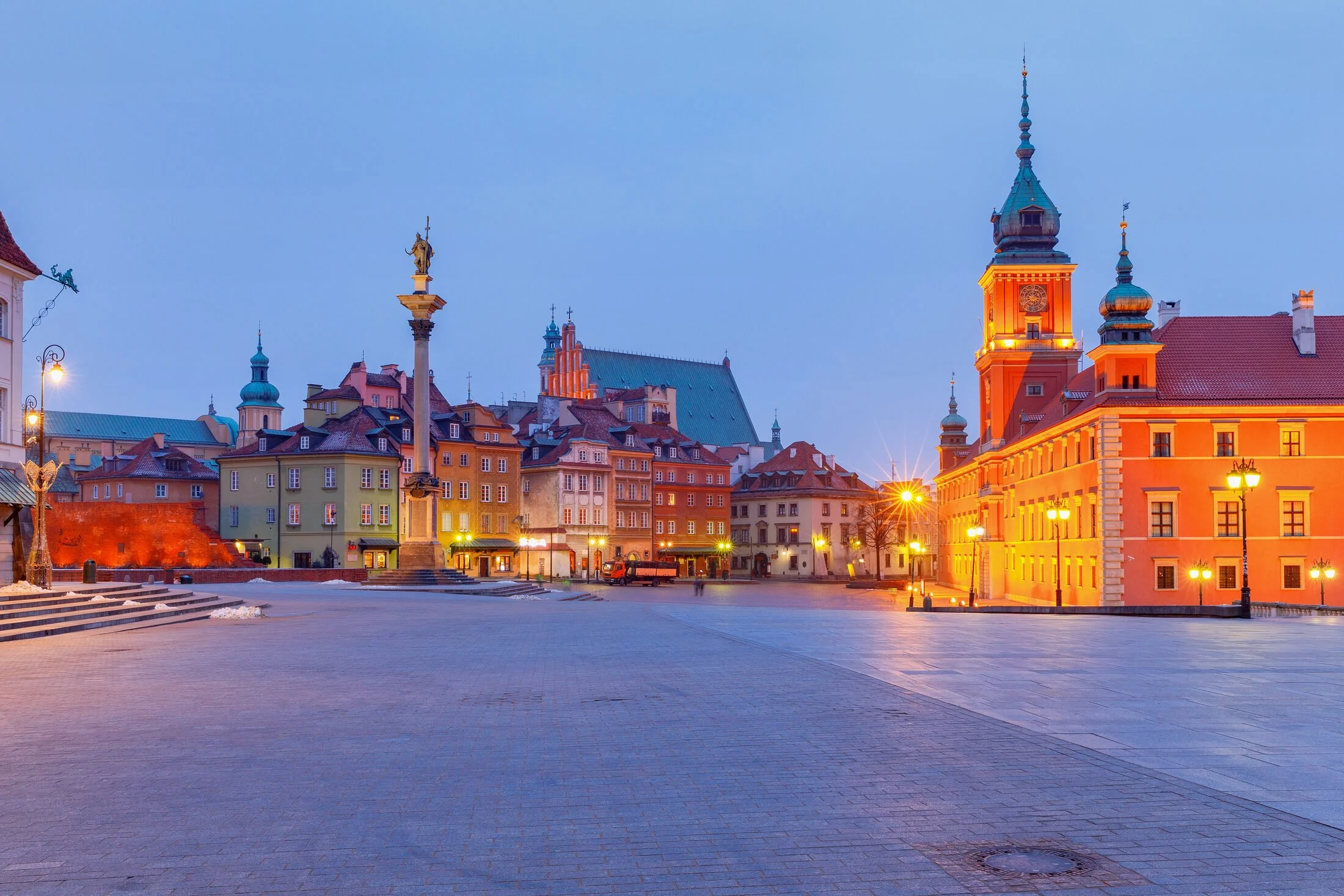
Poland Country Profile:
Major Source Country With an Exit Tax, Personal CFC Rules and a Family Foundation Worth Knowing
Poland has sent millions of its people to the UK, Germany, the Netherlands and Ireland since 2004, and its new HNW class is now the more interesting flow. Leaving Poland with wealth is a technical exercise: a personal exit tax above PLN 4 million, CFC rules that attribute offshore income annually, and a domestic family foundation that often beats the offshore alternative.
🇵🇱 Key Facts (2026):
Currency: Polish Złoty (PLN); roughly 3.73 to USD (mid-market, September 2026)
Personal income tax: 12% to PLN 120,000, 32% above; PLN 30,000 tax-free amount; under-26s exempt to PLN 85,528; returning residents exempt to PLN 85,528 for four years
Solidarity levy: 4% on aggregate income above PLN 1 million
Business income alternatives: 19% linear rate, or lump-sum tax on registered revenue at 2%–17% by activity (12% for most IT services, 8.5% for many other services)
Health contribution: 9% of income on the scale, 4.9% on the linear rate, fixed tiers on the lump sum; largely non-deductible
Corporate tax: 19% standard; 9% for small taxpayers with revenue up to EUR 2 million and start-ups; Estonian CIT at 10% (small) or 20% payable only on distribution; 10% minimum income tax for loss-making large companies
VAT: 23% standard; 8% and 5% reduced; registration threshold PLN 200,000
Capital gains: 19% flat on securities, dividends, interest and crypto (the Belka tax)
Exit tax: 19% on unrealised gains in shares, securities and business assets worth over PLN 4 million, on ceasing residence after five or more years' residence in the preceding ten
CFC rules for individuals: 19% on the income of controlled foreign companies, foundations and trusts, attributed annually; entities in listed jurisdictions including Panama are caught automatically
Wealth tax: none
Estate/inheritance tax: spouse, descendants, ascendants, stepchildren and siblings exempt on filing form SD-Z2 within six months; otherwise 3%–20% by relationship group
Tax residency trigger: centre of personal or economic interests in Poland, or more than 183 days in the tax year
Headline visa thresholds: business residence permit requires the company to have earned twelve times the average wage or employ two Polish nationals in the prior year; EU Blue Card at 150% of the average wage; no digital nomad or investor visa
Corporate setup: sp. z o.o. with PLN 5,000 minimum capital (USD 1,340); PLN 2,000–6,000 (USD 540–1,600) in fees. Annual maintenance: PLN 8,000–20,000 (USD 2,150–5,350)
Personal bank account minimum: nil; monthly fees PLN 0–15
Private banking threshold: PLN 1 million investable (USD 268,000) at PKO Bank Polski, Pekao, Santander and mBank private banking; PLN 500,000 at some
Cost of living, comfortable professional household in Warsaw: PLN 15,000–22,000 a month (USD 4,000–5,900)
CRS: participating; early adopter, first exchanges 2017 on 2016 data
FATCA: Model 1 IGA, signed October 2014
Treaties: roughly 90 comprehensive; no treaty with Panama
Population: ~37.5 million and falling, plus roughly a million Ukrainians under temporary protection
Time zone: UTC+1 (UTC+2 summer)
Last edited: 12 September 2026 by Joe Martin Hanson (Director & Global Partner) with advice from FTR’s Polish Tax Partners
Why Poland Matters
Poland matters to FTR as a source country, and the nature of the source has changed. The first wave, from EU accession in 2004, was young, wage-driven and went to the UK, Ireland, Germany and the Netherlands; Polish communities in those countries run to the hundreds of thousands each and needed no structuring. The second wave is the one FTR sees: founders, professionals and property owners who built wealth in Poland's twenty-year boom and now want a second residence, an international holding layer or a succession plan that does not depend on Polish law. They are leaving from a country that, unlike its southern neighbours, has built the full apparatus to tax the exit.
It matters second as a country people return to. The economy has outgrown most of the EU, Warsaw pays London-adjacent salaries in tech and finance, and a four-year income tax exemption for returning residents exists precisely to bring the first wave home. A Pole coming back after fifteen years in Manchester with a UK pension, a UK company and a UK house is a re-entry planning file, not a simple move.
It matters third, and least, as a destination. Poland has no investor visa, no digital nomad visa and no retirement route, its combined personal rate with solidarity levy and health contribution reaches the high thirties, and its CFC and exit tax regimes are the region's most developed. EU business owners come for Polish engineers and a 9% small-company rate, not for the personal tax.
Visa and Residency Routes
EU, EEA and Swiss nationals register their residence with the voivodeship office within three months on proof of income or employment and health cover, and qualify for permanent residence after five years. The office visit is the only friction.
For non-EU nationals, Poland is a work-and-family immigration country with no wealth-based route. A national D visa or a temporary residence permit (karta czasowego pobytu) is obtained for a stated purpose:
Employment permits and the EU Blue Card, at a salary of at least 150% of the average wage, are straightforward where a Polish employer sponsors; the voivodeship offices in Warsaw, Kraków and Wrocław take six to eighteen months to decide, during which the applicant may stay but not easily travel. The Poland Business Harbour fast track for IT specialists, mainly from Belarus and Ukraine, was suspended in 2024.
The business permit requires the applicant's Polish company to have earned at least twelve times the average monthly wage in the previous tax year or to employ two Polish nationals full time; a fresh company qualifies only on a credible plan and is refused more often than not. It is what FTR would use for a non-EU founder who is genuinely building in Poland and nobody else.
Family reunification and study permits work as elsewhere in the EU.
Permanent residence (karta stałego pobytu) is available to holders of the Karta Polaka, to people of Polish origin, and to spouses of Polish citizens after three years' marriage and two years' residence; the EU long-term residence permit requires five years, stable income and Polish at B1. Citizenship by recognition needs three years on permanent residence with B1 Polish and stable income and housing, or ten years' legal stay including permanent residence, or two years' permanent residence plus three years of marriage to a Pole; the President may also grant citizenship at discretion. Dual citizenship is tolerated.
The routes that matter to FTR's clients are the descent ones. Confirmation of Polish citizenship is available to descendants of Polish citizens who never lost it, which covers a large share of the Polish diaspora in the United States, the UK, Brazil and Argentina, and yields an EU passport without residence. The Karta Polaka for people of Polish origin worldwide gives a fast path to permanent residence and then citizenship for those who move. For a client with a Polish grandparent, this is the only reason to think of Poland as a citizenship jurisdiction.
Tax Peculiarities and Traps
The exit tax. Article 30da of the PIT Act taxes the unrealised gain in shares, securities, derivatives, fund units and business assets when an individual who has been Polish resident for at least five of the preceding ten years ceases to be resident, or transfers such assets abroad, where the assets' aggregate market value exceeds PLN 4 million. The rate is 19%, or 3% where the asset has no determinable tax basis. Payment can be spread in instalments over up to five years, and the tax is refundable if the individual returns within five years without disposing of the assets. For a founder leaving with a shareholding in a Polish company, this is the largest single planning item and the departure date is a variable. A foreigner who has lived in Poland fewer than five years leaves without it.
Personal CFC rules. Article 30f attributes the income of a controlled foreign entity, including foreign foundations and trusts, to a Polish-resident individual at 19% annually whether or not distributed. An entity is caught automatically if it sits in a jurisdiction on the EU non-cooperative list or the Ministry of Finance's tax-haven regulation, and Panama is on both; otherwise it is caught on a control, passive-income and low-effective-tax test. The resident must keep a CFC register and file a separate PIT-CFC return. The penalties for silence are criminal-fiscal, not merely administrative.
Solidarity levy and health contribution. Four per cent on aggregate income above PLN 1 million, and a 9% health contribution that since 2022 is largely non-deductible, take the effective top rate on employment income to around 40% and on linear-rate business income to about 28%. The lump-sum revenue tax at 12% for IT contractors with fixed health tiers is why so much of Polish tech works as B2B sole traders, and why the tax office scrutinises those arrangements.
Inheritance and gift tax filing. The exemption for close family is total but conditional: form SD-Z2 must be filed within six months of the inheritance or gift, and gifts of cash must move through a bank account. Miss the form and the transfer is taxed at up to 7% within the family and 20% for strangers, with a penal rate of 20% where the tax office discovers an undeclared gift. Diaspora families helping children buy Warsaw flats trip this constantly.
Return relief. A person who becomes Polish resident after at least three years abroad may exempt up to PLN 85,528 of employment, business and contract income a year for four consecutive years. Worth roughly PLN 60,000 over the period at the top rate; it needs a documented foreign residence history and does not cover investment income.
Estonian CIT and the family foundation. Two domestic regimes that change the structuring calculus: a sp. z o.o. electing Estonian CIT pays no corporate tax until profit is distributed, then 10% or 20% with a shareholder credit; and a fundacja rodzinna, available since May 2023 with a PLN 100,000 founding fund, pays no tax on permitted passive and holding activity, 15% on distributions, and nothing further to beneficiaries in the founder's immediate family.
The Structural Layer
For a Polish resident, FTR's default of a Panamanian Private Interest Foundation over a Panamanian SA with a modest director's salary paid in Poland does not fit and should not be attempted. Both the foundation and the SA are controlled foreign entities in a listed jurisdiction, their income is attributed at 19% annually with a CFC return, and the arrangement gains nothing while creating criminal-fiscal exposure. The Polish resident's structure is domestic: an operating sp. z o.o., often on Estonian CIT, held by a fundacja rodzinna for succession and asset protection, with international investments held through the foundation at nil Polish tax until distribution.
The Panamanian default comes into its own after departure. The sequence is to model the exit tax on every holding above the PLN 4 million aggregate, decide whether to sell, gift into the family foundation or accept the charge before leaving, establish residence in a treaty country or in Panama, sever the centre of personal and economic interests in Poland, and only then build the foundation and SA above whatever Polish companies remain. Polish-source income and Polish real estate stay taxable in Poland after departure; the CFC rules stop applying the day residence ends. The family foundation can survive a founder's departure, but its beneficiaries' tax position changes with their residence, and a foundation with non-resident beneficiaries needs review before, not after, they leave.
For a returning Pole, the reverse: Panamanian and other foreign structures accumulated abroad become CFCs on the first day of residence, and either the structure is unwound before return, or the return relief and a domestic foundation replace it. Assets held on return get no basis step-up.
Succession: Polish civil law reserves a forced share (zachowek) of half the intestate entitlement, two thirds for minors and the incapacitated, to descendants, spouse and parents. The family foundation is the domestic answer and the Panamanian foundation the international one; neither removes the forced-share claim over Polish property, but both keep international assets outside it.
Info-Sharing Reality (CRS and FATCA)
Poland was an early CRS adopter and has exchanged since 2017. Polish banks report non-resident account holders to the National Revenue Administration (KAS), which exchanges with roughly a hundred jurisdictions including the UK, Germany, Ireland, the Netherlands, Switzerland, the UAE and Panama. Under the Model 1 IGA, US persons' accounts go to the IRS through KAS.
The consequences: a Polish resident's Panamanian foundation is reported to Warsaw, where the CFC return should already have disclosed it; a Pole in Manchester who kept a Polish account is reported to HMRC; a Pole who "moved" to Dubai while keeping a Warsaw flat, a spouse and a company is reported by the UAE back to KAS, which asks why the centre of personal interests changed. KAS has matched CRS data to returns since 2019, uses the STIR anti-fraud system across the banking sector, and its CFC enforcement is the most active in the region.
Poland has never been a privacy jurisdiction and offers no product to anyone seeking one. Its beneficial ownership register is operational and public, its banks are subsidiaries of Spanish, Dutch, German, French and Portuguese groups or state-controlled, and its transparency obligations are enforced in full. For Chinese HNW families there is no residency product and no discretion.
Banking Reality
PKO Bank Polski and Pekao are the state-influenced champions; Santander Bank Polska, mBank (Commerzbank), ING Bank Śląski, BNP Paribas, Millennium and Alior complete the market. A resident with a PESEL number and address opens an account online in a day. A non-resident can open at PKO BP, Pekao and some others with a passport and proof of foreign address, in person, and will be asked to obtain a PESEL; without one, product access is limited. Corporate accounts for a sp. z o.o. take two to four weeks and are needed before registration completes.
Poland is on no blacklist or grey list, correspondent access is full and SWIFT is unrestricted. The sector is well capitalised after a decade of Swiss-franc mortgage litigation losses, and the state's influence over the two largest banks is a governance point rather than a solvency one. Russian and Belarusian nationals meet enhanced review or refusal across the market; Ukrainians are onboarded routinely; US citizens are accepted by the larger banks.
Cost of Doing Business
A sp. z o.o. needs PLN 5,000 of capital (USD 1,340) and can be registered online through the S24 system in days for a few hundred złoty in court fees, or through a notary for PLN 2,000–6,000 (USD 540–1,600) where a bespoke deed is needed. Annual accounting, payroll, VAT and filings run PLN 8,000–20,000 (USD 2,150–5,350). A sole trader carries social insurance (ZUS) contributions of roughly PLN 1,900 a month before health, which is the real fixed cost of the lump-sum regime.
Against the set: a Panamanian SA costs USD 1,500–2,500 to establish and USD 1,000–1,800 a year; Singapore roughly three times the Panamanian setup at USD 4,500–7,500 with USD 4,000–8,000 annual compliance; a Bulgarian EOOD USD 600–1,750 and USD 1,750–4,700 at 10%. Poland is a mid-cost EU jurisdiction with monthly VAT, the JPK electronic ledger filed with every return, and from 2026 mandatory e-invoicing through the national KSeF system; it is run for a Polish accountant, and the 9% small-company rate is the reward.
Cost of Living
Monthly, for Warsaw; Kraków and Wrocław run 15%–20% below on rent, Gdańsk and Poznań 25%.
Lean, single or couple: PLN 7,000–9,500 (USD 1,900–2,550): one-bedroom in Mokotów, Wola or Śródmieście PLN 3,500–5,000, groceries PLN 1,500–2,200, transit pass PLN 110, private medical subscription at Luxmed or Medicover PLN 200–400.
Comfortable, family of four: PLN 15,000–22,000 (USD 4,000–5,900): three-bedroom apartment or house in Wilanów, Żoliborz or Konstancin PLN 7,000–11,000, one car, family private medical PLN 600–1,000, one international school place at PLN 90,000–130,000 a year at the American School of Warsaw or the British School Warsaw amortised monthly.
HNW: PLN 40,000 and up (USD 10,700 and up): house in Konstancin-Jeziorna or Wilanów, two international school places, driver, help and a Masurian lake house.
Cultural and Practical Considerations
Language. Polish is difficult and is the floor for every official interaction: KAS, the voivodeship office, ZUS, notaries and courts operate in Polish, and citizenship requires B1. English is good among the under-45s in Warsaw, Kraków, Wrocław and Gdańsk and in every tech company, and thin in provincial administration. A resident can run a business through English-speaking advisers indefinitely; integration beyond the expat and tech circles requires the language and Poles respect the attempt.
Bureaucracy. Two countries in one. Digital government, through the mObywatel app, ePUAP and KAS's e-filing, is among the best in the EU. The voivodeship immigration offices are among the worst, with residence permit backlogs of six to eighteen months in the big cities, a stamp in the passport that permits stay but complicates travel, and no one to phone. Everything else works, mostly on time.
Politics. A coalition government since December 2023 faces a President from the opposing camp elected in 2025, so legislation is vetoed and the 2027 election is already the frame for policy. Poland is a NATO frontline state bordering Ukraine, Belarus and the Kaliningrad exclave, spends more of its GDP on defence than any other member, and has had Russian drones shot down over its territory. A resident feels this as a serious national mood rather than danger; daily life in Warsaw is unaffected and Poland remains one of the safest countries in Europe by crime rates.
Women. No legal or practical constraint on women travelling, residing, owning property or doing business alone, and women are strongly represented in business and the professions. Abortion has been almost entirely prohibited since a 2020 Constitutional Tribunal ruling, and a woman of child-bearing age moving to Poland should understand what that means in practice, including for a wanted pregnancy that goes wrong. Family law is no-fault with community of property by default.
LGBT residents. No recognition of same-sex partnership or marriage, no adoption, and a civil partnership bill has been stalled between the government and a President expected to veto it. The "LGBT-free zone" resolutions of 2019–2020 have largely been withdrawn. Warsaw, Kraków and Gdańsk are tolerant in daily life; the legal position is the weakest in the EU alongside Romania and Bulgaria, and family reunification for a foreign same-sex spouse is not available.
Religion, diet, climate. Catholic in identity and, increasingly among the young, not in practice; the Church remains politically influential. No dietary or dress constraints; vegetarian and vegan food is now easy in the cities. Cold, dark winters and warm summers; winter smog in Kraków and Silesia has improved but remains a health issue for anyone with a respiratory condition.
Healthcare and schooling. The public system (NFZ) is competent and slow; residents buy private subscriptions and use public hospitals for emergencies. State schools teach in Polish and are academically strong; the Warsaw international schools are good and priced at Western levels.
Pace and integration. Warsaw is orderly, punctual, direct and quieter than most capitals; Poles are formal on first meeting, blunt in business and loyal once a relationship exists. The expat community is large enough to live in and most foreigners do; the roughly one million Ukrainians now resident have changed the texture of the cities more than any Western expat cohort.
For Retirees
No route without EU citizenship or Polish family; returning Polish retirees should model the UK, Irish or German pension position before the move rather than after.
For Digital Nomads and Remote Professionals
Ninety Schengen days only; no permit. Those on Polish B2B contracts are usually residents whether they think so or not.
For Online Business Owners and Entrepreneurs
Inbound: a sp. z o.o. at 9% or on Estonian CIT with Polish engineers. Outbound: the exit tax and the departure sequence above.
For Multinational Business Owners
A Polish subsidiary for engineering and operations at 19%, or 9% while small; the holding layer sits elsewhere.
For High Net Worth (HNW) Families and Investors
For Polish HNW families, the family foundation at home and the Panamanian structure after departure, never both at once while resident; for foreign families, Poland offers no product and full transparency.
Common Traps
Establishing a Panamanian foundation or company while Polish resident, or keeping one on return: CFC attribution, a separate return and criminal-fiscal exposure for silence. Leaving with a shareholding above PLN 4 million without modelling the exit tax. Moving to Dubai while the flat, the spouse and the company stay in Warsaw. Receiving a family gift without filing SD-Z2. Treating a B2B contract as non-residence.
Poland also does not work for anyone who needs a wealth-based or retirement route, for a same-sex couple's legal security, for a woman who needs reproductive healthcare certainty, for anyone who cannot wait a year for a residence card, or as a low-tax personal residence at any income above the first bracket.
Next Steps
If you are Polish and within 24 months of leaving with a business or a portfolio, or returning after years abroad, book a scoping call. The exit tax and CFC rules make the sequence matter more here than almost anywhere in the EU.
Important note: General information. Not personal tax, legal, or financial advice. Speak to a qualified adviser at FTR or elsewhere before acting.
Continue reading
Suggested next, chosen by our partners.


