
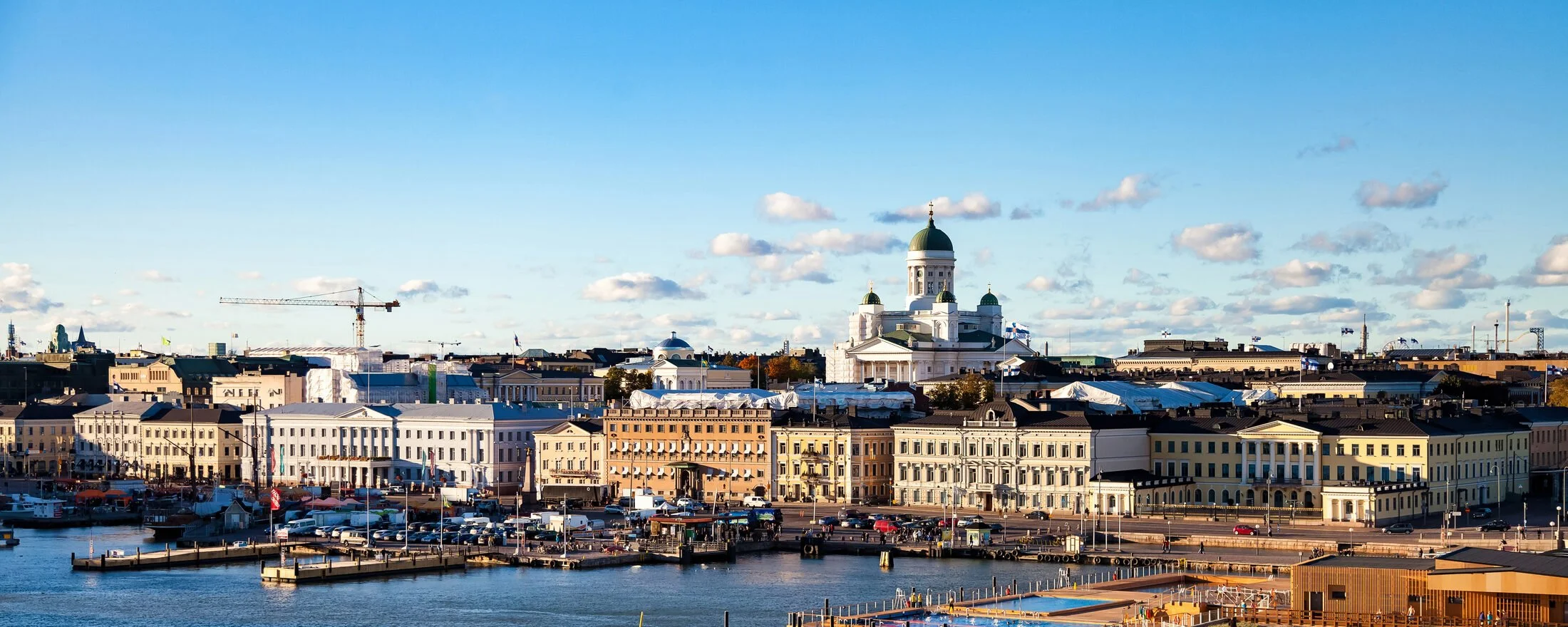
Finland Country Profile:
A Lower Top Rate Than Its Reputation, a Three-Year Shadow and Estonia Two Hours Away
Finland taxes earned income to about 48%, capital at 30% and 34%, and keeps its citizens tax-resident for three years after they leave. A Nordic source country whose emigrants are fewer than Sweden's or Denmark's and whose favourite shortcut, an Estonian company, no longer works from a Helsinki desk.
🇫🇮 Key Facts (2026):
Currency: Euro (EUR); ~USD 1.16 per EUR (mid-market, September 2026)
Personal income tax: national progressive scale to 37.50% on earned income above EUR 52,100, plus municipal tax of 4.70%–10.90% by municipality, plus church tax of 1%–2.25% for members
Combined top marginal rate: 48.40% (national plus the highest municipal rate); up to about 50.65% with church tax; employee pension, unemployment and health contributions of roughly 8%–10% of gross salary sit on top
Corporate tax: 20%
VAT (ALV): 25.5% standard; 14% on food, restaurants and most formerly reduced items; 10% on newspapers and periodicals
Capital income tax: 30% up to EUR 30,000 a year, 34% above; listed dividends 85% taxable; unlisted dividends 25% taxable up to 8% of the company's net assets (capped at EUR 150,000), the balance mainly taxed as earned income
Wealth tax: 0% (abolished 2006)
Inheritance tax: progressive 7%–19% for spouses, descendants and ascendants above an allowance of EUR 20,000; gift tax 8%–17% above EUR 5,000 in the same class; more distant beneficiaries have historically paid a higher schedule
Transfer tax: 3% on real estate, 1.5% on shares in housing companies and other securities
Exit tax on unrealised gains: none for individuals; the departure rule that bites is the three-year rule; a corporate exit tax applies on migrating a company
Tax residency trigger: a permanent home in Finland or a continuous stay of more than six months; a Finnish citizen who leaves remains resident for the year of departure and the three following years unless they show substantial ties are severed
Headline visa thresholds: specialist residence permit at a gross salary of roughly EUR 3,900 a month; EU Blue Card at a similar level; startup permit with a Business Finland eligibility statement; no investor, retirement or nomad route
Corporate setup (Oy): no minimum share capital; EUR 240 online registration plus EUR 500–2,500 adviser cost (~USD 580–2,900). Annual maintenance: EUR 2,000–8,000 (~USD 2,300–9,300)
Employer social contributions: roughly 20% of salary, mainly the TyEL pension contribution
Personal bank account minimum: nil; Finnish personal identity code and bank identification codes expected
Private banking threshold: roughly EUR 1 million investable (OP Private, Nordea, Danske, Evli, Mandatum)
Cost of living, comfortable professional household: EUR 4,500–6,500 a month in Helsinki (~USD 5,200–7,500)
CRS: participating; early adopter, first exchanges 2017 on 2016 data
FATCA: Model 1 IGA, signed 2014
Treaties: roughly 75 comprehensive, including the US, UK, Canada, Australia, Estonia and the Nordic multilateral convention; none with Colombia; an information exchange agreement with Panama since 2012 but no comprehensive treaty; the treaty with Portugal was terminated from 2019 and a new treaty with Spain took effect the same year
Population: ~5.6 million
Time zone: EET, UTC+2 (UTC+3 summer)
Last edited: 3 September 2026 by Joe Martin Hanson (Director & Global Partner) with advice from FTR’s Finnish Tax Partners
Why Finland Matters
Finland is the Nordic source country with the smallest emigration flow and the most misunderstood tax rate. The old combined top rate near 57% is gone: the 2023 health and social-services funding reform cut municipal rates sharply and raised national rates to compensate, and the 2026 scale tops out at 37.5% nationally, 48.4% with the highest municipal rate. That is still high, and employee contributions and a 25.5% VAT, the second-highest standard rate in the EU after Hungary, make the all-in cost of earning and spending a euro in Finland among the heaviest anywhere. But the pressure on capital is moderate: 30% and 34% on capital income, generous treatment of unlisted dividends, no wealth tax and an inheritance tax that tops out at 19% for the family.
Finland matters second because of how it lets go. There is no exit tax on unrealised gains for individuals, a proposal for one having been shelved in 2023, but a Finnish citizen who leaves remains fully tax resident for the year of departure and three more years unless they can show substantial ties are gone: the home, the family, the business, the social security cover all count. Finland also acts on treaties that stop working; it terminated its treaty with Portugal from 2019 over pensions and gains, the same year it replaced its Spanish treaty with one that lets Finland tax Finnish pensions.
Third, Finland is a modest inbound destination with a genuinely good specialist route, a two-week visa track for skilled workers, free schools that lead the OECD tables, and a language nobody learns quickly. It is not a tax destination. The people who leave go to Portugal while its regime was open, to Estonia for proximity and its distribution-only corporate tax, to the UAE, to Switzerland and to Panama.
Visa and Residency Routes
EU and EEA citizens register their right of residence with the Immigration Service within three months and take a personal identity code; Nordic citizens move under the Nordic passport union. Non-EU routes are employment-led.
Specialist residence permit. For expert work needing a degree, at a gross salary of roughly EUR 3,900 a month or more. On the D visa fast track the permit can be decided in two weeks and family can accompany. The route for inbound professionals and the one FTR would use.
EU Blue Card. For graduates on a salary at a similar threshold; more portable across the EU, otherwise little different in practice.
Residence permit for an employed person. For other work, subject to a labour-market availability test; one to four months. Since 2025 a permit holder who loses the job has three months, six for specialists, to find another or leave.
Startup permit. For founders of a scalable business with a positive eligibility statement from Business Finland, then a two-year permit. Selective, and suited to technology founders rather than lifestyle businesses.
Self-employed permit. Requires a credible business and income enough to live on. Slow, often refused, and not a route FTR would plan around.
Permanent residence needs four years of continuous residence on a qualifying permit, with legislation in progress to lengthen the period and add language and income conditions. Citizenship needs eight years of residence, raised from five in October 2024 (two for Nordic citizens, five for spouses of Finns), Finnish or Swedish at intermediate level on the national language test, self-support and a clean record. Dual citizenship has been permitted since 2003, so Finns who leave keep the passport and the three-year rule with it.
There is no golden visa, no investor route, no retirement route and no digital nomad visa.
Tax Peculiarities and Traps
The three-year rule (Income Tax Act section 11). A Finnish citizen who moves abroad is treated as resident for the year of departure and the three following years unless they demonstrate that no substantial ties remain. A home kept for personal use, a spouse or minor children in Finland, a business or employment in Finland, membership of the Finnish social security system and a substantial Finnish portfolio are the ties the Tax Administration looks at. During the period worldwide income and gains are taxed in Finland subject to treaty, and in Panama or the UAE there is no treaty to help. Non-citizens are released on the day they leave if the home is gone.
Place of effective management. Since 2021 a foreign company whose effective management is exercised in Finland is a Finnish tax resident. The Estonian company set up for the zero rate on retained profit and run from a laptop in Helsinki with a Finnish sole director is a Finnish company paying 20%. The ferry to Tallinn takes two hours and the Tax Administration knows the pattern.
Controlled foreign companies (CFC Act). A Finnish resident who, with related parties, holds 25% or more of a foreign entity whose effective tax is below three fifths of the Finnish level, about 12%, is taxed currently on its income. Genuine economic activity in an EEA state or a treaty state with adequate exchange of information is exempt; a Panamanian SA with foreign income is not.
Unlisted dividends and the 8% rule. A dividend from an unlisted Finnish company is 25% taxable as capital income, an effective 7.5%, up to 8% of the company's net assets and EUR 150,000 a year per shareholder; above 8% it is 75% taxable as earned income. Owner-managers build net assets to widen the band, and the band leaves with the shareholder's residency.
Inheritance and gift tax. Charged on the recipient at 7%–19% and 8%–17% for the closest class above allowances of EUR 20,000 and EUR 5,000. Finnish-situs assets and the assets of a Finnish-resident recipient are within scope wherever the deceased lived, so a Finnish child inheriting from a parent who emigrated decades ago pays Finnish inheritance tax.
Public tax data and church tax. Every November the Tax Administration releases the previous year's taxable income and tax for every resident, and journalists publish the higher earners by name. Members of the Evangelical Lutheran and Orthodox churches pay 1%–2.25% on top of municipal tax; membership is by baptism or registration, and resigning is a form.
The Structural Layer
For a client still resident in Finland, FTR's default of a Panamanian Private Interest Foundation owning a Panamanian SA does not fit. The SA is a CFC in the client's hands and, if run from Finland, a Finnish resident at 20% before the CFC Act is reached. Finland does not recognise trusts and treats a foreign foundation the founder controls as the founder's property for income, gift and inheritance tax, so the foundation adds nothing while the client is resident. A Finnish-resident owner is left with a Finnish Oy under a holding Oy, which gives a participation exemption on dividends and on gains from qualifying shareholdings of 10% or more, with the 8% dividend band as the low-tax outlet at the personal level.
After a genuine departure, and after the three-year rule has run for a citizen, the default works in its ordinary form with two adaptations. First, dividends from any Finnish Oy retained in the structure carry withholding at 20% for corporate recipients and 30% for individuals absent a treaty, and Panama is a non-treaty recipient, so the Finnish holding is sold, migrated within the EU, or held under a treaty. Second, the foundation should be settled after residency ends and with Finnish inheritance tax on Finnish-resident heirs in mind, because the recipient's residence drives the charge.
For the inbound specialist, the structure is salary through the Finnish employer, a pension contribution portable within the EU, and no directorship of a foreign holding company while resident.
Info-Sharing Reality (CRS and FATCA)
Finland is fully CRS-participating and one of the early adopters, exchanging with well over a hundred jurisdictions including Panama, Estonia, Portugal, Spain, Switzerland, the UAE, Singapore and Hong Kong. Finnish banks report non-resident account holders to the Tax Administration, which forwards the data; under the Model 1 FATCA IGA, US persons' accounts go to the IRS. The annual public release of taxable income goes beyond anything CRS requires.
A citizen inside the three-year rule is still a Finnish resident for reporting purposes, and Estonian, Portuguese and Emirati banks report the new accounts to Helsinki, where the Tax Administration uses the data to test the ties. Foreign residents holding Finnish accounts are reported home, including Chinese account holders to Beijing. Finland is not a privacy jurisdiction and has never been one.
Banking Reality
OP, the cooperative group, is the largest bank, followed by Nordea, Danske Bank, S-Pankki, Aktia, the Säästöpankki and POP savings-bank groups and Oma Säästöpankki. A resident with a personal identity code and a registered address opens an account in days, and the bank identification codes used for strong authentication unlock the Tax Administration, Kela, the health system and every contract. EEA residents have a legal right to a basic account; others get one with a residence permit and patience, and getting the codes as a non-resident is hard.
A foreign-owned Oy without a Finnish-resident director can wait weeks for a corporate account and be refused; Finnish banks apply the money-laundering rules carefully and treat inbound payments from Panama and Latin America as documentation events. Emigrants normally keep accounts if the address is updated, though banks review non-resident customers and some restrict services for residents of jurisdictions they consider high-risk. Private banking begins at roughly EUR 1 million at OP Private, Nordea, Danske, Evli and Mandatum. Finland is on no blacklist or grey list and has full correspondent and SWIFT access; cards and mobile payments dominate and cash is rare.
Cost of Doing Business
A Finnish osakeyhtiö needs no minimum share capital and costs EUR 240 to register online plus EUR 500–2,500 (~USD 580–2,900) with an adviser. Annual compliance runs EUR 2,000–8,000 (~USD 2,300–9,300); audit is not required for the smallest companies. Employer social contributions add roughly 20% to every salary, most of it the TyEL pension contribution.
Against the set: a Panamanian SA costs roughly USD 1,500–2,500 to establish and USD 1,000–1,800 a year including resident agent and franchise tax; Singapore runs around three times the Panamanian setup, USD 4,500–7,500, with USD 4,000–8,000 annual compliance; an Estonian OÜ is cheaper still to form and taxes nothing until distribution, which is exactly why the management rule exists. Finland is among the cheapest places in the set to form a company and reasonable to run at 20%; the cost that matters is the 20% employer contribution and the 48.4% on the salary.
Cost of Living
Monthly, for Helsinki; Tampere, Turku and Oulu run 20%–30% below on housing.
Lean, single or couple: EUR 2,000–2,700 (USD 2,300–3,100): a one-bedroom at EUR 900–1,300, public healthcare through the wellbeing services county with modest fees and occupational healthcare through the employer, groceries EUR 350–500, an HSL transit pass at EUR 70–110.
Comfortable, family of four: EUR 4,500–6,500 (USD 5,200–7,500): a three-bedroom at EUR 1,800–2,800, public school with free meals and near-free healthcare, daycare capped at roughly EUR 300 per child, a car at EUR 500–800 or none, since transit and cycling cover the city.
HNW: EUR 10,000–16,000 and up (USD 11,600–18,600): a house in Kulosaari, Westend or Eira at EUR 4,000–7,000 rent or the mortgage equivalent, international school places at roughly EUR 25,000–30,000 per child per year, help, a summer cottage and winter travel south.
Cultural and Practical Considerations
Finland is quiet, safe, competent and dark for half the year. A family that wants the best public schools in Europe, a functioning state and a lake in summer will be content; a client who needs noise, social ease or a warm winter will not.
Language and integration. Finnish is a Uralic language unrelated to anything a European or Latin American client has met; Swedish, the second official language, is spoken natively by about five percent. English is universal in professional life and at banks and agencies, and the tax and immigration portals work in English; Finnish is nonetheless the floor for belonging, a legal condition of citizenship and increasingly of permanent residence, and takes years. Finns are reserved, comfortable with silence and slow to invite, and friendship once given is durable. Foreigners without the language and without children in a local school report loneliness as a matter of course; the Helsinki expat community is small and does not substitute.
Women, LGBT residents and family law. Finland is at the top of the gender-equality indices, with no guardianship, dress or conduct issues; same-sex marriage has been law since 2017 and gender-recognition law was reformed in 2023. Family law gives each spouse a marital right to the other's property, so the net estate is divided equally on divorce unless a marriage contract is registered; the courts consider worldwide assets.
Climate. Helsinki has around six hours of daylight in December, Lapland none for weeks, and winter runs from November to April. Seasonal depression is a real health variable and the Finnish answer is the sauna, the ski track and the summer cottage.
Security and politics. Violent crime is low and personal security is not a planning variable. Finland joined NATO in 2023 and closed its land border with Russia the same year; the 1,300-kilometre frontier is a fact of daily politics rather than daily life, felt in the news and in defence spending rather than on the street. The current government is tightening immigration, citizenship and benefit rules year by year, and a non-EU resident should expect conditions to become stricter, not looser.
Bureaucracy and schooling. Digital, punctual and rule-bound once the identity code exists, slow before it; things happen when the letter says they will. Public schools are free, excellent and unhurried, with English-language classes in some Helsinki schools and international schools for children who will move again.
For Retirees
A Finnish pension is taxed in Finland wherever the pensioner lives under most current treaties, the Portugal route is closed, and the three-year rule follows a citizen. No inbound retirement route.
For Digital Nomads and Remote Professionals
A Finnish citizen travelling year-round with a flat in Helsinki has not left. No inbound visa.
For Online Business Owners and Entrepreneurs
The three-year rule and the management rule on the Estonian company are the departure problems; leave properly, then apply the default structure from the destination.
For Multinational Business Owners
A cheap place for a subsidiary at 20% with the participation exemption and a skilled workforce; a costly place for the owner to earn. Inbound specialists use the fast-track permit.
For High Net Worth (HNW) Families and Investors
A tolerable place for a passive family to stay, with no wealth tax and moderate capital taxation, and a poor one to arrive in: public tax data, full transparency, tightening residence rules and no investor route. Chinese and other HNW families should assume every Finnish account is reported home.
Common Traps
The half-departure. A Finnish citizen who keeps the home, the family, the business or the social security cover has not severed substantial ties and stays resident for three years.
The Estonian company run from Helsinki. Place of effective management makes it Finnish, and the CFC Act catches the rest.
Retiring to Portugal or Spain on a Finnish pension and expecting the old treaty positions; both have been closed.
Settling a foundation or trust while resident and finding it looked through for income, gift and inheritance tax.
Coming to Finland for tax: 48.4% on salary before contributions, 25.5% VAT, public tax data and a language that takes years.
Assuming the old 57% rate. It overstates the burden and leads to bad comparisons with Sweden and Denmark.
Next Steps
If you are a Finnish citizen within 24 months of leaving, run a foreign company from Finland, hold unlisted Finnish shares, or have heirs who will remain Finnish residents, book a scoping call. The three-year rule and the management and CFC rules are the whole of the Finnish exit, and each rewards planning that starts before the departure date.
Important note: General information. Not personal tax, legal, or financial advice. Speak to a qualified adviser at FTR or elsewhere before acting.
Continue reading
Suggested next, chosen by our partners.


