
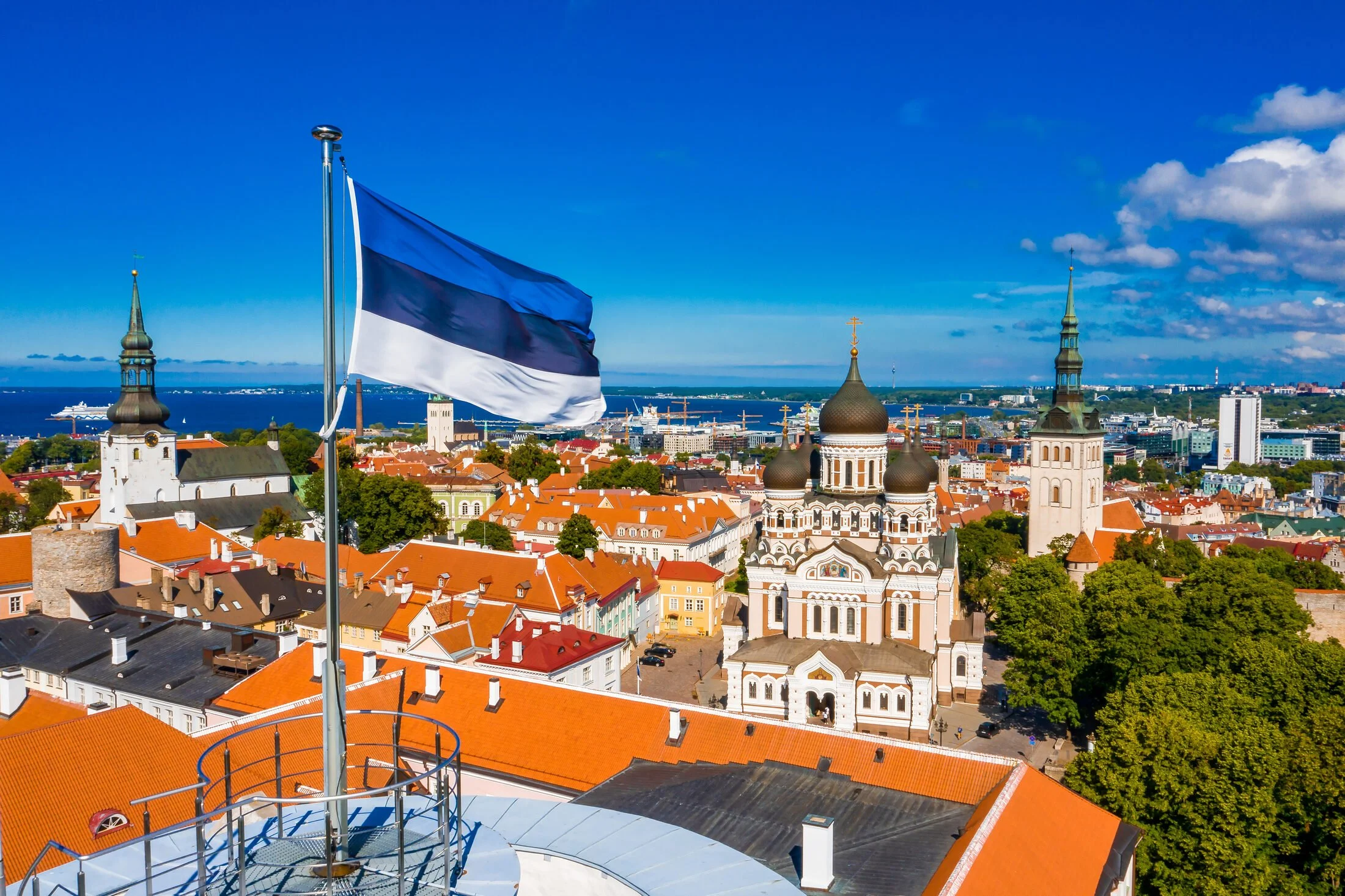
Estonia Country Profile:
Zero Tax on Retained Profits, Until You Take Them Home
Estonia's company tax is genuinely nil until profits are distributed, its administration is the most digital in Europe, and e-Residency lets anyone run an Estonian company from anywhere. The catch is that the other country, the one the owner actually lives in, usually taxes those profits anyway.
🇪🇪 Key Facts (2026):
Currency: Euro (EUR); roughly USD 1.17 per euro
Personal income tax: 22% flat on all income types, including capital gains and rental income. A basic exemption of up to EUR 654 a month tapers to nil for higher earners
Corporate tax: 0% on retained and reinvested profits; distributed profits taxed at 22%, calculated as 22/78 of the net amount paid out. The former 14% reduced rate on regular distributions was abolished from 2025
VAT: 24% standard since 1 July 2025; 13% on accommodation; 9% on books, periodicals and listed medicines. Registration mandatory above EUR 40,000 turnover
Social tax: 33% employer-borne on gross salary (20% pension, 13% health), plus unemployment insurance of 0.8% employer and 1.6% employee, and a 2% funded pension contribution; a minimum monthly social tax base applies
Capital gains: 22% for individuals; sale of the primary residence exempt; the investment account regime defers tax on reinvested financial gains. Companies pay nothing until distribution
Wealth tax: none
Estate/inheritance tax: none; no gift tax
Land tax: annual, municipal, small
Tax residency trigger: 183 days in any 12 consecutive months, or a place of residence in Estonia
Headline visa thresholds: Digital Nomad Visa on EUR 4,500 gross a month; temporary residence permit for business on EUR 65,000 invested in the company (EUR 16,000 for a sole proprietor); major investor permit on EUR 1 million; startup visa on Startup Committee approval with no capital floor; EU Blue Card at 1.5 times the average salary
e-Residency: state fee EUR 100–150, a digital identity, not a residence right; over 120,000 issued since 2014
Corporate setup: OÜ, minimum share capital EUR 0.01 per share, state fee EUR 265 online; USD 400–1,200 all-in through a service provider. Annual maintenance: USD 1,200–3,000 including accounting, registered address and mandatory contact person
Personal bank account minimum: nil for residents; non-residents and e-residents face acceptance rather than minimum problems
Private banking threshold: roughly EUR 250,000–500,000 investable at LHV, Swedbank and SEB
Cost of living, comfortable professional family of four in Tallinn: EUR 4,000–5,500 a month (USD 4,700–6,450)
CRS: participating; early adopter, first exchanges 2017 on 2016 data
FATCA: Model 1 IGA, signed April 2014
Treaties: roughly 62 comprehensive; no treaty with Panama
Population: ~1.37 million
Time zone: UTC+2 (UTC+3 summer)
Last edited: 8 September 2026 by Joe Martin Hanson (Director & Global Partner) with advice from FTR’s Estonian Tax Partners
Why Estonia Matters
Estonia matters because its corporate tax is honestly what it says. A company pays nothing on profits it keeps or reinvests, and 22/78 of the net amount only when it distributes. There is no separate corporate return in the usual sense; the tax is reported on the monthly TSD form in the month the dividend is paid. For a business that is growing, reinvesting or compounding, the effect is a real deferral that Ireland, Cyprus and Bulgaria do not offer at any rate, and for an owner who is himself Estonian resident, dividends from an Estonian company are exempt from personal tax because the company has already paid.
It matters second because the administration works. Company formation, annual reports, tax filings, contracts and board resolutions are signed digitally with a state-issued ID, tax returns pre-fill and are approved in minutes, and the tax authority answers in English. E-Residency, launched in 2014, extends that identity to non-residents, so a founder in Lisbon or Buenos Aires can own and manage an Estonian OÜ without visiting. Estonia is the rare jurisdiction where the bureaucracy is a reason to come rather than a cost of coming.
It matters third as a place to live for a specific kind of person: quiet, orderly, secular, safe, with excellent schools, a genuine tech industry and a small population that leaves you alone. Tallinn is a functioning capital where a resident can deal with every arm of the state without a lawyer.
What Estonia does not do is make the owner's home country go away. The v2 profile said it in one line and it deserves the whole paragraph: the 0% is genuine, and the CFC and management-and-control rules of the country where the owner sits usually nullify it. An Estonian OÜ run from Berlin is a German company for German tax purposes; one run from Madrid is Spanish; and the profits it retains are attributed to a US owner under GILTI. Estonia's retained-earnings regime is a tool for someone who is Estonian resident, or resident somewhere with no CFC rules for individuals, and a trap for everyone who read the headline.
Visa and Residency Routes
EU, EEA and Swiss nationals register their residence with the local government within three months and receive a right of residence; permanent residence follows after five years. Non-EU nationals need a temporary residence permit issued by the Police and Border Guard Board, typically in two to three months, or one of the visa routes below.
e-Residency is not a route. It is a digital identity card, collected at an Estonian embassy after a background check, that lets the holder sign documents, register a company and file taxes online. It confers no right to enter, live or work in Estonia and no tax residency. FTR uses it for what it is: the administrative key to an Estonian company for a client living elsewhere.
The Digital Nomad Visa, introduced in August 2020, is a long-stay visa for up to a year for someone working remotely for a foreign employer or their own foreign-registered company, on gross income of at least EUR 4,500 a month over the preceding six months. It is issued in about 30 days, cannot be extended into a residence permit, and does not lead to permanent residence. It is a trial-year tool. Staying more than 183 days on it makes the holder Estonian tax resident, which is sometimes the point and sometimes a surprise.
The Startup Visa and the associated residence permit are for founders of an innovative, scalable business approved by the Startup Committee. There is no capital floor; the test is the business. It leads to a temporary residence permit of up to five years and is outside the immigration quota. It is the route FTR would use for a genuine tech founder.
The temporary residence permit for business requires an investment of at least EUR 65,000 in the Estonian company (EUR 16,000 for a sole proprietor), a business plan and a real economic link. It is subject to the annual immigration quota, roughly 0.1% of the population, which fills early each year. The major investor variant, for EUR 1 million invested in an Estonian company or fund, gives a five-year permit without a residence requirement and outside the quota; it is rarely used.
Employment permits need a salary at least equal to the Estonian average; an EU Blue Card needs 1.5 times the average and is outside the quota, as are top specialists paid twice the average and intra-corporate transferees.
Long-term residence status comes after five years of continuous residence with B1 Estonian and a stable income. Citizenship needs eight years of residence, five of them permanent, B1 Estonian, a constitution exam and renunciation of the prior nationality. Estonia does not permit dual citizenship for naturalised citizens, which makes the passport a rare goal for FTR's clients.
What fails in practice: the business permit filed after the quota has closed for the year; e-Residency presented as if it were residence; and the nomad visa used as a permanent arrangement by someone who then discovers it does not convert.
Tax Peculiarities and Traps
The 22/78 arithmetic. A distribution of EUR 78,000 net costs the company EUR 22,000 in tax, so the headline "22%" is 28.2% of what the shareholder receives. Owners who model a 22% cost on the cash they take out understate it by more than a fifth.
Fringe benefits are taxed at the company. A company car, housing, or personal expenses paid by the OÜ are fringe benefits taxed on the company at 22/78 income tax plus 33% social tax, reported on the monthly TSD form. Expenses unrelated to business and gifts are taxed as if distributed. This is where e-resident-run companies most often go wrong, because the owner treats the OÜ as a personal wallet.
The salary-versus-dividend fight. The Tax and Customs Board has for years challenged owners who take only dividends from an OÜ that is in substance their own labour, a practice known locally as OÜ-tamine. A board member who does the work is expected to draw a reasonable salary, subject to 33% social tax, before dividends. FTR's practice is a defensible director's salary first.
Foreign dividends are exempt only if taxed abroad. An Estonian resident individual pays no tax on dividends from a foreign company where the underlying profit was taxed or tax was withheld at source. A distribution from a company that paid nothing anywhere is taxed at 22% in Estonia.
Low tax rate territories and personal attribution. The Income Tax Act treats a territory as low-tax where the profits of a company are untaxed or taxed at less than a third of the Estonian rate, and attributes the income of such a company to its Estonian resident individual controllers, regardless of distribution. A Panamanian SA earning foreign-source income falls squarely inside it. Payments to entities in such territories also attract withholding.
Transitional 7% withholding. Dividends paid out of profits that were taxed at the old 14% rate before 2025 carry a 7% withholding when paid to an individual. It will run off, but it catches owners with retained pre-2025 profits.
The security tax that half arrived. The Security Tax Act of 2024 raised VAT to 24% from July 2025 and legislated a rise in personal income tax to 24% and a 2% tax on corporate profits from 2026. The government cancelled the personal rate rise and the corporate profit tax before they took effect, and made the 24% VAT permanent. The flat rate is 22%.
Investment account. Individuals can register an investment account and defer 22% on financial gains until money is withdrawn beyond contributions. It is useful for an Estonian resident with a portfolio and irrelevant to everyone else.
Residence and the OÜ. An Estonian company is resident by incorporation, so it cannot be moved out by moving its management; but a foreign company managed from Estonia creates a permanent establishment taxed under the same distribution regime, and an Estonian OÜ managed from another country is, for that country's purposes, its own.
The Structural Layer
For a client resident in Estonia, FTR's default does not fit. A Panamanian Private Interest Foundation owning a Panamanian SA runs into the low-tax-territory attribution rule, so the SA's income is taxed on the client at 22% as it arises whether distributed or not; and dividends from the SA would in any event be taxable in Estonia because Panama levied nothing. The foundation adds succession value but no tax value, and the SA adds risk.
The right structure for an Estonian resident is an Estonian OÜ as the operating and holding company. Profits retained in it are untaxed; dividends to the resident owner are taxed once, at the company, at 22/78, and are exempt in the owner's hands; and foreign subsidiaries' dividends received by the OÜ are exempt from Estonian tax on redistribution where the subsidiary paid tax or is an EEA or Swiss company in which the OÜ holds at least 10%. A Panamanian foundation can sit above the OÜ for succession, since Estonia has no inheritance tax and a foundation holding shares in an Estonian company is not itself an Estonian taxpayer, but counsel should check the foundation against the same low-tax-territory rule before it is used.
For a client resident elsewhere using an Estonian OÜ through e-Residency, the analysis runs the other way. The OÜ's 0% retained-earnings regime is real in Estonia and irrelevant in the home country if that country applies CFC rules to individuals, as Germany, France, Spain, Italy, the UK, the US, Canada and Australia all do, or treats the OÜ as locally resident because it is managed there, as almost every country does. The OÜ works for a client resident in a country with no personal CFC rules and a territorial or remittance system, Panama, Georgia, Paraguay, Malaysia, Thailand and Mauritius among the set, and for an EU-facing operating company that needs a euro entity with a clean VAT number and digital administration. It does not work as a place to park profits for a resident of Western Europe or North America.
Substance in Estonia is cheap but not free: the Tax and Customs Board expects an OÜ with real activity to have a real board member, a contact person if the board is abroad, and accounts; the e-Residency service providers supply this for a few hundred euros a year.
Info-Sharing Reality (CRS and FATCA)
Estonia was an early CRS adopter and has exchanged since 2017. Estonian banks report non-resident account holders and controlling persons to the Tax and Customs Board, which exchanges with over a hundred jurisdictions including Finland, Germany, Sweden, the UK, Spain, Russia's former partners in the EU, and Panama. Under the Model 1 IGA, US persons' accounts go to the IRS via Tallinn. An e-resident's OÜ bank account at LHV is reported to the e-resident's country of residence with the e-resident as controlling person; the Estonian company is no more private than a local one at home.
Estonia is not marketed as private and is the opposite: the commercial register, including shareholders and board members, is public and free to search, the beneficial ownership register is public, annual reports are filed online and visible, and the state's whole model is transparency by design. A client who wants their Estonian company invisible has misunderstood the country.
For Chinese HNW families Estonia offers nothing as a Plan-B: no investment residence, no privacy, and a state that reports to Beijing under CRS and is one of the EU's most vigilant on Russian and Chinese money.
Banking Reality
The market is Swedbank, SEB, LHV, Luminor and Coop Pank. Residents open personal accounts in a day with an ID card; the banks are digital, cheap and excellent. Non-residents and e-residents are the problem. After the Danske Bank Estonia scandal, in which roughly EUR 200 billion of suspicious non-resident flows passed through the Tallinn branch between 2007 and 2015, the Financial Supervision Authority forced every bank to shed non-resident business, and the large Nordic-owned banks still decline most applicants without an Estonian connection.
LHV is the practical option for e-resident companies: it accepts applications from OÜs with a demonstrable Estonian link, charges an onboarding fee, and takes two to six weeks with a possible video interview. Without such a link the workable route is a fintech account with an Estonian or Lithuanian IBAN, Wise Business or Revolut Business, which most e-resident companies use and which the Estonian authorities accept for share capital and tax purposes. Corporate accounts for owners from outside the EU take longer and fail more often; owners from high-risk countries are refused.
Estonia is not on any FATF or EU list. SEPA and SWIFT access are unrestricted. Russian and Belarusian nationals face near-blanket refusal; US citizens are accepted with FATCA processing. Private banking is small: LHV, Swedbank and SEB run wealth desks from roughly EUR 250,000–500,000.
Cost of Doing Business
An OÜ costs EUR 265 in state fees to register online, with share capital from one cent, and USD 400–1,200 all-in through a service provider that supplies the registered address and contact person; e-Residency itself is EUR 100–150. Annual maintenance, accounting, annual report, registered address and contact person, runs USD 1,200–3,000 for a simple company, more with VAT and payroll. Estonia is the cheapest jurisdiction in the FTR set to run a euro company in, and the only one where every filing can be done from a phone.
Against the set: a Panamanian SA runs USD 1,500–2,500 to establish and USD 1,000–1,800 a year; Singapore roughly three times the Panamanian setup at USD 4,500–7,500 and USD 4,000–8,000 a year; Ireland USD 1,500–3,000 to set up and USD 3,000–6,000 a year at 12.5%; Latvia, running the same distribution model, USD 600–1,700 to set up and USD 1,750–4,100 a year. Estonia matches Panama on setup, undercuts everyone on running cost, and charges 22/78 on the way out where Panama charges nothing on foreign-source profits at all.
Cost of Living
Monthly figures for Tallinn; Tartu runs 20%–30% below on rent.
Lean, single or couple: EUR 1,600–2,200 (USD 1,850–2,600): a one-bedroom in Kalamaja, Kesklinn or Kristiine at EUR 600–900, groceries EUR 350–500, free public transport for registered residents, winter heating bills, and top-up private cover of EUR 40–100 alongside public insurance earned through social tax.
Comfortable, family of four: EUR 4,000–5,500 (USD 4,700–6,450): a three-bedroom flat or house in Kadriorg, Pirita or Nõmme at EUR 1,400–2,200, one car, family private cover EUR 150–300, and international school fees at the International School of Estonia of roughly EUR 14,000–20,000 a year per child amortised monthly; Tallinn European School and local English-stream schools cost far less.
HNW: EUR 8,000 and up (USD 9,350 and up): a house in Pirita or Viimsi or a renovated Old Town apartment, two international school places, and a city that offers little to spend the rest on beyond a summer house and a boat.
Cultural and Practical Considerations
Language. Estonian is Finno-Ugric, related to Finnish and to nothing else, and genuinely hard. It is the language of the state, but English is excellent in Tallinn, in tech and among everyone under 50, and the tax authority, the commercial register and the e-services all operate in English. A resident can run a life and a company in English for years; Estonian is required for long-term residence and citizenship, and for the parts of life outside Tallinn and Tartu. About a quarter of the population, concentrated in Tallinn's Lasnamäe and in the north-east around Narva, speaks Russian as a first language, and the state is phasing Russian out of schools.
Integration. Estonians are reserved, private, punctual and allergic to small talk; the stereotype is accurate enough to plan around. Integration is slow, friendships form over years, and the expat community, mostly tech workers and Finns, is small. Someone who reads reserve as coldness, or who needs a warm, sociable street life, will find Tallinn lonely, particularly between November and February when daylight runs six hours and the sky stays grey.
Bureaucracy. Estonia is the counter-example to every other profile in this set. Things work, on time, online, and the state assumes competence. The residual friction is immigration for non-EU nationals, where the quota and the Police and Border Guard Board's timelines are the one slow part.
Women. Full legal equality and one of Europe's safest countries; no constraint on women travelling, residing or doing business alone. The gender pay gap is among the EU's widest, which matters for an employed spouse.
LGBT residents. Registered partnerships since 2016 and same-sex marriage since 1 January 2024, with adoption rights. Society is secular and tolerant in Tallinn, more conservative in the Russian-speaking north-east and the countryside.
Religion and diet. One of the least religious countries in the world. No dietary or dress constraints; vegetarian and vegan options are good in the cities.
Climate and health. Cold, dark winters with snow from December to March and a short, light, beautiful summer. Public healthcare through the Health Insurance Fund is competent with waiting lists for specialists; the private clinics in Tallinn are good and cheap by Western standards. Seasonal depression is a real and common cost of the latitude.
Security and politics. Estonia borders Russia, hosts NATO forces, has conscription and takes the threat seriously; residents feel this as defence spending, the tax rises that funded it, occasional drone and GPS-jamming incidents, and a national mood that is calm but watchful. Domestic politics is stable, right-liberal and dull. Violent crime is very low.
Schooling. Estonian state schools are the best in Europe on PISA results and teach in Estonian; a young child will manage, a teenager will not. The international school in Tallinn is small and adequate.
For Retirees
Not a retirement destination: dark, cold, no pension route, and pensions taxed at 22% as ordinary income. The nomad visa is for the working.
For Digital Nomads and Remote Professionals
The Digital Nomad Visa above for a year; beyond that the routes above, the 183-day test, and an Estonian OÜ if resident here.
For Online Business Owners and Entrepreneurs
The core e-Residency segment, with the qualification that matters: the OÜ's 0% retained-earnings regime works for an owner resident in a territorial or no-CFC country and fails for one resident in Western Europe or North America. See the Structural Layer.
For Multinational Business Owners
An Estonian OÜ as the EU operating subsidiary, with a euro account, VAT number, digital compliance and 0% until distribution, is one of the best-value EU entities available; the holding layer sits elsewhere.
For High Net Worth (HNW) Families and Investors
No investment residence worth the name, no privacy, no dual citizenship. A place to live for a family that wants order and safety, not a Plan-B.
Common Traps
Coming for the 0% while living in Germany, France, Spain, Italy, the UK, the US, Canada or Australia: the home CFC or management-and-control rules tax the retained profits anyway, and the Estonian company is at best neutral and at worst a second set of filings. Coming with a Panamanian structure and expecting Estonia to ignore it: the low-tax-territory rule attributes its income to the resident owner.
Coming for a bank account without an Estonian connection: e-Residency does not entitle anyone to one, and the fintech workaround is the norm. Coming for privacy: the register is public down to the beneficial owner. Coming for the passport: eight years, B1 Estonian and renunciation. Coming for warmth, sociability or a retirement climate. Coming with a Russian or Belarusian passport and expecting to be banked or, in some cases, admitted.
And treating the OÜ as a wallet: fringe benefits, personal expenses and dividends-instead-of-salary are the three things the Tax and Customs Board looks for first.
Next Steps
If Estonia is the operating entity in your plan, or the residence for a founder who wants a state that works, book a scoping call. The company takes a morning; the question of where you live, and what that country does to the company's retained profits, is where the work is.
Important note: General information. Not personal tax, legal, or financial advice. Speak to a qualified adviser at FTR or elsewhere before acting.
Continue reading
Suggested next, chosen by our partners.


