
Montenegro Country Profile:
Euro Pricing, 9%–15% Tax, Property-Based Residence and an EU Accession Clock That Is Actually Running
Montenegro is the smallest and most likely next EU member, with a euro economy, low flat-ish rates, a residence permit that comes with an apartment and a coast that HNW money has already found. The citizenship-by-investment era is over; what remains is a cheap, sunny residency base with a real convergence story.
🇲🇪 Key Facts (2026):
Currency: euro, adopted unilaterally in 2002 without eurozone membership; no domestic monetary policy and no lender of last resort
Personal income tax, employment: 0% on gross monthly salary to EUR 700; 9% on the band to EUR 1,000; 15% above EUR 1,000
Personal income tax, self-employment and other income: 9% and 15%. Capital income (dividends, interest, capital gains, rent): 15%
Municipal surtax: 13% of the income tax liability, 15% in Podgorica and Cetinje, lifting the effective top rate to roughly 17%
Corporate tax: 9% on profit to EUR 100,000; 12% on the band to EUR 1.5 million; 15% above
Withholding on payments to non-residents: 15% on dividends, interest, royalties and service fees, reduced by treaty
VAT: 21%; reduced 7%; a 15% intermediate band introduced in 2025 for accommodation and some services; registration threshold EUR 30,000
Capital gains: 15% for individuals and within corporate profit for companies
Wealth tax: none
Inheritance and gift tax: charged through the real estate transfer tax on immovable property, with first-line heirs and spouses exempt; no tax on financial assets
Real estate transfer tax: 3% to EUR 150,000, 5% to EUR 300,000, 6% above (since 2024). Annual property tax: 0.25%–1% of market value, higher for undeveloped land and secondary residences in some municipalities
Social contributions: employee pension 10% plus 0.5% unemployment; employer 0.5% unemployment; employee health contributions abolished in 2022
Tax residency trigger: 183 days in the tax year, or a permanent home, or centre of business and personal interests in Montenegro
Headline visa thresholds: 90 days visa-free for EU, UK, US, Canadian and Australian passports; temporary residence on ownership of residential property with no minimum value; company-director residence and work permit; digital nomad permit to two years plus two; permanent residence after five years; citizenship after ten with renunciation
Citizenship by investment: ran 2019 to 31 December 2022 at EUR 250,000–450,000 in approved developments plus a government contribution; closed to new applicants, with approvals granted under it standing
Corporate setup: DOO, minimum capital EUR 1; USD 700–1,500 with a lawyer, registered in three to seven days. Annual maintenance: USD 1,800–4,500
Personal bank account minimum: nil to EUR 500
Private banking threshold: none domestically; Swiss, Austrian, Luxembourg or Serbian private banks are used
Cost of living, comfortable professional household: EUR 3,000–4,500 monthly in Podgorica (~USD 3,300–5,000); EUR 4,000–6,000 in Tivat or Budva
CRS: participating; committed to first exchanges from 2023
FATCA: Model 1 IGA, signed 2017
Treaties: roughly 45 double tax treaties, many inherited from Yugoslav-era and State Union agreements; none with the United States, Australia or Panama
FATF: never grey-listed; on no EU high-risk list
EU accession: candidate since 2010, negotiations since 2012, all chapters open; government target of closing negotiations in 2026 and membership by 2028
Population: ~620,000 (2023 census)
Time zone: CET, UTC+1 (UTC+2 in summer)
Last edited: 3 September 2026 by Joe Martin Hanson (Director & Global Partner) with advice from FTR’s Montenegrin Tax Partners
Why Montenegro Matters
Montenegro is the country in the Western Balkans that Brussels expects to join first. All negotiating chapters are open, closing benchmarks were met in 2024 and the government's stated plan is to finish negotiations in 2026 and be a member by 2028. That timetable may slip, but the direction has not changed under two governments, and it means a residence permit here is a residence permit in a future EU member state, bought at pre-membership prices in a country that already uses the euro.
The tax rates are the second reason. Employment income runs through 0%, 9% and 15% bands, capital income is a flat 15%, corporate profit is taxed at 9% to 15% depending on size, and there is no wealth tax and no inheritance tax on financial assets. The municipal surtax takes the personal top rate to around 17%, still among the lowest in Europe. Nothing here is a special regime for foreigners that could be withdrawn; it is the ordinary system.
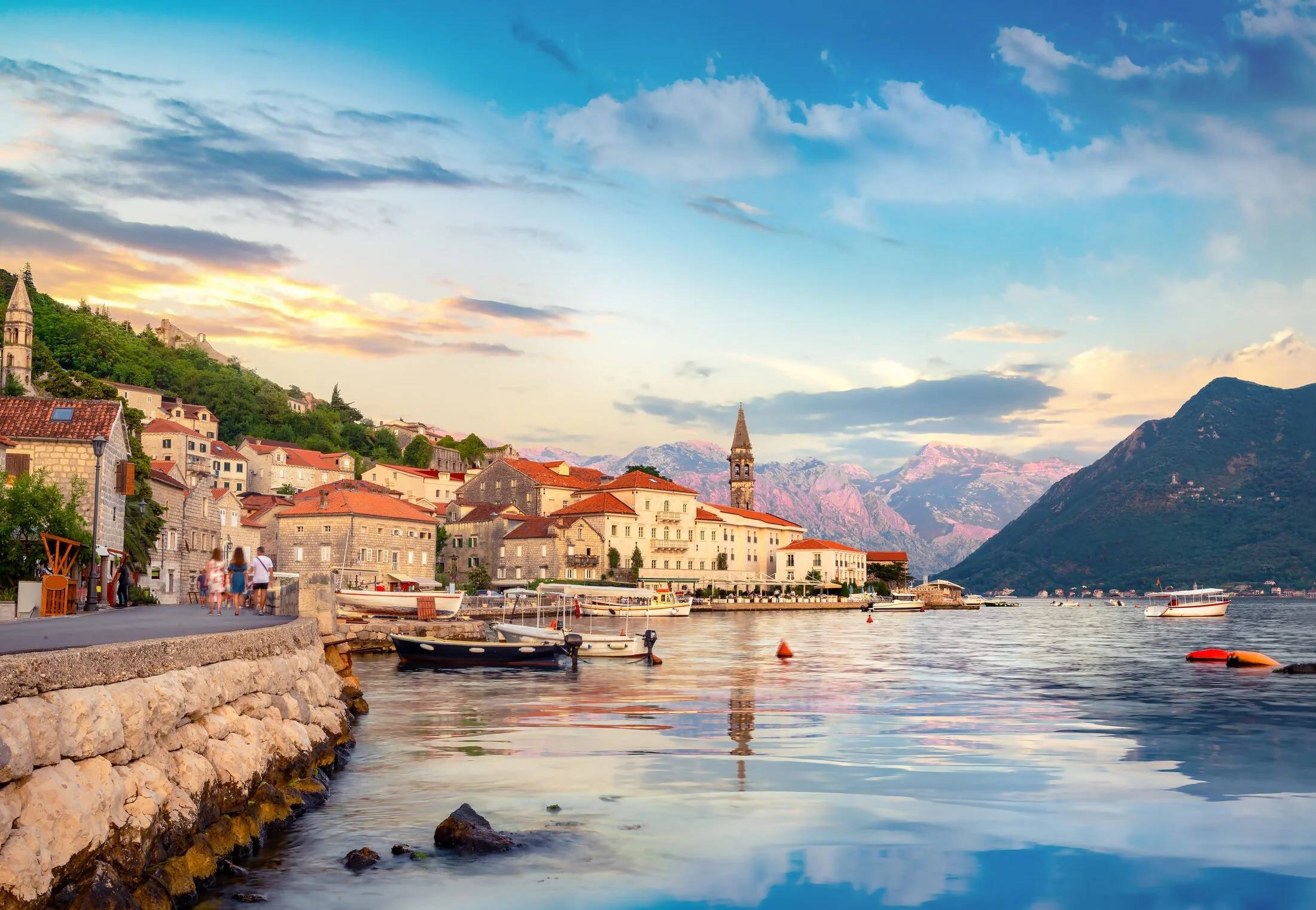
The third reason is the coast. Kotor Bay, Tivat, Budva and Luštica have absorbed serious money since Porto Montenegro opened, and a client who wants a Mediterranean base with a marina, an international school and a residence permit attached to the apartment can have all three without the price of Italy or the paperwork of Croatia.
What Montenegro is not is a place to keep wealth. The banking sector is small, foreign-owned and cautious; there is no private banking, no capital market and a legal system that is improving but still slow. The citizenship-by-investment programme that briefly made Montenegro a passport play closed at the end of 2022 under EU pressure and is not coming back.
Visa and Residency Routes
Visitor. EU, UK, US, Canadian, Australian and New Zealand passports get 90 days in 180. Montenegro is outside Schengen, so days here do not count against the Schengen clock. Russian citizens still enter visa-free for 30 days, which shapes the coast's demographics.
Temporary residence on property ownership. The route most foreign residents actually use. A foreigner who owns residential property in Montenegro, with no minimum value, can apply for a one-year temporary residence permit, renewable annually, on proof of title, health insurance, funds for maintenance and a clean record. It carries no right to work locally and requires the holder to be present for a meaningful part of the year (absences beyond 30 consecutive days, or 90 in aggregate, can cost the permit). Processing runs one to two months through the local police foreigners' office, in person. FTR would use this for a retiree, a passive-income client or an HNW family that wants the base without a business.
Company director route. Register a DOO, appoint yourself executive director, pay yourself a salary and contributions, and apply for a combined temporary residence and work permit. Annual renewal, one to two months' processing, and the route for anyone who needs to work or who wants Montenegrin tax residency built on local substance. The company must be real: registered address, accounting, filed returns.
Digital nomad permit. Available since 2022 for remote workers employed by or contracting with businesses outside Montenegro, for up to two years and renewable for a further two, after which a six-month gap is required before reapplying. Requires proof of foreign income above a published floor, health insurance and accommodation. It does not count toward permanent residence, which is its main limitation.
Family reunification, study and employment work as elsewhere.
Permanent residence requires five years of continuous temporary residence with limited absences. Citizenship by naturalisation requires ten years of lawful residence, a language test and, for most applicants, renunciation of existing citizenship; Montenegro does not generally allow dual citizenship for naturalised adults, which is why the old investment programme, which did, was so attractive.
The closed investment programme. Between 2019 and the end of 2022, Montenegro granted citizenship for EUR 450,000 in approved developments on the coast or in Podgorica, or EUR 250,000 in the north, plus a government contribution of EUR 100,000 (later doubled), on top of due diligence and processing fees. Roughly 1,300 applications were lodged, the largest single group from Russia, and approvals continued to be processed after the closing date. Passports already granted stand. No replacement exists, and any agent still marketing Montenegrin citizenship for investment is describing something that has not been available for over three years.
Which route for whom: property residence for retirees and the passive; the DOO route for anyone working; the nomad permit only for someone who wants two to four years, not a future.
Tax Peculiarities and Traps
The surtax. The headline bands omit the municipal surtax of 13% (15% in Podgorica and Cetinje) charged on the income tax itself. On a EUR 10,000 monthly salary, tax at the 15% band plus surtax takes the effective marginal rate to about 17.25%. It is small in absolute terms but it is the number that turns "15%" into something else on the payslip, and it is how most foreign residents discover that the summary they read was incomplete.
Worldwide taxation on residence. Residents are taxed on worldwide income with a credit for foreign tax. Foreign dividends, interest and capital gains are taxed at 15% when received. A client from a non-treaty country (the US, Australia, Canada) who trips residency here has no tie-breaker and must actually leave home.
Property costs stack. Transfer tax became progressive in 2024, at 3%, 5% and 6% by value band, on top of notarial fees and, for new-builds from a developer, VAT at 21% instead of transfer tax. Annual property tax is modest but rising in coastal municipalities, and some apply higher rates to non-primary residences. Capital gains on a sale are taxed at 15% of the gain, with acquisition cost, transfer tax and documented improvements deductible.
Land. Foreigners may own apartments and buildings freely but cannot own agricultural or forest land, or a bare plot, in their own name; these are bought through a Montenegrin company. This is routine and cheap, but it means the holding for a coastal villa on a large plot is often a DOO rather than a personal title, with corporate obligations attached.
Rental income. Short-let income from a coastal apartment is taxed at 15% after a standard deduction, and municipalities license and inspect tourist rentals more actively each season. Undeclared rental income is the commonest tax offence by foreign owners.
No lender of last resort. Montenegro uses the euro without the ECB behind its banks. Deposit insurance covers EUR 50,000 per depositor per bank. The point for a client is not to keep a seven-figure balance in a domestic bank.
The Structural Layer
For a Montenegrin tax resident, FTR's default of a Panamanian Private Interest Foundation owning a Panamanian SA, with a modest director's salary paid where the client lives, works well. Montenegro has no controlled foreign company rules, so the SA's undistributed profit is not attributed to the resident shareholder; distributions are taxed at 15% when received; a director's salary run through the 0/9/15 bands plus surtax covers living costs cheaply. There is no Montenegro–Panama treaty, so nothing turns on treaty relief and nothing is lost by its absence.
Two adaptations. First, a client who needs the company-director residence route needs a Montenegrin DOO as well, and that DOO must have a real function (local consulting, property holding, the local arm of the business) so that its salary and contributions are defensible. The Panamanian layer stays above it as the holding and cash-accumulation vehicle. Second, if the client's real management of the SA happens from a desk in Tivat, permanent establishment risk exists on paper; in practice enforcement against a small foreign holding company is negligible, but the structure should be documented so that board decisions are taken outside Montenegro.
Succession is simpler than in most of Europe: no inheritance tax on financial assets, first-line heirs exempt from transfer tax on property, and forced-heirship rules that apply to Montenegrin-situs assets. The foundation handles offshore assets; a Montenegrin will covers the apartment.
Where the default does not fit: a client from a country with strong CFC and foundation-attribution rules who remains resident there while buying a Montenegrin holiday base. The Montenegrin side changes nothing; the home-country rules still apply.
Info-Sharing Reality (CRS and FATCA)
Montenegro signed up to the Common Reporting Standard with a commitment to first exchanges from 2023, and Montenegrin banks now collect tax-residency self-certifications and report non-resident account holders to the Tax Administration for exchange with partner jurisdictions including Germany, Italy, Austria, the UK, Serbia and, as bilateral activations proceed, the rest of the CRS network. The network is younger and thinner than an EU member's; it is expanding, and accession will complete it.
A Model 1 FATCA intergovernmental agreement has been in place since 2017, so US persons' accounts are reported to the IRS through the Tax Administration.
Montenegro is sometimes described, by people selling property, as a discreet place for money from further east. It is not. Russian and Ukrainian inflows since 2022 have made every bank here more, not less, inquisitive, and EU-aligned sanctions apply. For a Chinese HNW family considering the coast as a European foothold, a Montenegrin account will be reported to China when the bilateral exchange activates, and the plan should assume it has.
Banking Reality
The market is small and foreign-owned: Crnogorska Komercijalna Banka (OTP Group), NLB Banka Podgorica, Erste Bank Montenegro, Hipotekarna Banka, Lovćen Banka, Universal Capital Bank, Adriatic Bank, Prva Banka, Zapad Banka and Ziraat Bank Montenegro. A non-resident can open a personal euro account with a passport, a Montenegrin address or property title and a local phone number, usually in a day or two; a residence permit makes it routine. Some banks now require a residence permit or property title for non-residents, and all of them ask about source of funds on inbound transfers above a few thousand euros. Minimum balances are nominal. Everything is in person.
Russian and Belarusian nationals face enhanced screening and frequent refusals since 2022. US persons are accepted under the IGA. There is no private banking; a client with a meaningful portfolio keeps a transactional account here and the wealth in Switzerland, Austria, Luxembourg or, for regional clients, Belgrade.
Montenegro has never been on the FATF grey list and is on no EU high-risk list. Correspondent relationships run through the Hungarian, Slovenian and Austrian parent groups and are stable; SWIFT and SEPA-style euro transfers clear normally. Card acceptance is universal on the coast and in Podgorica, though cash still moves the informal economy.
Cost of Doing Business
A Montenegrin DOO registers through the Central Registry with EUR 1 capital in three to seven days; with a lawyer, a registered address and the first tax registrations, setup runs USD 700–1,500. Annual accounting, filings and the executive director's minimum salary and contributions run USD 1,800–4,500, more for a company with real turnover. Corporate tax is 9% on the first EUR 100,000 of profit.
Against the set: a Panamanian SA runs about USD 1,500–2,500 to establish and USD 1,000–1,800 a year; Singapore roughly three times the Panamanian setup at USD 4,500–7,500 with USD 4,000–8,000 annual compliance. Montenegro is at Panama's level on headline cost and below Croatia or Greece; the hidden cost is time, since every registration is in person and in Montenegrin, and a good bilingual accountant is the most important hire.
Cost of Living
Monthly. Podgorica is the cheap, hot, administrative capital; Tivat, Kotor and Budva are where foreign residents actually live, and coastal rents have risen sharply since 2022 with the Russian and Ukrainian influx.
Lean, single or couple: EUR 1,300–1,900 (USD 1,400–2,100): one-bedroom EUR 500–700 in Podgorica or EUR 700–1,100 on the coast outside high season, groceries EUR 350–450, private outpatient cover EUR 50–100, a used car or the coastal bus.
Comfortable, family of four: EUR 3,000–4,500 in Podgorica, EUR 4,000–6,000 on the coast (USD 3,300–6,600): three-bedroom EUR 1,200–2,500, one car EUR 400–600, private health cover EUR 200–350, one international school place at EUR 10,000–18,000 a year, help and activities.
HNW: EUR 8,000–15,000 and up (USD 8,800–16,500): a Porto Montenegro or Luštica Bay apartment or a bay-side villa, two international school places, a berth if there is a boat, and regular travel to Belgrade, Zagreb, Vienna or Italy for medical and professional needs.
Cultural and Practical Considerations
Montenegro is a beautiful, small, clannish country that is welcoming to foreigners who spend and slow to absorb foreigners who stay.
Language. Montenegrin is mutually intelligible with Serbian, Bosnian and Croatian, written in both Latin and Cyrillic. English is good on the coast and among younger people in Podgorica, adequate in banks and poor in the tax office, the police foreigners' office and the courts. A client will need a bilingual accountant and a lawyer who works in the language; every official form is in Montenegrin.
Women. No legal constraint on women travelling, residing, owning property or running a business alone, and the coast's tourism economy is full of women doing all three. Social attitudes are patriarchal, especially inland and in the north, and a woman negotiating a property purchase or a contractor will sometimes be addressed through the man beside her. Family law is civil, with equal division of marital property; domestic violence is under-reported and the police response is uneven.
Religion and diet. Orthodox Christian majority, with Muslim Bosniak and Albanian minorities in the north and east; entirely secular in daily life. No dietary or dress constraints of any kind for foreigners.
LGBT residents. Same-sex life partnerships have been legally recognised since 2021, the first in the Western Balkans, giving partners property, inheritance and some family rights, though not adoption. Pride has marched in Podgorica since 2013 with heavy policing. Attitudes remain conservative outside the coast and the capital; discretion is the norm rather than the law.
Pace, noise and chaos. The coast is loud, crowded and traffic-choked from June to September and quiet to the point of shuttered from November to March; a client should visit in both seasons before buying. Podgorica is calm and dull. Bureaucracy is slow, in person and inconsistent between offices; permits that should take a month take two, and a fixer is not corruption here so much as translation. Driving is aggressive and the coastal road is dangerous.
Security and politics. Violent crime against foreigners is rare, but organised crime is real: clan feuds between Kotor-based groups have produced shootings in public places, and gun ownership is high. Politics is dominated by the Serbian-Montenegrin identity divide, church politics and the aftermath of the 2020 end of thirty years of one-party dominance; governments since have been unstable coalitions with a pro-Serbian and, in places, pro-Russian streak that sits awkwardly with EU alignment. A resident feels this as noise and occasional protests, not as personal risk, but it is the main variable in the accession timetable.
Climate and health. Podgorica is one of the hottest cities in Europe, regularly above 40°C in summer; the coast is Mediterranean with wet winters; the mountains are alpine. Wildfires are a summer feature and earthquake risk is real along the coast. Public healthcare is poor; private clinics in Podgorica and on the coast handle routine care, and anything serious means Belgrade, Zagreb, Bari or Vienna. Evacuation cover is essential.
Schooling. International schools in Tivat and Podgorica serve the marina and diplomatic communities well at EUR 10,000–18,000 a year; outside those two towns there is nothing suitable for a non-Montenegrin-speaking child.
For Retirees
The property-residence route above, a coastal apartment bought with a lawyer and a seasonal test, and a medical plan that runs through Belgrade or Italy; an active retiree's country, not a frail one's.
For Digital Nomads and Remote Professionals
The nomad permit for a two-to-four-year Adriatic base outside Schengen, or the property route for something longer; tax residency at 15% plus surtax if they choose to trip it.
For Online Business Owners and Entrepreneurs
The DOO-director route for residence and the Panamanian structure above it; costs at Panama's level, the euro, and the 9% first band if any profit is booked locally.
For Multinational Business Owners
A regional base and a place to live, not a group holding location; the 9%–15% corporate scale helps for a genuine local operation.
For High Net Worth (HNW) Families and Investors
The coast, an international school, a residence permit attached to the apartment and an EU passport possible only through ten years and renunciation; no longer a citizenship play, and for Chinese and Russian families no longer a quiet one.
Common Traps
Coming for citizenship: the programme closed at the end of 2022, naturalisation takes ten years and renunciation, and nobody credible is selling a shortcut. Coming for privacy: CRS, a FATCA IGA and banks made cautious by three years of Russian inflows. Keeping serious money in a domestic bank in a euro economy with no central bank behind it. Buying coastal property in high season without seeing it in February. Buying a plot in your own name and discovering the land cannot be held by a foreigner. Assuming the nomad permit leads to permanent residence. Anyone who needs functioning public healthcare, quiet efficient bureaucracy or a large urban expat community, none of which exists here. And a client whose home country has strong CFC and foundation-attribution rules, who buys the holiday base and imagines the Montenegrin rates now apply.
Next Steps
If Montenegro is on your list as a Mediterranean base with EU upside, book a scoping call. The property, the permit and the tax residency are three separate decisions that are cheap to sequence correctly and awkward to unpick.
Important note: General information. Not personal tax, legal, or financial advice. Speak to a qualified adviser at FTR or elsewhere before acting.
Continue reading
Suggested next, chosen by our partners.


