
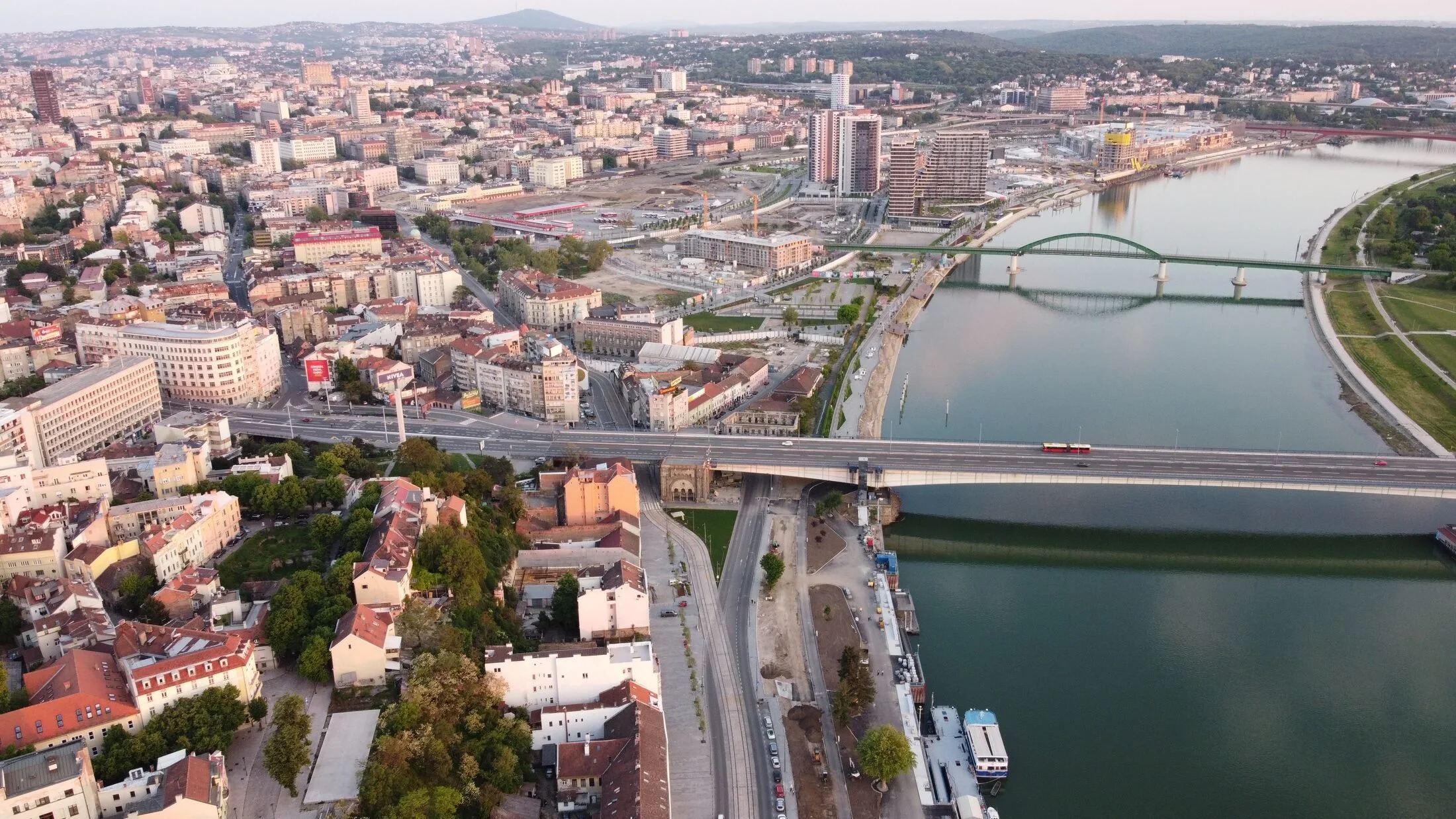
Serbia Country Profile:
A Non-EU Balkan Base With Low Rates, a Wide Treaty Net and Rising Belgrade Wealth
Serbia is a source country with a growing HNW community around Belgrade and a tax framework that is cheaper and simpler than its EU neighbours'. Its non-EU status, its Yugoslav-era treaty network and its foreign-exchange rules create specific cross-border considerations that matter more than the headline rates.
🇷🇸 Key Facts (2026):
Currency: Serbian Dinar (RSD); ~101 to USD (mid-market, September 2026); managed against the euro at roughly RSD 117 per EUR
Personal income tax: 10% on salary and on self-employment income; 15% on dividends, interest and capital gains; 20% on royalties, rental and other income; an annual complementary tax on total income above roughly three times the average annual wage at 10%, rising to 15% above roughly six times
Social contributions: roughly 19.9% employee and 15.15% employer on salary, subject to a monthly cap
Corporate tax: 15%
VAT: 20% standard; 10% reduced
Capital gains: 15%
Withholding to non-residents: 20% on dividends, interest and royalties; 25% to jurisdictions on Serbia's preferential-tax list; treaty rates where a treaty applies
Wealth tax: none; annual property tax up to roughly 0.4% for individuals on assessed value
Estate and inheritance tax: spouse, children and parents exempt; second-order heirs 1.5%; others 2.5%
Tax residency trigger: domicile or centre of business and vital interests in Serbia, or 183 days in any twelve-month period beginning or ending in the tax year
Headline visa thresholds: visa-free 90 days for EU, UK, US, Australian, Chinese, Russian and Turkish nationals among others; temporary residence by employment, own company, property ownership, family, study or digital nomad status, in a single permit of up to three years; permanent residence after three years; citizenship after three years' permanent residence
Paušalac lump-sum entrepreneur ceiling: RSD 6 million annual turnover (~USD 59,000)
Corporate setup and maintenance: d.o.o. with RSD 100 minimum capital, ~USD 800–2,000 to establish; ~USD 2,000–4,500 a year
Personal bank account minimum: none
Private banking threshold: roughly EUR 250,000–500,000 investable (~USD 290,000–580,000)
Cost of living, comfortable professional household in Belgrade: EUR 3,500–5,000 a month (~USD 4,050–5,800)
CRS: committed, late adopter; first automatic exchanges from 2026
FATCA: Model 1 IGA treated as in effect
Treaties: around 65 comprehensive treaties, a large part inherited from the former Yugoslavia
Population: ~6.6 million
Time zone: UTC+1, UTC+2 in summer
Last edited: 9 September 2026 by Joe Martin Hanson (Director & Global Partner) with advice from FTR’s Serbian Tax Partners
Why Serbia Matters
Serbia has a treaty network out of proportion to its size, partly a legacy of Yugoslavia's non-aligned positioning, which gives a Serbian-resident person or company treaty access across Europe, the Gulf and Asia at a 15% corporate rate and a 10% salary rate. For an operating business that needs a European address without the EU's regulatory load, that combination is genuinely useful.
Non-EU status is the other half of the proposition. Serbia is outside EU state-aid, DAC6 and ATAD, has no CFC regime for either companies or individuals, and no exit tax. It is also outside Schengen and the euro, which is a cost for a traveller and an advantage for anyone who wants a European base that is not Brussels-regulated. Belgrade has grown a HNW community around technology, real estate and the post-2022 arrival of Russian capital and talent, and that community is now looking outward for structuring, succession and second residencies.
Serbia matters to FTR as a source country: Serbian and Serbian-connected families with wealth built since the 2000s, diaspora returnees, and Belgrade-based owners of IT businesses selling into the EU and the US. It matters secondarily as a low-friction destination for a location-flexible earner who values cost, access and a large English-speaking professional class over EU membership.
Visa and Residency Routes
Serbia is visa-free for 90 days for most of FTR's readers and, unusually, for Chinese, Russian and Turkish nationals as well, which is why Belgrade has become a meeting point for all three communities since 2022.
The 2024 reforms to the Law on Foreigners created a single permit combining temporary residence and work authorisation, valid up to three years and renewable, applied for through the eUprava portal. The grounds that matter: employment with a Serbian employer; own company, where the applicant founds a d.o.o. or registers as an entrepreneur; property ownership, where owning a residential property in Serbia is itself a basis for temporary residence, with no minimum value set in law; family reunification; study; and a digital nomad basis for remote workers employed or contracted abroad. Processing is quick by regional standards, typically a few weeks once the file is complete.
The route FTR would actually use for a location-flexible earner is the own-company or entrepreneur route, because it pairs the residence with the paušalac regime described below; for a HNW family the property route is the simplest, since a Belgrade apartment purchase produces both an asset and a residence basis. The digital nomad ground is newer and less predictable at the counter.
Permanent residence follows three years' continuous temporary residence, reduced from five by the 2023 amendments, and requires basic Serbian. Citizenship by naturalisation requires three years' permanent residence and, in the general case, release from prior citizenship, with exceptions for spouses of Serbian citizens and for those of Serb origin; a person unwilling to give up a passport should plan on permanent residence, not citizenship. Physical presence is assessed on continuity of residence rather than a strict day count, but long absences will be noticed on renewal.
What looks good on paper and fails: buying property for residence and then living elsewhere, which produces a permit but not a defensible tax residency, and then finding that the home country still treats the person as resident.
Tax Peculiarities and Traps
The paušalac regime and the independence test. A registered entrepreneur with turnover under RSD 6 million (~USD 59,000) can elect lump-sum taxation, paying a fixed monthly amount for tax and contributions, generally RSD 30,000–60,000 depending on activity and municipality, regardless of actual profit. It is why Belgrade is full of IT freelancers. Since 2020 the independence test applies: an entrepreneur who meets five of nine criteria in relation to one principal (fixed hours, principal's premises and equipment, more than 70% of revenue from one client, and so on) is treated as that principal's employee, and the principal bears tax and contributions on the payments. A foreign company paying a Belgrade contractor through this regime should assume the test will be run.
The origin-of-assets law. The 2021 Law on Determining the Origin of Property and Special Tax allows the tax administration to compare a person's increase in assets against reported income over any period and, where the unexplained difference exceeds EUR 150,000 (~USD 174,000) in dinar equivalent, to tax it at 75%. It targets domestic political wealth but the mechanism is general, and a new resident who brings undocumented capital into Serbian property or accounts is exposed. Documentation of source of funds before arrival, not after a query, is the only defence.
Foreign bank accounts. Serbian residents generally need National Bank of Serbia approval to hold accounts abroad, with limited exceptions such as accounts held while living abroad or for specific purposes. This is a foreign-exchange rule, not a tax rule, and it is widely ignored by returnees and new residents until a transfer is queried. A person planning to keep an offshore account structure while resident in Serbia needs the position confirmed before moving.
The annual complementary tax. Salary tax at 10% is not the whole story for a high earner. Total annual income above roughly three times the average annual wage attracts an additional annual tax at 10%, and above roughly six times at 15%, with reduced bases for taxpayers under 40. A senior professional on a foreign-sourced salary discovers this in the spring.
Withholding to preferential jurisdictions. Payments of dividends, interest, royalties and service fees from a Serbian company to an entity in a jurisdiction on Serbia's preferential-tax list attract 25% withholding instead of 20%, and the list includes the usual Caribbean and Central American centres. Whether a Panamanian counterpart is on it needs checking in the current version before any Serbian company pays a Panamanian one.
Residency is twelve-month, not calendar. The 183-day test counts any twelve-month period beginning or ending in the tax year, so a stay spanning two calendar years can trigger residency in both.
The Structural Layer
Serbia has no CFC regime, no exit tax and no personal attribution rules, so FTR's default, a Panamanian Private Interest Foundation owning a Panamanian SA with a modest director's salary paid in Serbia, is legally undisturbed on the Serbian side. What Serbia taxes is what arrives: the salary at 10% plus contributions, and dividends from the SA at 15% when paid. Distributions from the foundation to a Serbian-resident beneficiary are the uncertain piece; Serbian law has no foundation concept for private benefit, and a distribution is likely to be characterised as other income at 20% or, where it can be shown to be a gift from a family member, as a gift subject to the inheritance and gift tax scale.
The practical constraints are elsewhere. The foreign-account approval regime above means the SA's bank account must be the SA's, not the person's, and the person's own offshore accounts need the National Bank's position resolved. The origin-of-assets law means every distribution into Serbia must be traceable. And the 25% withholding to preferential jurisdictions means the Serbian operating company, if there is one, should pay a Panamanian entity only after the list has been checked; where Panama is listed, the operating company sits under an EU or treaty holding instead.
For a Serbian resident with a Serbian operating business, the usual structure is a d.o.o. under a treaty-country holding, with the 15% corporate rate, dividends at 15% to a resident owner and treaty-reduced withholding to a non-resident one. For a Serbian who has left, the default works from the day residency ends; there is no exit tax and no deemed disposition.
Info-Sharing Reality (CRS and FATCA)
Serbia is a late adopter of the Common Reporting Standard, having committed to it through the Global Forum with first automatic exchanges from 2026, and the direction is fully transparent. Serbian banks collect tax-residency self-certifications and report non-resident account holders to the Serbian tax administration for exchange with partners including the EU member states, the United Kingdom, Switzerland and China. A Chinese, Russian or Turkish national who opened a Belgrade account on the strength of visa-free entry and assumed Serbia was outside the system should assume it is now inside it; Russia is the exception only because exchanges with it are suspended by most partners rather than by Serbia's design.
For Serbian residents the traffic runs the other way: foreign banks report Serbian-resident holders to Belgrade, which then has a data source for the origin-of-assets law. Under FATCA, Serbian banks report US persons on the Model 1 basis. Serbia is not a privacy jurisdiction, and the period in which it was informally treated as one has closed.
Banking Reality
Banca Intesa, OTP, Raiffeisen, UniCredit, NLB Komercijalna, Erste and AIK dominate; all open accounts for holders of a temporary residence permit within days, with no minimum. Non-residents can open accounts in principle, and the post-2022 wave of Russian arrivals has made the banks both experienced and cautious: source-of-funds documentation is asked for early, and a nationality with sanctions exposure can expect enhanced due diligence. Dinar accounts are standard; euro accounts are routine and most large transactions, including all property, are priced and often settled in euros. The dinar is not convertible outside Serbia.
Private banking exists at Intesa, Raiffeisen and UniCredit from roughly EUR 250,000–500,000, but serious Belgrade wealth is booked in Vienna, Zurich, Cyprus and increasingly Dubai. Serbia left the FATF grey list in 2019 and is on no EU blacklist; correspondent banking and SWIFT access are normal, with additional scrutiny on Russia-linked flows. Card infrastructure is good; cash remains common outside the capital.
Cost of Doing Business
A d.o.o. with RSD 100 capital is registered through the Business Registers Agency in a few days for roughly USD 800–2,000 including legal and a registered address; annual running cost for a small company, covering bookkeeping, VAT and the corporate return, is USD 2,000–4,500. The paušalac entrepreneur is cheaper still, at the fixed monthly amount and almost no compliance.
Against the set: a Panamanian SA runs roughly USD 1,500–2,500 to establish and USD 1,000–1,800 a year; Singapore roughly three times the Panamanian setup at USD 4,500–7,500 and USD 4,000–8,000 a year. Serbia is priced at or below Panama on the entity and well below Croatia or Bulgaria on professional fees, with the caveat that a Serbian company's non-EU status means EU VAT registration and an EU establishment are needed to sell into the single market on equal terms.
Cost of Living
Monthly, for Belgrade; Novi Sad and Niš run 25%–40% lower on housing.
Lean, single or couple: EUR 1,300–1,800 (USD 1,500–2,100): one-bedroom in Vračar or Dorćol EUR 550–800, groceries EUR 300–400, transit EUR 30, private health cover EUR 40–80.
Comfortable, family of four: EUR 3,500–5,000 (USD 4,050–5,800): three-bedroom in Dedinje, Senjak or Vračar EUR 1,300–2,200, one car EUR 300–450 all-in, private family health cover through MediGroup or Bel Medic EUR 150–300, Serbian public schooling free, activities and help EUR 400–800.
HNW: EUR 8,000–12,000 and up (USD 9,300–13,900): a Dedinje house, two international school places at EUR 15,000–25,000 each per year (International School of Belgrade, British International School, Chartwell), staff, a driver and travel.
Cultural and Practical Considerations
Belgrade is loud, late, hospitable and improvisational, and someone who needs quiet, order and things to happen on time will struggle regardless of the tax outcome. The city runs on personal relationships, coffee and the kafana; foreigners who accept invitations and learn a hundred words of Serbian are pulled into social life faster than almost anywhere in Europe. Foreigners who wait to be approached wait a long time. The Russian community that arrived from 2022 is large, professional and has its own infrastructure; the Chinese community is smaller and commercially focused.
Language. English is very good among under-40s in Belgrade and in the IT and professional sectors, and adequate in banks. Government offices, the tax administration and the police work in Serbian, in both Cyrillic and Latin script, and an agent or a bilingual accountant is the sensible default for anything official. Outside the capital, English thins quickly.
Women, LGBT residents and family law. Women face no legal constraint on travelling, residing, owning property or running a business alone, and Belgrade's professional and technology sectors are heavily female. Social norms outside the cities are patriarchal in a way that is felt rather than enforced. Homosexuality is legal and anti-discrimination law exists on paper; there is no partnership recognition, Belgrade Pride marches under heavy police protection, and social hostility outside the capital is real. A same-sex couple can live privately and comfortably in Belgrade; they should not expect the state to recognise the relationship or the countryside to welcome it. Family law is civil-law, with joint marital property by default; marital agreements are recognised.
Bureaucracy. Improving through eUprava but still paper-heavy, stamp-dependent and dependent on who is at the counter. Deadlines are elastic in both directions. Corruption is a background presence in permits and property rather than a daily extraction.
Noise, security and health. Violent crime against foreigners is rare; petty theft and aggressive driving are the practical hazards. Belgrade's winter air quality is poor, driven by lignite power and domestic heating, and someone with a respiratory condition should weigh that seriously. Smoking is still permitted in most bars and restaurants. Summers are hot; winters are cold and grey rather than severe. Public healthcare is under-resourced; the private clinics are good, affordable and used by everyone who can.
Politics and society. Serbia is stable in the sense that the same government has held power since 2012, and volatile in the sense that the collapse of the Novi Sad railway station canopy in November 2024 triggered the largest protest movement in a generation, running through 2025. EU accession is formally in progress and practically stalled; relations with Kosovo, Russia and the West are managed rather than settled. A resident feels this as periodic large demonstrations, a polarised media and an occasional sense that the direction of the country is undecided. It has not, so far, touched property rights or the banking system.
Schooling. Public schools are decent and teach in Serbian; Belgrade has a full set of international schools at moderate prices by Western European standards.
For Retirees
A low-cost, warm-hearted and medically adequate base for a retiree who has lived in the region or has family ties; pension income is taxed as other income unless a treaty allocates it, and the healthcare position requires private cover. Not a mainstream FTR retirement destination.
For Digital Nomads and Remote Professionals
The entrepreneur route and the paušalac regime above, with the independence test as the trap; the digital nomad residence ground exists for those who prefer to keep a foreign employer.
For Online Business Owners and Entrepreneurs
The Structural Layer above: no CFC, no exit tax, 15% corporate, but the foreign-account approval regime and the preferential-jurisdiction withholding list must be cleared before a Panamanian layer is used.
For Multinational Business Owners
A useful non-EU operating base with a wide treaty net and competitive engineering talent; the EU sales side needs an EU entity.
For High Net Worth (HNW) Families and Investors
For Serbian families, succession is easy (direct heirs exempt) and the exposure is the origin-of-assets law and CRS visibility of foreign accounts. For Chinese and other foreign HNW families, Serbia offers visa-free entry, cheap residence by property and a European address; it offers no privacy from Beijing or anyone else now that CRS exchanges run, and it should be bought as a foothold, not a shield.
Common Traps
Coming to Serbia for secrecy. Serbia was informally treated as outside the reporting net for a decade; it is inside it now, and the origin-of-assets law means the Serbian authorities have both the data and a 75% rate.
Running an offshore account structure as a Serbian resident without addressing the National Bank's foreign-account rules. It is the most common compliance failure among returnees and it surfaces at the worst moment, when a large transfer is queried.
Paying Belgrade contractors as paušalac entrepreneurs at 90% of their revenue from one client. The independence test converts them to employees and the payer carries the cost.
Buying property for a residence permit and assuming the tax residency follows, or that the home country's does not. Neither is automatic.
Expecting EU-level order. Belgrade is a warm, chaotic, politically restless city with bad winter air and bureaucracy that runs on paper; a person who needs Vienna should move to Vienna.
Next Steps
If you are Serbian-connected and building or exiting a business, returning from the diaspora with capital, or considering Belgrade as a non-EU European base, book a scoping call. The foreign-exchange, origin-of-assets and withholding-list questions should be answered before the move, not after.
Important note: General information. Not personal tax, legal, or financial advice. Speak to a qualified adviser at FTR or elsewhere before acting.
Continue reading
Suggested next, chosen by our partners.


