
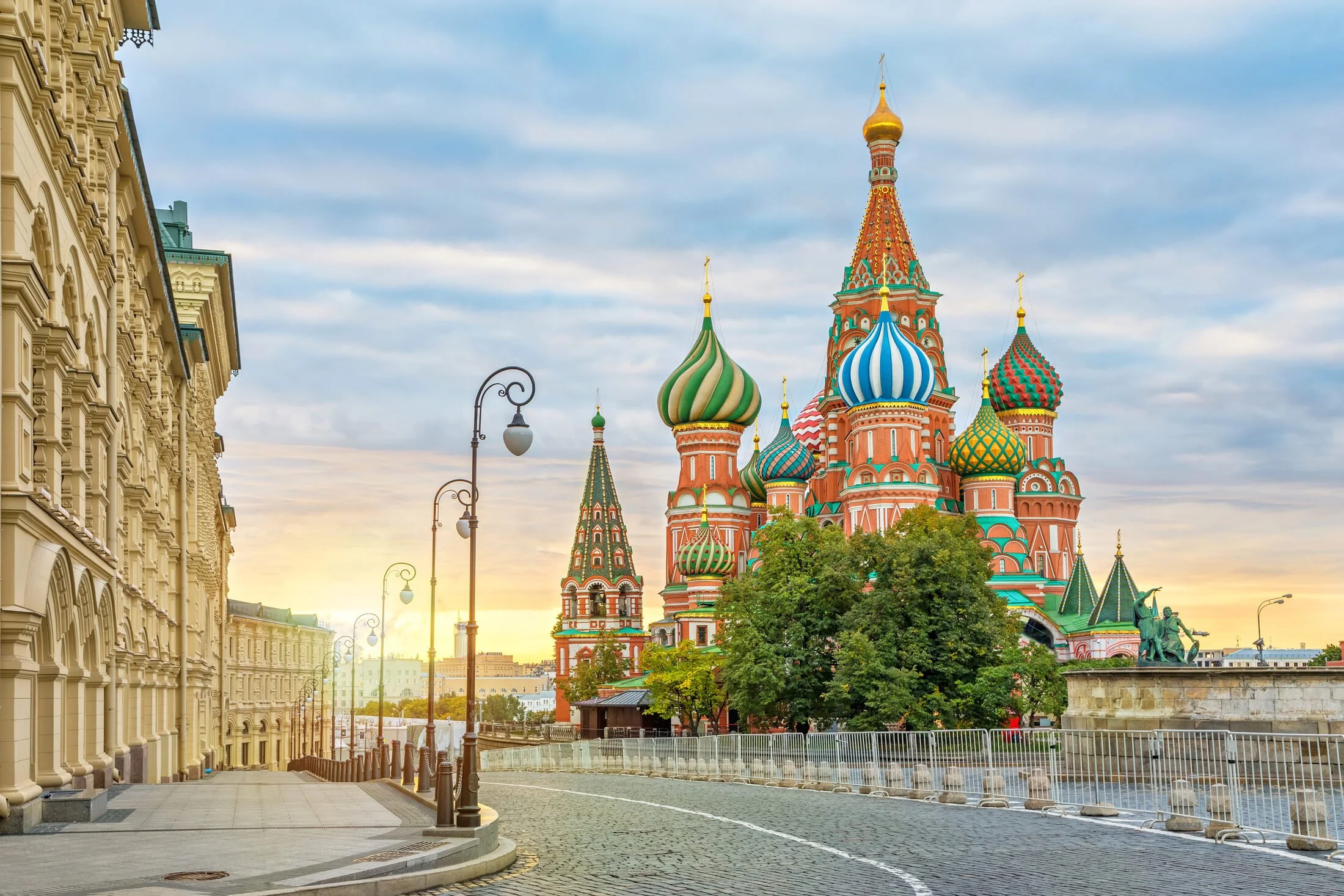
Russia Country Profile:
A Source Country Most Advisers Can No Longer Serve
Russia still produces outbound wealth, but sanctions now govern who may advise it, which banks will hold it and which countries will admit it. This profile is as much about what FTR cannot do as what it can.
🇷🇺 Key Facts (2026):
Currency: Russian Ruble (RUB); roughly 85 to USD and highly volatile, with official and street rates that diverge under stress
Personal income tax: progressive since 1 January 2025: 13% to RUB 2.4 million, 15% to RUB 5 million, 18% to RUB 20 million, 20% to RUB 50 million, 22% above; non-residents 30% flat on most Russian-source income
Corporate tax: 25% from 1 January 2025 (20% before)
VAT: 22% standard from 1 January 2026 (20% before); 10% reduced rate on food, medicines and children's goods
Capital gains: taxed as income at the personal scale; residential property held five years (three in some cases) exempt; non-residents 30%
Wealth tax: none
Estate/inheritance tax: none; transfers to close relatives exempt from income tax
Tax residency trigger: 183 days in Russia within 12 consecutive months, with status fixed for the calendar year; losing residency mid-year recomputes the whole year at 30%
CFC rules: control at 25% (10% where Russians together hold over 50%); CFC profit taxable above RUB 10 million; optional fixed-tax election starting at RUB 5 million a year
Currency controls: transfers abroad by residents capped at roughly USD 1 million a month; transactions with "unfriendly-state" persons in shares and real estate need Government Commission approval; foreign investors exiting Russian assets take a mandated discount and a budget contribution
Sanctions status: EU, UK, US, Canada, Australia, Japan, Switzerland and allies restrict banking, real estate, corporate services, professional services and residency for Russia-connected persons; Russia's own counter-measures restrict the reverse flow
Headline visa thresholds (inbound): highly qualified specialist permit at roughly RUB 750,000 a quarter; investor residence at roughly RUB 15 million into a Russian company or RUB 20 million into real estate; "shared values" residence route for nationals of unfriendly states; no digital nomad or retirement visa
Corporate setup (OOO): USD 500–1,500. Annual maintenance: USD 2,500–6,000
Personal bank account minimum: none
Private banking threshold: roughly RUB 60–100 million (Sber Private Banking, VTB Private, Alfa)
Cost of living, comfortable professional household, Moscow: RUB 400,000–600,000 monthly (USD 4,700–7,000)
CRS: committed jurisdiction, first exchanges 2018; a number of Western partners have unilaterally stopped sending data to Russia since 2022
FATCA: no IGA; Russian institutions report directly under Federal Law 173-FZ (2014) on a consent basis
Treaties: roughly 80 comprehensive treaties; key provisions of 38 suspended by Russia under Decree 585 of 8 August 2023; several counterparties have terminated or suspended in response. Russia–Colombia and Russia–Panama: no in-force treaty FTR would rely on
Population: ~144–146 million depending on whether Crimea is counted
Time zones: eleven, UTC+2 to UTC+12; Moscow UTC+3
Last edited: 19 July 2026 by Joe Martin Hanson (Director & Global Partner) with advice from FTR’s Russian Tax Partners
Why Russia Matters
Russia was, until 2022, one of the three or four largest sources of outbound private wealth in the world, and a great deal of that wealth is still in motion. What changed is not the demand but the supply of people permitted to meet it. EU sanctions prohibit EU nationals and EU-incorporated firms from providing accounting, bookkeeping, tax consulting, business and management consulting, IT consultancy and legal advisory services to the Russian government and to entities established in Russia; the UK has a parallel prohibition on professional and business services to "persons connected with Russia", a definition that reaches individuals ordinarily resident or located in Russia, not only companies. A firm that structures cross-border residency for a living cannot treat this as the client's problem. It is the firm's problem first.
FTR is Panama-anchored and not itself an EU or UK operator, but its counsel network, correspondent banks, fund administrators and some of its own staff are, and a structure that no compliant bank will hold is not a structure. The practical result is that FTR's Russia work is narrow: former Russian residents who have already established genuine residency and banking elsewhere, dual nationals and family members without a Russian passport, and pre-2022 structures that need maintenance rather than creation. Every enquiry is sanctions-screened before a scoping call is booked.
Where the work is possible, Russia still matters for the same reasons it always did: a large, sophisticated, internationally minded professional class; capital controls that reward early and orderly planning; and a tax and reporting regime that is now genuinely aggressive toward anyone who leaves badly.
Visa and Residency Routes
Inbound routes are listed for completeness, because FTR does not place clients in Russia and will not advise on it while the war continues. The highly qualified specialist permit sits on a salary floor of roughly RUB 750,000 a quarter, runs three years and is the route Western employers historically used. Temporary residence (RVP) is quota-bound and slow; permanent residence (VNZh) follows it, and citizenship is available after five years of VNZh with a language test. An investor residence route exists at roughly RUB 15 million into a Russian company or RUB 20 million into real estate. The 2024 "shared values" decree offers simplified residence to nationals of unfriendly states who disavow their home country's policies; it is a political instrument and not one any FTR client should be near. There is no digital nomad visa and no retirement visa. Any foreigner who naturalises must register for military service.
The outbound picture is what clients actually ask about. Russians face visa refusals, residency freezes and banking closures across the EU, UK, US, Canada, Australia, Japan and their allies, and the five Caribbean citizenship-by-investment programmes and Vanuatu suspended Russian and Belarusian applicants in 2022. The destinations that remain workable are the UAE (golden visa, property route, the largest Russian professional community outside the former Soviet Union), Turkey (citizenship at USD 400,000 in property, residence permits with tightening district quotas), Georgia (365 days visa-free, though hostility to Russian arrivals is real), Kazakhstan, Armenia, Kyrgyzstan, Serbia and Montenegro in the Balkans, and in Latin America Argentina, Paraguay and to a limited degree Mexico. Thailand and Indonesia absorb nomads and retirees. Panama's Friendly Nations Visa does not list Russia, and the Panamanian banking sector's appetite for Russian-passport-only clients is close to nil, so Panama is a structuring seat only for clients who already hold another nationality and clean, evidenced residency elsewhere.
Russian citizens must notify the Interior Ministry of any second citizenship or foreign residence permit; failing to do so is a criminal offence under Article 330.2 of the Criminal Code. Men of mobilisation age face an electronic summons register introduced in 2023 that can impose an exit ban on delivery of a summons. Both facts shape the sequence of any departure.
Tax Peculiarities and Traps
The 30% non-resident cliff. Residency is 183 days in Russia within 12 consecutive months, finalised for the calendar year. Someone who leaves in July and has already been paid Russian salary at 13%–22% for six months becomes non-resident for the whole year and owes the difference to 30% on all of it, usually collected through the employer or on the annual return. Remote employees of Russian companies working abroad were brought back to the resident scale from 2024 regardless of residency, which helps salary but not dividends, rent or gains.
CFC and the foreign structure. Chapter 3.4 of the Tax Code requires a Russian resident who controls a foreign company (25%, or 10% where Russians collectively hold over 50%) to notify participation, notify the CFC annually, and include its profit above RUB 10 million in their own return. Foundations and trusts are "structures without a legal entity" and the founder is the controlling person unless rights have been irrevocably surrendered. A fixed-tax election, starting at RUB 5 million a year for one CFC and rising with the number held, buys out the profit calculation but not the reporting. Penalties for non-notification are per company per year.
Currency-control reporting. Under Federal Law 173-FZ, Russian citizens are "currency residents" for life unless they spend more than 183 days a year abroad. Those who do not must notify the tax authority of every foreign account within a month of opening and file annual cash-flow reports; certain operations through foreign accounts are illegal and fined at up to the full amount of the transaction. The 183-day exemption is the reason a clean, documented departure matters more here than almost anywhere.
Treaty suspension. Decree 585 of 8 August 2023 suspended the substantive articles of Russia's treaties with 38 unfriendly states, including the US, UK, all EU members, Canada, Australia, Japan and Switzerland. Reduced withholding on Russian-source dividends, interest and royalties is gone for those countries; some counterparties have suspended or terminated in return, and the US suspended most of its treaty from 16 August 2024. Relief from double taxation now depends on domestic unilateral credit, which Russia grants only where a treaty exists. A departing Russian relying on a treaty tie-breaker for residency in an unfriendly state should assume it no longer works.
Counter-sanctions on exits. Sale of Russian shares or real estate to or from an unfriendly-state person needs Government Commission approval; dividends owed to unfriendly-state holders are paid into blocked "type C" accounts; and foreign owners exiting Russian assets take a mandated discount of at least 60% and a "voluntary contribution" to the budget of 35% of the market value. This is why pre-2022 structures with Russian operating assets underneath cannot simply be restructured.
The Structural Layer
FTR's default, a Panamanian Private Interest Foundation owning a Panamanian SA with a modest director's salary paid where the client lives, does not fit a Russian tax resident and FTR does not build it for one. The CFC rules capture both the foundation and the SA, the currency-control regime makes the SA's bank account a reportable foreign account, and no Panamanian bank will open the account in the first place.
For the client FTR can act for, the former Russian resident now genuinely living in the UAE, Turkey, Serbia, Kazakhstan or Latin America with a second nationality, the default can work with three adaptations. First, the sanctions file comes before the structure: source-of-wealth documentation back to the original Russian business, screening of every counterparty against EU, UK, US and Swiss lists, and confirmation that no designated person sits anywhere in the ownership chain, past or present. Second, the operating company sits where the substance now is, typically a UAE mainland or free zone entity or a Serbian d.o.o., with the Panamanian layer above it for succession only. Third, the personal residency must be evidenced beyond the usual standard, because banks assume a Russian client's residency is a convenience unless shown otherwise.
Pre-2022 structures, commonly Cyprus, BVI or Luxembourg holding companies over Russian operating assets, are a maintenance problem, not a design problem. Russia's own Special Administrative Regions on Russky and Oktyabrsky islands were built to redomicile exactly these holding companies inward, and Russia's 2022 "personal fund" law offers a domestic foundation equivalent; both are answers for a client staying in Russia, not leaving it. Family members without Russian citizenship, and dual nationals who can evidence life outside Russia, are the people around whom a compliant structure can usually be built.
Info-Sharing Reality (CRS and FATCA)
Russia committed to CRS with first exchanges in 2018 and its legislation remains in place, but the network has fractured. The UK, Germany, Switzerland and several other Western partners stopped sending account data to Russia after February 2022; Russia continues to exchange with jurisdictions it does not classify as unfriendly, and the UAE, Turkey, Kazakhstan, Armenia and Serbia matter most for FTR's purposes because those are where Russian clients now bank. A Russian resident's UAE accounts are reported to the Federal Tax Service. A former Russian resident who has not properly severed currency residency, and still holds Russian accounts, is reported by Russia to the new country of residence where that country still accepts Russian data.
There is no FATCA IGA. Russian banks report US persons directly to the IRS under domestic law, which makes a US-connected Russian client visible in both directions.
Nobody should mistake the fracture in CRS for privacy. Sanctions-driven due diligence in every workable destination is more intrusive than CRS ever was, and it asks about the origin of the money rather than merely its location.
Banking Reality
Sberbank, VTB, Gazprombank, Alfa-Bank and most other major Russian banks are disconnected from SWIFT and designated by the US, EU and UK. Visa and Mastercard withdrew in March 2022, so Russian-issued cards do not work abroad; Mir works in a shrinking list of countries and UnionPay co-badged cards are inconsistent. Domestic payments run on the SPFS and the Mir system and work well inside Russia. Correspondent access in dollars and euros has largely collapsed; the yuan is now the working foreign currency for Russian trade and for the private clients who bank domestically. Raiffeisenbank Russia and UniCredit's Russian arm still operate under pressure from their home regulators and are the last Western-owned channels of any size.
Outside Russia, a Russian passport is a hard stop at most EU, UK, Swiss, Singaporean and Panamanian banks, whatever the residency; existing accounts have been closed, frozen or restricted to small balances. The banks that will onboard are in the UAE (with heavy source-of-wealth work and a real residency), Turkey, Kazakhstan, Armenia, Serbia and, for the right profile, Hong Kong. Onboarding runs weeks to months, always in person, and a second nationality changes the answer more than any other single fact. Russia is not on the FATF grey or black list; the FATF suspended its membership in February 2023 rather than listing it, but the practical effect on correspondent banking is the same as a listing.
Cost of Doing Business
An OOO is cheap to form: the state fee is nominal, legal and registration work runs USD 500–1,500, and annual accounting, tax filings and the mandatory director and staff compliance run USD 2,500–6,000. That is on par with a Panamanian SA, which costs USD 1,500–2,500 to establish and USD 1,000–1,800 a year, and about a third of Singapore's USD 4,500–7,500 setup and USD 4,000–8,000 annual compliance. The comparison is beside the point. A Russian company cannot be paid from or pay into most of the world's banking system, and its foreign owner from an unfriendly state cannot sell it without Government Commission consent and a mandated discount.
Cost of Living
Monthly, Moscow; St Petersburg 20%–30% lower on housing.
Lean, single or couple: RUB 180,000–250,000 (USD 2,100–2,900): one-bedroom inside the Third Ring RUB 90,000–140,000, groceries RUB 35,000–50,000, metro pass under RUB 3,000, compulsory and voluntary medical cover through an employer or RUB 5,000–10,000 privately.
Comfortable, family of four: RUB 400,000–600,000 (USD 4,700–7,000): three-bedroom in a good district RUB 200,000–300,000, private clinic plan RUB 15,000–30,000, a car and driver where used, and a private Russian school at RUB 60,000–150,000 a month; the international schools that remain charge more and have lost most of their foreign staff.
HNW: RUB 1.2 million and up (USD 14,000 plus): a house on Rublyovka or a large flat in Khamovniki, full-time staff, and the cost of importing anything Western through parallel channels.
Cultural and Practical Considerations
Russia in 2026 is a country at war, and every practical consideration sits under that. Drone strikes reach Moscow and St Petersburg intermittently and border regions routinely; airport closures are frequent; internet restrictions and VPN blocking are tightening. Men holding Russian citizenship, including naturalised ones, are within reach of mobilisation and the electronic summons system, and a resident who is not a citizen should still expect security-service interest if they work in any sensitive sector.
Language. Russian is the floor for everything: banks, the tax authority, notaries, landlords, doctors. English is common among younger professionals in the two capitals and nowhere else, and the exodus of foreign firms has thinned it further.
Women. No guardianship rules and full legal capacity; women run businesses, professions and households on their own without legal impediment. Family law presumes joint marital property and split custody, but enforcement of maintenance is weak, and the 2017 decriminalisation of first-offence domestic battery means the law offers less protection in practice than on paper. Conservative "traditional values" policy has become more assertive since 2022, including restrictions on abortion counselling and on "childfree propaganda".
LGBT residents. The risk here is legal and real, not merely social. The 2013 "gay propaganda" law was extended to all ages in 2022; gender transition, including changing documents, was banned in 2023; and in November 2023 the Supreme Court designated the "international LGBT movement" as extremist, which has since been used to prosecute venue owners and individuals for displays as minor as rainbow imagery. FTR would not recommend residence to an openly LGBT client under any tax outcome.
Integration, pace and bureaucracy. Moscow is fast, orderly, expensive and, since 2022, inward-looking; foreigners who stayed report a narrowing social circle and a wariness toward Westerners that did not exist before. Bureaucracy runs on stamps, notaries and the Gosuslugi portal, which works well; migration registration must be done within seven working days of each arrival and is enforced. Climate is a health variable: five months of cold and darkness in Moscow, and the Russian winter is not a lifestyle preference.
Politics. Dissent is criminalised, foreign-agent designations reach individuals and firms, and dual nationals have been detained on espionage charges. Political volatility is not a risk to be priced; it is the environment.
For Retirees
Not a destination. For Russian retirees leaving, Turkey, Serbia and the UAE are the realistic seats, and the currency-control reporting above ends only when the 183-day absence is evidenced.
For Digital Nomads and Remote Professionals
Russians working remotely for Russian employers keep the resident scale but not the currency-control exemption; the destinations that admit them are in Visa and Residency Routes above, and Georgia and Armenia are the common first stops.
For Online Business Owners and Entrepreneurs
Move the operating company out of Russia before the owner, because a Russian company under a non-resident owner is the hardest case to unwind.
For Multinational Business Owners
Pre-2022 holding structures over Russian assets need a sanctions and exit-approval analysis before any tax analysis; the Structural Layer sets out why FTR treats these as maintenance rather than design.
For High Net Worth (HNW) Families and Investors
Second nationality and non-Russian family members are the pivot. Where they exist, the UAE, Turkey and a Panamanian succession layer above a non-Russian operating base can be built; where they do not, honest advice is that the options are thin and the banks decide.
Common Traps
Anyone still resident in Russia, or any entity established in Russia, is outside what FTR or its EU and UK counsel can lawfully serve for tax and structuring, and a scoping call will not change that. A designated person, or anyone whose wealth traces through one, is outside it permanently.
The half-departure fails harder here than anywhere: a flat kept, accounts left open, fewer than 183 days abroad in a year, and the client is a currency resident with unreported foreign accounts and a CFC filing obligation on the structure meant to protect them. Relying on treaty relief against an unfriendly state fails outright since 2023. Opening a Panamanian or European account on a Russian passport alone fails at onboarding. And nobody should come to Russia for tax reasons; the low personal rates of the 2010s have gone, the corporate rate is 25%, VAT is 22%, and the money cannot leave.
Next Steps
Russia-connected planning starts with a sanctions and nationality screen, not a scoping call. If you or your family hold a second nationality, live outside Russia and can evidence it, or maintain a pre-2022 structure that needs review, send the basic facts and FTR will say quickly whether it can act.
Important note: General information. Not personal tax, legal, or financial advice. Speak to a qualified adviser at FTR or elsewhere before acting.
Continue reading
Suggested next, chosen by our partners.


