
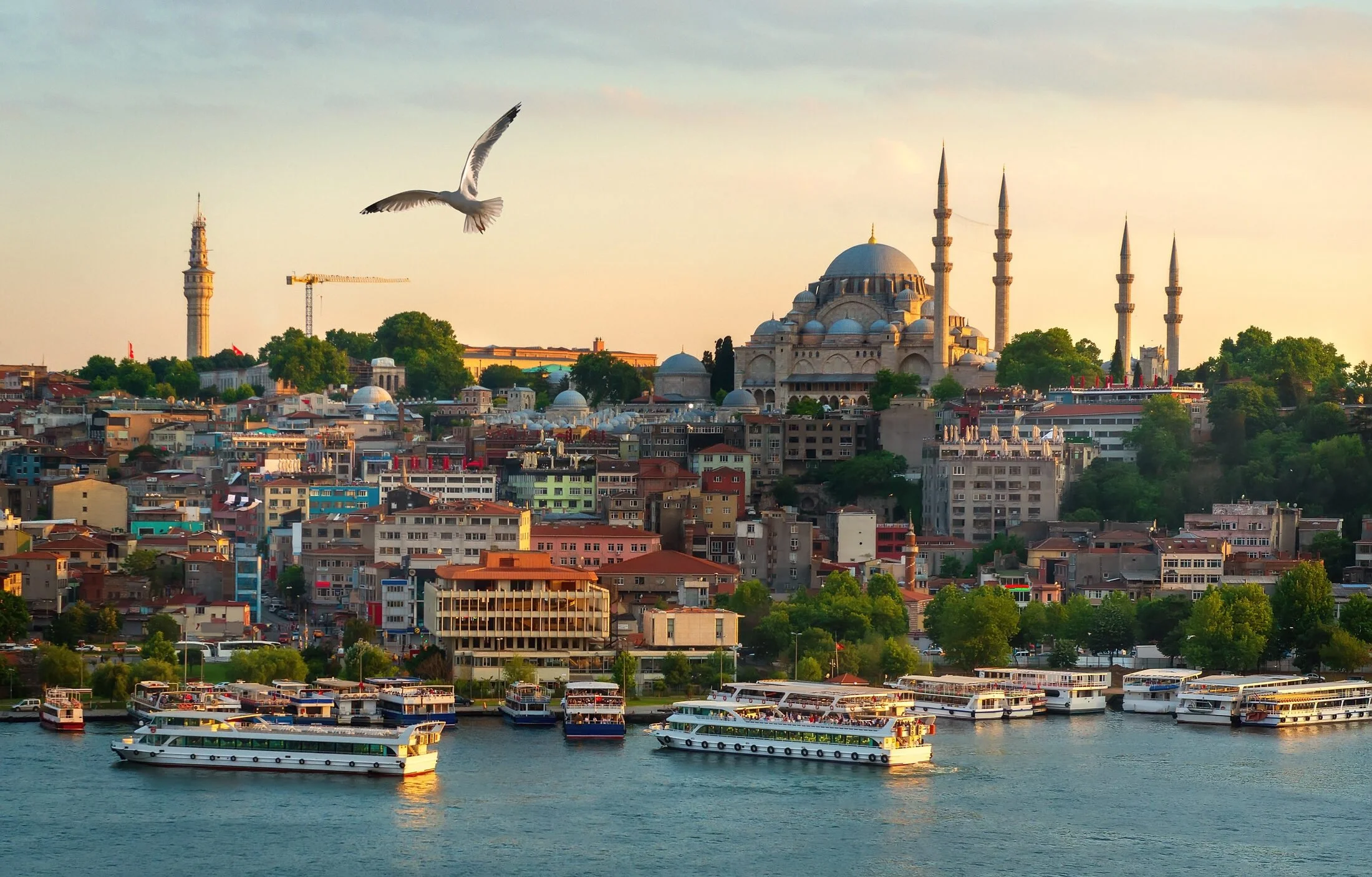
Turkey Country Profile:
The Cheapest Serious Passport, Bought by People Who Rarely Move There
Turkey sells citizenship at USD 400,000 through real estate and is used almost entirely for optionality rather than residence. It is also a growing source of departing HNW families, driven out by the lira, inflation and politics.
🇹🇷 Key Facts (2026):
Currency: Turkish Lira (TRY); roughly 43 to USD in September 2026, having lost most of its value against the dollar since 2018; treat any lira figure as a snapshot
Personal income tax: 15%, 20%, 27%, 35% and 40% progressive; brackets indexed annually in lira
Corporate tax: 25% standard; 30% for banks and financial institutions; a 10% domestic minimum corporate tax applies from 2025
VAT (KDV): 20% standard; 10% and 1% reduced rates
Capital gains: included in progressive income for individuals; shares held more than two years and real estate held more than five years are exempt; listed securities income runs through a separate withholding regime at 0% to 17.5%
Wealth tax: none
Estate/inheritance tax: inheritance 1% to 10% progressive; gifts 10% to 30% progressive, the combined 1% to 30% band
Tax residency trigger: legal domicile in Turkey, or presence of more than six months in a calendar year; foreigners present for a defined temporary purpose can fall outside the six-month test
CBI real estate route: USD 400,000 or more, held for three years, registered in the applicant's name
CBI bank deposit, government bond, investment fund and fixed-capital routes: USD 500,000 or more, held for three years
CBI processing time: six to eight months typical, with faster outcomes reported
Property-based residence permit: property worth at least USD 200,000 in a neighbourhood still open to foreign registration
Digital nomad visa: roughly USD 3,000 a month or USD 36,000 a year, ages 21 to 55, degree required, nationality-restricted
Turkish passport: visa-free or visa-on-arrival access to roughly 110 to 120 destinations; not the EU, UK, US or Canada
Corporate setup: Limited Şirket, minimum capital TRY 50,000; USD 1,500 to 4,000 all-in. Annual maintenance: USD 2,500 to 6,000
Personal bank account minimum: nil in principle; a tax number and, increasingly, a residence permit in practice
Private banking threshold: roughly USD 250,000 to 500,000 investable at the major banks' private arms
Cost of living, comfortable professional household, Istanbul: USD 3,500 to 5,500 monthly
CRS: participating; MCAA signed 2017, first exchanges 2020 on 2019 data, with gaps in activated relationships
FATCA: Model 1 IGA, signed 2015, in force 2021
FATF: grey-listed October 2021, removed June 2024
Treaties: roughly 85 to 90 comprehensive; none with Panama or Colombia; treaty with the US, UK, Germany and most of the EU
Population: ~85.7 million
Time zone: UTC+3, no daylight saving
Last edited: 13 September 2026 by Joe Martin Hanson (Director & Global Partner) with advice from FTR’s Turkish Tax Partners
Why Turkey Matters
Turkey runs one of the world's cheapest citizenship-by-investment programmes attached to a country of 85 million people and a real economy. A USD 400,000 apartment in Istanbul, held for three years, delivers a passport with visa-free access to roughly 110 to 120 destinations. It is not an EU, UK or US-grade document, and nobody serious pretends otherwise, but for holders of restrictive passports from Iran, Iraq, Syria, Yemen, Pakistan, Bangladesh and much of Central Asia it is a genuine step up in travel and business optionality, and for wealthy families from the Gulf, Russia and China it is a second nationality in a jurisdiction that is neither Western nor sanctioned.
Most buyers do not move. They keep minimal Turkish presence, stay below the tax residency threshold and hold the passport for what it is: an option. That is the correct way to think about it, and the reason the residence, tax and cost-of-living sections below matter less than they would elsewhere.
Turkey matters second as a source country. The lira has lost most of its value since 2018, inflation ran above 30% through 2025, and the arrest of Istanbul's mayor in March 2025 removed any remaining illusion about political predictability. Turkish HNW families are moving wealth and, increasingly, themselves to the UAE for proximity and zero personal tax, to the UK as the traditional destination, to the US, and into Greek and Portuguese residence routes and offshore structures. FTR's Turkish clients are mostly on that side of the ledger.
Third, it is a mid-tier CRS participant with a specific banking history: FATF grey-listed from October 2021 to June 2024, and Turkish banks were pressed by US secondary-sanctions exposure in 2024 to shed Russian clients. That history colours how a Turkish passport and a Turkish bank account are received abroad.
Visa and Residency Routes
Citizenship by investment. Four main routes, each with a three-year hold: real estate worth USD 400,000 or more, registered in the applicant's name with a title-deed annotation barring sale; a bank deposit of USD 500,000 or more in a Turkish bank; government bonds, real estate investment fund or venture capital fund units, or private pension contributions of USD 500,000 or more; or a fixed capital investment of USD 500,000 or more in a Turkish company. A job-creation route exists for 50 employees but is rarely used. The applicant first obtains a short-term residence permit on the basis of the investment, then applies for citizenship; spouse and children under 18 are included. Processing runs six to eight months typically, faster in clean files. No language test, no residence requirement, no interview of substance. Dual citizenship is permitted. This is the route FTR would use for any client who wants the passport rather than the country, which is nearly all of them.
The USD 400,000 real estate threshold has been in place since June 2022 and has been the subject of recurring increase rumours since 2024. Buyers should assume the price can rise with a decree and little notice, and should transact only on the rule in force when the property is valued and registered.
Property-based short-term residence permit. Ownership of real estate valued at USD 200,000 or more supports a renewable residence permit, but only where the property is in a neighbourhood not closed to foreign registration. Since 2022 the government has closed well over a thousand neighbourhoods where foreigners exceed 20% of residents, including much of the districts foreigners actually want in Istanbul and Antalya; check the neighbourhood before the deposit is paid.
Tourism-based short-term residence permit. Historically the easy route; in practice now heavily refused for first applications and renewals, especially in Istanbul. Do not plan around it.
Digital nomad visa. Launched in 2024 for nationals of a listed set of countries aged 21 to 55, with a degree and income of roughly USD 3,000 a month, granting a period of stay rather than a path to anything. Useful for a year in Istanbul, irrelevant to structuring.
Work permits and the Turquoise Card. Employer-sponsored, with quotas of five Turkish employees per foreigner; the Turquoise Card is a merit route for high-qualified investors and professionals with a low approval volume.
Long-term residence after eight years of uninterrupted permits, and naturalisation after five years of residence with limited absences, Turkish language competence and a clean record; the residence-based route is slow, discretionary and rarely worth pursuing against the investment route for anyone who can fund it.
Tax Peculiarities and Traps
The six-month test and the CBI buyer. Citizenship does not create tax residency. Residency follows domicile or presence of more than six months in a calendar year, and foreigners in Turkey for a defined temporary purpose can stay outside it. A CBI holder who keeps visits short remains taxable in Turkey only on Turkish-source income, chiefly rent from the qualifying property. Rental income is declared annually on progressive rates after a 15% lump-sum or actual expense deduction, and the 20% withholding on commercial tenancies is a credit, not a final tax. The trap is the family that moves, spends most of the year in Istanbul and assumes the passport was the only consequence; at that point worldwide income is on the table at rates to 40%.
Foreign-source dividends. Since 2023, a resident individual holding at least 50% of a foreign company can exempt half of its dividends, provided the dividend is brought to Turkey by the return filing date. It is a useful relief for Turkish residents with foreign operating companies and a filing discipline that is easy to miss.
Lira contracts. A 2018 decree bars residents from denominating most contracts between Turkish residents, including rent and many service agreements, in foreign currency. Foreigners holding residence permits can be caught, and landlords routinely price around it.
Capital gains on the CBI property. The five-year exemption for real estate means a sale at the end of the three-year hold is taxable on the lira gain, and in a currency that has fallen sharply the lira gain can be large while the dollar position is flat or negative. Model the sale in lira before assuming the exit is tax-free.
Inheritance and forced heirship. Inheritance tax runs 1% to 10% and gift tax 10% to 30%, payable in instalments over three years, with modest exemptions. More important, Turkish succession law applies to Turkish real estate whatever the owner's nationality, and to the whole estate of a Turkish citizen domiciled in Turkey, with reserved shares for descendants and spouse. A CBI buyer who becomes Turkish has just acquired a forced-heirship regime for at least the Turkish property.
Withholding on financial income. Interest, fund and securities income for individuals runs through a separate withholding regime at rates that have been changed by decree repeatedly, most recently upwards; do not budget on last year's rate.
The Structural Layer
For the CBI buyer who stays non-resident, nothing changes. FTR's default, a Panamanian Private Interest Foundation owning a Panamanian SA with only a modest director's salary paid where the person actually lives, sits entirely outside Turkey's reach; Turkey sees a property owner and, if there is one, a tenant.
For a client who becomes Turkish tax resident the default needs adapting rather than abandoning. Turkey's controlled foreign company rule in the Corporate Tax Law is aimed at corporate shareholders; a resident individual is taxed on foreign dividends when received, with the 50% exemption above where the holding and repatriation conditions are met. A Panamanian SA owned through a foundation therefore defers rather than attributes, so long as the SA has real foreign substance and its management is not exercised from Istanbul, which would make it Turkish resident outright. The foundation's succession role collides with forced heirship for anyone who takes Turkish citizenship and domicile; the workable pattern is to keep Turkish real estate in personal names and expect reserved shares over it, while the foundation holds the non-Turkish estate.
For the outbound Turkish HNW family the default fits well once residence has moved: an operating company where the substance is, personal residency in the UAE, UK or Portugal, the foundation above for succession across a family that is now spread across three jurisdictions. Turkey imposes no exit tax, but a client who keeps a home and family in Istanbul and claims Dubai residence will be found to be Turkish domiciled, and the treaty tie-breakers with the UK and most of Europe will turn on where the permanent home and centre of vital interests actually are.
Info-Sharing Reality (CRS and FATCA)
Turkey is a CRS participant. It signed the multilateral agreement in 2017 and, after delay, began exchanging in 2020 on 2019 data. Turkish banks report non-resident account holders to the Revenue Administration, which exchanges with the EU, UK, Switzerland and most OECD members; the arrival of Turkish account data in Germany caused real alarm among the diaspora there. What V2 called "non-CRS bilateral limitations" is the gap in activated exchange relationships: Turkey has not activated exchange with every partner, and some counterparts have been slow to activate with Turkey, so the network is thinner than a Western European country's. That gap narrows every year and no client should be advised on the assumption it will hold.
Under the FATCA Model 1 agreement Turkish banks report US persons to the Revenue Administration for onward transmission to the IRS. A US citizen with a CBI property and a Turkish rental account is visible.
The candid point for the Plan-B segment: Turkey is attractive to Middle Eastern, Central Asian, Russian and some Chinese families precisely because it is outside the Western bloc, and that is a different thing from being private. Chinese account holders in Turkish banks are reported to China under CRS. The sanctions dimension cuts the other way: after US secondary-sanction pressure in early 2024, Turkish banks closed or restricted large numbers of Russian-linked accounts and became noticeably more cautious with dual nationals from sanctioned countries. A Turkish passport does not shield a Russian or Iranian original nationality from a bank's screening anywhere.
Banking Reality
Ziraat, İşbank, Garanti BBVA, Yapı Kredi, Akbank, QNB, DenizBank, VakıfBank and Halkbank all open accounts for foreigners, and the CBI process requires one. The practical requirements are a Turkish tax number, passport, proof of address and, increasingly, a residence permit; without the permit many branches now decline. Onboarding is same-day to a week once the documents are right. Lira and foreign-currency accounts sit side by side and most CBI money moves in US dollars. The exchange-rate-protected deposit scheme that propped the lira from 2021 was wound down through 2025 and no longer matters to a new depositor.
Turkey is on no FATF list as at 2026, having left the grey list in June 2024 after nearly three years on it. Correspondent banking and SWIFT access are normal for the large banks, but compliance is heavy: banks screen dual nationals from sanctioned countries aggressively, and a Turkish bank statement presented to a European private bank attracts more questions than a Swiss one. Nationality restrictions are not formal but Russians, Iranians and Syrians face materially harder onboarding. Private banking at the major banks' private arms starts around USD 250,000 to 500,000 investable, with real quality at the top tier; serious Turkish HNW wealth is nonetheless banked in Switzerland, London and Dubai rather than at home.
Cost of Doing Business
A Limited Şirket takes a week or two with a notary, sworn translation and trade-registry filing, and minimum capital of TRY 50,000; all-in setup runs USD 1,500 to 4,000, with an Anonim Şirket at TRY 250,000 minimum capital costing somewhat more. Annual bookkeeping, e-filing and statutory compliance runs USD 2,500 to 6,000, more with payroll, and a foreign director who lives in Turkey needs a work permit. Corporate tax at 25%, a 10% domestic minimum tax and 20% VAT sit on top.
Against the set: a Panamanian SA costs USD 1,500 to 2,500 to establish and USD 1,000 to 1,800 a year; Singapore runs about three times Panama, USD 4,500 to 7,500 setup and USD 4,000 to 8,000 annually. Turkey is comparable to Panama on headline cost and far more burdensome on compliance, with the lira adding a translation layer to every figure. It is a place to hold an operating business that serves the Turkish market, not a holding location.
Cost of Living
Istanbul, monthly, at roughly 43 lira to the dollar; Antalya and Izmir run 25% to 40% below on rent. Lira prices move with 30%-plus inflation, so dollar figures hold better than lira ones.
Lean, single or couple: USD 1,500 to 2,200: one-bedroom in Kadıköy or Beşiktaş USD 700 to 1,100, mandatory private health insurance for the permit USD 40 to 100, transport USD 40, groceries USD 350 to 500.
Comfortable, family of four: USD 3,500 to 5,500: three-bedroom in a good district USD 1,600 to 2,800, comprehensive private health cover USD 250 to 500, a car with fuel taxed among the highest in the world USD 400 to 700, international schooling USD 10,000 to 30,000 per child per year on top.
HNW: USD 12,000 and up: Bosphorus or Zorlu-grade housing USD 6,000 to 15,000, two international school places, help, a driver, and the Istanbul social circuit.
Residents with a permit for a year can join the public SGK health scheme at modest cost; the private system in Istanbul is excellent and cheap by Western standards, which is why medical tourism is a Turkish export.
Cultural and Practical Considerations
Istanbul is a genuine world city of 16 million, secular in its legal system and cosmopolitan in its western districts, and it is also loud, gridlocked, expensive in dollar terms for what it delivers on housing, and on a fault that seismologists expect to rupture. The February 2023 earthquakes killed more than 50,000 people in the south-east; building quality in Istanbul varies enormously and a CBI buyer should treat a post-2000 code-compliant building as a survival question, not a preference.
Women. Turkish law provides full legal equality: no guardianship rules, no restriction on women travelling, residing, holding property or running a business alone, and a civil code that presumes equal division of marital property. Practice varies sharply by district and region. Istanbul's western shore, Izmir and coastal Antalya are as relaxed as southern Europe; Anatolian cities and conservative Istanbul neighbourhoods are not, and dress and conduct expectations there are real. Family-law exposure for a foreign woman married to a Turkish national is modest in the courts and larger in practice around child custody, where Turkish courts favour the parent resident in Turkey.
LGBT residents. Homosexuality is legal and has been for over a century; there is no recognition of same-sex relationships, no anti-discrimination protection, Istanbul Pride has been banned since 2015 and government rhetoric since 2023 has been openly hostile. Private life in Kadıköy or Cihangir is unremarkable; public life is not protected, and a same-sex couple should not expect their marriage to be recognised for residence, inheritance or any other purpose.
Language. Turkish is the floor for anything involving banks, the tax office, the land registry, a notary or a hospital admissions desk outside the private chains. English works in tourist and business Istanbul and nowhere official. Every CBI transaction runs through a sworn translator, and the client should hire their own rather than the seller's.
Integration. Turks are hospitable and foreigners who learn the language are absorbed; those who do not stay inside an expat layer that is thinner and more transient than in Dubai or Lisbon. Alcohol is legal, heavily taxed and unremarked in the west, frowned on in the conservative interior. Halal is the default and vegetarians eat well.
Bureaucracy and pace. Officialdom is slow, paper-heavy and moody; the migration directorate's residence-permit decisions can be inconsistent within the same building. Things happen, but on Turkish time and through a lawyer or fixer. Personal security in Istanbul is better than in most Latin American capitals, with petty crime and occasional political violence rather than routine street crime.
Politics and money. A resident feels the volatility directly: inflation above 30%, a currency that reprices imported goods monthly, and a government that has jailed the opposition's leading candidate. Anyone who needs predictability of rules, prices or courts will find Turkey wearing. The climate is Mediterranean on the coasts and continental inland; Istanbul winters are grey and damp, summers humid.
Schooling. International schools in Istanbul are good and expensive; Turkish state schooling is not a realistic option for a non-Turkish-speaking child. Foreign children are permitted only in international schools, not in Turkish private schools, which limits choice.
For CBI seekers.
The real estate route above; buy in an open neighbourhood, in a code-compliant building, through your own lawyer and translator, and stay below the six-month test unless you intend to be taxed here.
For High Net Worth (HNW) Families and Investors
For Middle Eastern, Central Asian, Russian and some Chinese families Turkey's non-Western alignment, geography and cheap citizenship make it a rational second nationality; the currency, the politics and full CRS reporting to China are the price, and the passport does not launder a sanctioned original nationality at any bank.
For Turkish source clients.
The outbound structuring in The Structural Layer above: break domicile cleanly, move the holding layer with the family, and expect Turkish banks to stay in the picture only for Turkish-source income.
For Digital Nomads and Remote Professionals
The nomad visa buys a year in Istanbul at a good price; it leads nowhere and is not a structuring tool.
For Retirees
Rarely. Currency instability and inflation make Turkey a poor pure retirement destination unless income is in hard currency and the retiree is comfortable with a health system that is excellent privately and Turkish-speaking publicly.
Common Traps
Buying the passport for travel to the EU, UK, US or Canada; it does not deliver that, and Turkish nationals face full visa processes for all four. Treating Turkey as a privacy jurisdiction; it reports under CRS and FATCA. Assuming a Turkish passport will pass a bank's screening on its own when the original nationality is Russian, Iranian or Syrian; banks look through it. Moving to Istanbul for the tax outcome; there isn't one, and worldwide income at 40% with 20% VAT and a 30% inflation rate is worse than most alternatives. Buying below the USD 400,000 threshold on a valuation that has been inflated to meet it; the valuation is government-appraised and the deal collapses. Relying on the tourism-based residence permit as a fallback; it is refused routinely. Coming for order, quiet and predictability.
Next Steps
If Turkish citizenship, a Turkish property purchase, or a Turkish family's move abroad is on the table, book a scoping call. The right sequence is nationality first, residence second, tax residency only if intended, and FTR's role is usually to keep the last of those from happening by accident.
Important note: General information. Not personal tax, legal, or financial advice. Speak to a qualified adviser at FTR or elsewhere before acting.
Continue reading
Suggested next, chosen by our partners.


