
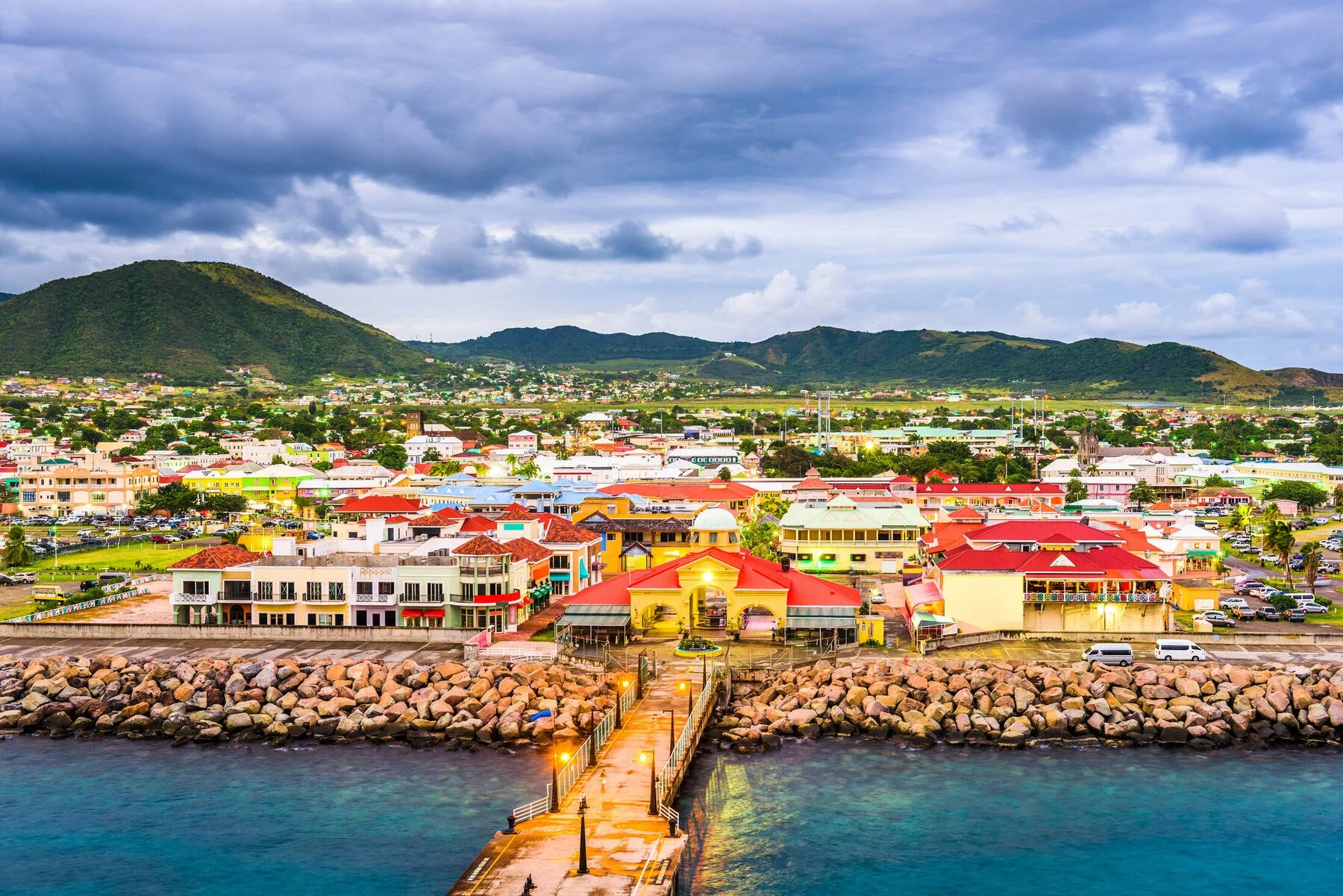
St Kitts & Nevis Country Profile:
Nevis Asset Protection and the Oldest Passport Programme
Two islands, two products. Nevis has the most debtor-friendly LLC and trust statutes in the world; St Kitts runs the citizenship-by-investment programme every other one copied. Neither is a place FTR's clients move to, and neither changes where they pay tax.
🇰🇳 Key Facts (2026):
Currency: Eastern Caribbean Dollar (XCD); pegged since 1976 at XCD 2.70 = USD 1. USD accepted widely
Personal income tax: 0%
Corporate tax: 33% on locally sourced income of resident companies; Nevis LLCs and business corporations with no St Kitts & Nevis source income and management outside the federation pay 0%
Unincorporated business tax: 4% of gross revenue for local sole traders
VAT: 17% standard; 10% on hotels and restaurants
Capital gains tax: 0% (a 20% charge can apply to assets sold within a year of acquisition)
Wealth tax: 0%
Estate/inheritance tax: 0%
Property: annual property tax of about 0.2%–0.3% of market value; stamp duty on transfers of 6%–12%, usually borne by the vendor; non-citizens need an Alien Landholding Licence costing 10% of value, waived for approved CBI property
Social security and levies: 5% employee and 6% employer social security; Housing and Social Development Levy of 3.5%–10% on higher earnings
Tax residency trigger: 183 days; consequential only for a tax residency certificate, since there is no income tax
Citizenship by Investment, Sustainable Island State Contribution: USD 250,000 for a single applicant or family of up to four; additional dependants USD 25,000–50,000 each
CBI real estate: USD 325,000–400,000 for a unit in an approved development, or USD 600,000–800,000 for a private home, held for seven years
CBI processing: roughly four to eight months; mandatory interview since 2023
CBI passport: visa-free or visa-on-arrival access to roughly 150 destinations including the Schengen area and the UK; not the US or Canada
Nevis LLC setup: USD 3,000–8,000. Annual maintenance: USD 2,000–5,000
Nevis trust setup: USD 5,000–15,000; annual trustee fees USD 3,000–8,000
Nevis creditor bond: USD 100,000 to bring a claim against a Nevis LLC or trust
Personal bank account minimum: USD 1,000–5,000 for residents; USD 10,000–25,000 for non-resident accounts at Nevis international banks
Private banking threshold: effectively none locally; Nevis international banks take relationships from USD 100,000–250,000
Cost of living, comfortable professional household: USD 6,000–9,000 a month
CRS: participating; first exchanges 2018
FATCA: Model 1 IGA, signed August 2015
Treaties: the CARICOM multilateral tax agreement and a handful of limited older arrangements; nothing of practical use with the US, Canada, Australia or the EU; around 20 tax information exchange agreements
Public UBO register: none; beneficial ownership held by registered agents and available to authorities
EU and FATF lists: on neither
Population: roughly 47,000–54,000 depending on source; the 2022 census counted about 47,000
Time zone: UTC-4, no daylight saving
Last edited: 26 June 2026 by Joe Martin Hanson (Director & Global Partner) with advice from FTR’s St Kitts and Nevis Tax Partners
Why St Kitts & Nevis Matters
Nevis is known globally for aggressive asset-protection law. The Nevis Limited Liability Company Ordinance and the Nevis International Exempt Trust Ordinance were drafted to make it as hard as the legislature could manage for a foreign creditor to reach assets held in a Nevis vehicle: charging orders as the sole remedy, a cash bond before a claim can be filed, a criminal standard of proof on fraudulent transfer, short limitation periods, and no recognition of foreign judgments. Among the offshore asset-protection jurisdictions only the Cook Islands compares, and Nevis is cheaper.
St Kitts is home of the world's oldest citizenship-by-investment programme, running since 1984. It provides a second passport with visa-free access to roughly 150 destinations in exchange for a qualifying contribution or investment, with no residence requirement, and every Caribbean programme that followed was modelled on it.
Same country, different products, different clients. Nevis suits the HNW individual facing genuine, not hypothetical, creditor risk: the surgeon, the developer, the person anticipating a divorce or a business dispute. St Kitts suits the holder of a weak passport who wants travel access and exit optionality. Neither product does anything for tax, and a client who expects otherwise has been sold the wrong thing.
Visa and Residency Routes
Citizenship by Investment. Two routes. The Sustainable Island State Contribution, a non-refundable payment to the government of USD 250,000 for a single applicant or family of up to four, with additional dependants at USD 25,000–50,000 each; or an investment in approved real estate, USD 325,000–400,000 for a unit in a government-approved development or USD 600,000–800,000 for a private home, held for seven years, with a Public Benefit Option at USD 250,000 into approved projects. Due diligence fees run about USD 10,000 for the main applicant and USD 7,500 per adult dependant, plus government processing fees. A virtual or in-person interview has been mandatory since 2023. Processing runs four to eight months in practice. There is no residence or visit requirement, dual nationality is unrestricted, and the passport is valid for ten years.
The passport gives visa-free or visa-on-arrival access to the Schengen area, the UK, Hong Kong, Singapore and most of Latin America; it does not give access to the United States, which has never included St Kitts & Nevis in its visa waiver programme, or Canada, which imposed a visa requirement in 2014. The programme's standing is under continuous pressure: the EU has adopted a mechanism allowing visa-free access to be suspended for countries running investor citizenship schemes, and the United States has pressed the five Caribbean programmes on due diligence and pricing, which drove the 2023 price rise and the 2024 regional agreement on minimum thresholds. A client buying the passport for Schengen access should understand that access is a policy decision in Brussels, not a right.
Ordinary residence. Work permits are employer-sponsored and slow. A person of independent means can obtain a residence permit with proof of income and accommodation; permanent residence follows discretionary long residence. There is no residency-by-investment programme separate from citizenship, because the citizenship programme makes one unnecessary.
Tax residency. With no income tax, tax residency in St Kitts & Nevis matters only for obtaining a tax residency certificate to present to banks and home-country authorities under CRS self-certification. A certificate requires genuine presence, and banks increasingly discount certificates from zero-tax countries where the client plainly lives elsewhere.
FTR would use the CBI programme for a client whose home passport restricts travel or whose exit planning needs a second nationality, and would treat it as a document purchase, not a relocation. For anyone wanting to live in the Caribbean at zero tax, the Bahamas, Cayman and Panama all have more infrastructure and a clearer legal route.
Tax Peculiarities and Traps
The passport does not move your tax residency. A St Kitts & Nevis citizen who lives in Canada, Australia or Germany is tax resident there on the same facts as before. The passport is not a residency; a client who acquires it and then self-certifies to a bank as tax resident in St Kitts & Nevis while living elsewhere is making a false CRS declaration, and the bank, seeing a Toronto address and a Nevis passport, will report to Ottawa anyway.
The 2018 reforms. Under EU pressure, the federation removed the ring-fenced exemption that made Nevis LLCs and business corporations tax-free by statute. The practical position is that a Nevis entity with no local-source income and management outside the federation has no local tax to pay, but the certainty of the old exempt-company regime is gone, and an entity managed from St Kitts by a resident director can be a resident company taxed at 33% on local income.
Asset protection is not tax protection. A Nevis LLC owned by a US person is a foreign entity requiring Form 8858 or 8865 or 5471, FBAR and FATCA reporting; a Nevis trust settled by a US person is almost always a grantor trust reported on Forms 3520 and 3520-A, and its income is the settlor's income. Canadian and Australian settlors face attribution and non-resident trust rules. The vehicle protects the asset from a creditor, not from a tax authority, and failing to report it converts a legitimate structure into a penalty case.
Fraudulent transfer law follows the settlor. Nevis will not recognise a foreign judgment, but the home-country court that gave the judgment retains jurisdiction over the settlor. US courts have jailed settlors for contempt when they claimed to be unable to repatriate assets from offshore asset-protection trusts, and a transfer made after a claim has arisen is voidable at home regardless of what Nevis says. The protection works for a transfer made in calm weather; it fails for a transfer made in a storm.
VAT and the cost of the islands. 17% VAT, import duties and a customs service charge make the islands expensive, and the Alien Landholding Licence at 10% of value makes property outside approved CBI projects materially dearer for foreigners.
The Structural Layer
FTR's default is a Panamanian Private Interest Foundation owning a Panamanian SA, with a modest director's salary paid where the client lives. Nevis enters the structure only where there is a genuine creditor-protection need, and then as a layer beneath or beside the foundation rather than instead of it.
The standard adaptation: the Panamanian foundation, or the client directly, owns a Nevis LLC that holds the assets exposed to litigation risk, typically a liquid portfolio or an interest in a business, with a Nevis or third-country manager. The operating company stays where the substance is, in Panama or wherever the client works. Where the risk is severe and the wealth substantial, a Nevis international exempt trust holds the LLC, with a licensed Nevis trustee, a protector the settlor trusts, and a flight clause allowing migration to the Cook Islands or elsewhere. The settlor can be a beneficiary and can hold protector powers, which Nevis permits and most onshore jurisdictions do not.
Where the default plainly does not fit: a St Kitts & Nevis citizen who is tax resident elsewhere gains nothing from Nevis for tax, and the home-country CFC, attribution and foreign-trust rules apply in full. A US settlor gets grantor-trust treatment and a heavy reporting load. And a client whose creditor is already at the door cannot use Nevis at all; the transfer will be unwound at home.
Panamanian entities are more widely accepted by global counterparties than Nevis ones; Nevis entities sometimes trigger extra scrutiny at banks, and a Nevis LLC that needs to hold a brokerage account should expect a longer onboarding than a Panamanian SA. That is a cost of the reputation the statutes have earned.
Info-Sharing Reality (CRS and FATCA)
St Kitts & Nevis is a CRS participant and has exchanged since 2018. Its financial institutions, which include the Nevis international banks and licensed trust companies acting as trustees, report foreign tax residents' accounts, and the controlling persons of Nevis LLCs and trusts, to the Inland Revenue Department for onward exchange with the account holder's country of tax residence. Under the Model 1 FATCA IGA, US persons' accounts go to the IRS.
A Nevis LLC or trust with an account at a Nevis bank is reported to the settlor's or member's home country. One with an account in Panama, Switzerland or Singapore is reported by that bank, which will look through the LLC to the controlling persons in any case. The vehicle is visible to the tax authorities of Canada, Australia, the UK, Germany and China; what it resists is a private creditor with a foreign judgment, which is a different thing entirely.
The CBI programme adds a specific hazard. The OECD has publicly listed residence and citizenship-by-investment schemes that pose a high risk of CRS circumvention, and St Kitts & Nevis was named. Banks therefore treat a St Kitts & Nevis passport presented as evidence of tax residency with suspicion, and ask where the client actually lives. Chinese HNW families, historically among the largest buyers of Caribbean passports, bought them for travel and exit optionality; those who bought them to reclassify their tax residency for CRS purposes found that the banks report to Beijing on the facts, not the passport.
St Kitts & Nevis is a creditor-protection and passport jurisdiction. It is not a privacy jurisdiction, and it is marketed as one more often than any other country in this set.
Banking Reality
Domestic banking is thin and regulated by the Eastern Caribbean Central Bank. St Kitts-Nevis-Anguilla National Bank, Bank of Nevis and Republic Bank (which acquired Scotiabank's Eastern Caribbean operations) serve residents; a resident with a permit can open an account with USD 1,000–5,000 and local proof of address, in two to six weeks.
Nevis licenses a small number of international banks, notably Bank of Nevis International, which open non-resident USD accounts for individuals and Nevis entities with minimums of USD 10,000–25,000, remotely with apostilled documents, in four to twelve weeks. They are useful as an operating account for a Nevis LLC and unsuitable as a primary private-banking relationship; product range is narrow and the correspondent banking behind them is fragile. The Eastern Caribbean as a whole has suffered correspondent-bank de-risking since 2015, and payments through the local system can be slow and occasionally refused by intermediary banks.
Most Nevis structures bank elsewhere: Panama, Puerto Rico, Switzerland or Singapore. Expect the foreign bank to ask why a Nevis vehicle was chosen and to want a coherent asset-protection rationale in writing. St Kitts & Nevis is on neither the EU non-cooperative list nor the FATF grey list; the European attention it receives is directed at the CBI programme, not the banks.
Cost of Doing Business
A Nevis LLC costs USD 3,000–8,000 to establish with a registered agent and a properly drafted operating agreement, and USD 2,000–5,000 a year in agent, government and manager fees. A Nevis international exempt trust with a licensed trustee is USD 5,000–15,000 to establish and USD 3,000–8,000 a year, with a Nevis LLC underneath adding the figures above.
Against the set: a Panamanian SA is USD 1,500–2,500 to establish and USD 1,000–1,800 a year, with a Private Interest Foundation above it at a similar order; the Panamanian pair is a succession and holding structure with modest asset-protection features, not a litigation shield. A BVI BC is USD 1,000–3,000 and USD 1,000–2,500 a year. A Cook Islands asset-protection trust, the only closer comparison, runs USD 15,000–30,000 to establish and USD 5,000–10,000 a year, so Nevis delivers similar statutory protection at roughly half the cost. Singapore, at three times Panama, is the benchmark for a substantive operating company and is not in the same category. Nevis is a specialty purchase; priced against what it does, it is reasonable, and priced against what most clients actually need, it is unnecessary.
Cost of Living
Basseterre and Frigate Bay on St Kitts, or Charlestown and the western coast of Nevis, monthly. Small islands, imported food, expensive electricity.
Lean, single: USD 3,000–4,000: one- or two-bedroom apartment USD 1,000–1,600, private health cover with evacuation USD 250–400, groceries USD 600–800, a used car and fuel USD 400–500.
Comfortable, family of four: USD 6,000–9,000: a three-bedroom house in Frigate Bay or on Nevis USD 2,000–3,500, family cover with air evacuation USD 700–1,200, private school places USD 500–1,000 each a month, two cars, and electricity at USD 300–500.
HNW: USD 15,000 and up: a villa in a CBI-approved development such as Christophe Harbour or on Nevis's Four Seasons estate, staff, boat, and regular travel to Miami or San Juan for medical care and everything else.
Healthcare is basic: JNF General Hospital in Basseterre and Alexandra Hospital on Nevis handle routine and emergency care, and anything serious is flown to Barbados, Puerto Rico or Miami. Evacuation cover is not optional.
Cultural and Practical Considerations
These are small, quiet, Christian, English-speaking islands with a tourist economy and a population smaller than a mid-sized suburb. They are pleasant to visit and, for most FTR clients, hard to live in year-round.
Women. No legal or practical constraint on women travelling, residing, owning property or doing business alone. Domestic violence is a recognised social problem and support services are limited.
LGBT residents. The High Court struck down the colonial-era criminalisation of consensual same-sex conduct in August 2022. There is no recognition of same-sex relationships, churches are influential, and discretion is expected; the law is now neutral, the society is not yet.
Language and integration. English throughout, with a local creole. The islands are small enough that a foreign resident is known within weeks; integration is warm but shallow, and the expat community is a few hundred people, many of them retirees and CBI investors who visit rather than live.
Pace, security and bureaucracy. The pace is slow and government slower; permits, licences and land transactions take months. St Kitts has had one of the highest per-capita homicide rates in the Caribbean in recent years, concentrated in Basseterre and gang-related; Nevis is markedly calmer. Foreign residents in gated developments are rarely affected but should not pretend the problem is elsewhere.
Climate and health. Hot, humid, hurricane-exposed; Nevis was badly hit by Hugo in 1989 and the islands sit in the path every season. Electricity and water supply are less reliable than the cost suggests.
Schooling. No full international school. A few private schools offer a Caribbean curriculum to secondary level; families with older children plan on boarding abroad.
Politics. Stable parliamentary democracy with a real Nevis-St Kitts fault line: Nevis has its own assembly and a constitutional right to secede, and a 1998 referendum fell just short of the two-thirds required. The CBI programme's revenue and reputation are a permanent political issue, and changes to the programme arrive with little notice.
For Retirees
Not typically a primary destination: infrastructure is limited, healthcare basic, and the cost of living moderate but not cheap by regional standards. The residence permit above exists for those who want a small island anyway.
For Digital Nomads and Remote Professionals
No dedicated permit; a CBI passport does not change where a nomad pays tax.
For Online Business Owners and Entrepreneurs
Nevis adds nothing to the Panamanian default unless litigation exposure is real; then the Structural Layer above applies.
For Multinational Business Owners
Nothing here; the substance is elsewhere, and a Nevis vehicle at the top of a group invites more questions than it answers.
For High Net Worth (HNW) Families and Investors
The CBI passport is a genuine Plan-B document for families whose home passport limits travel or whose exit planning needs a second nationality, and a Nevis trust is a genuine shield against a private creditor. Chinese HNW families have bought both; the passport travels, the trust is visible to Beijing under CRS, and neither alters tax residency.
Common Traps
Buying the passport to change your tax residency: it does not, and self-certifying to a bank on the strength of it is a false declaration that the bank will see through. Buying it for US or Canadian access: neither is visa-free. Assuming Schengen access is permanent: it is a policy decision under active review.
Setting up a Nevis LLC or trust after a claim has arisen: home-country fraudulent-transfer law unwinds it, and a US settlor can be held in contempt for not repatriating what he says he cannot reach. Using Nevis for privacy or tax deferral: CRS reports the controlling persons and home-country CFC and trust rules attribute the income. Failing to file the home-country forms because the vehicle is offshore: the penalties exceed the protection.
Moving here for a comfortable professional life: no international school, basic healthcare, a serious crime problem in the capital, and a small-island pace that most people who have not lived on one underestimate.
Next Steps
If you face a genuine creditor exposure at the USD 2 million and above wealth level, or your passport restricts your travel and your planning needs a second nationality, book a scoping call. Bring the litigation timeline in the first case and the home-country residency position in both; they decide whether either product is worth buying.
Important note: General information. Not personal tax, legal, or financial advice. Speak to a qualified adviser at FTR or elsewhere before acting.
Continue reading
Suggested next, chosen by our partners.


