
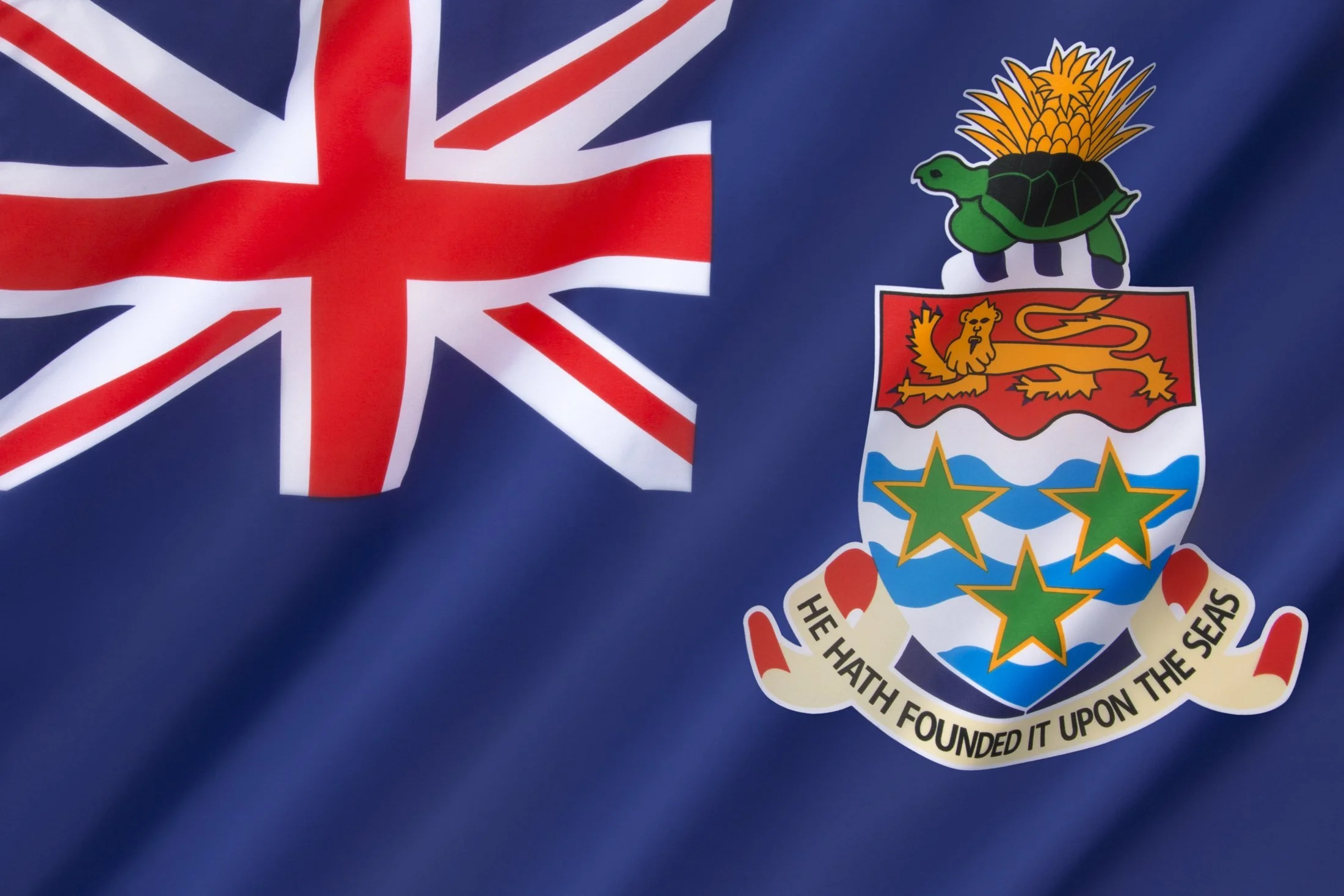
Cayman Islands Country Profile:
Institutional Structuring Capital, Priced for Institutions
Cayman is where the world's funds, structured finance and family-office holding vehicles live. Zero direct tax, deep case law, full CRS transparency and costs that assume institutional scale. For most FTR clients it is a component, not a home.
🇰🇾 Key Facts (2026):
Currency: Cayman Islands Dollar (KYD); fixed since 1974 at 1 KYD = USD 1.20 (1 USD = 0.83 KYD). USD circulates freely
Personal income tax: 0%
Corporate tax: 0%; no withholding taxes
VAT/GST: none; import duty on most goods, commonly 22%, funds the government alongside work-permit and financial-services fees and tourism
Capital gains tax: 0%
Wealth tax: 0%
Estate/inheritance tax: 0%
Property transfer: stamp duty of 7.5% on real estate purchases; no annual property tax
Tax residency trigger: none in the tax sense (no income tax); immigration status is what matters
Certificate of Permanent Residence for Persons of Independent Means: CI$2,000,000 (USD 2.4M) in developed real estate, plus a CI$100,000 (USD 120,000) issue fee
Residency Certificate for Persons of Independent Means (25-year, renewable): CI$1,000,000 (USD 1.2M) invested in Cayman, at least CI$500,000 of it in developed real estate, plus income of CI$120,000 a year or a CI$400,000 Cayman bank deposit; lower thresholds on Cayman Brac and Little Cayman
Certificate of Direct Investment: CI$1,000,000 (USD 1.2M) in an employment-generating business; 90 days' presence a year
Work permit term limit: nine years, after which a permit holder must leave unless granted permanent residence
Exempted company setup: USD 2,000–5,000 through a corporate services provider for a plain company; USD 5,000–15,000 where a law firm drafts bespoke articles or the entity is a segregated portfolio company or fund
Exempted company annual maintenance: government fee USD 854–3,132 depending on authorised capital, plus registered office; USD 2,000–6,000 all-in for a simple company, USD 3,500–10,000 with directors, economic substance filings and AML officers
Cayman trust: USD 5,000–15,000 for a straightforward trust with a private trustee; USD 10,000–30,000 setup and USD 5,000–15,000 a year with a licensed trust company
Foundation Company setup: USD 5,000–15,000
Economic substance: International Tax Co-operation (Economic Substance) Act, in force since 1 January 2019, applies to nine relevant activities; pure equity holding companies face a reduced test
Beneficial ownership: Beneficial Ownership Transparency Act 2023 in force since July 2024; access for competent authorities and, since 2025, a legitimate-interest channel; not a public register
Personal bank account minimum: USD 5,000–25,000 at local retail banks for non-Caymanian residents; non-residents generally not onboarded for retail
Private banking threshold: USD 250,000–1M for wealth-management relationships at local banks; USD 5M and above for full-service international private banking
Cost of living, comfortable professional family, Grand Cayman: USD 12,000–18,000 a month
CRS: participating, early adopter; first exchanges September 2017 on 2016 data
FATCA: Model 1 IGA, signed November 2013
Treaties: no comprehensive double tax treaties of practical use (a limited arrangement with the UK only); roughly 36 tax information exchange agreements
EU and FATF lists: on neither; removed from the EU non-cooperative list in October 2020 and from the FATF grey list in October 2023
Population: roughly 77,000 (mid-2026 estimate; the 2021 census counted about 71,000)
Time zone: UTC-5, no daylight saving; aligned with New York in winter
Last edited: 19 August 2026 by Joe Martin Hanson (Director & Global Partner) with advice from FTR’s Cayman Tax Partners
Why the Cayman Islands Matter
Cayman is the world's largest offshore financial centre by fund assets. Hedge funds, private equity feeders, structured finance vehicles and institutional holding companies have standardised on Cayman exempted companies, exempted limited partnerships and segregated portfolio companies, and a bank, a prime broker or an investor in New York, London or Hong Kong will accept a Cayman entity without a second look. The legal system is English common law with a Privy Council appeal, the case law on trusts and insolvency is deep, and the professional bench is genuinely first-rate.
That infrastructure was built for institutions, and its pricing assumes institutional scale. Cayman law firms bill at London and New York rates; anything non-standard becomes expensive quickly. For a structure holding USD 50 million or more these costs are trivial. For a family with USD 2 million they are usually disproportionate, and the same family gets a better-fitting result from a Panamanian foundation at a fraction of the running cost.
For FTR's readers, then, Cayman does three things well. It provides the vehicle when a client is raising outside capital or co-investing with institutions. It provides a Foundation Company or STAR trust where a counterparty, a bank or a family office insists on Cayman law for succession. And, for the small number of UHNW clients who want zero-tax personal residency in a safe, orderly, English-speaking jurisdiction an hour from Miami, it provides that too, at a price of entry above USD 1.2 million.
Visa and Residency Routes
Cayman has no tax residency test, because it has no income tax. What a client acquires is immigration status, and the routes are priced accordingly.
Certificate of Permanent Residence for Persons of Independent Means. Invest CI$2,000,000 (USD 2.4M) in developed residential real estate on Grand Cayman, pay a CI$100,000 issue fee, and receive the right to reside for life. It carries no right to work unless separately varied, for a further fee. After five years' residence the holder can apply for naturalisation as a British Overseas Territories citizen, and Caymanian status becomes available after fifteen years. There is no formal minimum-days requirement, but an annual declaration is made and long absences invite questions. Decisions typically take three to six months. This is the route for the UHNW client who genuinely intends to live in Cayman.
Residency Certificate for Persons of Independent Means. A 25-year renewable certificate for a CI$1,000,000 (USD 1.2M) investment, at least half in developed real estate, plus either a continuing annual income of CI$120,000 from sources outside Cayman or a CI$400,000 deposit with a Cayman bank. The issue fee is CI$20,000 plus CI$1,000 per dependant. On Cayman Brac and Little Cayman the investment falls to CI$500,000 with CI$250,000 in real estate and the income test to CI$75,000. Minimum presence is 30 days a year. It does not by itself lead to permanent residence; it is a residence right, not a path.
Certificate of Direct Investment. For a CI$1,000,000 (USD 1.2M) investment in a licensed, employment-generating business, a 25-year certificate with the right to work in that business. Requires at least 90 days' presence a year and a CI$20,000 fee. This suits an entrepreneur who is actually relocating an operating business, not a passive investor.
Residency Certificate (Substantial Business Presence). For someone owning at least 10% of an approved-category business (fund administration, insurance, reinsurance, family office, fintech and similar) or holding a senior management position in one. 25 years, 90 days' presence, a modest fee. In practice this is how family-office principals and fund managers obtain residence.
Global Citizen Concierge Program. A remote-work permit for up to two years, requiring annual income of USD 100,000 for a single applicant, USD 150,000 for a couple and USD 180,000 for a family, with a fee of roughly USD 1,500 a year. It does not lead anywhere and it does not buy anything Cayman's tax system does not give every visitor anyway; it is a lifestyle permit for people who can afford Grand Cayman rents.
Work permits remain the ordinary route for professionals in financial services, and the nine-year term limit is the trap: at the end of it the permit holder must leave unless permanent residence has been granted under the points system, which becomes available after eight years' residence and is competitive.
FTR would use the Certificate of Permanent Residence for a UHNW family relocating in earnest, the Substantial Business Presence certificate for a family-office principal, and would not use the Global Citizen Concierge Program for any structuring purpose. The 25-year Persons of Independent Means certificate looks attractive on paper but leaves the holder in a permanent renewal cycle; a client who wants Cayman for the long term should price the permanent certificate from the start.
Tax Peculiarities and Traps
Cayman has no income tax, so the traps are not Cayman's; they belong to the country the client is actually tax resident in.
The 0% illusion. A Cayman exempted company owned by a resident of Canada, Australia, the UK, Germany, Spain or China is a controlled foreign company under that country's rules, and its passive income is attributed to the owner as it arises. Cayman's zero rate neither defers nor shelters anything for a beneficial owner in a worldwide-taxation country. This is the single most common misunderstanding FTR encounters about Cayman.
Economic substance. Since 1 January 2019, an exempted company carrying on a relevant activity (banking, insurance, fund management, financing and leasing, headquarters, shipping, distribution and service centre, intellectual property, or holding business) must show adequate people, premises and expenditure in Cayman proportionate to that activity, and file an annual return with the Department for International Tax Cooperation. A pure equity holding company faces only a reduced test: a registered office and compliance with filing obligations. An entity that is tax resident elsewhere can claim that status instead, with evidence. Penalties escalate and strike-off follows persistent failure. This is where cheap Cayman structures set up before 2019 have quietly become non-compliant.
Import duty and stamp duty. Zero tax is funded somewhere. Duty of around 22% on most imports feeds directly into the cost of living, and the 7.5% stamp duty on real estate is a real cost on the USD 2.4 million property that buys permanent residence.
Mandatory health insurance. Every resident and work-permit holder must carry approved health insurance under the Health Insurance Act. It is not a tax, but it behaves like one.
The Structural Layer
FTR's default, a Panamanian Private Interest Foundation owning a Panamanian SA with a modest director's salary paid where the client lives, fits the typical FTR client better than any Cayman equivalent and costs a third to a fifth as much to run. Cayman enters the picture in three situations.
First, where the client is raising or pooling capital with outsiders. An exempted company or exempted limited partnership, often a segregated portfolio company where assets need compartmentalising, is the vehicle investors and prime brokers expect. The Panamanian foundation can sit above the client's interest in that vehicle; it should not try to replace it.
Second, where succession needs Cayman law. The Foundation Company, introduced by the Foundation Companies Act 2017, is a company with no shareholders that can hold assets for purposes or beneficiaries, and it is increasingly used by families whose bankers or trustees want a Cayman vehicle. STAR trusts under the Special Trusts (Alternative Regime) provisions allow purpose trusts and beneficiaries with no enforcement rights, which suits holding an operating business across generations. Both are well-tested and both cost more than the Panamanian foundation; the choice is about counterparty comfort and governance sophistication, not about tax or privacy, since both are fully visible under CRS.
Third, where the client actually becomes a Cayman resident. Cayman has no CFC rules, no income tax and no exit tax, so a client holding a Certificate of Permanent Residence can own operating companies anywhere through whatever holding vehicle suits; the default Panamanian structure works unchanged, and the salary paid to the client in Cayman is simply untaxed. The home country's departure rules, not Cayman's, decide whether that is clean.
The Limited Duration Company and the exempted LLC are specialised options for joint ventures and US-facing structures, and the exempted LLC is the natural vehicle where US counsel wants partnership treatment.
Info-Sharing Reality (CRS and FATCA)
Cayman was an early adopter of the Common Reporting Standard and has exchanged since September 2017. Every Cayman financial institution, which includes funds, trust companies and many holding vehicles that would not think of themselves as banks, reports foreign tax residents' accounts, and the controlling persons of trusts, foundations and companies, to the Department for International Tax Cooperation, which forwards them to the home tax authority. A Canadian, Australian, British, German, Chinese or Indian beneficial owner of a Cayman structure is reported to Ottawa, Canberra, London, Berlin, Beijing or New Delhi.
Under the Model 1 FATCA IGA the same institutions report US persons to the IRS, and Cayman was the first offshore centre to build the reporting plumbing properly.
Beneficial ownership sits on a central register under the Beneficial Ownership Transparency Act 2023, held by the Registrar and searchable by Cayman and foreign competent authorities; since 2025 a legitimate-interest channel allows journalists and civil society bodies limited access in defined circumstances. It is not a public register, but it is not private in any sense a home-country tax authority would recognise.
Cayman is transparent to home-country tax authorities. Chinese HNW families use Cayman extensively, for red-chip listings and family holding companies, and the Chinese tax authorities see those structures under CRS. Cayman's value is structural and legal; it is not a place to hide anything, and anyone selling it as one is a decade out of date.
Banking Reality
Cayman's banking is thorough in the way Switzerland's is, and slower than most clients expect. Onboarding an entity or a private-banking relationship takes weeks to months, with full source-of-wealth documentation, and many international banks will not take a retail client who is not a Cayman resident.
The local retail and commercial banks are Butterfield, Cayman National, RBC Royal Bank (Cayman), CIBC Caribbean (formerly CIBC FirstCaribbean) and Scotiabank. A resident with a work permit or residence certificate can open a personal account with USD 5,000–25,000 and proof of address and status; a non-resident individual generally cannot. Wealth-management relationships at the local banks begin around USD 250,000 to 1 million. Full-service international private banking, the kind that holds a family's global portfolio and lends against it, starts at USD 5 million and rises.
Correspondent banking and SWIFT access are complete; Cayman entities clear USD through New York without difficulty, which is one reason institutions use them. Cayman is on neither the EU list of non-cooperative jurisdictions nor the FATF grey list, having left the first in October 2020 and the second in October 2023, and was removed from the EU's AML high-risk list in 2024.
For most FTR clients the practical answer is that the Cayman entity banks elsewhere, in Panama, Singapore or Switzerland, and Cayman provides only the vehicle.
Cost of Doing Business
A plain exempted company from a corporate services provider costs USD 2,000–5,000 to establish; the same company with law-firm-drafted articles, or a segregated portfolio company or fund, runs USD 5,000–15,000. Annual maintenance is the government fee, which scales with authorised capital from USD 854 to USD 3,132, plus registered office and agent fees; USD 2,000–6,000 covers a simple holding company, and USD 3,500–10,000 is realistic once directors, economic substance returns and an AML officer are added. A Cayman trust with a licensed trustee is USD 10,000–30,000 to establish and USD 5,000–15,000 a year; a Foundation Company USD 5,000–15,000.
Against the set: a Panamanian SA costs roughly USD 1,500–2,500 to establish and USD 1,000–1,800 a year, with a Private Interest Foundation above it at a similar order of cost. Singapore runs about three times Panama, USD 4,500–7,500 to set up and USD 4,000–8,000 a year in compliance. Cayman sits at Singapore's level at the simple end and well above it once anything bespoke is involved; a BVI Business Company, at USD 1,000–3,000 to establish and USD 1,000–2,500 a year, does the same holding job for a third of the price where Cayman-specific law is not required. For a family with USD 2 million in assets, Cayman's running costs are often a full percentage point of wealth a year for no tax benefit Panama does not also deliver.
Cost of Living
Grand Cayman is among the most expensive places to live in the Americas: a small island importing almost everything at 22% duty, with rents set by the financial-services payroll. Figures are monthly.
Lean, single professional: USD 5,000–6,500: one-bedroom apartment away from Seven Mile Beach USD 2,200–3,000, mandatory health insurance USD 300–600, groceries USD 800–1,100, a used car and fuel USD 500–700.
Comfortable, family of four: USD 12,000–18,000: three-bedroom house or condo in the Seven Mile Beach corridor or South Sound USD 5,500–9,000, family health cover USD 1,200–2,000, two international-school places at Cayman International School or Cayman Prep at USD 1,500–2,500 each a month, two cars, and groceries at 30–50% above US prices.
HNW: USD 30,000 and up: a beachfront residence, full private cover with US evacuation, staff, and the travel that a small island makes unavoidable.
Healthcare is good for a small island (Health City Cayman Islands for tertiary care, Doctors Hospital and the public hospital in George Town), with serious cases evacuated to Miami; insurance must cover that.
Cultural and Practical Considerations
Cayman is safe, orderly, clean and English-speaking, and it is small. Grand Cayman is 76 square miles with a resident population of a modest county town, and the social world of finance professionals, lawyers and their families is intimate to the point of claustrophobia. People who thrive here like routine, the sea and a short commute; people who need a city, anonymity or cultural variety find it wears thin within two years, which is roughly the point at which many work-permit holders leave.
Women. No legal or practical constraint on women travelling, residing, holding property or doing business alone. Financial services employs many women in senior roles and the professional culture is British-Canadian in tone.
LGBT residents. Same-sex marriage is not available. Civil partnerships with substantially equivalent rights have existed since the Civil Partnership Act 2020, after litigation that ended in the Privy Council. Society is churchgoing and conservative by North American standards, though the financial-services community is not; a gay couple will find the law adequate and the island quiet rather than hostile.
Language and integration. English everywhere. Integration with Caymanians is possible but slow; the expat community is large enough to substitute for it entirely, and most expats let it. Caymanian preference in employment and the nine-year term limit are designed to keep foreigners temporary, and the sense of being a guest is real.
Pace, security and noise. Low crime by any regional standard, some burglary and occasional violent incidents in George Town and West Bay. Traffic on the single road into George Town has become a genuine daily grievance. The pace is slow outside the office; government is professional but not fast.
Climate and health. Hot and humid year-round, with a hurricane season from June to November; Ivan in 2004 flooded most of Grand Cayman, and anyone buying property should understand elevation and insurance costs. Air conditioning is a health necessity, not a luxury, and electricity is priced accordingly.
Schooling. Cayman International School and Cayman Prep are strong; places are limited and waiting lists are a planning item for a family arriving mid-year. Public schools are for Caymanians and permanent residents.
Politics. Stable British Overseas Territory with local self-government; the political issues are housing cost, immigration policy and the term limit, all of which touch expats directly. Cost of living is the dominant complaint, and it is not going to fall.
For Retirees
Rarely the right answer. The Persons of Independent Means routes above are priced for the wealthy, and a retiree with USD 1–3 million gets zero tax, a foundation and a far lower cost of living in Panama.
For Digital Nomads and Remote Professionals
The Global Citizen Concierge Program above, for those who can afford it; it buys lifestyle, not structure.
For Online Business Owners and Entrepreneurs
Cayman adds nothing to the Panamanian default unless the business is raising outside capital, in which case an exempted company becomes the vehicle investors expect.
For Multinational Business Owners
The natural home for a fund, a co-investment vehicle or an institutional holding company; the Structural Layer above sets out where the Panamanian foundation sits relative to it.
For High Net Worth (HNW) Families and Investors
For families above USD 50 million, Cayman's Foundation Company and STAR trust are serious succession tools and the Certificate of Permanent Residence is a serious residence. Chinese HNW families use Cayman for exactly this, and should do so knowing that Beijing sees the structure under CRS; the benefit is structural and legal, not private.
Common Traps
Coming to Cayman for privacy: it has reported under CRS since 2017 and its beneficial-ownership register is searchable by foreign authorities. Using a Cayman company to defer tax from a worldwide-taxation home country: CFC rules attribute the income whether or not it is distributed. Running a family of USD 2–5 million through Cayman entities: the professional fees alone will consume more than any plausible benefit. Setting up a pre-2019 style shell and ignoring economic substance: the filings are enforced and the penalties escalate to strike-off.
Retiring on a middle-class budget: rents and groceries make Grand Cayman untenable for anyone who needs to watch monthly spending. Assuming a work permit is a route to staying: the nine-year term limit is enforced and permanent residence is competitive. And anyone who needs a city, or who cannot live within a small, observant community, will not last.
Next Steps
If your structure involves outside investors, a fund, or a family holding above USD 50 million, or if you are seriously considering Cayman residency at the Certificate of Permanent Residence threshold, book a scoping call. If your wealth is below that level, read the Panama profile first; it will usually be the better answer.
Important note: General information. Not personal tax, legal, or financial advice. Speak to a qualified adviser at FTR or elsewhere before acting.
Continue reading
Suggested next, chosen by our partners.


