
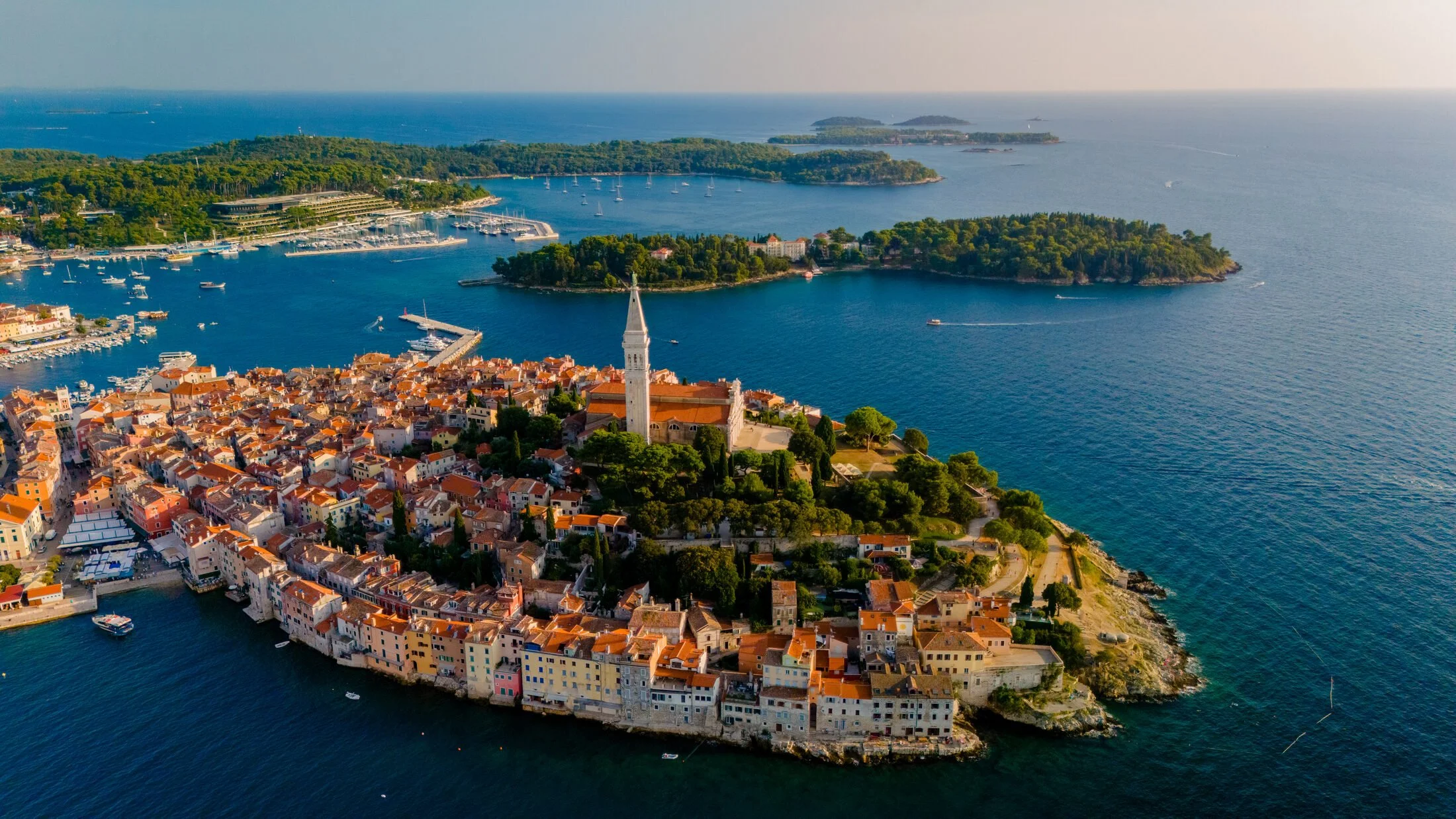
Croatia Country Profile:
Euro, Schengen, a Working Nomad Permit and a Coast That Empties in November
Croatia joined the euro and Schengen on the same day in 2023 and became a mainstream EU option overnight. It has a functional digital nomad permit, moderate tax, cheap company formation and a beautiful coast; what it lacks is a retirement route, a large expat layer and anything to do in winter.
🇭🇷 Key Facts (2026):
Currency: Euro (EUR), adopted 1 January 2023; ~1.16 to USD (mid-market, 14 September 2026)
Personal income tax: two brackets, rates set by each municipality within national bands: 15%–23% on annual income to EUR 60,000 and 25%–33% above; default 20% and 30%; Zagreb 23% and 33%; surtax abolished 2024; personal allowance EUR 600 a month
Social security: employee pension contributions 20% of gross; employer health contribution 16.5%
Corporate tax: 10% on companies with annual revenue up to EUR 1 million; 18% above
VAT: 25% standard; 13% and 5% reduced
Capital gains: 12% on financial assets sold within two years of acquisition, exempt after two years; dividends and interest 12%; real estate sold within two years taxed at the municipal lower rate, exempt after two years or as a main residence
Wealth tax: none; from 2025 an annual municipal property tax of EUR 0.60–8.00 per square metre on second homes and short-let property, primary residences and long-term rentals exempt
Inheritance and gift tax: 4% on cash, claims, securities and movables worth more than EUR 6,700; spouse, descendants and ancestors exempt; inherited real estate carries the 3% transfer tax with the same family exemption
Real estate transfer tax: 3%
Digital Nomad permit: roughly EUR 3,300 a month net income (~USD 3,830), stays of up to 18 months, remote income exempt from Croatian income tax
Retirement visa: none; retirees use the one-year temporary stay for other purposes, or EU free movement
Property purchase: EU and EEA nationals unrestricted; others need Ministry of Justice consent and reciprocity; agricultural land closed to all foreigners
Tax residency trigger: 183 days, or a dwelling owned or rented and available for at least 183 days whether or not used
Corporate setup: d.o.o. with EUR 2,500 share capital or j.d.o.o. with EUR 1, EUR 500–1,500 all-in (~USD 580–1,740). Annual maintenance: EUR 1,500–4,000 (~USD 1,740–4,640)
Personal bank account minimum: nil; personal identification number (OIB) required
Private banking threshold: EUR 250,000–500,000 investable
Cost of living, comfortable household in Zagreb or Split: EUR 3,500–5,000 a month (~USD 4,060–5,800)
CRS: participating; first exchanges 2017 on 2016 data
FATCA: Model 1 IGA, signed 2015
Treaties: roughly 65; none with Colombia; none with Panama; a treaty with the United States signed December 2022 is not yet in effect
Population: ~3.85 million and falling
Time zone: CET, UTC+1 (UTC+2 in summer)
Last edited: 27 September 2026 by Joe Martin Hanson (Director & Global Partner) with advice from FTR’s Croatian Tax Partners
Why Croatia Matters
Croatia matters because on 1 January 2023 it became, at a stroke, a euro country inside Schengen with an Adriatic coastline, a functioning digital nomad permit and moderate taxes. Before that it was a summer destination with a currency and a border; after it, a Croatian residence permit is a Schengen permit, a Croatian bank account is a SEPA account, and a Croatian company invoices in euros. That change raised its European appeal more than anything the country itself did, and it has been rising as an EU nomad and lifestyle destination since.
It matters second for a specific client: the remote worker earning in dollars or pounds who wants an EU base without the tax of France or Spain and without Portugal's visa gymnastics. The nomad permit is well designed and exempts the remote income from Croatian tax.
It matters third, more modestly, for HNW families buying coastal property in Dalmatia and Istria, and for the large Croatian diaspora in Australia, Canada, the United States, Chile and Argentina, for whom citizenship by descent is available with dual nationality. It is not a tax jurisdiction in its own right and has no retirement route.
Visa and Residency Routes
Digital Nomad permit. A temporary stay for non-EU nationals working remotely for foreign employers or their own foreign company, on proof of roughly EUR 3,300 a month net income plus about 10% per family member, health insurance, a clean record and a Croatian address. Introduced in 2021 and extended in 2025 from twelve to eighteen months, after which the holder leaves for six months before reapplying; processing takes four to eight weeks. It does not lead to permanent residence, because the months do not count toward the five years, and the holder may not work for Croatian clients. FTR uses it for exactly what it is: an eighteen-month EU base for a remote professional, tax-free on the remote income.
Temporary stay for other purposes. A one-year permit on proof of means, insurance and accommodation, which is how non-EU retirees and property owners actually stay; not renewable without leaving and not a retirement visa. A property-ownership stay exists for non-EU owners wanting seasonal residence. A non-EU national forming a d.o.o. can obtain a residence and work permit as its director on modest capital and a real business plan; the EU Blue Card and ordinary work permits cover employees.
EU citizens register after three months. Permanent residence follows five years' continuous temporary stay with A2 Croatian. Citizenship ordinarily requires eight years' residence, a B1 test and renunciation of the prior nationality; the exception that matters is descent, where a Croatian parent, grandparent or in some cases great-grandparent gives a passport with no residence, language test or renunciation. For a diaspora client that is the most valuable thing Croatia offers.
The route that looks good on paper and fails in practice is retirement: the one-year permit, the forced gap and the absence of a pension track mean a non-EU retiree cannot simply live on the coast, and FTR does not sell Croatia to non-EU retirees on any other assumption.
Tax Peculiarities and Traps
The dwelling test. Croatian tax residence attaches not only to 183 days' presence but to having a dwelling, owned or rented, at one's disposal for at least 183 days in a year, used or not. A non-EU family that buys a coastal house and visits for August has, on the face of the statute, a Croatian residence; the treaty tie-breaker usually rescues them, but only where a treaty exists, and there is none with Panama, Colombia or, yet, the United States.
Municipal rates. Since 2024 there is no surtax; each municipality sets its rates within the 15%–23% and 25%–33% bands. Zagreb is at the top, many coastal towns lower. Where a resident lives, not works, sets the rate, and the gap between Zagreb and a favourable coastal municipality is up to eight points on the top bracket.
Two-year clocks. Financial assets sold within two years of purchase are taxed at 12%; after two years the gain is exempt. Real estate sold within two years is taxed; after two, or as a main residence, exempt. Croatia taxes trading and not holding.
The new property tax. From 2025 second homes and short-let flats pay EUR 0.60–8.00 per square metre a year; a 100 square metre holiday flat in Split at the top of the band costs EUR 800. Primary residences and long-term lets are exempt, the intent being to push holiday property into the rental market.
Non-EU purchase consent. A non-EU buyer needs the Ministry of Justice's consent, granted only where the buyer's own country lets Croatians buy on equal terms; Americans, Canadians, Australians and Britons qualify, consent takes months and the contract is conditional on it. Agricultural land, which includes much coastal land, cannot be bought by any foreigner; the common workaround is a Croatian d.o.o., which buys as a domestic legal person.
No US treaty in effect. The 2022 treaty awaits ratification; until then a US citizen resident in Croatia relies on the foreign tax credit and exclusion alone, and Croatian dividends to a US shareholder carry the domestic 12%.
The Structural Layer
For a nomad permit holder, FTR's default, a Panamanian Private Interest Foundation owning a Panamanian SA with a modest director's salary paid where the client lives, fits with one qualification: the permit exempts the remote income and the SA is the foreign employer that makes the arrangement coherent, but the client is on a temporary stay and usually non-resident for treaty purposes, so the structure is doing its work in the home country, not Croatia. Keep management of the SA outside Croatia; a company managed from a flat in Split is a Croatian company at 10% or 18%.
For a client who becomes fully Croatian resident, the default still works better than in most of the EU. Croatia's CFC rule, adopted under the Anti-Tax Avoidance Directive, applies to corporate taxpayers rather than individuals, so a resident individual holding a Panamanian SA is taxed on distributions at 12% when made and not before. There is no wealth tax and no inheritance tax within the family; the foundation's role is succession and control, and the salary lands at municipal rates, which is the reason to live outside Zagreb.
Where it does not fit: Croatian real estate should be held directly or through a Croatian d.o.o., never the foundation, both for the purchase consent and because transfer and inheritance exemptions run to family members, not entities. For a US citizen the Panamanian layer carries its usual US reporting weight and the missing Croatia–US treaty adds nothing to offset it.
Info-Sharing Reality (CRS and FATCA)
Croatia has exchanged under CRS since 2017 with the full network, Panama, Colombia, Switzerland, the UAE, Singapore, Australia, Canada, the United Kingdom and China included, and Croatian banks report US accounts under the Model 1 agreement for onward transmission to the IRS. A nomad permit holder who opens a Croatian account is reported to the tax residence he declared, which is why the residence declared to the bank and the residence claimed to the home tax office must be the same. A diaspora client with a Croatian passport and account is reported to wherever he actually lives. Croatia has never been marketed as a private jurisdiction and is not one; the appeal is transparency at moderate rates.
Banking Reality
Zagrebačka banka (UniCredit), Privredna banka Zagreb (Intesa Sanpaolo), Erste, OTP and Raiffeisen hold most of the market; all are foreign-owned, conservatively run and inside the euro system. Residents open accounts on an OIB, passport and proof of address with no minimum in a few days; non-residents can open with an OIB and a documented reason, a property purchase or permit application, in one to three weeks, generally in person; the OIB itself takes a day at the tax office. Private banking is small; the domestic wealth arms start at EUR 250,000–500,000 and serious money is booked in Vienna, Zurich or Luxembourg. Croatia is on no blacklist or grey list, has full correspondent and SWIFT access, and applies standard EU source-of-funds scrutiny with refusals for Russian and Belarusian nationals since 2022.
Cost of Doing Business
A d.o.o. needs EUR 2,500 share capital and a notarial deed; the simplified j.d.o.o. needs EUR 1. Either is formed through HITRO.HR or online in one to two weeks for EUR 500–1,500 (USD 580–1,740). Annual bookkeeping, accounts and filings run EUR 1,500–4,000 (USD 1,740–4,640), and a director not otherwise insured pays social contributions on a minimum base of roughly EUR 350 a month. Corporate tax is 10% below EUR 1 million of revenue and 18% above, dividends 12%, an effective 20.8% or 27.8% to a resident shareholder.
Against the set, a Panamanian SA costs USD 1,500–2,500 to establish and USD 1,000–1,800 a year; Singapore runs about three times the Panamanian setup at USD 4,500–7,500 with USD 4,000–8,000 in annual compliance. Croatia is the cheapest EU formation in FTR's set alongside Greece and below Portugal, with a lower headline rate for a small company; the cost is not money but a bureaucracy that still wants stamps, in-person visits and Croatian-language filings.
Cost of Living
Monthly figures for Zagreb and Split; Dubrovnik and Hvar run 30%–50% higher on rent in season, Rijeka, Zadar and inland towns lower.
Lean, single or couple: EUR 1,600–2,200 (USD 1,860–2,550): one-bedroom EUR 600–900 in Zagreb or EUR 700–1,000 in Split, groceries EUR 350–450, transport pass EUR 40, HZZO state insurance roughly EUR 100 a month self-insured or private cover EUR 60–120, utilities EUR 150–200.
Comfortable, family of four: EUR 3,500–5,000 (USD 4,060–5,800): three-bedroom EUR 1,300–2,000, health top-up EUR 150–300, one car EUR 350–500, public schooling free, international school EUR 12,000–20,000 a year per child at the American International School of Zagreb or the few Split and Dubrovnik options, activities EUR 200–400.
HNW: EUR 9,000–15,000 and up (USD 10,400–17,400): a villa in Istria, on Brač or the Split Riviera at EUR 1–3 million, two international school places or boarding abroad, two cars, a boat berth and staff; the second-home tax and the purchase consent are part of the cost.
Cultural and Practical Considerations
Croatia is safe, clean, slow-moving and seasonal. Zagreb is a proper year-round central European city; the coast is glorious from May to October and shuttered from November to April.
Language, officials and bureaucracy. Croatian is hard and English is widely spoken by anyone under 45 in Zagreb and on the coast; a foreigner can live for years in English, but the police administration (MUP), the tax office, the land registry and the courts run in Croatian, and an accountant and a lawyer are standard. Permanent residence needs A2 and citizenship B1, years of study for a non-Slavic speaker. The bureaucracy is post-Yugoslav in style: paper, stamps, queues and answers that vary by office. E-government has improved it; MUP permits still take longer than published and the land registry can take months to record a transfer.
Integration. Croatians are hospitable, direct and family-based, and integration in a small coastal town is possible in a way it is not in much of Europe, but it runs through the language, the café and the summer. The expat community is small outside Zagreb and Split and cannot substitute for local ties; the nomad community is transient by design. Retirees who arrive on the coast in September without Croatian, a car and a winter plan are the commonest failed relocations.
Women, LGBT residents and family law. No legal or practical constraint on women travelling, living, owning property or doing business alone; personal security is among the best in Europe. Same-sex life partnerships since 2014 with most of the rights of marriage; same-sex marriage is constitutionally barred and adoption was opened by the courts. Zagreb and the coastal cities are comfortable; inland Slavonia is Catholic and socially conservative. Family law provides for community of marital property and forced heirship reserving a share for children and spouse, which a foundation must be drafted around.
Climate, health, schooling and politics. Quiet, except July and August on the coast, when Split and Dubrovnik fill and residents leave. The bura wind is real, summers are getting hotter, Zagreb winters are grey. Earthquakes are a risk, as Zagreb and Petrinja found in 2020, and older stone houses are not built for them. Public healthcare through HZZO is adequate in Zagreb, Split and Rijeka, thin on the islands and slow for elective care; serious cases go to Zagreb or across the border to Austria and Slovenia. Public schools are Croatian-language and decent; international options are few and in Zagreb. Politics is stable and dull in the best sense, HDZ in government for most of three decades; the volatility a resident feels is corruption scandals, a shrinking population and the young leaving for Germany and Ireland. Nothing in it threatens property or rule of law.
For Retirees
EU retirees only, on free movement: a cheaper, quieter Adriatic than Italy with no tax on foreign pensions once outside the two-year clocks. Non-EU retirees have no route and should look at Greece, Portugal or Spain.
For Digital Nomads and Remote Professionals
The core segment: the eighteen-month permit above, tax-free on remote income; keep the SA managed from outside and the bank residence declaration consistent with the home tax office.
For Online Business Owners and Entrepreneurs
A Croatian d.o.o. at 10% and 12% on dividends is one of the cheapest honest onshore EU operating companies; the Panamanian layer above it is for succession and for the client who later moves on.
For Multinational Business Owners
A market and a subsidiary at 18%, a competent nearshore base for Germany and Austria; not a holding location.
For High Net Worth (HNW) Families and Investors
Coastal property through a d.o.o. where consent is a problem, seasonal residence on the property permit, and citizenship by descent where the family tree allows. Chinese HNW families have no descent route, face the reciprocity requirement on purchase and are reported to China through CRS; Croatia is a holiday, not a Plan-B, for them.
Common Traps
Non-EU retirement on the coast: no visa, a one-year permit with a forced gap, thin healthcare on the islands. Buying coastal land without checking whether it is classified agricultural. Buying as a non-EU national without the Ministry of Justice consent or from a country without reciprocity. Assuming the holiday house is tax-neutral; the dwelling test can make its owner Croatian resident and the second-home tax is annual.
Managing a Panamanian or any other foreign company from a Croatian flat. Living in Zagreb when the same job from a coastal municipality is taxed eight points lower. Trading securities within two years and expecting the holding exemption. A US citizen expecting a treaty that is not yet in effect. Anyone who needs a large expat community, English-speaking officialdom, twelve months of activity on the coast or a bureaucracy that runs on time; and anyone looking for a tax jurisdiction rather than a moderate-tax, fully transparent EU country with a good coast.
Next Steps
If Croatia fits as an eighteen-month EU base under the nomad permit, a low-cost EU operating company, a coastal property purchase or the descent route, book a scoping call before signing a lease or purchase contract; the dwelling test and the purchase consent are cheap to plan for and expensive to discover afterwards.
Important note: General information. Not personal tax, legal, or financial advice. Speak to a qualified adviser at FTR or elsewhere before acting.
Continue reading
Suggested next, chosen by our partners.


