
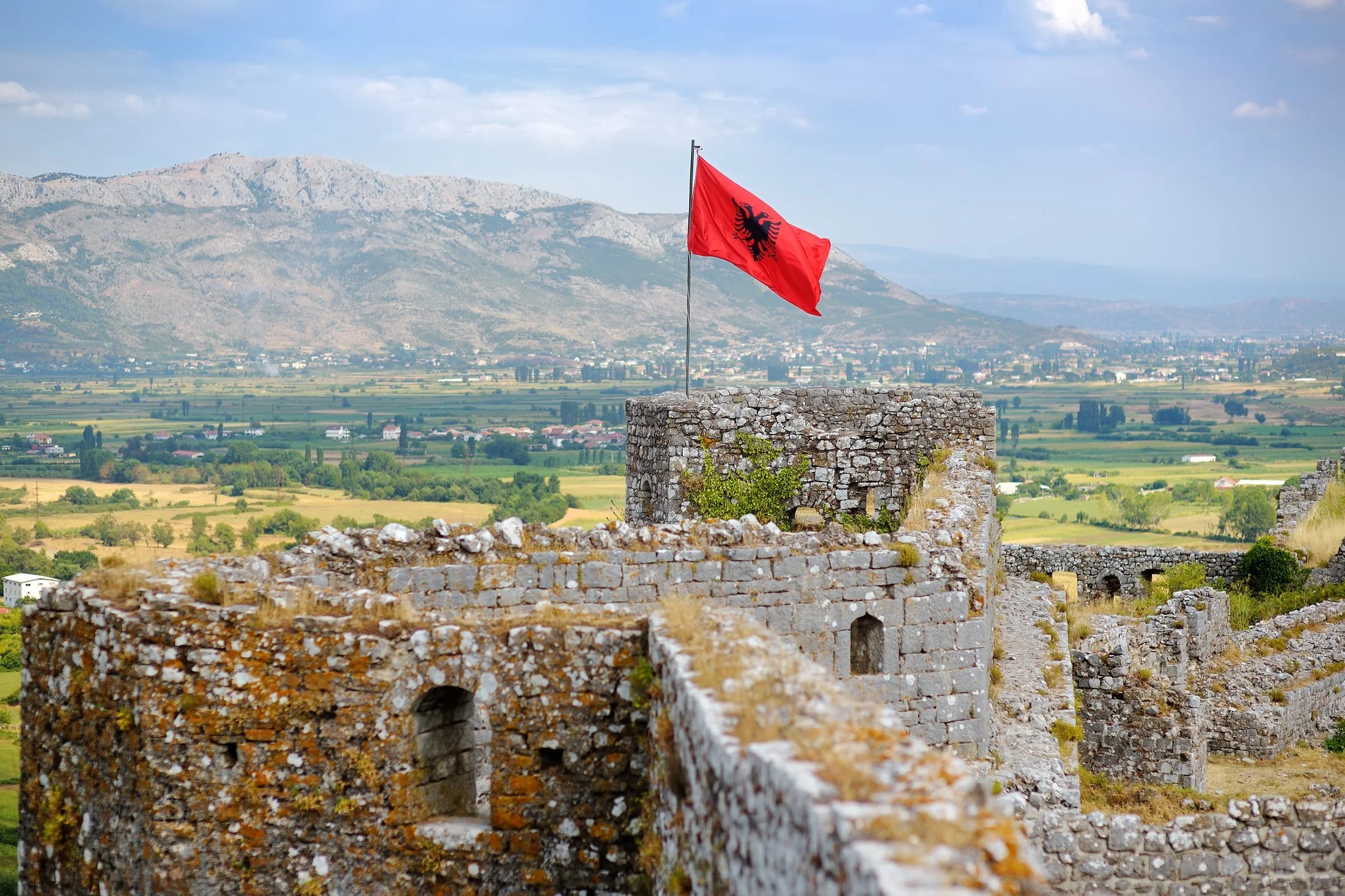
Albania Country Profile:
Cheap, Loosely Taxed and Heading for the EU, With a Freelancer Regime Worth Knowing
Albania is a low-cost Adriatic base with a 0% band for small business income through 2029, a one-year visa-free stay for Americans and a serious EU accession timetable. It is a place to live and run a modest operation from, not a place to hold wealth.
🇦🇱 Key Facts (2026):
Currency: Albanian lek (ALL); roughly 85 to USD and 98 to EUR, after several years of appreciation driven by tourism receipts and remittances
Personal income tax, employment: 0% on monthly salary to ALL 50,000; 13% on the band to ALL 200,000; 23% above ALL 200,000 monthly (Law 29/2023, in force 1 January 2024)
Personal income tax, self-employed and business income: 0% on annual income to ALL 14 million (through 31 December 2029); 23% above
Dividends: 8% flat. Interest, royalties, rent: 15% withholding
Corporate tax: 15%; 0% for entities with annual turnover to ALL 14 million through 2029; a 5% rate for certain sectors including software development and agricultural cooperatives
VAT: 20%; 6% on accommodation and some tourism services; registration threshold ALL 10 million turnover
Capital gains: 15% for individuals on securities and real estate
Wealth tax: none
Inheritance and gift tax: 15% as income, with exemptions for transfers between spouses and in the direct line
Annual property tax: 0.05% of value on residential buildings, 0.2% on commercial
Social contributions: employee 11.2% (9.5% social plus 1.7% health); employer 16.7%
Tax residency trigger: permanent home in Albania, or 183 days' presence in any twelve-month period ending in the tax year, or centre of vital interests
Headline visa thresholds: US citizens visa-free for one year; most EU, UK, Australian and Canadian passports 90 days in 180; Unique Permit for digital nomads, pensioners, employees, self-employed and investors; permanent residence after five years; citizenship after seven
Corporate setup: SHPK, minimum capital ALL 100 (nominal); USD 500–1,500 with a lawyer, registered in one to two days. Annual maintenance: USD 1,500–4,000
Personal bank account minimum: nil to ALL 10,000 (~USD 120)
Private banking threshold: none domestically; clients use Swiss, Luxembourg or Austrian banks
Cost of living, comfortable professional household: EUR 3,000–4,500 monthly in Tirana (~USD 3,300–5,000)
CRS: participating; committed to first exchanges from 2021
FATCA: no intergovernmental agreement in force; Albanian banks report directly to the IRS as participating foreign financial institutions
Treaties: roughly 45 double tax treaties, almost all European; none with the United States, Canada, Australia or Panama
FATF: removed from the grey list in October 2023 after three and a half years on it
EU accession: candidate since 2014, negotiations opened July 2022, government target of closing negotiations by 2027 and membership around 2030
Population: ~2.4 million (2023 census), falling
Time zone: CET, UTC+1 (UTC+2 in summer)
Last edited: 8 August 2026 by Joe Martin Hanson (Director & Global Partner) with advice from FTR’s Albanian Tax Partners
Why Albania Matters
Albania is the cheapest place on the Adriatic to live a European life, and the only one in the FTR set that lets a US citizen stay a full year without a visa. Tirana has become a genuinely functional capital in a decade: card payments, e-government, a young English-speaking professional class and property still priced at a fraction of Croatia, Montenegro or Greece. For a professional earning abroad in euros or dollars, the arithmetic is straightforward.
The tax system has a feature that matters for FTR's core segment. Since the 2024 income tax reform, self-employed and business income up to ALL 14 million a year, roughly EUR 140,000, is taxed at 0% through the end of 2029, and salary income has a 0% band and a 13% band before the 23% top rate bites above ALL 200,000 a month. A freelancer or small online business owner who becomes Albanian tax resident can legitimately pay very little on a mid-six-figure income, provided the activity is registered and the regime's conditions are met. Dividends are taxed at 8%. None of this is a loophole; it is deliberate policy to formalise a cash economy.
The third reason is the trajectory. Albania opened EU accession negotiations in 2022, has opened negotiating clusters at a pace Brussels has praised, and left the FATF grey list in October 2023. A client who establishes residence now is buying into a country whose banking access, legal predictability and property values are converging on EU norms, at pre-convergence prices. The lek's appreciation since 2022 is the market pricing the same thing.
What Albania is not is a wealth-holding jurisdiction. It has no private banking, a shallow capital market, a legal system still reforming, and a CRS obligation like everyone else's.
Visa and Residency Routes
Entry is generous. US citizens may stay up to one year without a visa; EU, UK, Australian, Canadian and New Zealand passports get 90 days in any 180. Albania is not in Schengen, so time here does not count against the Schengen clock, which is why so many nomads use it as a reset base.
Residence is granted as a Unique Permit (leje unike) under the 2021 Law on Foreigners, combining residence and work authorisation, applied for through the e-Albania portal and the local migration office with in-person appearance for biometrics. The relevant categories:
Digital nomad permit. Introduced in 2022 for remote workers employed by or contracting with foreign businesses. One year, renewable, with a documented foreign employment or client relationship, health insurance and proof of accommodation. There is no fixed published income floor comparable to Spain's or Portugal's; in practice a demonstrable income around EUR 1,000–1,500 a month is accepted, and higher is safer. This is the route FTR would use for a nomad or online business owner who wants tax residency without local employment.
Pensioner permit. For retirees with a foreign pension or passive income sufficient to live on; no statutory minimum is published, and applications are assessed on the evidence. Renewable annually, leading to permanent residence.
Self-employed and investor permits. Registering an SHPK and appointing yourself administrator supports a permit for the owner-manager; there is no golden visa and no fixed investment threshold. Strategic investor status exists under a separate law for large projects and is irrelevant to FTR's clients. Buying property does not of itself confer residence but is accepted as evidence of ties and accommodation.
Employment and family reunification work as elsewhere in Europe.
Permanent residence is available after five years of continuous lawful residence. Citizenship requires seven years of residence, a language test and a clean record; dual citizenship is permitted. A citizenship-by-investment scheme was floated in 2019–2020 and abandoned under EU pressure; anyone offering one is selling something that does not exist.
Physical presence expectations are light in practice, but a client who wants Albanian tax residency to displace another country's needs to be here for real: 183 days, a lease or a purchased home, and the paper trail to prove it.
Tax Peculiarities and Traps
The 2024 reform and the freelancer question. Law 29/2023 replaced the flat-rate era with the bands above. For individuals earning business income, the 0% band to ALL 14 million is the headline, but the reform also tried to bring professional service providers (lawyers, consultants, IT contractors) into a 15% charge on net profit from 2024, and that provision was challenged in the Constitutional Court. The practical position for a foreign freelancer is that the outcome depends on how the activity is classified and registered, and it should be confirmed with an Albanian accountant before relying on a 0% outcome.
Worldwide taxation on residence. Albanian tax residents are taxed on worldwide income with a credit for foreign tax. A digital nomad who trips residency here but remains resident in a home country with no Albanian treaty (the US, Canada, Australia) has two claims on the same income and no tie-breaker.
Dividends at 8%, but only as dividends. Distributions from a foreign company to an Albanian resident are taxed at 8%; salary from the same company runs through the 0/13/23 bands and attracts social contributions if paid by an Albanian employer. Getting the character of the income right is the whole game.
Property. Capital gains on real estate are taxed at 15% of the gain; transfer tax and notarial costs run 2%–3%. Foreigners buy apartments and buildings freely but cannot own agricultural land directly, a real constraint on the coastal and rural purchases now fashionable. Title on the coast is unreliable: overlapping communist-era, restitution and informal claims make a thorough title search and registered lawyer essential, and buying off-plan from a developer without one is how foreigners lose money here.
Cash and informality. A large share of the economy is still cash, in lek and euro. Paying rent or a contractor in cash is normal; claiming that cash as a deduction is not. The tax administration's audits of foreigners are rising with the tourism boom.
The Structural Layer
For an Albanian tax resident, FTR's default of a Panamanian Private Interest Foundation owning a Panamanian SA, with a modest director's salary paid in Albania, works cleanly. Albania has no controlled foreign company rules applying to individuals, so undistributed profits of the SA are not attributed. Distributions are taxed at 8% as dividends when received. The director's salary is taxed under the salary bands, and a salary set inside the 0% and 13% bands covers living costs at a trivial rate. Albania has no treaty with Panama, so nothing turns on treaty relief.
The adaptation is at the local level. A client who actually works from Albania with Albanian clients or staff needs an SHPK for the local activity, both because a permit category may require it and because permanent establishment risk for the SA is real if management is exercised here. A small SHPK under the ALL 14 million turnover threshold pays 0% corporate tax through 2029, so the local vehicle is cheap to run.
Succession is the part that needs adapting: Albanian forced-heirship rules apply to Albanian-situs assets and, arguably, to Albanian-domiciled individuals' estates. The foundation keeps offshore assets outside that, but an Albanian apartment will pass under Albanian law, and a will in Albanian form is worth the modest cost.
Where the default does not fit: a client who wants Albanian assets to be the core of the plan. There is nothing to build with locally; Albania is where the person lives, not where the wealth sits.
Info-Sharing Reality (CRS and FATCA)
Albania participates in the Common Reporting Standard and committed to first exchanges from 2021. Albanian banks collect tax residency self-certifications and report non-resident account holders to the General Directorate of Taxes, which exchanges with partner jurisdictions including Germany, Italy, Greece, Switzerland and the UK. The exchange network is smaller and younger than a Western European country's, but the direction is clear and it widens each year as accession proceeds.
There is no FATCA intergovernmental agreement. Albanian banks registered directly with the IRS as participating foreign financial institutions and report US persons' accounts, and the practical result is that some banks decline US clients altogether rather than carry the compliance.
Albania is not marketed as private and should not be treated as if it were. What it offers is low tax, not secrecy. For a Chinese HNW family looking at Albania as a European foothold, the same rule applies as everywhere else in the set: an Albanian account will be reported to China once the bilateral relationship activates, and the plan should assume it already has.
Banking Reality
The market is dominated by BKT (Banka Kombëtare Tregtare), Raiffeisen Bank Albania, Credins Bank, OTP Bank Albania and Intesa Sanpaolo Bank Albania, with Union Bank, Tirana Bank, ProCredit and ABI Bank behind them. Opening a personal account requires a passport, an Albanian tax identification number and usually either a residence permit or a lease; a tourist walking in with a passport alone will be turned away at most branches. Onboarding takes from a day to two weeks once the documents are in order and is always in person. Minimum balances are nominal, and lek and euro accounts are standard.
US persons face the friction described above. Russian and Belarusian nationals are refused or heavily screened. There is no domestic private banking worth the name; a client with a seven-figure portfolio banks it in Switzerland, Luxembourg or Austria and keeps a transactional account here.
Albania left the FATF grey list in October 2023 and is on no EU high-risk list. Correspondent relationships through the Italian, Austrian and Turkish parent groups are stable, SWIFT access is normal, and euro transfers to and from the EU clear routinely. Large inbound transfers attract source-of-funds questions, as they should.
Cost of Doing Business
An Albanian SHPK is registered through the National Business Centre in one to two days with nominal capital; with a lawyer the setup runs USD 500–1,500, and annual accounting, filings and a registered address run USD 1,500–4,000 depending on VAT registration and payroll. Corporate tax is 0% under the ALL 14 million turnover threshold and 15% above.
Against the set: a Panamanian SA runs about USD 1,500–2,500 to establish and USD 1,000–1,800 a year; Singapore roughly three times the Panamanian setup at USD 4,500–7,500 with USD 4,000–8,000 annual compliance. Albania is cheaper than both on headline cost and comparable to Georgia or Serbia; the true cost is the professional quality gap, since English-speaking accountants who understand cross-border clients are few and worth paying properly.
Cost of Living
Monthly, for Tirana; Durrës and Vlora run 20%–30% below outside the summer season, and coastal rents double in July and August.
Lean, single or couple: EUR 1,200–1,800 (USD 1,300–2,000): one-bedroom EUR 450–700 in a central district, groceries EUR 300–400, private outpatient insurance EUR 40–80, transport by bus, taxi and on foot.
Comfortable, family of four: EUR 3,000–4,500 (USD 3,300–5,000): three-bedroom EUR 1,000–1,600 in Blloku or the Lake Park area, one car with insurance and fuel EUR 350–500, private health cover EUR 150–300, one international school place at EUR 8,000–15,000 a year, help and activities.
HNW: EUR 7,000–10,000 and up (USD 7,700–11,000): a villa or a premium new-build apartment, two international school places, driver and household staff, and regular flights to Rome, Vienna or Istanbul for medical and professional needs.
Cultural and Practical Considerations
Albania is easy to like and easy to underestimate. It is safe, friendly to foreigners in a way its neighbours are not, and improvising in a way that people who need systems find exhausting.
Language. Albanian is not related to any language a Western client will know. Younger Tiranans speak good English, older ones Italian, and the coast manages in both; banks and the tax office work in Albanian, and the e-Albania portal is partly translated. A client will need a bilingual accountant and, for anything legal, a lawyer who drafts in Albanian and explains in English. Daily life without Albanian is workable in Tirana and thin elsewhere.
Women. No legal constraint of any kind on women travelling, residing, owning property or running a business alone; Tirana's professional class is heavily female. Social attitudes are patriarchal outside the capital, especially in the north, where customary norms linger. Harassment is uncommon; assumptions about who makes decisions are not. Family law is civil and secular, with equal division of marital property acquired during marriage.
Religion and diet. Nominally Muslim-majority and deeply secular; alcohol, pork and mixed company are unremarkable everywhere, and religious observance is a private matter. Nobody will ask.
LGBT residents. Homosexuality has been legal since 1995 and anti-discrimination law has covered sexual orientation and gender identity since 2010, but there is no marriage or civil union for same-sex couples and social conservatism is real; a same-sex partner has no legal status for immigration or succession, and a couple should plan on that basis rather than on Tirana's tolerant surface.
Pace, noise and bureaucracy. Tirana is loud, under construction and driven badly. Things get done through people rather than processes, and appointments are approximate. The e-government portal has genuinely removed much of the queueing, but any interaction that cannot be done online is slow and in person. Someone who needs order and quiet will not find it in the capital; the southern coast out of season is another matter.
Security and politics. Violent crime against foreigners is rare. Organised crime is a national issue that surfaces in construction, cannabis and money laundering rather than on the street, and the country's reputation lags its lived reality. Politics is polarised and personal, with the Socialist government in power since 2013 and opposition protests a periodic feature; a resident feels this as noise, not risk. Corruption in permitting and courts is a practical rather than a personal problem for most foreigners, but anyone buying property or litigating will meet it.
Climate and health. Mediterranean summers are hot, Tirana's air quality is poor in winter, and the 2019 earthquake was a reminder that the building stock is uneven. Public healthcare is weak; private hospitals in Tirana handle routine and moderate needs, and anything serious goes to Italy, Austria or Turkey. A client with a significant chronic condition needs evacuation cover and a plan.
Schooling. Two or three international schools in Tirana serve the diplomatic and business community adequately at EUR 8,000–15,000 a year; there is no international schooling outside the capital, and local state schools are not a realistic option for a non-Albanian-speaking child.
For Retirees
The pensioner permit above, a rental or purchase in Tirana, Vlora or Sarandë, and a realistic view of healthcare; Albania suits an active retiree with a European base within reach for medical care, not a frail one.
For Digital Nomads and Remote Professionals
The one-year US visa-free stay and the nomad permit make Albania a Schengen reset that can become a tax residency; the choice is whether to remain a visitor or to trip residency deliberately and use the bands.
For Online Business Owners and Entrepreneurs
The strongest fit in the set for a modest operation: the 0% small-business band or the 8% dividend rate on a Panamanian structure, an SHPK for local substance, and costs a fraction of anywhere in the EU.
For Multinational Business Owners
A regional or nearshore operation, not a headquarters; the 5% software rate and cheap technical labour are the draw.
For High Net Worth (HNW) Families and Investors
A European property and a residence permit at low cost, with accession as the upside; not a banking or wealth-holding base, and for Chinese families no more private than anywhere else.
Common Traps
Coming for privacy: Albania reports under CRS and its banks report US persons directly. Coming for banking or capital markets: there are none of consequence. Coming with a chronic health condition and no evacuation plan. Buying coastal land or an off-plan apartment without a registered lawyer and a title search. Assuming the 0% freelancer band applies to professional services without confirming how the activity is classified. Someone who needs quiet, order and punctuality, who will find Tirana a daily irritation. And anyone whose home country has no treaty with Albania and who half-moves, keeping ties at home while tripping residency here, ending up taxed in both.
Next Steps
If Albania is on your list as a low-cost European base, book a scoping call. The tax outcome depends on how income is characterised and registered before you arrive, and that is cheap to get right and expensive to fix.
Important note: General information. Not personal tax, legal, or financial advice. Speak to a qualified adviser at FTR or elsewhere before acting.
Continue reading
Suggested next, chosen by our partners.


