
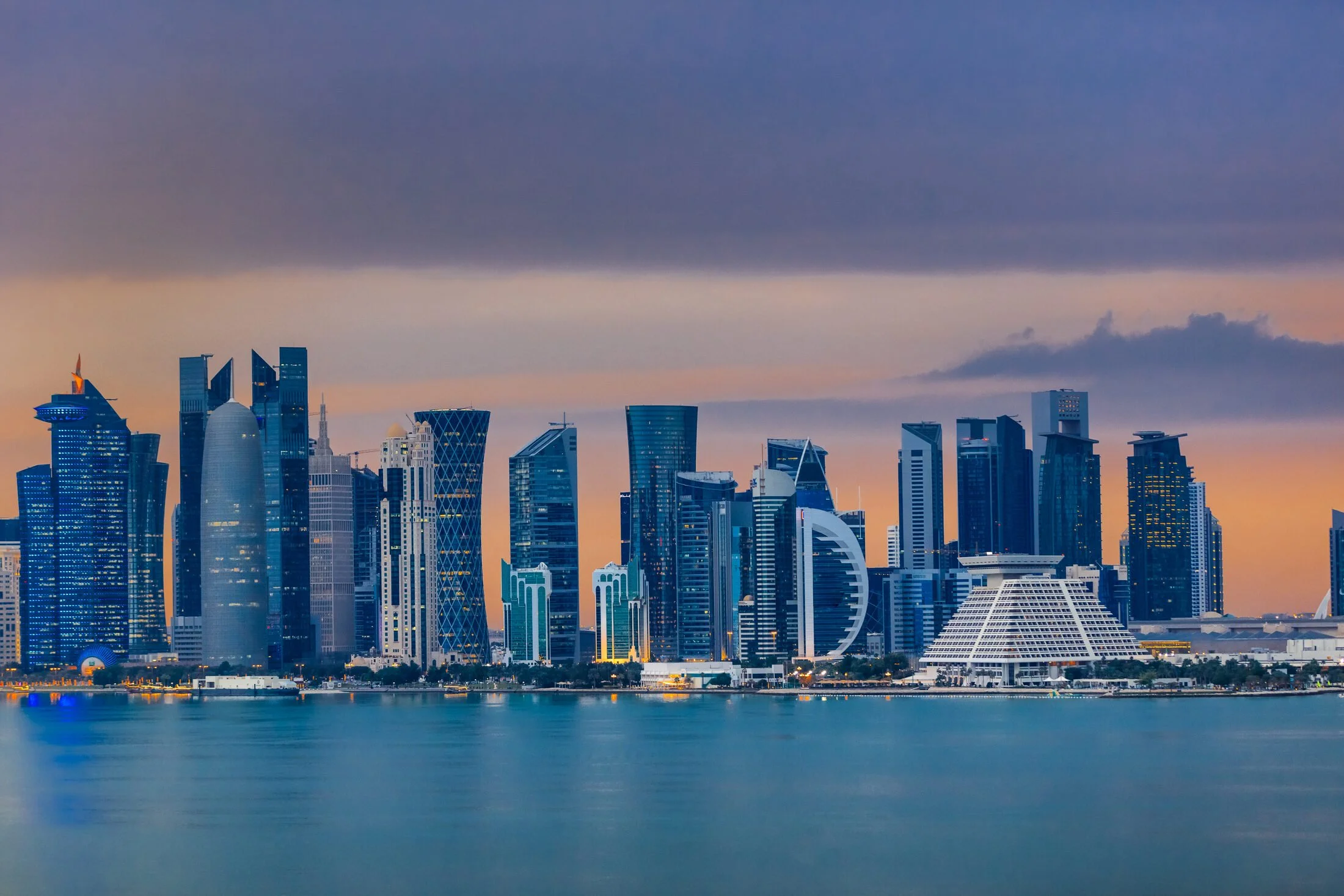
Qatar Country Profile:
Zero Personal Tax, Sponsored Residency and a Common-Law Financial Centre Inside a Conservative State
Qatar is a zero-personal-tax destination for salaried professionals, a source of family wealth that already structures through Doha, and home to the QFC, a common-law jurisdiction that can hold a family office. Residency is granted by an employer or a property, never by a tax return.
🇶🇦 Key Facts (2026):
Currency: Qatari Riyal (QAR); pegged at 3.64 to USD
Personal income tax: 0% on employment income; an individual carrying on a business in Qatar is taxed on the profits like a company
Corporate tax: 10% on the share of profits attributable to non-Qatari, non-GCC ownership; 0% on the Qatari and GCC-owned share; petroleum operations at a minimum of 35%
Domestic Minimum Top-Up Tax: 15% effective rate for multinational groups with consolidated revenue of EUR 750 million or more, fiscal years from 1 January 2025; registration deadline 2 November 2026
Withholding tax: 5% on royalties, technical fees, interest, commissions and service fees paid to non-residents without a Qatari permanent establishment
VAT: none; the 2016 GCC framework provides for 5% but Qatar has not implemented it. Excise since 2019: 100% on tobacco and energy drinks, 50% on sugary drinks
Capital gains: 0% for individuals on personal assets; gains on Qatari business assets and unlisted Qatari shares are business income for foreign owners; QSE-listed shares exempt
Wealth tax: none
Estate/inheritance tax: none; Sharia succession applies to Muslims, and non-Muslims may ask the court to apply the law of their nationality
Tax residency trigger: a permanent home in Qatar, or 183 days in any twelve months, or centre of vital interests, under Law No. 11 of 2022
Property residency: QAR 730,000 (~USD 200,000) in a designated area for a residence permit; QAR 3.65 million (~USD 1 million) for permanent-residency privileges
Permanent residency: Law No. 10 of 2018; 100 grants a year; 20 years' lawful residence (10 if born in Qatar)
Corporate setup: QFC entity USD 5,000–15,000 first year; mainland LLC USD 8,000–20,000. Annual maintenance: USD 5,000–15,000
Personal bank account minimum: none formally with a Qatar ID; fee waivers at ~QAR 5,000–10,000 average balance
Private banking threshold: premium tiers from ~QAR 1 million (~USD 275,000); private banking proper from ~USD 1 million
Cost of living, comfortable professional household: QAR 25,000–35,000 monthly (~USD 6,900–9,600)
CRS: participating; first exchanges 2018
FATCA: Model 1 IGA, signed January 2015
Treaties: roughly 85 double tax agreements, including the UK, Switzerland, Singapore, Hong Kong and Panama
Population: ~3 million, roughly 88% foreign nationals
Time zone: UTC+3, no daylight saving
Last edited: 11 June 2026 by Joe Martin Hanson (Director & Global Partner) with advice from FTR’s Qatari Tax Partners
Why Qatar Matters
Qatar has one of the world's highest per-capita GDPs and a small citizen population holding concentrated wealth, managed at state level through the Qatar Investment Authority and privately through family offices. That produces substantial demand for international wealth structuring, in a place where the domestic tools, the Qatar Financial Centre above all, are better than most readers assume.
It is also a destination. Foreign professionals in energy, finance, health, education, technology and the sports and hospitality economy built for the 2022 World Cup earn tax-free salaries that are often the highest of their careers. The FTR client is the one who has done that and must now decide where the capital lives, because Qatar will not give them a permanent home unless they buy one.
Against the UAE, Qatar offers the same zero personal tax in a smaller, quieter, more conservative setting with a less diversified economy and a smaller foreign community; the UAE is more accessible for HNW residency. Against Saudi Arabia, Qatar remains more welcoming to a foreign presence, though Vision 2030 is closing that gap.
Visa and Residency Routes
Every route produces a Residence Permit and a Qatar ID card (QID), the document every bank, landlord and ministry asks for first.
Employer-sponsored residence is how the overwhelming majority of foreigners live here: the employer applies, the permit issues within four to eight weeks of arrival, renewable in one- to three-year terms. Since 2020 employees can change employer without a no-objection certificate and exit permits have gone for most workers, but the permit ends when the job does and leads nowhere permanent.
Property-based residence under Cabinet Resolution No. 28 of 2020 is the route FTR would use for a self-funded client. Freehold worth at least QAR 730,000 in a designated area, principally The Pearl, Lusail, West Bay Lagoon and Al Khor, gives the owner and immediate family a residence permit for as long as the property is held, with no employer. At QAR 3.65 million the owner gains the privileges attached to permanent residency, meaning public health and education and the right to run a business without a Qatari partner, though not the card itself. Buy completed and titled; off-plan units confer nothing until handover.
Investor residence attaches to owning a Qatari company. Law No. 1 of 2019 allows 100% foreign ownership of most mainland companies with ministry approval, and a QFC or Qatar Free Zones Authority licence gives it as of right; the company then sponsors its owner. It suits a genuine operating presence and is an expensive residency device otherwise.
Permanent residency under Law No. 10 of 2018 is capped at 100 grants a year and needs 20 years' continuous residence (10 if born in Qatar), Arabic, a clean record and sufficient income; it confers property and business rights, not citizenship. Citizenship under Law No. 38 of 2005 is discretionary, takes 25 years as a floor, is granted to a handful a year, and dual nationality is not permitted. Neither belongs in a plan.
Tax Peculiarities and Traps
Residency is now defined, and it is not what people assume. Law No. 11 of 2022 gave Qatar a statutory residence test: permanent home, 183 days in any twelve months, or centre of vital interests. With no personal tax this looks academic, but it decides whether the General Tax Authority issues a tax residency certificate, and that certificate is what the home country, the CRS self-certification and any treaty claim turn on. A client with 150 days in Doha and 120 in London has no Qatari certificate and a serious UK problem.
The 10% follows ownership, not location. A mainland company with a Qatari partner at 51% pays 10% on the foreign 49% of profit; a 100% foreign-owned company pays 10% on all of it; a foreign sole trader is taxed the same way. Salaried employees pay nothing.
The top-up tax. The Council of Ministers amended the Executive Regulations on 12 February 2026 to introduce an Income Inclusion Rule and a Domestic Minimum Top-Up Tax, and the General Tax Authority's decisions of May 2026, published in August, apply them to fiscal years from 1 January 2025. Groups at or above EUR 750 million register by 2 November 2026 and pay up to a 15% effective rate on Qatari profits, including profits previously sheltered by Qatari ownership or a QFC or free-zone concession. Owner-managed businesses are outside it; a Gulf family group crossing the threshold is not.
Withholding and contract reporting. Royalties, technical fees, interest, commissions and service fees paid to a non-resident without a Qatari permanent establishment carry 5% withholding under Law No. 24 of 2018, and Qatari payers notify contracts with non-residents through the Dhareeba portal. An offshore company invoicing Qatar loses 5% at source unless treaty relief applies, and the invoice is visible.
Sharia succession on Qatari assets. A Muslim resident's Qatari assets pass in Sharia shares through the courts; a non-Muslim's heirs may petition for the law of nationality, but accounts freeze on death and Qatar has no equivalent of the DIFC's non-Muslim wills registry. A registered will and capital held outside Qatar are the practical answers.
Gratuity. The end-of-service gratuity of three weeks' basic pay per year is tax-free in Qatar and often taxable at home if the client has not properly left.
The Structural Layer
For a foreign professional resident in Qatar, FTR's default of a Panamanian Private Interest Foundation owning a Panamanian SA meets nothing on the Qatari side: no personal income tax, no controlled foreign company rules, no exit tax, no tax on foreign-source personal income. The SA holds the portfolio and any non-Qatari business; the foundation holds the SA and does the succession work Sharia would otherwise do differently; the employer or the apartment provides the permit.
Two adaptations. The modest director's salary is pointless, since it would be taxed at 0% and the SA cannot sponsor a permit; the structure carries capital, not residency. And nothing Qatari should sit inside it: a Panamanian SA owning a Qatari mainland company makes it 100% foreign-owned and 10% taxable on everything, and a Panamanian invoice into Qatar meets the 5% withholding.
For Qatari and Gulf families the honest comparison is the Qatar Financial Centre, established by Law No. 7 of 2005 as a separate legal jurisdiction with English-language common-law courts, its own regulator, 100% foreign ownership, 10% tax on locally sourced profits and none on foreign-source income, trust regulations, a foundations regime since 2020 and a single family office licence. A Gulf family with USD 50 million and a Doha base is usually better served by a QFC, DIFC or ADGM foundation; Panama enters as the holding node for Latin American assets or as a non-Gulf second jurisdiction. The Qatar Free Zones Authority at Ras Bufontas and Umm Alhoul and the Qatar Science and Technology Park offer 100% ownership and long tax holidays for operating businesses with a real footprint.
The home country decides the rest: a professional who has not severed British, Canadian or Australian residency is taxed there on the Panamanian income whatever Qatar thinks.
Info-Sharing Reality (CRS and FATCA)
Qatar has exchanged under the CRS since 2018. Banks collect self-certifications and report non-resident-for-tax account holders to the General Tax Authority, which forwards to the declared tax residence: the UK, India, Pakistan, Egypt, the Philippines, Canada, Australia, the EU states and China all receive Qatari data. Under the Model 1 FATCA agreement of January 2015, US persons' accounts go to the IRS.
Inbound is the direction that matters. A client genuinely tax resident in Qatar, with a QID and a General Tax Authority certificate, is reported by banks in Switzerland, Singapore or Panama to Qatar, which levies nothing; that is the legitimate outcome of a legitimate residency. A client living mostly elsewhere who self-certifies Qatari residence on the strength of a QID is making a false declaration, and home authorities increasingly cross-check day counts and the missing certificate. Chinese HNW families using Doha alongside Dubai are reported to the State Taxation Administration like everyone else. Qatar is not a secrecy jurisdiction and has never marketed itself as one.
Banking Reality
Qatar National Bank, the largest bank in the Middle East and Africa, Commercial Bank of Qatar, Doha Bank, Qatar Islamic Bank, Masraf Al Rayan, Dukhan Bank and Ahli Bank dominate; HSBC and Standard Chartered serve expatriates and corporates. A personal account needs a QID and usually a salary letter, opens in person within days, and non-residents essentially cannot open one. When the permit is cancelled the account is expected to close, so balances should leave before the final exit. Salaries run through the mandatory Wage Protection System, and a bank can block a departing employee's exit until loans are settled.
Private banking exists at QNB First, QNB Private, Commercial Bank Sadara and the international names, from roughly QAR 1 million for premium service and USD 1 million for a discretionary mandate. Qatar is on no FATF list, its 2023 MENAFATF evaluation was broadly favourable, and correspondent and SWIFT access held through the 2017–2021 blockade. Iran-linked counterparties attract enhanced due diligence.
Cost of Doing Business
A QFC holding, advisory or single family office entity costs roughly USD 5,000–15,000 in the first year and the same annually plus audit. A mainland LLC costs USD 8,000–20,000 to establish once commercial registration, trade licence, office lease and government relations are counted, and USD 5,000–15,000 a year including audited accounts and Dhareeba filings.
Against the set: a Panamanian SA costs roughly USD 1,500–2,500 to establish and USD 1,000–1,800 a year; Singapore runs about three times the Panamanian setup, USD 4,500–7,500, with USD 4,000–8,000 annual compliance; a UAE free-zone company sits at USD 5,000–12,000 and USD 4,000–10,000 a year. Qatar is the expensive end of the region for a pure holding vehicle and competitive only where the client needs a Qatari presence. Otherwise hold offshore and bank in Qatar.
Cost of Living
Monthly, for Doha.
Lean, single or couple: QAR 12,000–16,000 (~USD 3,300–4,400): mid-range one-bedroom QAR 5,500–8,000, groceries QAR 2,000–3,000, a used car and cheap petrol, employer health cover.
Comfortable, family of four: QAR 25,000–35,000 (~USD 6,900–9,600): three-bedroom compound villa or Pearl apartment QAR 13,000–18,000, two international school places at QAR 45,000–80,000 each a year, two cars, domestic help QAR 2,500–4,000.
HNW: QAR 60,000 and up (~USD 16,500+): West Bay Lagoon or Lusail waterfront villa, top-tier schooling, staff, club memberships, travel.
Petrol, power and water are cheap; imported food, alcohol through the Qatar Distribution Company permit and international schooling are not. No property tax and no tax on individuals' rental income.
Cultural and Practical Considerations
Qatar is orderly, safe, clean and slow. Crime against residents is negligible, the roads are the main hazard, government portals such as Metrash work and permits arrive when promised. The cost is a society in which foreigners are guests on a permit that can be withdrawn.
Women. Expatriate women drive, work, rent, bank, own property and travel alone without legal constraint, and Doha is among the safer cities in the world for a woman at night. The guardianship rules that draw international criticism apply to Qatari women, who need male permission to marry and, when young and unmarried, to travel or take certain jobs. Dress expectation is covered shoulders and knees. A Western woman doing business alone is taken seriously in finance and professional services, less consistently in family trading businesses.
Family law. Law No. 22 of 2006 applies Sharia to Muslims and gives Qatari courts jurisdiction over residents' divorce and custody. A non-Muslim couple can ask for their national law, but a foreign mother in a custody dispute with a Qatari or Muslim father is in a difficult position, and a child of a Qatari father is Qatari and cannot leave without his consent. This is the largest legal exposure for a foreign woman in Qatar and belongs in the conversation before a mixed marriage.
LGBT residents. Same-sex sexual activity is a criminal offence for everyone, with penalties up to seven years, and a Sharia offence for Muslims. Enforcement against discreet expatriates is rare and no visiting fans were arrested during the World Cup, but there is no protection, a same-sex spouse cannot be sponsored, and detentions of Qataris are documented. Discretion is not a long-term plan.
Language and integration. English runs business, banking and most ministry counters; Arabic controls contracts and courts. Social contact with Qataris is limited and mostly professional; the expatriate community, organised by nationality and employer, substitutes completely, which suits people comfortable with expatriate life and wears on those who wanted to belong somewhere.
Religion, conduct and climate. Alcohol is confined to licensed hotels and the QDC permit; public drunkenness, drugs and public affection are prosecuted; Ramadan restricts daytime eating in public; criticism of the ruling family and religion is criminal. From May to September temperatures exceed 45°C with coastal humidity and outdoor life stops; anyone heat-sensitive should visit in August before committing.
Schooling. Doha College, Doha British School, ACS Doha, the American School of Doha and the Qatar Foundation schools are strong; places at the best are scarce and often set a family's timing.
Politics and security. A stable absolute monarchy in an unquiet region: the 2017–2021 blockade cut land and air links overnight, Iranian missiles were fired at Al Udeid air base in June 2025, and an Israeli strike on Doha in September 2025 was the first attack on a Gulf capital. Residents felt each more in the news than in daily life, but a Plan-B client must price the neighbourhood.
For Digital Nomads and Remote Professionals
No route: no nomad visa, no work on a tourist entry, and a permit needs a sponsor or a property.
For Online Business Owners and Entrepreneurs
Hold the business offshore, bank personally in Qatar, and never let a Qatari company become the operating entity without a Qatari market to serve.
For Multinational Business Owners
Qatar rewards a real operating presence through 100% ownership and QFC or free-zone licences, not a brass plate; groups near EUR 750 million now face the top-up.
For High Net Worth (HNW) Families and Investors
Gulf families: the QFC foundation and family office regime domestically, Panama as the non-Gulf leg. Families from elsewhere: a comfortable base and a poor Plan-B, with no permanent status short of 20 years, no citizenship and three security shocks in a decade. Chinese families should expect full reporting home.
For Retirees
Only via the property route, with private cover and a genuine liking for the climate; there is no retirement visa.
Common Traps
Coming for a visa without a job or a property. Treating employer sponsorship as a settled life. Counting on permanent residency, a 20-year wait for one of 100 annual grants, or on citizenship. Claiming Qatari tax residency at home on the strength of a QID while spending most of the year there. Buying off-plan for the permit. Running an online business through a mainland Qatari company at 10%. Anyone who needs alcohol in ordinary social life, an outdoor climate half the year, a same-sex partner recognised, or the sense of belonging. Any foreign woman entering a marriage under Qatari family law without understanding custody and exit rules first.
Next Steps
If Qatar-connected planning fits your situation, whether you are earning there and deciding where the capital should live, or a Gulf family weighing the QFC against a Panamanian structure, book a scoping call.
Important note: General information. Not personal tax, legal, or financial advice. Speak to a qualified adviser at FTR or elsewhere before acting.
Continue reading
Suggested next, chosen by our partners.


