
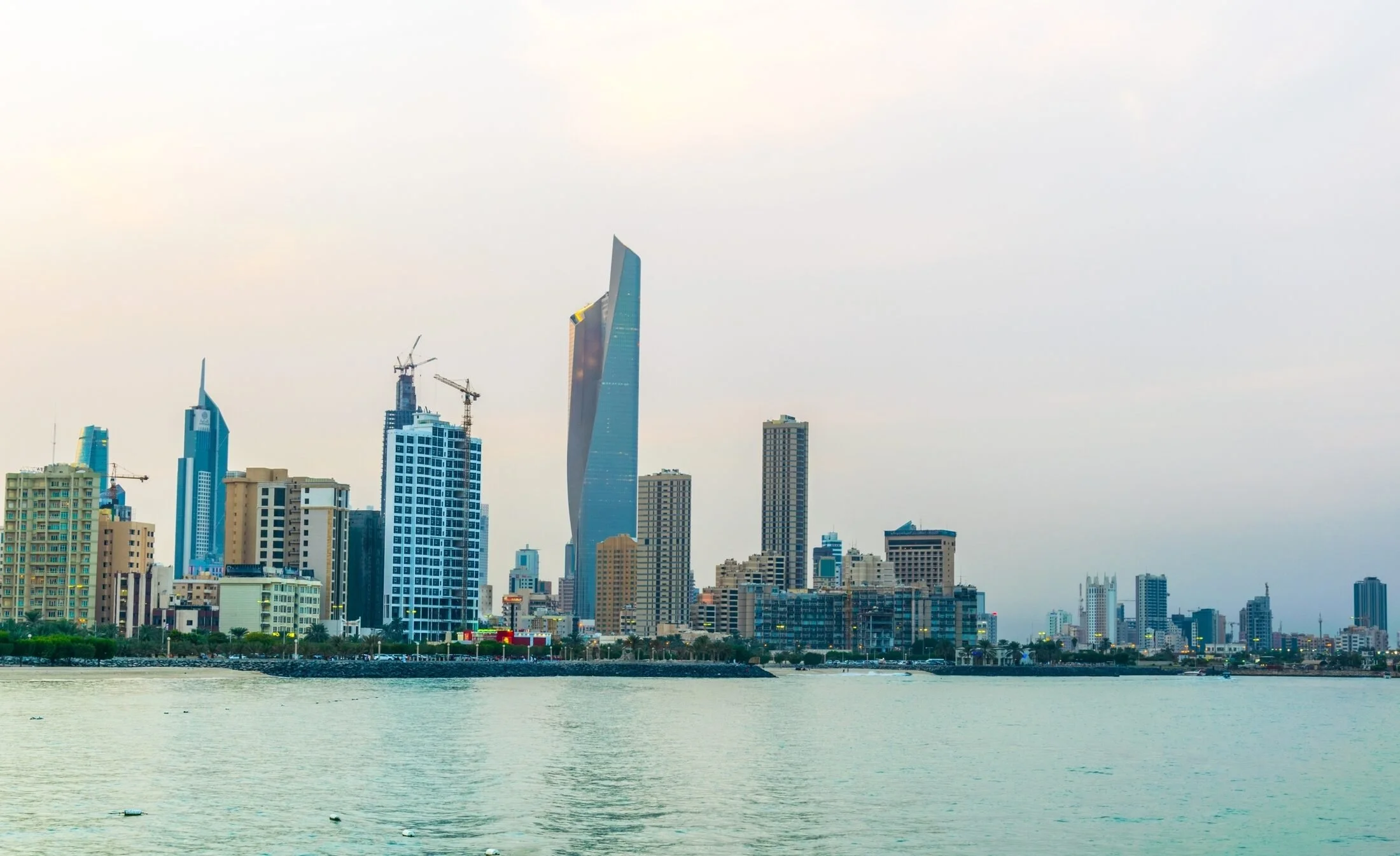
Kuwait Country Profile:
Gulf Wealth Source With Almost No Inbound Route
Kuwait is a source country. Its citizens hold substantial private wealth, cannot easily emigrate and invest heavily abroad; its foreign residents earn tax-free on a permit that ends with the job. Zero personal tax, a new 15% top-up for large groups, and no realistic path to permanent status for anyone not born Kuwaiti.
🇰🇼 Key Facts (2026):
Currency: Kuwaiti Dinar (KWD); pegged to an undisclosed basket, ~0.306 to USD (1 KWD ≈ USD 3.27), the world's highest-valued currency unit
Personal income tax: 0%
Corporate tax: 15% flat on foreign corporate bodies carrying on business in Kuwait, including the foreign shareholder's share of a Kuwaiti company; 0% on Kuwaiti and GCC corporate bodies
Domestic Minimum Top-Up Tax: 15% effective rate for multinational groups with consolidated revenue of EUR 750 million or more in two of the preceding four years, effective 1 January 2025 under the DMTT Law with Ministerial Resolution No. 55/2025; in-scope groups pay DMTT instead of ordinary corporate tax and Zakat
Zakat: 1% of net profit for Kuwaiti shareholding companies under Law No. 46 of 2006; National Labour Support Tax: 2.5% of net profit for Kuwait-listed companies; KFAS contribution: 1%
Tax retention: 5% of contract payments withheld by Kuwaiti payers until the foreign contractor produces a tax clearance certificate
VAT: none; the GCC framework 5% remains unimplemented and an excise tax is in preparation
Capital gains: 0% for individuals; gains of foreign corporate bodies on Kuwaiti business assets are taxable at 15%, with listed-share gains exempt
Wealth tax: none; Zakat performs a similar function on Kuwaiti companies
Estate/inheritance tax: none; Sharia succession applies
Tax residency trigger: none defined for individuals, since there is no personal income tax
Headline visa thresholds: employer-sponsored Article 18 residence; family residence (Article 22) above a salary floor of around KWD 800 a month; investor and property-owner long-term residence of up to 15 and 10 years respectively under the 2024 residence law, thresholds set by regulation
Corporate setup: KWD 3,000–8,000 (~USD 9,800–26,000) for a Kuwaiti-partnered WLL or a KDIPA 100% foreign-owned licence. Annual maintenance: KWD 2,000–6,000 (~USD 6,500–19,600)
Personal bank account minimum: none with a Civil ID and salary transfer; fee waivers from ~KWD 500 balance
Private banking threshold: NBK Private Banking and KFH Private from roughly KWD 250,000–500,000 (~USD 800,000–1.6 million)
Cost of living, comfortable professional household: KWD 2,500–3,500 monthly (~USD 8,200–11,400)
CRS: participating; first exchanges 2018
FATCA: Model 1 IGA, signed April 2015
Treaties: roughly 70 comprehensive double tax agreements; none with Panama
Population: ~4.7–5 million, roughly two-thirds foreign nationals
Time zone: UTC+3, no daylight saving
Last edited: 14 August 2026 by Joe Martin Hanson (Director & Global Partner) with advice from FTR’s Kuwaiti Tax Partners
Why Kuwait Matters
Kuwait matters to FTR as a source of wealth, not as a place to send anyone. Kuwaiti HNW concentration is substantial, built on oil, the Kuwait Investment Authority's long record and a citizen population of about 1.5 million that owns most of the domestic economy. Domestic investment options are limited, the local stock market is narrow, foreigners cannot own most real estate and the Kuwaiti retail sector is saturated, so persistent international diversification is the default behaviour of every wealthy family.
The outbound pattern is well established. London has been the traditional destination for Gulf wealth for half a century; the United States, the UAE for proximity, and Europe generally follow. Real estate in London, Paris and the major US cities, private equity and internationally managed portfolios are the typical holdings, and family office structures commonly sit in the UAE, Luxembourg or the Cayman Islands.
Kuwait also has a large foreign workforce, mainly from South Asia, Egypt and the Philippines, with a smaller Western professional cohort in oil, engineering, banking, health and education. They earn well and tax-free, cannot stay when the contract ends, and leave with capital that needs a home. FTR's job starts when that chapter closes.
Visa and Residency Routes
Employer-sponsored residence (Article 18) is the route for nearly every private-sector foreigner: the employer holds the work permit and the residence, processing takes four to eight weeks after entry, and the permit ends with the employment. Government employees hold Article 17 permits. Family residence (Article 22) lets a sponsored employee bring a spouse and children above a monthly salary floor of about KWD 800, tightened in 2024 with exceptions for certain professions. Self-sponsored residence (Article 24) exists for investors and for the rare foreigner permitted to own property.
Decree-Law No. 114 of 2024, Kuwait's new residence law, replaced the 1959 framework and introduced long-term residence of up to 15 years for investors and up to 10 years for property owners, with investment thresholds and eligible property left to executive regulations. In practice it is aimed at the small class of foreigners already invested in Kuwait, not at newcomers.
Property is closed to non-GCC foreigners outside narrow exceptions. Company ownership above 49% requires a licence from the Kuwait Direct Investment Promotion Authority under Law No. 116 of 2013, granted to businesses that bring capital, technology or jobs; a Kuwaiti partner at 51% is the default for everyone else. Citizenship is not realistically available, and in 2024–2025 the government revoked citizenship from tens of thousands of people, including naturalised spouses, which tells any client what a Kuwaiti passport is worth as a Plan-B.
FTR would not use any of these routes for an inbound client. Kuwait is a place people are posted to.
Tax Peculiarities and Traps
The 15% follows the foreign owner into the Kuwaiti company. Corporate income tax under Amiri Decree No. 3 of 1955 as amended by Law No. 2 of 2008 applies to foreign corporate bodies carrying on business in Kuwait, including through a share in a Kuwaiti company. A WLL with a 49% foreign corporate shareholder pays 15% on that 49% of profit; the Kuwaiti share is untaxed but bears Zakat and NLST where applicable. A foreign individual shareholder is in principle outside the corporate tax, which is why individual rather than corporate ownership of a Kuwaiti stake is often the cleaner position.
The 5% retention. Every Kuwaiti payer must retain 5% of payments to a contractor until it produces a Ministry of Finance tax clearance certificate. Not a final tax, but for an offshore company invoicing Kuwait it becomes one unless the company registers, files and obtains clearance.
The top-up tax. The DMTT Law released in December 2024 took effect on 1 January 2025, with Ministerial Resolution No. 55/2025 of 30 June 2025 aligning it to the OECD GloBE rules. Where a group with consolidated revenue of EUR 750 million or more in two of the preceding four years has a Kuwaiti effective rate below 15%, a top-up applies, and in-scope groups are then outside ordinary corporate tax, Zakat and NLST. A broader business profits tax on all companies, Kuwaiti-owned included, has been in draft for some time and remains a live possibility.
Zakat, NLST and KFAS. Kuwaiti shareholding companies pay 1% Zakat on net profit, listed companies a further 2.5% National Labour Support Tax, and shareholding companies a 1% contribution to the Kuwait Foundation for the Advancement of Sciences. These fall on the Kuwaiti-owned layer, not on foreign individuals.
Sharia succession and the frozen account. Death of a resident freezes Kuwaiti bank accounts pending a court succession order; Sharia shares apply to Muslims, and non-Muslims can seek their national law slowly. Keep investment capital outside Kuwait.
The Structural Layer
For the foreign professional resident in Kuwait, FTR's default of a Panamanian Private Interest Foundation owning a Panamanian SA meets no Kuwaiti resistance: no personal income tax, no controlled foreign company rules, no exit tax, no tax on foreign-source personal income. The salary component of the default is irrelevant, since it would be taxed at 0% and the SA cannot sponsor a residence permit. The structure holds the capital earned in Kuwait outside Kuwait, outside Sharia succession and outside the freeze that follows a death or a cancelled permit. The client's home country, not Kuwait, is where the CFC and foreign-trust analysis is done.
For Kuwaiti families the picture is different. Their wealth is already structured, usually through a DIFC or ADGM foundation, a Luxembourg holding or a Cayman fund, with London and New York as the asset locations. Panama does not compete with those; it earns a place as the holding node for Latin American investments or as a non-Gulf, non-European second jurisdiction, and FTR should sell that role rather than pretend Panama displaces Dubai. Nothing Kuwaiti should sit inside the structure, since a Panamanian company owning a Kuwaiti stake creates a foreign corporate body taxable at 15% where individual ownership would not be.
Info-Sharing Reality (CRS and FATCA)
Kuwait has exchanged under the CRS since 2018. Kuwaiti banks collect self-certifications and report non-resident-for-tax account holders to the Ministry of Finance for onward transmission to India, Egypt, the Philippines, the United Kingdom, the EU states and every other partner, and receive data on Kuwaiti tax residents in return, on which the Ministry levies nothing. The FATCA Model 1 IGA signed in April 2015 sends US persons' accounts to the IRS.
Kuwaiti families banking in London, Geneva and Singapore are reported to Kuwait, which is harmless. What is not harmless is the family member who has acquired a second residence, a Canadian or British or Portuguese one for the children's schooling, and is now tax resident there without having noticed; the Gulf bank reports that person to Ottawa or London. Kuwait has never marketed itself as a privacy jurisdiction and is not one. Chinese HNW involvement in Kuwait is negligible; the Plan-B lens does not apply.
Banking Reality
National Bank of Kuwait, Kuwait Finance House, Gulf Bank, Burgan Bank, Boubyan Bank, Commercial Bank of Kuwait, Al Ahli Bank of Kuwait and Warba Bank cover the market. A personal account requires a Civil ID, an employer salary letter and a visit in person, and is opened within a week once the residence permit is issued. Non-residents cannot open accounts. Accounts are tied to the residence permit and are expected to close when it is cancelled.
Private banking is strong for a market of this size: NBK Private Banking operates from Kuwait, London, Geneva and Singapore and is the natural first port for a Kuwaiti family; KFH offers Sharia-compliant private banking. Thresholds start around KWD 250,000–500,000. Kuwait sits on no FATF grey or black list, banks have full correspondent and SWIFT access, and Kuwaiti institutions are conservative on politically exposed persons and Iran-linked flows.
Cost of Doing Business
A Kuwaiti WLL with a local partner or a KDIPA 100% foreign-owned licence costs KWD 3,000–8,000 (~USD 9,800–26,000) to establish once the commercial licence, office lease, capital deposit and government relations are counted, and KWD 2,000–6,000 (~USD 6,500–19,600) a year to maintain. Against the set: a Panamanian SA costs roughly USD 1,500–2,500 to establish and USD 1,000–1,800 a year; Singapore runs about three times the Panamanian setup, USD 4,500–7,500, with USD 4,000–8,000 annual compliance; a UAE free-zone company sits at USD 5,000–12,000 to establish and USD 4,000–10,000 a year. Kuwait is the most expensive and least flexible of these and only justified by a Kuwaiti operating contract.
Cost of Living
Monthly, for Kuwait City and its suburbs; rents are lower than Doha or Dubai and the currency makes everything look cheap until converted.
Lean, single or couple: KWD 1,000–1,400 (~USD 3,300–4,600): one-bedroom in Salmiya or Hawally KWD 300–450, groceries KWD 250–350, a used car and petrol at a fraction of European prices, the expatriate health fee and basic private cover.
Comfortable, family of four: KWD 2,500–3,500 (~USD 8,200–11,400): villa or large apartment in Salwa, Mishref or Jabriya KWD 900–1,400, two international school places at KWD 4,000–8,000 each per year, two cars, domestic help, private health insurance at KWD 300–1,500 per person.
HNW: KWD 6,000 and up (~USD 19,600+): a large villa in Mishref or Abdullah Al Salem, top-tier schooling, staff and travel.
Cultural and Practical Considerations
Kuwait is the most socially conservative of the Gulf states after Saudi Arabia and, unlike Saudi Arabia, is not changing. Alcohol is completely prohibited with no licensed venues, pork is unavailable, and entertainment is malls, restaurants and private homes. Anyone for whom a drink with colleagues is ordinary life will find it wearing within months.
Women. Expatriate women drive, work, rent and travel freely and harassment is low; dress expectation is modest, and Kuwaiti society is segregated in ways that limit informal networking for a woman doing business alone. Kuwaiti women cannot pass citizenship to children of a foreign father. Family law applies Sharia to Muslims and gives Kuwaiti courts custody jurisdiction, with the exposure for a foreign mother married to a Kuwaiti that exists across the Gulf.
LGBT residents. Same-sex activity between men is criminalised under Article 193 of the Penal Code with up to seven years, with no protection or recognition. The Constitutional Court struck down the "imitation of the opposite sex" offence in 2022, but the climate is hostile and enforcement real. A gay client should not move here.
Language and integration. English works in banks, hospitals and the professional workplace; Arabic controls contracts and courts. Contact between Kuwaitis and foreigners is thin, the foreign community is stratified sharply by nationality and income, and integration is not on offer.
Bureaucracy, health and climate. Administration is slow, paper-heavy and unpredictable; expatriate healthcare has been progressively separated from the citizen system through the Dhaman scheme. Summer runs above 45°C with dust storms from May to September, and air quality is among the worst in the region.
Politics. Kuwait had the Gulf's only elected parliament with real power until the Emir suspended it in May 2024 for up to four years, and the citizenship revocations that followed have left even citizens less secure. Foreign residents feel policy through visa rules, family-permit salary floors and periodic drives to cut expatriate numbers, a constant of the last decade.
For High Net Worth (HNW) Families and Investors
The core segment: capital already abroad, structures already in Dubai, Luxembourg or Cayman, and a Panamanian foundation as the Latin American or non-Gulf second leg. The exposure to manage is a family member who has quietly become tax resident in London, Toronto or Lisbon.
For Foreign professionals leaving Kuwait.
Tax-free savings, a cancelled permit, a closing bank account: the structuring happens on the way out, into the default structure above, before the next posting or the return home.
For Online Business Owners and Entrepreneurs
No route in and no reason to look for one.
For Multinational Business Owners
A KDIPA licence for a genuine operation with Kuwaiti contracts; the 5% retention and the 15% on foreign ownership are the cost of that market, and large groups now face the top-up tax.
Common Traps
Kuwait as a destination, for anyone, for tax reasons: there is nothing to obtain that the UAE, Qatar or Bahrain do not offer with property rights, a liberal social environment and a path to long-term residence. Buying into a Kuwaiti company for residency. Assuming a Kuwaiti passport is a durable Plan-B for a naturalised spouse. Invoicing Kuwait from offshore without registering and losing the 5% retention. Leaving capital in a Kuwaiti bank account after the permit is cancelled or, worse, after a death. Anyone who needs alcohol, an outdoor life, social integration or a same-sex partner recognised.
Next Steps
Kuwaiti cross-border planning benefits from specialist Middle East advisers working alongside FTR's Panama team. If you are a Kuwaiti family diversifying abroad, or a foreign professional preparing to leave with tax-free capital, book a scoping call.
Important note: General information. Not personal tax, legal, or financial advice. Speak to a qualified adviser at FTR or elsewhere before acting.
Continue reading
Suggested next, chosen by our partners.


