
Nicaragua Country Profile:
The Cheapest Retirement in Central America, Under a Government That Strips Citizenship and Confiscates Assets
Nicaragua has the lowest cost of living in the region, a territorial tax system and a pensionado law with a USD 600 threshold. It also has a government that has denationalised hundreds of opponents, cancelled thousands of organisations, left the OAS and drawn a Level 3 "Reconsider Travel" advisory for wrongful-detention risk. FTR does not recommend it, and this profile explains why.
🇳🇮 Key Facts (2026):
Currency: Nicaraguan Córdoba (NIO); roughly 36.6 to USD, with the crawling devaluation set to zero since 2024. USD used for rent, property and most expat spending
Personal income tax: progressive, 0% to 30% on Nicaraguan-source income, 30% above NIO 500,000
Territorial scope: foreign-source income of residents not taxed; foreign pensions outside the net
Corporate tax: 30%, or a minimum definitive payment of 1–3% of gross income, whichever is higher
VAT (IVA): 15%
Capital gains: definitive withholding, 10% general; tiered 1–7% on real estate transfers by value
Wealth tax: none
Estate/inheritance tax: no separate tax; gratuitous transfers of Nicaraguan assets fall within the capital gains rules
Property tax (IBI): 1% on 80% of cadastral value; municipal tax 1% of gross sales for businesses
Tax residency trigger: more than 180 days in the calendar year
Pensionado (Law 694): USD 600/month; Rentista: USD 750/month; Investor residency: USD 30,000 invested
Corporate setup: USD 1,500–3,000 for an SA. Annual maintenance: USD 1,500–2,500
Personal bank account minimum: USD 100–500 equivalent, residency generally required
Private banking threshold: none meaningful; USD 250,000 or so buys a relationship manager at BAC or LAFISE
Cost of living, comfortable professional household: USD 2,000–3,500 monthly
CRS: not a participant; not a Global Forum member
FATCA: no intergovernmental agreement; banks register and report directly to the IRS
Treaties: none
Political risk: US State Department Level 3, Reconsider Travel (14 May 2026), citing wrongful detention; withdrawal from the OAS completed November 2023
Population: ~7 million
Time zone: UTC-6, no daylight saving
Last edited: 23 September 2026 by Joe Martin Hanson (Director & Global Partner) with advice from FTR’s Nicaraguan Tax Partners
Why Nicaragua Matters
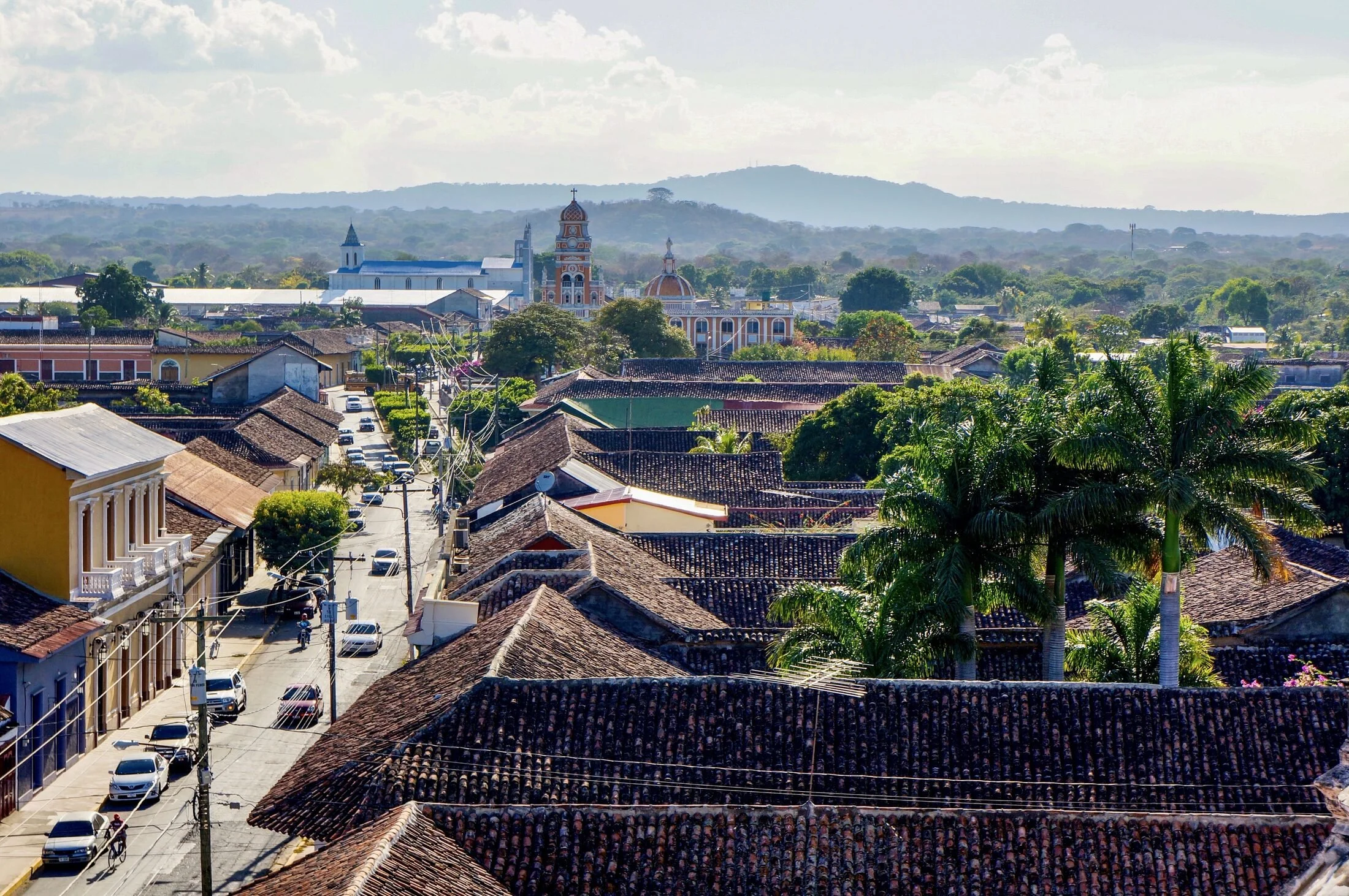
It matters because clients ask about it, and because on paper it looks better than it is. The colonial cities of Granada and León, the Pacific surf coast around San Juan del Sur and Ometepe Island in Lake Nicaragua drew a real retiree population through the 2000s and 2010s on the strength of a territorial tax system, a pensionado law with the lowest threshold in the region and living costs that undercut Costa Rica by half and Panama by more. The infrastructure of that period, the lawyers, the residency fixers, the expat bars, still exists in reduced form.
It matters second as a cautionary example. Nicaragua is what a residency destination looks like when the rule of law goes: the government of Daniel Ortega and Rosario Murillo, now constitutionally co-presidents, has since 2018 killed protesters, jailed and then exiled opponents, stripped more than 300 of them of Nicaraguan nationality by decree and court order, cancelled the legal status of more than five thousand non-governmental organisations and confiscated their assets, closed independent media, and withdrawn from the Organization of American States after the OAS declared the 2021 election neither free nor fair. Foreign residents have been refused entry, expelled and had property taken. The United States advises its citizens to reconsider travel because of the serious risk of wrongful detention and the arbitrary application of law to perceived opponents.
For a risk-tolerant retiree whose only priority is cost, Nicaragua still functions day to day. For everyone else, Costa Rica, Panama and Mexico offer a better risk-adjusted outcome, and FTR steers clients there. Against Costa Rica: Nicaragua is far cheaper and Costa Rica is dramatically more stable and better established. Against Panama: Nicaragua is cheaper and Panama has the institutions, the banking and the structures.
Visa and Residency Routes
Pensionado, Law 694. The 2009 Law for the Promotion of Foreign Retirees and Rentiers requires a lifetime pension of USD 600 a month, plus a further amount per dependant, and grants duty-free import of household goods to a stated value, a partial exemption on a vehicle, and confirmation that foreign-source income is untaxed. Application is at the Dirección General de Migración y Extranjería in Managua with apostilled birth and police certificates, a health certificate and proof of the pension; processing runs three to six months and produces temporary residence for one year, renewable, with permanent residence after three years and naturalisation after four (two for Central Americans and Spaniards). The threshold is the lowest in the region; whether the directorate is still processing foreign retirees at the pace it once did is uncertain, and FTR would not file without a local lawyer confirming current practice.
Rentista, Law 694. USD 750 a month of stable non-pension income, same package, same process.
Investor residency. USD 30,000 invested in a registered Nicaraguan business or approved project, with a business plan and registration through the investment promotion agency; residence follows the same temporary-then-permanent ladder. Tourism projects under Law 306 attract income tax and import exemptions.
Physical presence is lightly enforced for residence cards, though the tax residency test is 180 days. What fails in practice is the assumption that a residence card protects anyone. Entry is at the discretion of a directorate that has turned away residents at the airport for social media posts; there is no appeal that works.
Tax Peculiarities and Traps
Territorial, by Law 822. The 2012 Tax Concertation Law taxes Nicaraguan-source income only. Foreign pensions, foreign investment income and foreign business profit are outside the net, and there is no grace period or remittance rule to worry about; work performed physically in Nicaragua is Nicaraguan-source, so a remote worker is technically within the progressive schedule.
The minimum definitive payment. Companies pay the higher of 30% on profit and 1–3% of gross income, so a loss-making or thin-margin business still pays tax on turnover.
Withholding on sales. Property sales carry a tiered definitive withholding of 1–7% of value, collected at transfer; the buyer's lawyer handles it and a foreign seller should not expect a refund process that works.
Property and expropriation. Title in Nicaragua has been contested since the 1980s confiscations, and the 2023 legislation allowing the state to seize the property of those declared traitors added a political layer. Independent title searches at the Registro Público are essential, and a foreign owner should assume that a dispute with a well-connected local party will not be decided on the law.
The Structural Layer
FTR's default fits Nicaragua's tax rules and not its politics. A Panamanian Private Interest Foundation owning a Panamanian SA, with a modest director's salary paid in Nicaragua, produces Nicaraguan-source salary in the progressive schedule and foreign-source profit outside the net; Nicaragua has no controlled foreign company rules, no exit tax and no treaty with Panama. That is also the point: the structure keeps every asset that matters outside Nicaragua, in a jurisdiction with functioning courts, and the client holds nothing in-country beyond a lease, a car and a living-expenses account. FTR would not put a Nicaraguan entity or Nicaraguan real estate into a client's structure unless the client already owned it, and would then plan for how to get out of it.
Info-Sharing Reality (CRS and FATCA)
Nicaragua does not participate in the Common Reporting Standard and is not a member of the Global Forum, so no account information leaves the country automatically. That is not a feature. It is a symptom of the same institutional isolation that makes correspondent banks cautious, and it does nothing for a client whose home country taxes them on residence or citizenship: Canada, Australia, Spain or the United States will assess the client on their own tests, and a Nicaraguan account that is not reported is simply an unreported account. FATCA applies through Nicaraguan banks' direct registration with the IRS, so US persons are reported regardless.
The frank version: nobody serious markets Nicaragua as a privacy jurisdiction, and the people who do are selling the wrong thing to the wrong client.
Banking Reality
The banks are BANPRO (Grupo Promerica), LAFISE Bancentro, BAC Credomatic, Banco de Finanzas (BDF), Banco Ficohsa and Banco Avanz. All offer córdoba and USD accounts and the USD account is what a resident uses. Opening requires a residence card in practice; a few branches will open on a passport with references, at their discretion. In person, one to three weeks, minimums USD 100–500 equivalent, adequate online banking.
The problem is outside the bank. US sanctions on individuals and entities close to the government, including in the gold and financial sectors, have thinned correspondent relationships; one bank associated with the ruling family closed in 2019 after being sanctioned. International wires clear, slowly and with questions, and some mainland US and European banks apply enhanced scrutiny to Nicaraguan counterparties or decline them. Nicaragua was on the FATF grey list from 2020 and was removed in October 2022; it is on no EU list. Portfolios stay outside the country; the Nicaraguan account is for living expenses and nothing else.
Cost of Doing Business
A Nicaraguan SA costs USD 1,500–3,000 to form through the Ventanilla Única de Inversiones and USD 1,500–2,500 a year to maintain with an accountant filing monthly IVA, withholding and municipal returns. Against the set: a Panamanian SA runs about USD 1,500–2,500 to form and USD 1,000–1,800 a year with no local filings; Singapore about three times the Panamanian setup at USD 4,500–7,500 and USD 4,000–8,000 a year. Nicaragua costs Panama's money for a 30% tax rate, a turnover minimum tax and political exposure. Free zone companies under Law 917 are exempt from most taxes for real export operations only.
Cost of Living
Monthly figures for Granada, León and San Juan del Sur; Managua (Las Colinas, Villa Fontana) runs 20–30% higher on housing.
Lean, single or couple: USD 1,200–1,800. One or two-bedroom USD 400–700, groceries USD 300–450, local health plan USD 60–120, electricity with air conditioning USD 100–180, taxis and buses.
Comfortable, family of four: USD 2,000–3,500. Three-bedroom house USD 800–1,400, one car USD 400–600, international health cover USD 300–500, one place at the American Nicaraguan School or Lincoln International Academy in Managua at USD 8,000–14,000 a year, help USD 200–300.
HNW: USD 5,000–8,000 and up, which buys as much as Nicaragua has to sell; the constraint is not money but what money cannot buy locally.
Private healthcare at Hospital Vivian Pellas in Managua is good for routine and much acute care; outside Managua it is, in the State Department's words, extremely limited, and evacuation cover to Miami or Costa Rica is not optional for anyone over 60.
Cultural and Practical Considerations
Spanish is the floor everywhere except the surf bars of San Juan del Sur. Banks, migration, the tax office, doctors and the police work in Spanish, and a resident without it depends on a fixer for everything.
The determining fact of daily life is the state. Nicaragua is a surveillance society in which criticism of the government, in print, on social media or at a dinner party, can cost a foreigner their residence and a citizen their nationality. Residents self-censor as a matter of course, avoid political conversation with people they do not know well, and understand that the police and the party's neighbourhood structures report. Someone who cannot live like that, or who has a public record of commenting on politics anywhere, should not come. The expat communities of Granada and San Juan del Sur shrank sharply after 2018 and have not recovered; what remains is quieter and older.
Women face no legal restriction on residing, owning property or running a business alone, and foreign women do all three; street harassment is common and mostly verbal, and abortion is prohibited in all circumstances. Family law follows the civil-law community-property model. Same-sex relationships are legal, with no marriage, civil union or anti-discrimination protection and a conservative society; LGBT residents live without legal jeopardy and with social friction, and the government's hostility to civil society has closed the organisations that once supported them.
Personal security is a mixed picture: violent crime is lower than in Honduras or El Salvador historically were, petty theft and burglary are common, and the police are both arbitrary and a source of risk in themselves. Bureaucracy is slow, personal and increasingly political. The Pacific side is hot, dry and volcanic, with earthquakes; the Caribbean side is wet and hurricane-exposed; dengue is endemic; power and water cut out. Schooling for accompanying children is acceptable at two Managua international schools and poor elsewhere. Social integration with Nicaraguans is warm at the personal level and constrained at every other level by the politics.
For Retirees
The only segment for whom Nicaragua is even arguable: a pensionado on USD 600 a month who prioritises cost above everything and accepts the risks above. FTR would still point them to Mexico or the cheaper parts of Panama first.
For Digital Nomads and Remote Professionals
No. The source rule taxes work done in-country, the banking cannot support a business and the political exposure is unjustified when Costa Rica and Panama are next door.
For Multinational Business Owners
Only for an existing operation, free zone manufacturing or tourism under Law 306, structured to hold nothing of value in-country.
For High Net Worth (HNW) Families and Investors
No. A Plan-B is bought for stability, rule of law and a passport; Nicaragua offers none, and the same government that denationalises its own citizens will not protect a foreigner's assets. Chinese HNW families have no reason to look here.
Common Traps
Anyone with a public political record, including on social media; anyone who will not self-censor; anyone who needs functioning courts to protect property; anyone with a health condition that needs care beyond Managua; anyone whose business needs reliable correspondent banking; and anyone treating the absence of CRS as a tax strategy. The residence card, the pensionado package and the low costs are real, and none of them is worth the exposure for a client with an alternative. Almost every client has one.
Next Steps
If Nicaragua fits your specific situation despite everything above, book a scoping call for a realistic assessment. FTR will more often recommend Costa Rica, Panama or Mexico, and will say so.
Important note: General information. Not personal tax, legal, or financial advice. Speak to a qualified adviser at FTR or elsewhere before acting.
Continue reading
Suggested next, chosen by our partners.


