
Liechtenstein Country Profile:
Alpine Foundation Law and Private Banking, Not a Place to Move To
Liechtenstein is where a European HNW family puts a foundation and a private banking relationship, not where it lives. Its foundation law predates Panama's, its banks are among the best capitalised in Europe, and its residence permits are rationed by lottery.
🇱🇮 Key Facts (2026):
Currency: Swiss Franc (CHF); USD 1 ≈ CHF 0.82, so CHF 1 ≈ USD 1.22 (mid-market, September 2026)
Personal income tax (national plus municipal): roughly 2.5% to 22.4% combined; a national scale to 8% with municipal surcharges of 150% to 250%
Wealth tax: levied through the income tax: net wealth is deemed to yield 4% notional income, which is taxed on the income scale with the municipal surcharge, giving an effective charge of roughly 0.06% to 0.9% of net wealth depending on bracket and municipality
Expenditure-based (lump-sum) taxation: available to foreigners taking up residence who do not work in Liechtenstein and live on foreign income; tax negotiated on living expenditure
Corporate tax: 12.5% flat, minimum CHF 1,800 a year; 4% notional interest deduction on equity; dividends and capital gains on shareholdings exempt
Private asset structure (PVS) status: foundations and companies holding only passive assets pay the CHF 1,800 minimum tax only
VAT: Swiss VAT applies under the 1923 customs treaty; 8.1% standard
Capital gains on private movable property: 0%; real estate gains taxed separately on a sliding scale
Estate/inheritance and gift tax: 0%, abolished 2011
Tax residency trigger: domicile in Liechtenstein, or physical presence of more than six months
Residence permits: quota-limited; roughly 70–90 permits a year for EEA nationals, about half by lottery, a small quota for Swiss nationals, and a handful for third-country nationals on employment or, at government discretion, financial independence
Foundation (Stiftung): minimum capital CHF 30,000; setup CHF 15,000–30,000 or more (~USD 18,400–36,700) in legal and trustee fees; annual maintenance CHF 5,000–15,000 or more (~USD 6,100–18,400) including the licensed board member and the minimum tax
Corporate setup: AG CHF 50,000 capital, GmbH CHF 10,000, Anstalt CHF 30,000; formation CHF 8,000–15,000 (~USD 9,800–18,400). Annual maintenance: CHF 8,000–20,000 (~USD 9,800–24,500) with a licensed resident director and audit
Personal bank account minimum: nil for residents and cross-border employees; non-residents routed to private banking
Private banking threshold: typically CHF 5 million or more for a full relationship; some houses open from CHF 1 million
Cost of living, comfortable professional household: CHF 8,000–11,000 monthly (~USD 9,800–13,500)
CRS: participating; early adopter, first exchanges 2017 on 2016 data
FATCA: Model 1 IGA, signed May 2014
Treaties: around 25 comprehensive double tax treaties, including Switzerland, Germany, Austria, the UK, Luxembourg, the Netherlands, Singapore, Hong Kong and the UAE; a wider network of tax information exchange agreements
Membership: EEA since 1995, Schengen since 2011, customs and currency union with Switzerland; not in the EU
Population: ~40,000, about a third foreign nationals; a workforce of similar size, more than half of it commuting daily from Switzerland and Austria
Time zone: CET, UTC+1 (UTC+2 summer)
Last edited: 13 September 2026 by Joe Martin Hanson (Director & Global Partner) with advice from FTR’s Liechtenstein Tax Partners
Why Liechtenstein Matters
Liechtenstein is a niche jurisdiction with a very specific competence: the civil-law family foundation, which it has had since the Persons and Companies Act of 1926, and the private banking that grew up around it. Its population is small, its per-capita wealth among the highest in the world, and its three main banks hold client assets many times the size of the national economy. For a European HNW family wanting a foundation with Alpine rather than Panamanian infrastructure, recognised by German and Austrian courts and tax authorities and sitting next to a Swiss-standard bank, Liechtenstein is the alternative FTR reaches for.
The Liechtenstein foundation predates the Panamanian Private Interest Foundation, which was modelled on it in 1995, and shares its essential features: a self-owning legal person, no shareholders, beneficiaries who have no ownership, a founder who can reserve powers or not, and a board that administers the assets according to the foundation deed and by-laws. What Liechtenstein adds is EEA membership, which matters under the German and Austrian rules that tax foreign foundations, a 2009 reform that modernised governance and beneficiary rights, a supervised trustee profession, and a hundred years of case law. What it costs is five to ten times the Panamanian equivalent.
It matters second for private banking. LGT, owned by the Princely family, VP Bank and the Liechtensteinische Landesbank are serious international private banks with Swiss-grade custody, franc and euro capability and conservative balance sheets. And it matters, marginally, as a residence: a 12.5% corporate rate, a personal rate that tops out around 22%, no inheritance tax, a lump-sum regime for the retired wealthy, and the safest, quietest environment in the set. The obstacle is that almost nobody is allowed to move there.
Visa and Residency Routes
Liechtenstein is in the EEA but negotiated a permanent exception to free movement of persons, and it uses it. Residence is rationed by annual quota, and the quota is small.
EEA nationals. Roughly 70–90 residence permits a year, about half allocated by a lottery held twice a year among EEA nationals who have applied, and the other half at the government's discretion, in practice for people with employment of particular value to the country. An EEA national can work in Liechtenstein without residing there, and most do: the country has more jobs than residents, and more than half of the workforce commutes daily from the Swiss Rhine valley and the Austrian Vorarlberg, where housing is cheaper and available.
Swiss nationals. A separate small quota under the bilateral arrangement, on similar terms.
Third-country nationals. A handful of permits a year, for skilled employment that cannot be filled from the EEA, or, at the government's discretion, for financially independent persons of exceptional means and standing who will bring substance to the country. This is the passive route V1 described as requiring substantial financial commitment and government approval; it is real, it is discretionary, there is no published threshold, and FTR would not build a client's plan around obtaining it.
Family reunification and marriage. Spouses and minor children of permit holders and of Liechtenstein nationals, subject to housing and means conditions.
Permits progress from an initial B permit to permanent settlement (C) after five years for EEA nationals and ten for others. Citizenship takes thirty years of residence (years before age twenty counting double), or ten years followed by a vote of the municipality's citizens, or five years of marriage to a citizen, and requires renunciation of the previous nationality. No FTR client plans on Liechtenstein citizenship.
The route that works in practice is the employment-linked one: a senior role at a bank, trustee firm or one of the industrial groups (Hilti, Ivoclar, ThyssenKrupp Presta) with a permit from the discretionary half of the quota. The route that looks good on paper and fails is the investor idea: there is no investor visa, no property-purchase route, and buying property is itself restricted to residents. Most clients who use Liechtenstein live in Switzerland, Austria, Germany or Monaco and visit their trustee.
Tax Peculiarities and Traps
Wealth tax through the income tax. Liechtenstein has no standalone wealth tax rate; net wealth is converted to a notional income at 4% and added to actual income, the total taxed on the progressive national scale with the municipal surcharge, and a combined cap applies. The effective charge on wealth is small, roughly 0.06% to 0.9% a year, but a resident with a large portfolio and little income still pays it, and the mechanism means that simple percentage comparisons with Switzerland's cantonal wealth taxes mislead.
Expenditure-based taxation. A foreigner taking up residence for the first time, or after at least ten years away, who does not work in Liechtenstein and lives on foreign income may apply to be taxed on living expenditure rather than income and wealth, on a negotiated basis. It resembles the Swiss lump-sum regime; the obstacle is the residence permit, not the tax.
Foundation classification. A foundation holding only passive assets and not engaged in business qualifies as a private asset structure and pays the CHF 1,800 minimum tax; one that trades, holds an operating business directly or receives active income is taxed at 12.5% on its profit. Getting the classification wrong on formation costs money every year.
The founder who keeps control. A foundation whose founder reserves the power to revoke it, amend the beneficiaries and direct the board is treated as transparent by Germany, Austria, Switzerland, Italy, Spain, France and the UK for income, gift and inheritance tax purposes, and by the United States as a grantor trust. The Liechtenstein foundation delivers its benefits only when the founder genuinely gives the assets away to an independent board, with rights of information and protector oversight rather than control.
German and Austrian attribution rules. Germany attributes the income of a foreign family foundation to a German-resident founder or beneficiary under section 15 of the Foreign Tax Act, but exempts foundations in the EU and EEA where the assets are legally and factually separated from the founder and information exchange exists, which Liechtenstein satisfies and Panama does not. Austria taxes contributions to a comparable foreign foundation at the 2.5% foundation entrance tax rather than the 25% penal rate where the foundation is comparable and the beneficiaries disclosed. These two rules are the reason a German- or Austrian-resident client uses Liechtenstein rather than Panama.
Real estate. Property can be acquired only by residents with a demonstrated need, subject to approval; foreign or non-resident ownership is not available, and real estate gains carry their own tax.
The Structural Layer
Liechtenstein replaces the top of FTR's default rather than the bottom. The Panamanian Private Interest Foundation owning a Panamanian SA, with a modest salary paid where the client lives, works for clients in the Americas, Iberia, the UK and Asia; for a family resident in Germany, Austria or Switzerland, or one whose heirs live there, the attribution rules above make a Panamanian foundation transparent or penalised, and a Liechtenstein foundation with an independent board, a licensed Liechtenstein trustee on it and a disclosed beneficiary class takes its place. The Panamanian SA can sit beneath it for Americas operations, with a Luxembourg SOPARFI or Swiss AG for European holdings, and the foundation's PVS status keeps Liechtenstein tax at the CHF 1,800 minimum so long as it holds shares and portfolios rather than trading.
Three points of design. First, the foundation is either registered in the commercial register (required where it carries on a business) or merely deposited with the register (the norm for private family foundations), the deposited form disclosing less publicly, although the beneficial ownership register introduced in 2019 records founders, beneficiaries and board members for authorities and those with a legitimate interest. Second, the founder's reserved rights must be limited to what the home-country rule tolerates: information rights, a protector with veto over changes, a letter of wishes, not revocation or direction. Third, substance is real: the board meets in Vaduz, the trustee keeps the books, the bank is in Liechtenstein or Switzerland, and the accounts are audited where required.
The alternatives within Liechtenstein law are the Anstalt (establishment), a hybrid that can have a founder's rights or be foundation-like, the Treuunternehmen (trust enterprise) and the common-law-style trust that Liechtenstein has recognised since 1928. FTR uses the foundation for succession and the Anstalt or AG for operations. For a client who actually obtains Liechtenstein residence, the default is simply a Liechtenstein foundation above a Liechtenstein AG or foreign operating companies, with the lump-sum regime considered if the client does not work; where the default plainly does not fit is the client with modest assets, for whom the annual cost of a Liechtenstein foundation exceeds the tax it saves, and the US person, for whom it is a foreign grantor trust with Form 3520 reporting either way.
Info-Sharing Reality (CRS and FATCA)
Liechtenstein's banking secrecy ended in substance in 2009. A stolen LGT client list sold to the German tax authorities in 2008 triggered prosecutions across Europe; the Principality issued the Liechtenstein Declaration in March 2009 accepting the OECD standard, signed a disclosure facility with the UK that ran to 2015, and became an early adopter of the CRS with first exchanges in 2017 on 2016 data. It signed a Model 1 FATCA intergovernmental agreement with the United States in May 2014.
The mechanics: Liechtenstein banks, trustees and foundations that are financial institutions report non-resident account holders and controlling persons, including foundation founders, beneficiaries and board members, to the Liechtenstein tax administration, which exchanges with Germany, Austria, Switzerland, Italy, the UK, Spain, France, Panama, Colombia, China and the rest of the network. A foundation with a German beneficiary is reported to Germany; a Chinese founder is reported to Beijing. Liechtenstein's beneficial ownership register, the supervised trustee profession and the FMA's enforcement record make it one of the most compliant jurisdictions in the set, which is its selling point: a Liechtenstein foundation is built to be shown to a tax authority and to survive the inspection. Anyone describing it as discreet is describing 2007.
Banking Reality
Around a dozen banks, supervised by the FMA, of which three matter internationally: LGT Group, owned by the Princely family and the largest, VP Bank, and the Liechtensteinische Landesbank, majority state-owned, all with Swiss operations and international booking centres. Bank Frick, Kaiser Partner Privatbank, Neue Bank and Bendura Bank serve smaller and specialist segments, Bank Frick being the one that banks regulated crypto businesses. Clearing runs through the Swiss system; franc and euro payments and SWIFT are unremarkable, and Liechtenstein is on no FATF, EU or OECD list.
Private banking relationships typically start at CHF 5 million for full service, with some houses opening from CHF 1 million; onboarding takes four to twelve weeks, involves at least one meeting in person in Vaduz or Zurich, and demands source-of-wealth evidence to the transaction level. Foundation and company accounts are opened alongside the trustee, who is known to the bank, which is the practical advantage of doing the structure and the banking in the same valley. Residents and cross-border employees open retail accounts at LLB or the Raiffeisen and Swiss banks across the border without minimums. Nationality restrictions follow Swiss and EU sanctions practice: Russian and Belarusian clients are effectively closed, US persons are accepted by the larger houses under the IGA, and Chinese and Latin American clients are accepted with full documentation.
Cost of Doing Business
A Liechtenstein foundation costs CHF 15,000–30,000 or more (~USD 18,400–36,700) to establish, including the CHF 30,000 minimum endowment that remains the foundation's own capital, legal drafting and trustee fees, and CHF 5,000–15,000 or more a year (~USD 6,100–18,400) for the licensed board member, bookkeeping, the minimum tax and, where required, audit; a foundation with a large portfolio and an active board costs more. An AG needs CHF 50,000 of capital and a GmbH CHF 10,000, formation runs CHF 8,000–15,000 (~USD 9,800–18,400), and annual maintenance CHF 8,000–20,000 (~USD 9,800–24,500) with a resident licensed director and audit.
Against the set, a Panamanian Private Interest Foundation costs roughly USD 2,000–5,000 to establish and USD 1,000–2,000 a year, and a Panamanian SA USD 1,500–2,500 with USD 1,000–1,800 annual; Singapore corporate setup runs around three times the Panamanian figure at USD 4,500–7,500 with USD 4,000–8,000 annual compliance. Liechtenstein is five to ten times Panama on the foundation and roughly level with Luxembourg and Switzerland on companies, reflecting the licensed trustee profession and Swiss-style regulation. The premium buys EEA recognition, German and Austrian tax treatment, and a bank in the same building; it is worth paying only for the clients who need those three things.
Cost of Living
Monthly, for Vaduz, Schaan and Triesen; many residents and almost all employees live across the Rhine in Buchs and Sargans or in Feldkirch, Austria, at 30%–40% less.
Lean, single: CHF 4,000–5,000 (USD 4,900–6,100): a one-bedroom at CHF 1,500–2,200, mandatory health insurance CHF 300–400 with a deductible, Swiss-level groceries, a car or the LIEmobil bus network and the Swiss rail link at Buchs and Sargans.
Comfortable, family of four: CHF 8,000–11,000 (USD 9,800–13,500): a three- or four-bedroom apartment or small house at CHF 3,000–4,500, free public schooling in German, family health insurance CHF 900–1,300, two cars, Zurich airport an hour and a quarter away.
HNW: CHF 15,000–25,000 and up (USD 18,400–30,600): a house in Vaduz or on the slopes above Triesenberg, subject to the residents-only property rules, private schooling at Formatio in Triesen or the International School Rheintal in Buchs at CHF 20,000–30,000 a year per child, and Swiss prices for everything.
Healthcare is Swiss-standard, with the national hospital in Vaduz for general care and Grabs, St Gallen and Zurich for specialist and acute treatment under the mandatory KVG insurance.
Cultural and Practical Considerations
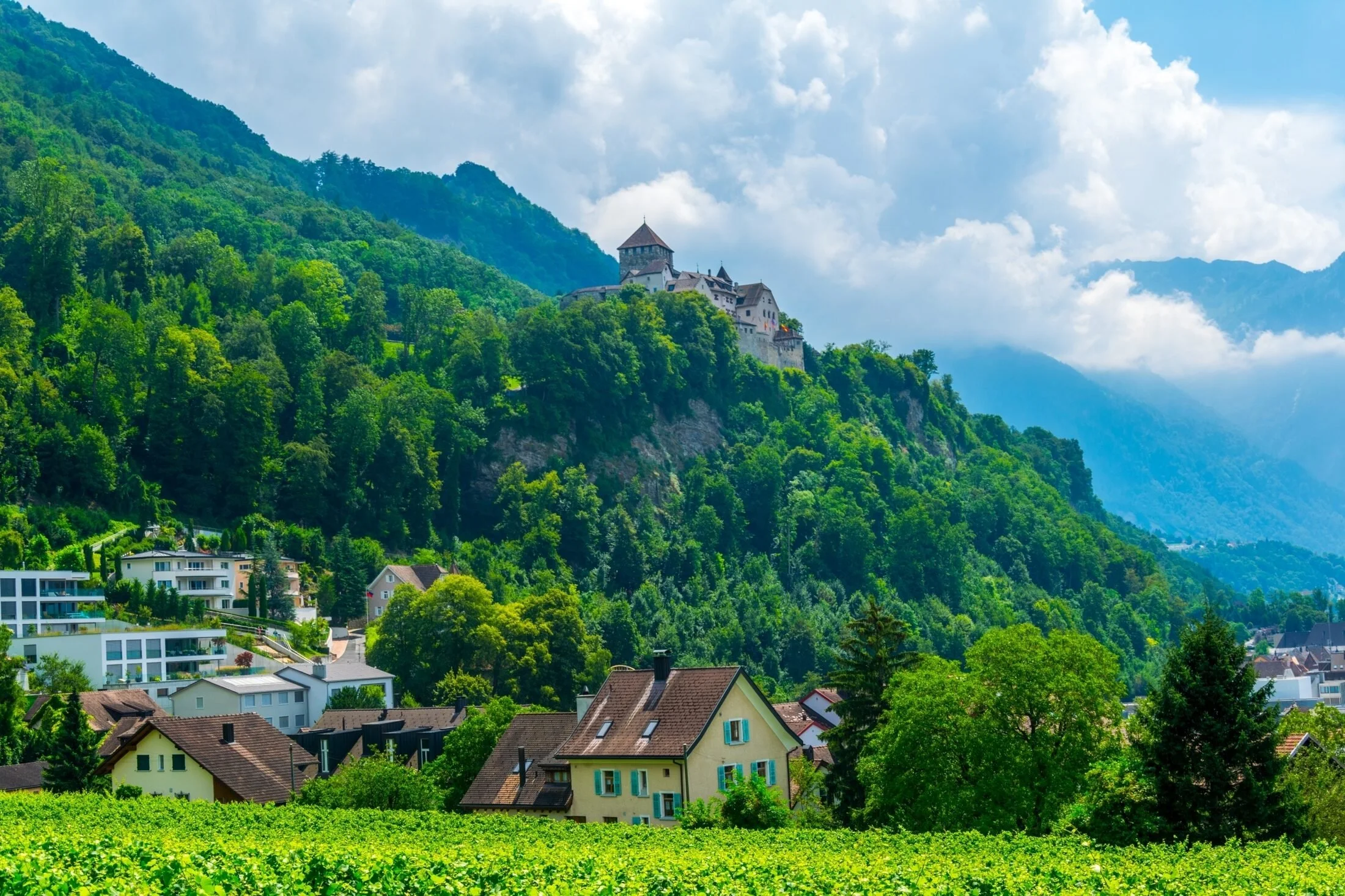
Liechtenstein is eleven villages along a valley floor and up a mountainside, with 40,000 residents, no city, no airport, no motorway of its own and an atmosphere of order, prosperity and calm. It is German-speaking, Catholic, conservative, monarchical and extremely safe; the crime that occurs is financial. People who want quiet, mountains, a two-minute commute and a predictable life are content; people who want variety, nightlife or anonymity leave for Zurich within the year.
Language. German is the official language, spoken in a strong Alemannic dialect that even Germans find hard; English is universal in the banks and trustee firms, and a professional can work in English. The immigration office, the tax administration, doctors, schools and the municipality run in German, and a resident needs it.
Integration. The community is small, tight and multigenerational; a third of residents are foreign, mostly Swiss, Austrian, German and Italian, and integration comes through the workplace, the village associations, the church and children's schools, slowly. There is no expat community of the Dubai or Lisbon kind to substitute for it.
Women, LGBT residents and family law. No legal or practical constraint on women living, travelling or doing business alone; women received the vote only in 1984, which says something about the pace of social change, and the Hereditary Prince acts as head of state under a constitution that the 2003 referendum tilted toward the monarchy. Same-sex marriage has been legal since January 2025. Abortion remains prohibited except in narrow cases, and women travel to Switzerland or Austria; a 2011 referendum to liberalise the law failed after the Prince indicated he would veto it. Family law is civil-law, close to Swiss and Austrian, with a matrimonial property contract before a notary worth having.
Bureaucracy, pace and climate. Efficient, formal and fast by any standard; things work, on time, in German. The climate is Alpine, with cold winters, a warm foehn wind that some people find affects their sleep and mood, and pleasant summers; air quality is excellent.
Schooling. Public schools are good and German-medium through to the Liechtenstein Gymnasium; Formatio in Triesen and the International School Rheintal in Buchs offer English-medium and IB routes; universities are in Switzerland and Austria.
Politics. A constitutional hereditary monarchy in which the Prince has real powers, including a veto, alongside an elected Landtag; two centre-right parties have governed in coalition for decades. A resident feels no volatility whatever. Regulatory change comes from the EEA and the FMA, not from the ballot box.
For Retirees
Only for the rare EEA national who wins a lottery permit or is granted discretionary residence, and then the expenditure-based regime above; for everyone else the retirement is in Switzerland or Austria and the foundation is in Vaduz.
For Digital Nomads and Remote Professionals
No route, no reason, and no permits.
For Online Business Owners and Entrepreneurs
No personal residence, but a Liechtenstein foundation above a Panamanian SA for a founder with German or Austrian heirs, once the assets justify the cost.
For Multinational Business Owners
The foundation as the family's top holding vehicle where EEA recognition matters, with the Luxembourg or Swiss holding company beneath it and operations wherever they are.
For High Net Worth (HNW) Families and Investors
The core use: succession and asset protection for European families through a foundation with an independent board and a private bank next door, with full CRS reporting to wherever the family lives. For Chinese HNW families, LGT and VP Bank are open with full documentation and full reporting to Beijing; the foundation is a legitimate succession vehicle, not a shield, and residence is not on offer.
Common Traps
Moving to Liechtenstein. The quota is tiny, the lottery is a lottery, there is no investor route and property is for residents only.
A foundation the founder still controls; every tax authority that matters looks through it, and the Liechtenstein board will not accept instructions in any case.
Privacy; the 2008 data theft, the 2009 declaration, CRS since 2017 and the beneficial ownership register.
Clients with modest assets; a foundation costing CHF 10,000 a year to run needs a purpose worth that, and Panama does the same job for a fifth of the price where EEA recognition is not needed.
A trading business inside the foundation; it loses PVS status and pays 12.5%.
Anyone who needs a city, a direct flight, or a social scene, or who cannot function in German outside the bank.
Next Steps
If your family is resident in, or your heirs are in, Germany, Austria or Switzerland, or you want a European foundation and private banking relationship alongside or instead of the Panamanian structure, book a scoping call. FTR will assess whether the Liechtenstein premium over Panama is buying you something your home country's rules actually require.
Important note: General information. Not personal tax, legal, or financial advice. Speak to a qualified adviser at FTR or elsewhere before acting.
Continue reading
Suggested next, chosen by our partners.


