
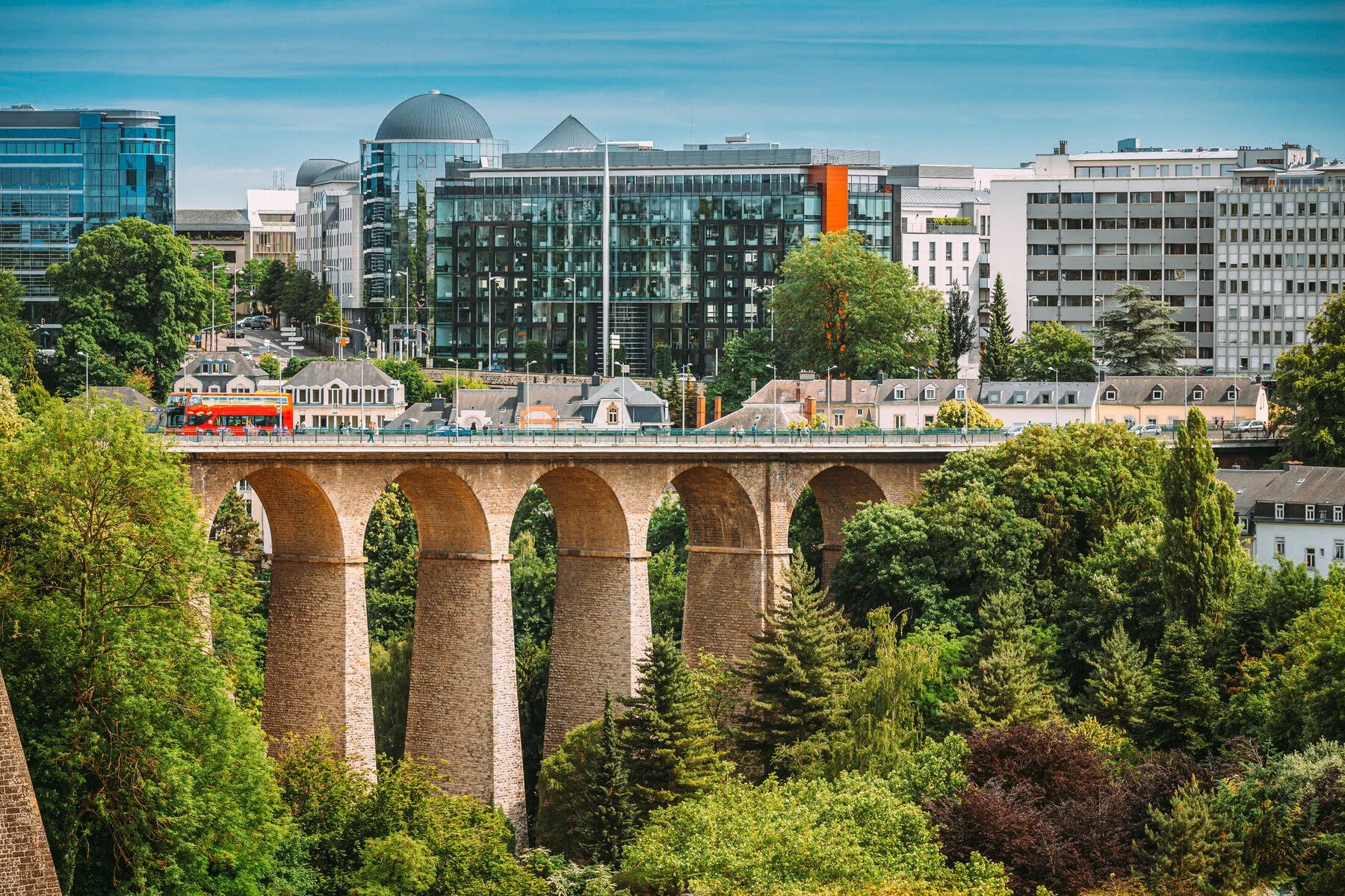
Luxembourg Country Profile:
The EU's Wealth Hub, Better for Structures and Banks Than for Living
Luxembourg is where EU-facing holding companies, funds and private banking relationships sit. It is also a small, expensive, well-run country a few HNW clients choose to live in for its zero inheritance tax on the direct line and its treatment of long-held shares.
🇱🇺 Key Facts (2026):
Currency: Euro (EUR); ~1.16 USD per EUR (mid-market, September 2026)
Personal income tax: 0% to 42% progressive, 42% from EUR 234,870 (class 1); plus a 7% solidarity surcharge on the tax, 9% above EUR 150,000 (class 1) or EUR 300,000 (class 2), for a maximum effective rate of about 45.8%
Corporate income tax: 16% on income above EUR 200,000 (14% below EUR 175,000, with a transition band), plus 7% solidarity surcharge and 6.75% municipal business tax in Luxembourg City, for a combined 23.87%
Net wealth tax on companies: 0.5% on net assets to EUR 500 million, 0.05% above; minimum EUR 535 to EUR 4,815; not levied on individuals since 2006
VAT: 17% standard, the lowest in the EU; 14%, 8% and 3% reduced
Capital gains, individuals: shares held over six months exempt unless a substantial holding (over 10%); substantial holdings taxed at half the global rate, roughly 21% maximum; speculative gains under six months at full rates
Inheritance tax: 0% on the legal share passing in the direct line and between spouses with children; 0%–48% otherwise; no tax on foreign real estate
Gift tax: 1.8%–14.4% on registered gifts; unregistered gifts of movables untaxed
Inpatriate regime: 50% of gross salary exempt up to EUR 400,000 for eight years, minimum salary EUR 75,000
Tax residency trigger: domicile in Luxembourg, or physical presence for more than six months
Headline visa thresholds: investor residence permit at EUR 500,000 in an existing Luxembourg company, EUR 500,000 in a new company creating five jobs, EUR 3 million in an investment structure or EUR 20 million deposited in a Luxembourg bank; EU Blue Card salary roughly EUR 64,000
Corporate setup: SARL EUR 12,000 minimum capital (SARL-S from EUR 1), SA EUR 30,000; formation EUR 3,000–6,000 (~USD 3,500–7,000). Annual maintenance: EUR 5,000–15,000 (~USD 5,800–17,400) basic; EUR 15,000–40,000 (~USD 17,400–46,400) for a SOPARFI with substance
SPF subscription tax: 0.25% of paid-in capital and certain debt, minimum EUR 1,000, maximum EUR 125,000
Personal bank account minimum: nil at retail banks for residents; non-residents effectively routed to private banking
Private banking threshold: typically EUR 1 million or more for full service; EUR 250,000–500,000 for entry-level tiers at some houses
Cost of living, comfortable professional household: EUR 7,000–9,500 monthly in Luxembourg City (~USD 8,100–11,000)
Investment fund industry: second largest in the world after the United States, with over EUR 5 trillion under administration
CRS: participating; early adopter, first exchanges 2017 on 2016 data; EU automatic exchange since 2015 ended bank secrecy
FATCA: Model 1 IGA, signed March 2014
Treaties: roughly 87 comprehensive in force, including Panama (2011); Colombia signed 2024
Population: ~680,000, roughly 47% foreign nationals, plus over 220,000 daily cross-border commuters
Time zone: CET, UTC+1 (UTC+2 summer)
Last edited: 28 September 2026 by Joe Martin Hanson (Director & Global Partner) with advice from FTR’s Luxembourg Tax Partners
Why Luxembourg Matters
Luxembourg is the jurisdiction FTR uses rather than the country FTR sends people to. Any HNW structure with European assets, investors or a likely European buyer passes through a Luxembourg holding company or fund at some point, because the SOPARFI's participation exemption, the treaty network, the regulatory reputation and the depth of service providers make it the default for EU-facing holding work in the way Panama is the default for the Americas. Luxembourg banks hold roughly a fifth of Europe's cross-border private wealth, and the fund industry is the second largest in the world.
It matters second, for a narrow set of clients, as a place to live. Shares held more than six months below the 10% threshold are sold tax-free; there is no wealth tax on individuals; children and spouses inherit without tax; VAT is the lowest in the EU; and the inpatriate regime exempts half of a senior salary for eight years. For a family whose wealth is a diversified portfolio rather than an operating business, and who can live with the cost and the scale, Luxembourg is a legitimate low-friction EU residence.
Third, it is a small source. Luxembourgers are among the wealthiest people in Europe per head and diversify abroad, and finance professionals who spent a decade here leave with a portfolio, a pension and a question about what the next country does to both. What Luxembourg is not is discreet: bank secrecy ended in 2015, the UBO register is live, and every Luxembourg structure is built to be shown to a tax authority.
Visa and Residency Routes
EU and EEA citizens register with the commune within eight days of arrival and are done. Non-EU routes exist but are narrow, and the investor route is used far less than its existence suggests.
Salaried worker and highly qualified worker (EU Blue Card). The realistic inbound route: a Luxembourg employer, usually a bank, fund administrator, law firm or the EU institutions, offers a role; the Blue Card salary threshold is roughly EUR 64,000 gross, lower for shortage occupations. Processing runs two to three months through the Ministry of Foreign Affairs, family members come with work rights, and the permit leads to permanent residence after five years.
Investor residence permit. Since 2017, a non-EU national may obtain a residence permit for investing at least EUR 500,000 in an existing Luxembourg company maintained with its jobs for five years; EUR 500,000 in a new company creating five jobs within three years; EUR 3 million in an investment and management structure with substance; or EUR 20 million deposited in a Luxembourg bank for five years. The Ministry of the Economy vets the investment first. Uptake has been very low: the thresholds are high, the substance is real and the holder must actually live here. FTR would use it only for a client who was going to run a Luxembourg business anyway.
Self-employed, and private reasons. A business permit from the Ministry of the Economy with qualifications and proof of means works for a genuine professional practice. A residence permit for private reasons, on sufficient independent income, health insurance and accommodation, is used by a small number of retirees and rentiers; it is discretionary, applied for from abroad, and the closest Luxembourg comes to a passive-income route.
Permanent residence after five years' continuous lawful residence. Citizenship after five years with a Luxembourgish test at A2 speaking and B1 comprehension plus a civics course; dual nationality has been permitted since 2009. The language test is the obstacle: Luxembourgish is spoken by well under a million people and few expats reach the standard without deliberate effort.
Tax Peculiarities and Traps
The six-month rule and the 10% threshold. Gains on shares held more than six months are exempt for an individual unless the holding, alone or with a spouse and minor children, exceeded 10% of the company at any point in the five years before sale. Substantial holdings are taxed at half the global rate, with an allowance of EUR 50,000 (EUR 100,000 for a couple) usable once a decade. The trap is the look-back: a founder who diluted below 10% three years ago is still substantial. Speculative gains within six months are fully taxed.
Residency by six months, and by domicile. Presence for more than six months in a twelve-month period makes a person resident, and so does a domicile, meaning a home kept and used, regardless of days. Cross-border workers living in France, Belgium or Germany are non-resident but taxed on Luxembourg salary, with treaty day-limits on home working that catch people who forget them.
Inheritance tax's geography. Luxembourg taxes the worldwide movable estate of a resident and Luxembourg real estate of anyone, but not foreign real estate of a resident. Direct-line heirs pay nothing on their legal share and a modest rate on any excess; a resident with no children leaving to siblings or a partner outside marriage faces rates to 48%. The zero rate is why HNW couples with children consider living here.
Net wealth tax on companies. Every Luxembourg company, including a SOPARFI, pays 0.5% of net assets annually, reduced by participation-exemption assets and subject to a minimum charge; a pure holding company usually pays only the minimum, a company holding cash or non-qualifying assets pays the full rate.
SPF limits. The SPF is exempt from income, municipal and wealth tax and pays only the 0.25% subscription tax, but it may not carry on a business or hold real estate directly, may only be owned by individuals or entities acting for family wealth, loses its status if it lends to or trades with its shareholders, and has no treaty access, so withholding on inbound dividends is not reduced. It is a passive family wallet, not a business vehicle.
Withholding and Pillar Two. 15% on dividends paid by Luxembourg companies, reduced under treaties and to zero under the participation exemption for qualifying EU and treaty parents; none on interest to non-residents or on liquidation proceeds. Groups over EUR 750 million revenue face the 15% minimum tax since 2024, irrelevant to most FTR clients but relevant to the funds they invest through.
The Structural Layer
Luxembourg is the one country in this set where FTR's default is complemented rather than displaced. The Panamanian Private Interest Foundation owning a Panamanian SA works for a client living in Panama, Colombia, Portugal or the UAE with Americas assets; where the assets or investors are in Europe, a Luxembourg SOPARFI beneath the foundation, owned by the SA or by the foundation directly, holds the EU shareholdings. The SOPARFI takes dividends and gains from qualifying subsidiaries tax-free under the participation exemption (10% or EUR 1.2 million acquisition cost for dividends, 10% or EUR 6 million for gains, held twelve months), accesses the treaty network and the Parent-Subsidiary Directive, and pays nothing out on liquidation. Panama and Luxembourg have had a treaty since 2011, which matters for the dividend path.
Three conditions. Substance: Luxembourg and its treaty partners expect a resident majority of directors, board meetings held here, a real office and a decision-making record, at EUR 15,000–40,000 a year rather than the EUR 5,000 domiciliation of a decade ago. Anti-abuse: the general anti-abuse rule, the anti-hybrid and CFC rules and beneficial-ownership tests in treaty partners mean a SOPARFI inserted only for a withholding benefit will be challenged, and DAC6 will have disclosed it. And the foundation above must be a real owner, a PIF whose council actually decides, not a nominee for the founder.
For a client living in Luxembourg the default changes shape. Luxembourg has no CFC or look-through rule aimed at individuals, so a Panamanian foundation is not attributed to a resident founder as it would be in Belgium or the Netherlands, but distributions are taxable income and a Panamanian SA run from Luxembourg risks being managed and controlled here. The cleaner domestic structure is an SPF for a passive portfolio, a SOPARFI for active holdings, and direct personal holding of listed shares under the six-month rule; succession is largely solved by the direct-line zero rate, so the foundation's role is control and cross-border continuity rather than tax.
For the finance professional leaving, the default applies in its ordinary form from the destination; Luxembourg has no exit tax on individuals, and its interest ends with Luxembourg-situs real estate and any substantial holding sold within the look-back.
Info-Sharing Reality (CRS and FATCA)
Luxembourg is fully CRS-participating and an early adopter, exchanging with well over a hundred jurisdictions including Panama, Colombia, Portugal, Spain, Switzerland, the UAE, Singapore and Hong Kong. Luxembourg banks and fund administrators report non-resident account holders to the Administration des contributions directes, which forwards the data; under the Model 1 FATCA IGA, US persons' accounts go to the IRS. Automatic exchange within the EU began in 2015, which is the date Luxembourg bank secrecy ended in substance; the register of beneficial owners went live in 2019 and the LuxLeaks disclosures of 2014 and the resulting state-aid cases ended the era of private rulings.
A client who banks or structures in Luxembourg should assume their home country sees the account, the SOPARFI and the beneficial ownership, and that DAC6 will have reported the arrangement's hallmarks. Chinese HNW families using Luxembourg funds or private banks are reported to Beijing. Luxembourg's value is credibility with tax authorities and regulators, which is precisely the opposite of privacy; anyone marketing a Luxembourg structure as discreet is describing 2009.
Banking Reality
Retail banking for residents runs through Spuerkeess (BCEE, state-owned), BGL BNP Paribas, BIL, ING Luxembourg and Banque Raiffeisen; an account opens within a week with a residence certificate and employment contract. Non-residents are routed to private banking, where the international houses operate: Pictet, Lombard Odier, UBS, Julius Baer, Edmond de Rothschild, Quintet, Banque de Luxembourg, Degroof Petercam, Banque Havilland and the private arms of the big French and German banks. Onboarding is document-heavy, with source-of-wealth and source-of-funds evidence to the transaction level, and takes four to twelve weeks; once complete, multi-currency, multi-jurisdiction custody is routine. Full private banking typically starts at EUR 1 million; some houses take EUR 250,000–500,000 into advisory or execution tiers.
Corporate accounts for a new SOPARFI are the slow point: the bank wants the structure chart to the ultimate beneficial owner, the rationale for Luxembourg and evidence of substance, and Panamanian ownership prompts questions rather than refusal. Luxembourg is on no blacklist or grey list, is CSSF-regulated, and has full correspondent and SWIFT access with the euro clearing depth that Panama lacks.
Cost of Doing Business
A Luxembourg SARL needs EUR 12,000 of capital (a SARL-S from EUR 1 for individual founders) and an SA EUR 30,000, with a notarial deed; formation costs EUR 3,000–6,000 (~USD 3,500–7,000) including notary, registration and RCS filing. A basic company costs EUR 5,000–15,000 a year (~USD 5,800–17,400) for domiciliation, accounting, the annual accounts filing, the RBE confirmation and the tax return; a SOPARFI with the substance now expected costs EUR 15,000–40,000 (~USD 17,400–46,400) with resident directors and an office. An SPF costs about the same as a basic company plus the subscription tax.
Against the set: a Panamanian SA costs roughly USD 1,500–2,500 to establish and USD 1,000–1,800 a year including resident agent and franchise tax; Singapore runs around three times the Panamanian setup, USD 4,500–7,500, with USD 4,000–8,000 annual compliance. Luxembourg is the most expensive vehicle in the set to run properly, several times Singapore on annual cost once substance is included, and it is worth it only where the EU access, the treaty network or the regulatory reputation is actually being used. Compared with Switzerland the corporate rate is similar and the EU passporting is the difference; compared with Ireland the SOPARFI is more flexible and the operating environment more expensive.
Cost of Living
Monthly, for Luxembourg City; the communes across the French and Belgian borders are 30%–50% cheaper on housing and thousands of residents commute from them.
Lean, single or couple: EUR 3,200–4,200 (USD 3,700–4,900): a one-bedroom at EUR 1,600–2,200, mandatory CNS health cover through payroll at a few percent of salary with near-full reimbursement, groceries EUR 500–700, public transport free nationwide since 2020.
Comfortable, family of four: EUR 7,000–9,500 (USD 8,100–11,000): a three-bedroom apartment or terraced house at EUR 3,200–4,500, public schooling free in the trilingual state system or the European Schools where eligible, a top-up health policy EUR 100–200, one car with insurance and fuel EUR 500–800, childcare partly subsidised through the chèque-service.
HNW: EUR 15,000–25,000 and up (USD 17,400–29,000): a house in Belair, Limpertsberg or the outer communes at EUR 6,000–10,000 in rent or the mortgage equivalent, two international school places at EUR 15,000–25,000 each per year, help and travel; property purchase prices among the highest in Europe per square metre.
Cultural and Practical Considerations
Luxembourg is small, safe, orderly, multilingual and dull in the way that people who want to work hard and raise children in peace find restful and people who want a city find suffocating. Half the residents are foreign, a further 220,000 commute in daily from France, Belgium and Germany, and the working language of finance is English.
Language. Luxembourgish is the national language, French the administrative and commercial one, German the newspaper language, English the language of banking and funds. A professional can work entirely in English; the commune, the tax office, a doctor or a school run in French, and Luxembourgish is the price of citizenship. Children in the state system learn all three plus English, a gift or a burden depending on the child.
Integration. The expat community substitutes for local social life almost entirely, and Luxembourgers, a minority in their own capital, keep to themselves. Integration happens through state schools and sports clubs, rarely through work, and turnover is high: finance professionals come for five years and leave.
Women, LGBT residents and family law. No legal or practical constraint on women living, travelling or doing business alone. Same-sex marriage since 2015, an openly gay prime minister for a decade, strong protections. Family law defaults to a community-of-acquisitions regime; marital contracts before a notary are common and matter for the inheritance planning above.
Bureaucracy, pace and climate. Efficient and formal; things work, on time, in French. Housing is the constraint, with prices and rents among the highest in Europe. Noise and chaos are absent, personal security is excellent, cross-border traffic at rush hour is the daily friction. The climate is temperate, grey and wet through winter, pleasant from May to September.
Schooling. The state system is free, trilingual and demanding; the European Schools are free for EU institution families and open to others for a fee; the International School of Luxembourg and St George's are strong and expensive. For a family the schooling choice is also a language choice.
Politics. Among the most stable anywhere; a resident feels politics as EU policy and financial regulation, not domestic volatility.
For Retirees
For EU citizens, or the private-reasons permit above for others, and only for those who value zero inheritance tax on the direct line and a portfolio held under the six-month rule enough to pay Luxembourg prices. Not a cost-of-living destination.
For Digital Nomads and Remote Professionals
No visa and no reason; a nomad who kept a Luxembourg flat would be resident by domicile.
For Online Business Owners and Entrepreneurs
A Luxembourg operating company is expensive and unnecessary for a small online business; Luxembourg enters only when the business is sold to a European buyer or takes European investors, at which point a SOPARFI above it earns its keep.
For Multinational Business Owners
The core use: a SOPARFI as the EU holding platform beneath the Panamanian foundation, with real substance, for EU subsidiaries, European private equity and fund investments.
For High Net Worth (HNW) Families and Investors
For a European family, Luxembourg private banking and a SOPARFI or SPF are the standard toolkit; the family lives elsewhere. For Chinese and other non-EU HNW families, Luxembourg funds and banks are open with full reporting home, the investor permit is a real but demanding route, and the country is a place for the money rather than the family unless the children's schooling and an EU base are the point.
Common Traps
Luxembourg for cost of living: housing is the most expensive in the EU and there is no arbitrage.
A SOPARFI without substance: a domiciliation address and a nominee director bought a treaty benefit in 2010 and buy a challenge in 2026.
Luxembourg for privacy: automatic exchange since 2015, UBO register, DAC6, and banks that ask for the paper trail behind every transfer.
An SPF that trades, lends to its shareholder or holds real estate; each ends the exemption.
Selling a founder's shareholding after moving to Luxembourg expecting the six-month exemption; the 10% look-back covers five years.
The investor permit as a passport programme: it is a residence permit for someone who will run or fund a Luxembourg business and live here, and the Ministry checks both.
Naturalisation without Luxembourgish; the test is real.
Next Steps
If your structure has European assets, investors or a likely European buyer, or you are considering Luxembourg as a residence for a family whose wealth is a portfolio rather than a business, book a scoping call. Luxembourg is the EU leg of FTR's structuring work, and it pays for itself only when the substance is real and the reason is clear.
Important note: General information. Not personal tax, legal, or financial advice. Speak to a qualified adviser at FTR or elsewhere before acting.
Continue reading
Suggested next, chosen by our partners.


