
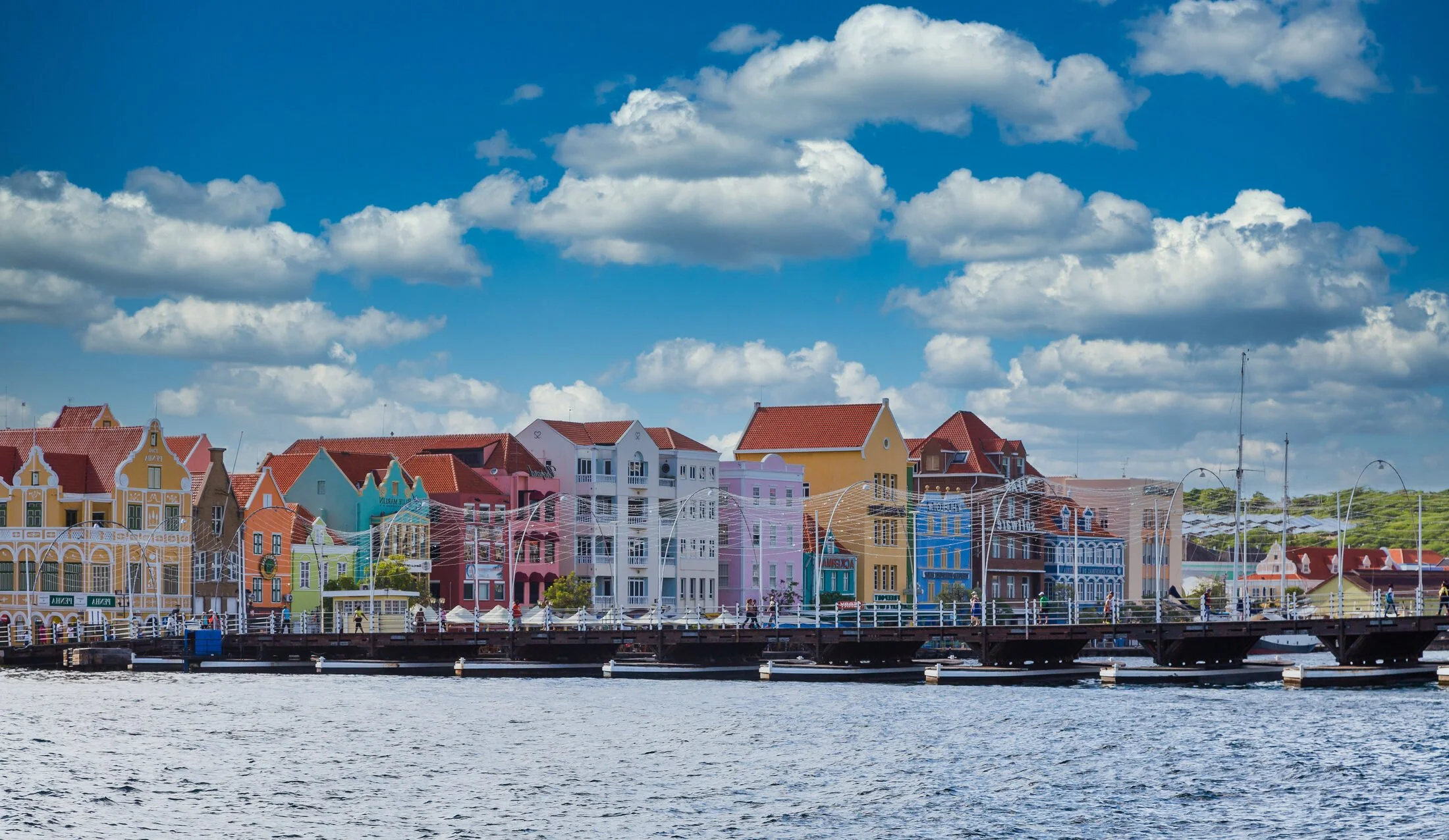
Curaçao Country Profile:
Dutch Law, a Penshonado Regime and a Road to an EU Passport Outside Europe
Curaçao is a constituent country of the Kingdom of the Netherlands: Dutch civil law, Dutch courts of last resort, Dutch nationality after five years, and a Caribbean tax system with a flat 10% regime for foreign retirees and a territorial profit tax. Its treaty-conduit past is over; its usefulness as a residence and a Kingdom entry point is not.
🇨🇼 Key Facts (2026):
Currency: Caribbean Guilder (XCG); pegged at XCG 1.79 = USD 1, the peg carried over from the Netherlands Antillean Guilder, which ceased to be legal tender on 1 July 2025. Commercial rates run about 1.77–1.82. USD accepted widely
Personal income tax: progressive, from just under 10% to a top rate of 46.5%; social security premiums on top
Penshonado regime: foreign-source income taxed at a flat 10% for qualifying residents aged 50 or over
Corporate tax (profit tax): 22% standard; territorial system under which qualifying foreign-source profits are exempt; 0% for the tax-transparent Curaçao Investment Company and the exempt private foundation (SPF)
VAT (omzetbelasting, OB): 6% general; 7% and 9% on specified categories
Capital gains tax: 0% on private assets; gains and dividends on a substantial interest (5% or more) taxed at 19.5%
Wealth tax: 0%
Estate/inheritance tax: yes; inheritance and gift tax at modest rates that rise with the value and the distance of the relationship
Property: real estate tax of roughly 0.4%–0.6% of value a year; transfer tax 4%
Tax residency trigger: facts and circumstances, centred on where the person's life is; no bright-line day count
Investor permit: XCG 500,000 (about USD 280,000) for a three-year permit; XCG 750,000 for five years; XCG 1.5 million for an indefinite permit
Penshonado permit: age 50 or over, proof of income, a home purchased for at least XCG 450,000 (about USD 250,000) within 18 months
@HOME in Curaçao (remote work): six months, extendable to twelve; fee under USD 300
Dutch nationality: naturalisation after five years' lawful residence in the Kingdom
Corporate setup (NV or BV): USD 3,000–6,000. Annual maintenance: USD 3,500–7,000
SPF (private foundation) setup: USD 3,000–5,000. Annual: USD 2,500–5,000
Personal bank account minimum: USD 500–2,500 for residents; non-resident accounts rarely opened
Private banking threshold: USD 250,000–500,000 at MCB's and the international banks' wealth units
Cost of living, comfortable professional household: USD 5,500–8,000 a month
CRS: participating; first exchanges 2018
FATCA: Model 1 IGA, signed 2014
Treaties: the Netherlands (Belastingregeling Nederland Curaçao, 2016), Norway and Malta; the Kingdom tax arrangement with Aruba and Sint Maarten; around 30 tax information exchange agreements
EU and FATF lists: on neither
Population: roughly 150,000
Time zone: UTC-4, no daylight saving
Last edited: 28 June 2026 by Joe Martin Hanson (Director & Global Partner) with advice from FTR’s Curaçao Tax Partners
Why Curaçao Matters
Curaçao is Dutch law in the Caribbean. Its civil code tracks the Netherlands', its Joint Court of Justice sits with Dutch judges, and the Hoge Raad in The Hague is the court of last resort. A residence permit in Curaçao is residence in the Kingdom of the Netherlands, and five years of it qualifies for Dutch nationality, which is an EU passport, obtained without living in Europe, paying Dutch taxes or learning to endure a Dutch winter. Nothing else in the Caribbean offers that.
For retirees, the penshonado regime taxes foreign-source income at a flat 10% for residents aged 50 and over who buy a home. For a pensioner or an investor living on portfolio income, the effective rate is lower than almost anywhere in Europe and the legal environment is more familiar than anywhere in Latin America.
The corporate side has shrunk. The old Netherlands Antilles route, which passed Dutch dividends through a Curaçao NV at low rates under the Kingdom tax arrangement, was closed by the 2016 Netherlands-Curaçao arrangement and by EU pressure that ended the E-zone and offshore regimes. What remains is a 22% profit tax with a territorial exemption for foreign-source profits, a tax-exempt investment company, a private foundation that is exempt by statute and a large, controversial online-gaming licensing sector. Curaçao is a place to live under Dutch law and a modest structuring option for Kingdom and Latin American business, not a conduit.
Visa and Residency Routes
Admission is governed by the Landsverordening Toelating en Uitzetting. Dutch nationals from the European Netherlands are admitted by right and simply register; every other nationality, EU citizens included, needs a permit.
Investor permit. Introduced in 2014 for investors in real estate, a local business or Curaçao-listed securities: XCG 500,000 for a three-year permit, XCG 750,000 for five years, XCG 1.5 million for an indefinite permit, plus health insurance and a clean record. Processing runs two to four months. The permit covers the spouse and dependent children and counts toward the five years of Kingdom residence required for Dutch nationality.
Penshonado permit. For applicants aged 50 or over with sufficient foreign income, who buy a home worth at least XCG 450,000 within 18 months of arrival and who were not resident in Curaçao in the preceding five years; the tax regime is elected within two months of registering. Renewable, family included, counts toward naturalisation.
@HOME in Curaçao. A remote-work permit of six months, extendable to twelve, for foreign employees and business owners with health insurance. Cheap and quick; no path to permanence and no local tax on remote income.
Employment and business permits. Employer-sponsored work permits are slow and protective of the local labour market; a director of a Curaçao company with real activity can obtain a permit on that basis.
Dutch nationality. After five years of continuous lawful residence in the Kingdom, with Dutch or Papiamentu language ability at A2 and the civic integration examination. The Netherlands generally requires renunciation of the prior nationality, with exceptions for spouses of Dutch citizens and where renunciation is impossible or unreasonable. Permanent residence is available at the same five-year mark for those who do not want to naturalise.
FTR would use the penshonado permit for the over-50 client with portfolio or pension income, the investor permit for the family that wants Dutch nationality without Europe, and the remote-work permit for a nomad testing the island. A client who needs to keep their existing nationality should confirm the renunciation position before counting on the passport.
Tax Peculiarities and Traps
Penshonado conditions are strict and the alternative is worse. The 10% flat rate applies to foreign-source income only; Curaçao-source income, including a local salary or rental, is taxed at ordinary progressive rates. The election must be made within two months of registration, the home must be bought within 18 months, and the prior five years must have been spent abroad. A resident who misses the election, or whose income turns out to be Curaçao-source, is in the 46.5% progressive scale. A deemed-income alternative, taxing a fixed amount of XCG 500,000 at ordinary rates, exists for those whose foreign income is large.
Residency is a facts-and-circumstances test. Curaçao, like the Netherlands, has no day count. Residence turns on where the home, family, economic and social life are. A penshonado who keeps a house and a spouse in Rotterdam or Caracas is at risk of being treated as resident there under that country's rules, and the Netherlands arrangement contains a tie-breaker that will not always favour the island.
Inheritance tax exists. Unusually for the Caribbean, Curaçao levies inheritance and gift tax. Rates are modest and exemptions apply between spouses and children, but a client from a no-inheritance-tax country who dies resident in Curaçao with local assets has an estate exposed to it, and the SPF is the standard answer.
The substantial-interest rule. A resident holding 5% or more of a company anywhere is taxed at 19.5% on dividends and gains from that holding. This catches the online business owner who assumed capital gains were untaxed; it applies to the shares of the operating company, wherever incorporated.
Territorial profit tax is not automatic. The exemption for foreign-source profits requires that the profits genuinely arise outside Curaçao, and the Belastingdienst applies a nexus and substance analysis. A Curaçao company managed from a laptop in Willemstad earning service fees from abroad will find its profits treated as domestic.
Gaming licences. Curaçao's online-gaming sector, reorganised in 2024 under the Landsverordening op de Kansspelen with a new Curaçao Gaming Authority replacing the old master-licence system, attracts operators and the banking and reputational problems that come with them. A structure that shares a corporate service provider or a bank with gaming operators inherits their scrutiny.
The Structural Layer
FTR's default is a Panamanian Private Interest Foundation owning a Panamanian SA, with a modest director's salary paid where the client lives. For a Curaçao resident the default needs adapting on two points. Curaçao taxes residents on worldwide income and has a substantial-interest rule, so retained profits in a Panamanian SA owned directly by the client are not taxed until distributed, but the distribution and any sale are taxed at 19.5%; the Panamanian foundation above the SA, with the client as beneficiary rather than shareholder, is the structure that addresses that, and counsel must confirm how the Belastingdienst characterises the foundation's distributions. For the penshonado, foreign-source income is at 10% in any event, and the salary paid into Curaçao is the local-source income taxed at ordinary rates, so it should stay modest.
Curaçao's own vehicles are worth knowing. The SPF, the stichting particulier fonds, is a tax-exempt private foundation under Dutch civil law, familiar to Dutch banks and courts, and a natural holding and succession vehicle for a Dutch or Latin American family that wants Kingdom law rather than Panamanian law above its assets. The Curaçao Investment Company is a tax-transparent or exempt holding for passive investment. A Curaçao NV or BV at 22% with the territorial exemption is a substance-backed operating company for a business trading in the Dutch Caribbean, Suriname or northern South America, and it enjoys the Netherlands arrangement.
Where the default plainly does not fit: a Dutch national moving to Curaçao remains within the Kingdom for exit-tax purposes, and the Netherlands' conserverende aanslag on substantial interests and pension claims applies on emigration to Curaçao as to anywhere else; and a US person resident in Curaçao gains nothing from any of this and picks up CFC, PFIC and foreign-trust reporting on the SPF.
Info-Sharing Reality (CRS and FATCA)
Curaçao is a separate CRS jurisdiction from the Netherlands and has exchanged since 2018; it has operated a Model 1 FATCA IGA since 2014. Every bank, trust company and insurer reports the accounts of foreign tax residents, and the controlling persons of Curaçao NVs, BVs and SPFs, to the Belastingdienst for onward exchange: to The Hague, Caracas, Bogotá, Beijing, Washington. A Dutch resident with a Curaçao account or SPF is visible to the Dutch Belastingdienst; so is a Venezuelan or Colombian resident to their own authorities, which is the reason the Curaçao private-banking book of the 2000s has largely gone.
An SPF is a reportable entity and its founder, board and beneficiaries are its controlling persons; the statutory exemption from profit tax does not remove it from CRS. Curaçao is not on the EU or FATF lists and is not a privacy jurisdiction; its reputation for one dates from a regime that ended a decade ago. For a Chinese HNW family the value is Dutch law and a Kingdom residence that leads to an EU passport, and the reporting to Beijing continues while the family's life is there.
Banking Reality
Maduro & Curiel's Bank, a Scotiabank affiliate, is the dominant retail and commercial bank; Banco di Caribe, Orco Bank and Vidanova Bank serve residents and businesses, and a shrinking group of international banks licensed by the Central Bank of Curaçao and Sint Maarten serve non-resident and corporate clients. A permit holder can open a resident account in two to six weeks with the permit, a Curaçao address, references and source-of-funds evidence, at low minimums. Non-residents without a permit are seldom accepted. Wealth management from USD 250,000–500,000 is available at MCB and the international banks.
Correspondent banking is adequate through Dutch and US relationships, and USD and EUR transfers are routine, but the gaming sector and Venezuelan proximity have made banks cautious; a new company with foreign shareholders should expect eight to twelve weeks of onboarding and detailed questions about activity and beneficial ownership. A Curaçao company owned by a Venezuelan or Russian national will struggle to bank at all.
Cost of Doing Business
A Curaçao NV or BV costs USD 3,000–6,000 to establish through a notary and corporate service provider, and USD 3,500–7,000 a year in registered office, filings and accounts, with an audit for larger companies. An SPF is USD 3,000–5,000 and USD 2,500–5,000 a year. A Panamanian SA is USD 1,500–2,500 and USD 1,000–1,800 a year, with a Private Interest Foundation at a similar order; Panama runs at roughly one third of the Singapore equivalent. A Dutch BV in the European Netherlands is USD 2,500–5,000 and USD 4,000–8,000 a year at a 25.8% headline rate with a global treaty network. Singapore is USD 4,000–7,000 and USD 5,000–10,000 a year at 17%.
Curaçao is priced between Panama and the Netherlands and buys Dutch law without the Dutch treaty network. That is a fair price for a Kingdom holding or succession vehicle and a poor one for a general-purpose operating company, which Panama does for half.
Cost of Living
Willemstad and its suburbs, monthly. Jan Thiel and Vista Royal for expatriates, Punda and Pietermaai for the young, Julianadorp and Emmastad for families.
Lean, single: USD 2,500–3,500: one-bedroom apartment USD 900–1,400, basic health insurance through the statutory BVZ scheme plus a private top-up USD 150–300, groceries USD 500–700, a used car and fuel USD 300–450.
Comfortable, family of four: USD 5,500–8,000: a three-bedroom house in Jan Thiel or Vista Royal USD 2,000–3,500, family private cover USD 500–900, the International School of Curaçao at USD 1,000–1,700 a child a month or a Dutch-curriculum school at a fraction of that, two cars, electricity from Aqualectra USD 250–450.
HNW: USD 15,000 and up: a waterfront villa in Jan Thiel or Spanish Water at USD 5,000–10,000 a month or USD 1–4 million to buy, staff, a boat, and flights to Amsterdam or Miami as needed.
Healthcare is good for the region: the Curaçao Medical Center, opened in 2019, is a modern general hospital, residents are covered by the BVZ basic scheme, and complex cases go to Colombia, Miami or the Netherlands.
Cultural and Practical Considerations
Curaçao is a dry, hilly island of 150,000 people outside the main hurricane belt, with a Dutch-built capital, a Papiamentu-speaking population and a Latin American neighbour forty miles away. It is more cosmopolitan than the English-speaking Caribbean and less orderly than the Netherlands.
Women. No legal or practical constraint on women travelling, residing, owning property or doing business alone. Dutch family law applies, including for divorce and matrimonial property.
LGBT residents. Same-sex conduct has always been legal under Dutch law. Dutch marriages are recognised across the Kingdom, and the courts have ruled that Curaçao must open marriage to same-sex couples; the local political class resisted, and public attitudes remain more conservative than in the Netherlands.
Language and integration. Papiamentu is the language of daily life, Dutch of government, courts and paperwork, English and Spanish of commerce and tourism. English gets a resident through banks and shops; Dutch is needed for officialdom and is required at A2 for naturalisation. The Dutch expatriate community is large, the Venezuelan and Colombian communities larger, and social integration is easier for Spanish or Dutch speakers than for anglophones.
Pace, security and bureaucracy. Crime is moderate, with burglary and occasional violent robbery, and worse than a decade ago; Venezuelan migration has strained services. Bureaucracy is Dutch in form and Caribbean in pace; permits and registrations take months. Electricity and water are expensive and reliable.
Climate and health. Hot, dry and windy, outside the usual hurricane track; dengue is present. The Isla refinery's long-running future is an environmental and economic issue on the west side of Willemstad.
Schooling. Dutch-curriculum public and private schools of reasonable quality; the International School of Curaçao offers an American curriculum and the IB diploma. Children who arrive without Dutch go to the international school.
Politics. Stable within the Kingdom, with Dutch supervision of public finances since 2010 and periodic tension between Willemstad and The Hague over autonomy and reform. Venezuela's crisis, the refinery and the gaming sector are the live issues a resident notices.
For Retirees
The penshonado route above: 10% on foreign income, Dutch healthcare standards for the region, Dutch nationality after five years.
For Digital Nomads and Remote Professionals
The @HOME permit above, for up to a year; nothing changes at home.
For Online Business Owners and Entrepreneurs
The adapted default in the Structural Layer, watching the substantial-interest rule and keeping the SA's management outside the island.
For Multinational Business Owners
A Curaçao NV or BV with substance for Dutch Caribbean and northern South American trade, under the Netherlands arrangement; not a conduit for anything else.
For High Net Worth (HNW) Families and Investors
The investor permit as a route to an EU passport outside Europe, and the SPF as a Kingdom-law succession vehicle. Renunciation of the prior nationality is the catch for most Chinese and many other families.
Common Traps
Using Curaçao as a treaty conduit: the Antilles route closed in 2016 and the E-zone and offshore regimes are gone. Claiming the penshonado rate on local-source income, or missing the two-month election. Assuming there is no inheritance tax or capital gains tax; both exist in specific forms. Expecting privacy from a Dutch-law jurisdiction that exchanges under CRS with the Netherlands and everyone else.
Moving here without Dutch or Spanish and expecting easy integration, or with a business that needs fast permits. Counting on Dutch nationality while intending to keep a nationality the Netherlands requires you to give up.
Next Steps
If you are over 50 with foreign portfolio or pension income, or your family wants Dutch nationality without living in Europe, book a scoping call. Bring the home-country exit position and your nationality plans; they decide whether Curaçao or Panama is the better base.
Important note: General information. Not personal tax, legal, or financial advice. Speak to a qualified adviser at FTR or elsewhere before acting.
Continue reading
Suggested next, chosen by our partners.


