
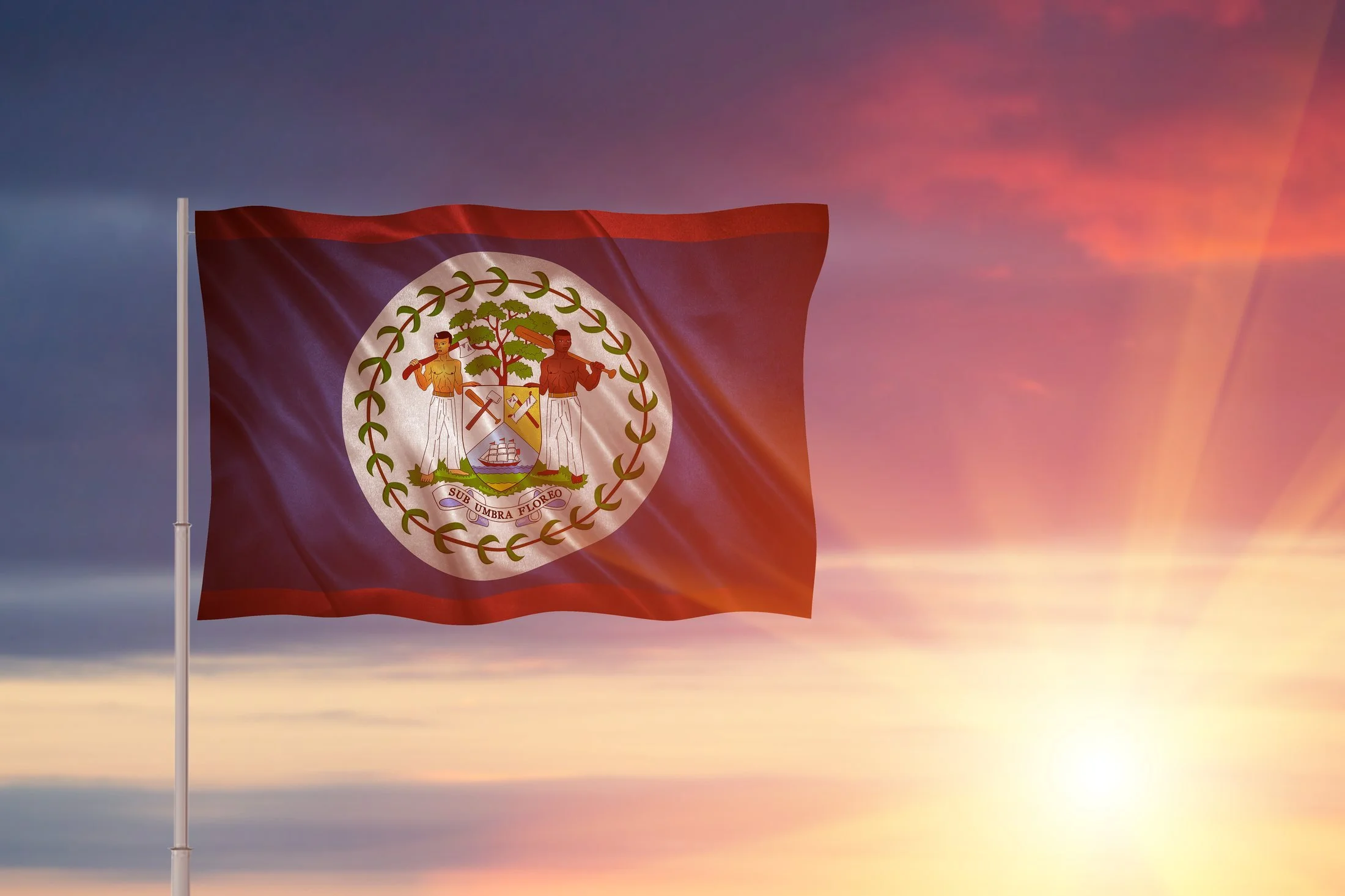
Belize Country Profile:
English-Speaking Retirement Base With a Diminished Offshore Layer
Belize is the only English-speaking, common-law country on the Central American mainland, with a retiree programme that works and a company jurisdiction that no longer does what it used to. Come for the QRP and the cayes, not for the structure.
🇧🇿 Key Facts (2026):
Currency: Belize Dollar (BZD); pegged at 2:1 to USD since 1976
Personal income tax: 25% flat on employment income above the BZD 26,000 (USD 13,000) exemption; foreign-source income of individuals generally not taxed
Business tax: levied on gross receipts in place of profit-based corporate tax for most activities, at rates from 1.75% (trade) to 6% (professional services) and 15% on certain non-resident payments; nominal corporate income tax 25%
Corporate tax on foreign-source income of Belize companies: 0% where the company is non-resident for tax and meets the economic substance rules; the blanket IBC exemption ended 1 January 2019
GST: 12.5%
Capital gains tax: none
Wealth tax: none
Estate/inheritance tax: none; stamp duty of about 8% on real property transfers above a small threshold
Tax residency trigger: 183 days in a calendar year
Qualified Retired Persons (QRP): age 45 and over; USD 2,000 per month (USD 24,000 per year) verifiable pension or investment income deposited into a Belize bank; minimum 30 days a year in Belize; programme fees around USD 1,350 for the principal on approval plus USD 750 per dependant
QRP benefits: duty-free import of household goods and a vehicle, boat and light aircraft; no Belize tax on foreign income; expedited status. It is not permanent residency and does not count toward citizenship
Tourist stay: 30 days on arrival, renewable monthly for BZD 100 (USD 50) for six months, then BZD 200 (USD 100) a month
Permanent residency: available after one year of continuous legal residence with no more than 14 consecutive days abroad; fee varies by nationality from roughly USD 1,000 to USD 2,500
Citizenship by naturalisation: five years' residence (one year for spouses of Belizeans); dual nationality permitted
Company setup (Belize Companies Act 2022): USD 1,000–1,800. Annual maintenance: USD 800–1,800 including registered agent, annual return and economic substance filing
Personal bank account minimum: USD 500–1,000 at domestic banks; USD 5,000–10,000 at international banks
Private banking threshold: effectively none onshore; Belize has no genuine private banking tier
Cost of living, comfortable expat household: USD 2,000–3,500 per month; USD 3,500–5,500 on Ambergris Caye
CRS: participating; first exchanges 2018
FATCA: Model 1 IGA, treated as in effect since 2015
Treaty count: fewer than 15 comprehensive agreements, including CARICOM, the UK, Austria and Switzerland; none with Panama, Colombia, the US, Canada or Australia
EU list status: listed as non-cooperative in 2019 and again October 2023 to February 2024; on the grey-list annex thereafter
Population: ~410,000
Time zone: UTC-6, no daylight saving
Last edited: 12 June 2026 by Joe Martin Hanson (Director & Global Partner) with advice from FTR’s Belize Tax Partners
Why Belize Matters
Belize is a former British colony with English as the official language, a common-law legal system, a currency hard-pegged to the US dollar and a Caribbean coastline. For a North American retiree who wants beach and reef without learning Spanish, that combination exists nowhere else on the mainland. The Qualified Retired Persons programme, run by the Belize Tourism Board rather than the immigration department, is deliberately simple and remains the easiest retiree entry in the region.
The tax picture is territorial for individuals: no capital gains tax, no wealth tax, no inheritance tax, and foreign pension and investment income is not taxed whether or not the client holds QRP status. What Belize taxes is local employment and local business, and it does so through a gross-receipts business tax rather than a profit-based system.
Belize was for two decades a volume IBC jurisdiction. That business is largely gone. The 2018 amendments ended the tax exemption from 1 January 2019, the Economic Substance Act followed, and the IBC Act was folded into the Belize Companies Act 2022. What remains is a functional but unremarkable company law with reporting obligations, a reputational discount at correspondent banks and no advantage over Panama or BVI for an FTR client. Belize matters as a place to live, not as a place to hold.
Visa and Residency Routes
Qualified Retired Persons (QRP). Age 45 or over, USD 2,000 a month from a pension, annuity or investment income, paid into a Belize bank account, and at least 30 days a year in the country. Approval typically takes three to six months. It delivers duty-free import of household effects and a vehicle, exemption from Belize tax on foreign income, and a status that renews annually. It does not permit paid employment for a Belizean employer, it is not permanent residency, and time spent on it does not count toward naturalisation. FTR would use it for a retired couple with pension income who want a straightforward, low-touch status and are not looking to build toward a passport.
Tourist entry followed by permanent residency. The route most working-age arrivals actually use. Enter as a visitor, renew monthly at the immigration office, live in the country for a full year with no absence longer than 14 consecutive days, then apply for permanent residency. Processing has historically taken six to eighteen months, with a police record, medical and proof of means required. Permanent residency permits work and business ownership and starts the five-year clock to naturalisation. It demands real presence in the first year; a client who cannot commit to being in Belize almost continuously for twelve months should take the QRP route or not come.
Work permit and business investor entry. A foreigner establishing a local business can obtain a work permit tied to it; there is no formal investor-visa threshold and decisions are discretionary. Practical, but not a route FTR would sell.
Citizenship. Five years' residence after permanent residency, with a language and character test; spouses of Belizeans after one year of marriage and residence. The passport is respectable within CARICOM and the Commonwealth but offers no material visa-free advantage over the passports FTR's clients already hold.
Tax Peculiarities and Traps
The business tax on gross receipts. Belize replaced profit-based taxation for most activities with a turnover tax under the Income and Business Tax Act (Chapter 55). A consultant billing local clients pays 6% of gross fees whether or not the year was profitable; a trading business pays 1.75% of turnover. Anyone bringing a thin-margin business onshore should model the turnover tax first, because a 1.75% levy on gross can exceed 25% of profit.
The 2019 company regime change. Companies formed under the old IBC Act lost their tax exemption from 1 January 2019, became liable to file, and were re-registered under the Belize Companies Act 2022. A company claiming to be outside Belize tax on its foreign income must now show it is tax resident elsewhere or meets the Economic Substance Act tests for its activity. Dormant legacy IBCs that were never re-registered or never filed are a live problem: penalties accrue, the company may have been struck off, and a struck-off company cannot cleanly transfer the assets it holds.
Exchange control. Belize operates exchange controls under the Exchange Control Regulations. Residents need Central Bank approval to acquire or hold foreign currency and to move capital abroad. A client who becomes resident and then wants to repatriate the proceeds of a property sale in US dollars will discover that the peg is maintained by rationing dollars, not by an open market. Non-residents holding USD accounts at international banks are outside this, which is why the two banking tiers exist.
Property. No capital gains tax on disposal, but stamp duty on transfer at around 8% and a requirement for Central Bank permission where a non-resident buys with foreign currency. Title is registered and reliable in the main expat areas; buy through a Belizean attorney and a title search, and never on a caye without checking the reclamation and lease status of the land.
Common-law unions. Belize recognises a common-law union after five years' cohabitation, with property and inheritance consequences comparable to marriage. Retirees arriving with a partner should know this is a legal status they may acquire without signing anything.
The Structural Layer
FTR's default, a Panamanian Private Interest Foundation owning a Panamanian SA with a modest director's salary paid where the client lives, works cleanly for a Belize resident. Belize does not tax foreign-source income of individuals, has no CFC rules, no controlled foreign trust attribution and no wealth or inheritance tax, so the foundation and the SA sit untouched. The director's salary, if paid for work performed in Belize, is Belize-source and taxed at 25% above the exemption, which is tolerable at the modest level FTR recommends.
Belize entities do not belong in the structure. A Belize company holding foreign assets now carries filing obligations, an economic substance return and a jurisdiction name that triggers enhanced due diligence at every correspondent bank, for no benefit Panama does not deliver more cheaply and with better banking. Belize trusts under the Trusts Act have a genuine asset-protection reputation, but the same banking discount applies and the Panamanian foundation does the succession job with less friction. Where a client arrives with a legacy Belize IBC or trust, the first task is to confirm its status, bring its filings current and migrate the assets out in an orderly way.
For the retiree who is the typical Belize client, the structure is often simpler still: pensions paid directly, a US or Canadian brokerage kept offshore, and the home-country exit done properly. The home-country rules do all the damage; Belize itself does none.
Info-Sharing Reality (CRS and FATCA)
Belize is a participating CRS jurisdiction and has exchanged since 2018. Belizean banks report non-resident account holders to the Belize Tax Service Department, which exchanges with the client's country of tax residence: Canada, the UK, Australia, Mexico, Colombia, Panama and the rest of the network. Under the Model 1 FATCA IGA, US persons' accounts are reported to the IRS via the Belize authorities. The IBC-era marketing of Belize as a place where accounts were invisible is a decade out of date; it was never entirely true and it is now simply false.
Belize's international banks and company agents were also, in the 2010s, the vehicle of choice for several US-prosecuted frauds, most visibly the Sanctuary Belize case that took down Atlantic International Bank in 2019. That history is why the jurisdiction's name draws enhanced scrutiny, and why FTR does not use Belize entities for privacy or anything else. The transparency position is the same as Panama's: full CRS, full FATCA, no secrecy. The banking is worse.
Banking Reality
Two tiers. Domestic banks, principally Belize Bank, Atlantic Bank and Heritage Bank, open accounts for residents and for QRP holders with a passport, proof of address, bank reference and a modest opening deposit, generally in person and within a few weeks. Accounts are in BZD, with USD accounts available subject to exchange control. Service is slow, online banking is basic, card acceptance abroad is patchy, and outward international transfers need approval and paperwork.
International banks, licensed under the International Banking Act and serving non-residents only, hold USD accounts outside exchange control. Caye International Bank is the survivor of a shrinking sector; minimum opening deposits run USD 5,000–10,000 and onboarding takes several weeks of document review. Correspondent access is the constraint: Belizean banks lost most of their US correspondent relationships in the 2015–2016 de-risking wave and rebuilt them only partially, so USD wires can route through a single correspondent, take days and cost USD 50–100 each. SWIFT works; it is not fast or cheap.
Belize is not on the FATF grey list. Its EU list history above is the reason some European banks flag Belize-linked payments. There are no nationality restrictions beyond standard sanctions screening, but US clients should expect FATCA-driven reluctance at the smaller institutions.
Cost of Doing Business
A Belize company under the Companies Act 2022 costs USD 1,000–1,800 to form through a registered agent and USD 800–1,800 a year to maintain, including the agent, the annual return, a tax filing and an economic substance return where relevant. Cheap on paper.
Against the set: a Panamanian SA runs USD 1,500–2,500 to establish and USD 1,000–1,800 a year, and comes with Panama City banking, a deeper professional market and no EU-list history. Singapore is roughly three times Panama's setup, USD 4,500–7,500, with USD 4,000–8,000 annual compliance, and buys credibility Belize cannot. BVI sits near Panama on cost with better bank recognition. Belize's small saving is consumed at the first bank that asks why the company is there.
Cost of Living
Belize imports most of what it consumes, so groceries, fuel, vehicles and anything electrical cost more than in Mexico or Guatemala; housing and labour cost less, except on Ambergris Caye.
Lean, single or couple, Cayo or Corozal: USD 1,400–2,000: rent USD 500–900 for a two-bedroom, groceries USD 400–600, local health cover or self-insurance, a used vehicle.
Comfortable, couple or family, Placencia or San Pedro: USD 3,000–5,000: rent USD 1,200–2,500 for a modern two- or three-bedroom, international health and medevac insurance USD 300–600, golf cart or vehicle, school fees where a private school exists.
HNW: USD 6,000–12,000: beachfront ownership on Ambergris Caye or Placencia at USD 500,000 upward, private boat, routine medical travel to Mérida, Houston or Miami, and staff.
Healthcare is the real constraint. Karl Heusner Memorial in Belize City and the private Belize Medical Associates handle routine and moderate cases; serious cardiac, oncology and trauma cases go to Mexico or the US. Medevac cover is not optional for anyone over 60. Schooling: QSI International School in Belize City and Island Academy on Ambergris Caye are the credible options; elsewhere, private schooling is thin and home-schooling common.
Cultural and Practical Considerations
Belize is small, personal and slow. With 410,000 people, everyone in an expat area knows everyone, reputations travel fast, and the same three officials will handle every renewal, permit and registration for years. That suits people who enjoy a village and infuriates people who want anonymity and speed. Things do not happen on time; power and internet fail; the monthly tourist renewal is a queue.
Language. English is official and used by banks, courts and government, which is the country's main practical advantage. Kriol is the everyday language of Belize City and much of the coast; Spanish dominates the north and west and is increasingly the majority home language. A client who speaks only English will be fine; one who also speaks Spanish will be better served.
Security. Belize's national homicide rate is among the higher ones in the region, but it is concentrated in the south side of Belize City and tied to gang activity there. Ambergris Caye, Placencia, Cayo and Corozal see property crime, burglary of unoccupied homes and opportunistic theft rather than violence. The US advisory is Level 2. Live outside Belize City, secure the house when travelling, and the risk is manageable; ignore that and it is not.
Women, LGBT residents and family law. No legal restriction on women residing, owning property or running a business alone, and many single women do. Street harassment is common, and sexual violence rates are high by regional standards; single women tend to settle in the expat-dense areas for that reason. Consensual same-sex conduct was decriminalised by the Supreme Court in 2016 and upheld on appeal in 2019; there is no recognition of same-sex relationships, the country is socially conservative and religious, and LGBT residents keep a low profile outside San Pedro and Placencia. Family law is common-law based and the common-law union rule above applies.
Climate and health. Hot and humid year round, a hurricane season from June to November with a real landfall risk on the coast and cayes, sandflies and mosquitoes, and dengue every wet season. Retirees with respiratory or cardiac conditions should test a full summer before buying.
Integration and politics. The expat community on the cayes and in Cayo is large enough to substitute for local integration, which is both its appeal and its limit. Belizeans are friendly and unhurried; friendships form through church, sport and neighbourhood, not through business. Politics is a stable two-party democracy with low volatility; the territorial dispute with Guatemala is before the International Court of Justice and does not touch daily life.
For Retirees
The core segment: QRP for those over 45 with pension income who want the duty-free import and light presence requirement; the tourist-to-permanent-residency route for those who want work rights and a path to a passport. Get the home-country exit right, because Belize will not tax you and your old country will try.
For Digital Nomads and Remote Professionals
Belize has no nomad visa; the monthly tourist renewal works for a season, internet is adequate on the cayes and poor inland, and there is no tax reason to establish residence here rather than in Panama. A lifestyle stop, not a base.
For Online Business Owners and Entrepreneurs
Live here on the Panamanian structure described above; do not incorporate here. Local-source income from Belizean clients falls into the gross-receipts business tax.
For Multinational Business Owners
Nothing to see. A regional operation belongs in Panama, Costa Rica or Mexico.
For High Net Worth (HNW) Families and Investors
Belize offers a second residence in an English-speaking, dollar-pegged country with no estate tax and a one-year path to permanent residency. That is a genuine, cheap Plan-B for a North American family. It offers nothing to a Chinese or other Asian HNW family: no banking depth, no schooling, no flights, and a jurisdiction name that hurts more than it helps.
Common Traps
Coming to Belize for the structure. The IBC exemption is gone, the substance rules apply, the banks are weak and the name draws scrutiny. Anyone still selling a Belize IBC as an offshore solution is selling a 2015 product.
Coming for the banking. Correspondent access is thin, transfers are slow and exchange control limits residents' access to dollars. Keep the money in Panama, the US or Singapore and bring in what you spend.
Expecting first-world healthcare, schooling or infrastructure. The cayes are beautiful and remote; a medical emergency on Ambergris Caye means a flight.
Treating QRP as residency. It is a tax and import concession with a 30-day presence rule and no path to citizenship. A client who wants a Belizean passport must live here properly for six years.
Next Steps
If Belize is on the retirement shortlist, or a legacy Belize company or trust is sitting in the file, book a scoping call. The first job is usually the home-country departure; the second is deciding whether anything Belizean should survive.
Important note: General information. Not personal tax, legal, or financial advice. Speak to a qualified adviser at FTR or elsewhere before acting.
Continue reading
Suggested next, chosen by our partners.


