
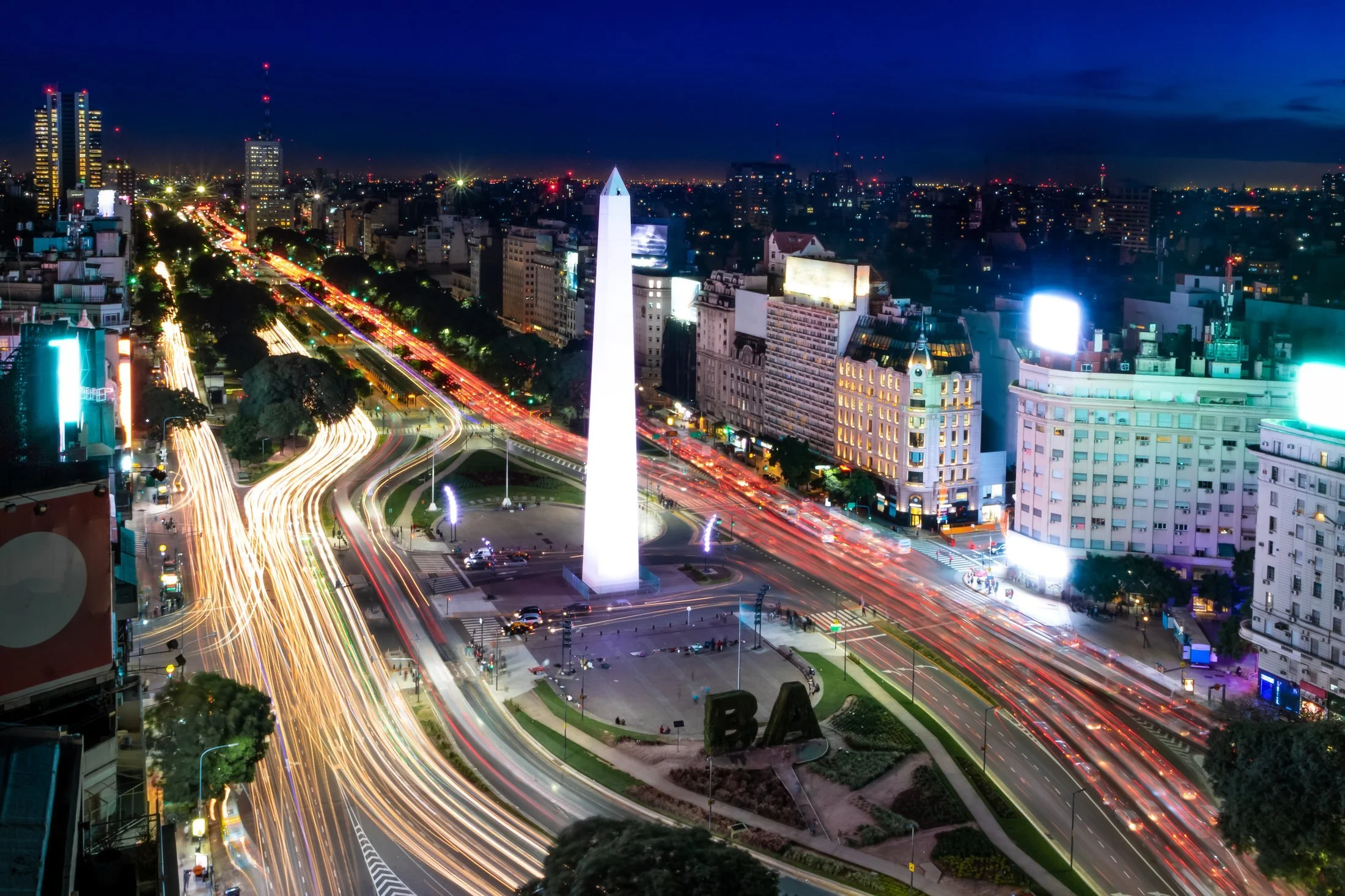
Argentina Country Profile:
A Chronic Wealth-Exit Source Whose Currency Regime Has Actually Changed
Argentina has exported wealth for decades, and the wealth tax, inflation and capital controls that drove it are all in transition. The cepo was lifted for individuals in April 2025, Bienes Personales is being phased down, and Buenos Aires is no longer cheap in dollars. The structuring problem is now about breaking residency properly, not smuggling money out.
🇦🇷 Key Facts (2026):
Currency: Argentine Peso (ARS); roughly 1,400 to 1,500 to USD in September 2026, floating within a managed band; official and parallel rates have converged since April 2025
Currency controls: the cepo cambiario was lifted for individuals on 14 April 2025; residual restrictions remain for companies, chiefly on repatriating pre-2025 profits
Personal income tax: 5% to 35% progressive
Capital gains: 15% flat on foreign securities, unlisted shares and real estate acquired since 2018 (cedular regimes); Argentine listed shares exempt; other gains in progressive rates
Wealth tax (Bienes Personales), FY2025: 0.50% to ARS 52,664,283; 0.75% to ARS 114,105,948; 1.00% above; legislated to fall to 0.25% by 2027; lower rates for compliant taxpayers; indexed non-taxable minimum and a separate family-home exemption
REIBP: optional lump-sum advance payment of Bienes Personales granting fiscal stability to 2038, enrolment window now closed
Corporate tax: 25% to 35% progressive on profit bands; 7% dividend withholding
VAT: 21% standard; 27% on utilities; 10.5% reduced
Provincial gross receipts tax (Ingresos Brutos): roughly 1.5% to 5% on turnover, by province and activity
Bank debits and credits tax: 0.6% each way on most account movements
Estate/inheritance tax: none federally; Buenos Aires Province levies its own
Tax residency trigger: Argentine nationals resident unless permanent residence abroad or 12 months' continuous absence is shown; foreigners after 12 months' permanent residence or presence; centre of vital interests test on dual residence
Citizenship: two years' residence under the Constitution; tightened by 2025 decree; an investor route announced at USD 500,000
Rentista and pensionado visas: stable passive income of roughly USD 2,000 a month; Digital nomad visa: 180 days, extendable
Corporate setup: SAS or SRL USD 1,500 to 3,000. Annual maintenance: USD 3,000 to 8,000
Personal bank account minimum: nil; DNI or CDI required
Private banking threshold: roughly USD 500,000 investable; most Argentine private wealth is banked abroad
Cost of living, comfortable professional household, Buenos Aires: USD 3,500 to 5,500 monthly
CRS: participating, early adopter; first exchanges 2017 on 2016 data
FATCA: Model 1 IGA, signed December 2022, first exchanges 2024
Treaties: roughly 20 to 25 comprehensive, including Spain, UK, France, Germany, Italy, Brazil, Chile, Mexico, Switzerland, Canada, Australia and the UAE; a limited 2012 agreement with Uruguay; none with the US, Colombia or Panama
Population: ~46 million
Time zone: UTC-3, no daylight saving
Last edited: 23 September 2026 by Joe Martin Hanson (Director & Global Partner) with advice from FTR’s Argentine Tax Partners
Why Argentina Matters
Argentina is one of the world's most consistent exporters of private wealth, and has been for a century. Currency collapses, inflation that ran above 200% in 2023, a wealth tax on worldwide assets, capital controls in most years since 2011 and a politics that swings between extremes have taught Argentine families to hold their savings in dollars, abroad, and out of sight. FTR's Argentine clients arrive already holding accounts in Uruguay, Miami or Switzerland, often undeclared, and the work is regularising and restructuring what exists rather than building something new.
The reason it matters now is that the ground has moved. The Milei government unified the exchange market and lifted the cepo for individuals in April 2025, the peso trades within a managed band that has held with central bank and US Treasury support, inflation has fallen sharply, a 2024 amnesty brought a great deal of foreign wealth onto the books, and Bienes Personales is being cut to 0.25% by 2027 with an advance-payment regime that locks rates until 2038. An Argentine family that was leaving for tax reasons in 2022 has weaker tax reasons in 2026 and the same political reasons, and their adviser should be able to tell them which is which.
Argentina matters third as a destination of a narrow kind: citizenship after two years' residence under the Constitution, a passport with visa-free access to roughly 170 destinations including the Schengen area and the UK, Mercosur residence for regional nationals, and a capital that is, for the right temperament, one of the great cities. It stopped being cheap for dollar earners in 2024; that fact belongs in the profile because V2's version of it is now wrong.
Visa and Residency Routes
Mercosur residence. Nationals of Mercosur and associated states, including Brazil, Uruguay, Chile, Colombia and Peru, obtain two-year temporary residence on nationality alone, converting to permanent residence. This is the route for the regional segment and is administratively the simplest thing Argentina does.
Rentista and pensionado visas. Temporary residence for one year, renewable, then permanent residence after three years, for people with stable passive income from abroad, in practice around USD 2,000 a month evidenced by bank records or a pension. Processing through the Dirección Nacional de Migraciones and the RaDEX online system runs three to nine months and is slow, inconsistent and paper-heavy. This is the route FTR would use for a retiree or investor who intends to live in Buenos Aires.
Digital nomad visa. A 180-day permit, extendable once, for remote workers with foreign income; useful for a season, leading nowhere.
Investor visa. Historically a nominal peso investment threshold that inflation rendered meaningless; the 2025 reforms announced a citizenship-by-investment route at USD 500,000 or more in a productive investment. Its regulations and take-up should be treated as unsettled.
Citizenship. The Constitution allows naturalisation after two years' continuous residence, and the courts have for decades granted it to applicants who could show two years' physical presence and livelihood, regardless of migratory status. A 2025 decree tightened this to two years of continuous legal residence without extended absence, with a clean record, and made the investor route the alternative. Children born in Argentina are citizens at birth, which produced a small industry of birth tourism from Russia in 2023 that the government has since curbed. Even tightened, this remains the fastest serious passport in the set, and the reason some clients consider Argentina at all.
Work and family visas function as elsewhere. What fails in practice: assuming the DNI process will take weeks (it takes months), and building a plan on the investor route before its regulations are settled.
Tax Peculiarities and Traps
Breaking residency. An Argentine national remains tax resident until they can show either permanent residence in another country or twelve months' continuous absence, with temporary presences in Argentina of up to 90 days in aggregate not interrupting the count. Even then, a person who keeps a permanent home in Argentina or their centre of vital interests there is treated as resident under the dual-residence rules. The departure must be registered with ARCA, the renamed tax agency, and the last resident return filed; until that is done, worldwide income and worldwide wealth stay in the net. The family that moves to Montevideo but keeps the Recoleta apartment, the club membership and the children in a Buenos Aires school has not left.
Bienes Personales on the way out and after. Resident individuals pay annually on worldwide net wealth above an indexed minimum, with a separate exemption for the family home, at the FY2025 schedule of 0.50%, 0.75% and 1.00% falling to 0.25% by 2027; the surcharge for assets held abroad was removed in the 2024 reform. Non-residents remain liable on Argentine-situs assets through a substitute taxpayer, typically at a flat rate, so a departed family with an Argentine apartment and company shares keeps filing. The REIBP allowed taxpayers to prepay five years of the tax at a reduced rate and receive fiscal stability to 2038; those who elected it are protected from future increases, those who did not are not, and the window has closed.
Income tax on foreign assets. Argentine residents pay 15% on gains from foreign securities and on foreign-currency gains embedded in them, and progressive rates on foreign interest, dividends and rent, with a foreign tax credit. Foreign trusts and foundations where the settlor or beneficiary retains control or benefit are transparent under the 2018 reform, and passive foreign companies are looked through.
The 2024 amnesty. The Régimen de Regularización de Activos let residents declare undeclared assets, with the first USD 100,000 free of charge and rising rates above, closing in 2025. Clients who used it have a clean base; clients who did not are now holding undeclared foreign accounts that Argentina receives data on through CRS from Uruguay, Switzerland, Spain and the rest, and from the US through FATCA since 2024.
The taxes nobody prices. Ingresos Brutos on gross turnover at up to 5% by province, the bank debits-and-credits tax at 0.6% each way, and the Monotributo simplified regime whose category caps expel a growing freelancer into the full system. The PAIS tax on foreign-currency purchases expired at the end of 2024.
Inflation accounting. Corporate returns apply inflation adjustment; a company that does not run it produces nonsense figures and tax on phantom gains.
The Structural Layer
For an Argentine tax resident, FTR's default does not work. A Panamanian Private Interest Foundation with an Argentine resident as founder or beneficiary is transparent under the 2018 anti-deferral rules where control or benefit is retained; a Panamanian SA holding passive assets is looked through; the assets are in the Bienes Personales base whatever holds them; and Argentina receives Panamanian account data under CRS. The pre-2018 practice of parking an Argentine family's dollars in a Panamanian or BVI company with a Uruguayan account and not mentioning it is, in 2026, simply undeclared wealth that the tax agency can already see.
The default works once residency has genuinely moved. The standard FTR sequence for an Argentine family: establish permanent residence in Uruguay, Spain, Panama or the US; register the departure with ARCA and file the final resident return; then settle the foundation and operating company with the family outside Argentina's reach, leaving only Argentine-situs assets under the substitute-taxpayer regime. Uruguay's tax holiday on foreign-source passive income, a decade or a 7% flat rate depending on election, makes Montevideo or Punta del Este the natural first stop, and Uruguay imposes no wealth tax on most foreign assets. Panama fits families who want USD banking and structuring outside the River Plate; Spain suits those with the passport or the ties, at full Spanish tax cost; Miami is the traditional hub for those with US immigration options and the appetite for US worldwide taxation.
Two adaptations. Argentina has no exit tax, so timing turns on the wealth tax year-end of 31 December rather than a deemed disposition. And forced heirship applies to Argentines' estates, with two-thirds reserved for descendants, so the foundation's succession function must be planned around the reserved portion for Argentine-situs assets and for any heir who can bring a claim in an Argentine court.
Info-Sharing Reality (CRS and FATCA)
Argentina was an early CRS adopter, exchanging from 2017, and uses the data aggressively; ARCA cross-matches foreign account information against Bienes Personales returns and has issued mass notices to residents whose foreign balances do not appear. Uruguay, Switzerland, Spain, the UK, Panama and Brazil all report Argentine residents' accounts to Buenos Aires. The FATCA Model 1 agreement signed in December 2022 closed the last large gap: US banks now report Argentine residents' accounts to the IRS for transmission to Argentina, with first exchanges in 2024, and Miami accounts opened to escape the cepo are visible.
V2's candour stands: full CRS participation coexists with a population that holds assets abroad specifically to escape currency controls and inflation, which means that a large share of Argentine foreign wealth was undeclared until the 2024 amnesty and a material share still is. The reporting rules for what was declared are complex, involving the wealth tax, the income tax on foreign assets and, where a structure is involved, transparency and information regimes. FTR does not structure around undeclared wealth; it regularises it or declines the file.
For inbound clients the point is symmetrical. Argentine banks report non-residents' accounts to their home countries under CRS, and Chinese, European and Latin American residents should expect that. There is no privacy in Argentine banking, only inefficiency.
Banking Reality
Banco Nación, Galicia, Santander, BBVA, Macro, ICBC and HSBC's successor operate the retail system, with digital players such as Mercado Pago and Ualá handling much of daily payment. A resident with a DNI opens an account in a week; a non-resident with a CDI tax identifier can open a limited account with more friction. Since April 2025 individuals can buy dollars freely through their bank, hold dollar accounts and move funds abroad with ordinary documentation, ending the multi-rate era in which the blue, MEP and official rates diverged by 100%. Companies still face restrictions on repatriating profits earned before 2025 and on some cross-border payments.
Argentina is on no FATF list, though its 2024 mutual evaluation found deficiencies and follow-up is continuing. Correspondent banking and SWIFT access are normal; foreign banks treat Argentine wires as higher-risk for source-of-funds purposes because of the history. Domestic private banking exists at Galicia, Santander and a few boutiques from around USD 500,000, but Argentine private wealth is banked in Montevideo, Miami, Zurich and Geneva, and the local relationship is for operating cash. Dollar deposits in Argentine banks carry the memory of the 2001 corralito, and no Argentine over 40 keeps their savings in one.
Cost of Doing Business
A Sociedad por Acciones Simplificada or SRL forms in two to four weeks for USD 1,500 to 3,000 including notary and registration; an SA takes longer and costs more. Annual compliance, with monthly VAT and Ingresos Brutos filings, inflation-adjusted accounts, payroll and provincial registrations, runs USD 3,000 to 8,000 for a small company and climbs fast, and every foreign shareholder needs a CDI and a local representative. Corporate tax at 25% to 35%, 7% dividend withholding, 21% VAT, gross receipts tax and the debits-and-credits tax stack on top.
Against the set: Panama's SA at USD 1,500 to 2,500 setup and USD 1,000 to 1,800 a year, Singapore at roughly three times Panama on setup and USD 4,000 to 8,000 annually, Uruguay's SAS at USD 2,000 to 3,500 with USD 2,500 to 5,000 in annual maintenance and no worldwide tax on the holding layer. Argentina is comparable to Panama on formation cost and among the most expensive places in the set to operate, because the compliance load and the cascade of turnover taxes fall on every peso of revenue. It is a place for a company that sells into Argentina, never a holding location.
Cost of Living
Buenos Aires, monthly, in dollars. The real appreciation of the peso through 2024 and 2025 made the city expensive by regional standards; Córdoba and Mendoza run 30% to 40% below.
Lean, single or couple: USD 1,500 to 2,300: one-bedroom in Palermo or Villa Crespo USD 600 to 1,000, a prepaga health plan such as OSDE or Swiss Medical USD 150 to 300, transport USD 40, groceries USD 400 to 600.
Comfortable, family of four: USD 3,500 to 5,500: three-bedroom in Palermo, Belgrano or Recoleta USD 1,300 to 2,200, family prepaga USD 500 to 900, a car USD 400 to 600, bilingual private schooling USD 6,000 to 20,000 per child per year on top.
HNW: USD 10,000 and up: a house in a Zona Norte gated community or a Recoleta floor USD 3,500 to 7,000, international school places at St George's or Lincoln USD 20,000 to 35,000 each, help, security and a second home in Punta del Este.
Public healthcare is free and, in the capital, better than its reputation; the prepaga system is good and its prices rose sharply in 2024 and 2025 after deregulation.
Cultural and Practical Considerations
Buenos Aires is European in its architecture, Latin in its hours and Argentine in its improvisation; dinner is at ten, strikes and road blockades are a weekly fact, the state works badly and the people work around it with wit. Someone who needs order, punctuality and predictable rules will be unhappy regardless of the tax outcome. Someone who can tolerate chaos in exchange for one of the world's great cultural cities will thrive.
Women. Full legal equality, no guardianship or dress constraints, abortion legal since 2020, a large and visible feminist movement, and a femicide rate that the country itself treats as a crisis. A foreign woman living alone in Buenos Aires faces street harassment and petty crime rather than legal constraint. Family law is equal-division and no-fault; custody disputes with an Argentine parent are slow and favour the parent in the country.
LGBT residents. Among the most protective legal frameworks in the world: same-sex marriage since 2010, a gender-identity law since 2012, adoption rights, anti-discrimination protection. The current government's rhetoric against "gender ideology" has not changed the law, and Buenos Aires is as open a city as any in Europe. Provincial Argentina is more conservative but not hostile.
Language. Spanish is the floor, and Rioplatense Spanish at that; English is spoken in business and among the educated young and nowhere in a government office, a bank branch or a hospital. Every immigration and tax process runs in Spanish and through a gestor.
Integration. Porteños are warm, argumentative and clannish; a foreigner with Spanish is absorbed into friend groups and family asados within a year, and a foreigner without it is not. The expat community is small relative to the city and does not substitute. Beef and wine are the culture; vegetarians manage and vegans struggle outside Palermo. No religious constraints.
Security and pace. Petty crime, phone snatching and motochorros are routine in the capital; violent crime against foreigners is rare. Rosario has a serious narco-violence problem that the rest of the country does not. Noise, traffic and protest are constant.
Bureaucracy. Argentine bureaucracy is slow, contradictory and dependent on the particular clerk; the DNI, the CUIL, the bank account and the apartment lease each depend on the previous one, and none is quick. Deregulation since 2024 has removed a great deal of paper and the direction of travel is good; the starting point was very low.
Politics and money. Inflation, still high by any standard other than Argentina's, is felt in every price; the peso's history means residents think in dollars and the government's band regime is an experiment whose durability past the next election is uncertain. A resident lives inside that uncertainty.
Climate and schooling. Temperate, with humid summers over 35 degrees and mild winters; the north is subtropical, Patagonia cold and windy. Private bilingual schools in Buenos Aires are good and reasonably priced; public schools in the capital are usable and elsewhere are not.
For Argentine source clients.
The residency-break sequence and the structure in The Structural Layer above; regularise first, then move, then structure.
For Retirees
The rentista or pensionado route above, with prepaga cover priced in and an understanding that the country is no longer cheap and never quiet.
For Digital Nomads and Remote Professionals
The 180-day visa above; Buenos Aires was a budget nomad hub through 2023 and is now a mid-priced one, worth it for the city rather than the arithmetic.
For Citizenship seekers.
Two years' legal residence under the tightened 2025 rule, with a strong passport at the end; genuine presence is now required.
For High Net Worth (HNW) Families and Investors
Argentina is where the Plan-B family comes from, not where it goes; Uruguay, Panama, Spain and Miami are the destinations and each is covered in its own profile.
For Online and multinational business owners.
Sell into Argentina through a local subsidiary if you must; hold nothing here.
Common Traps
Leaving without registering the departure with ARCA, or leaving while keeping the apartment, the club and the children's school in Buenos Aires; residency does not break on a plane ticket. Keeping the Montevideo or Miami account undeclared on the theory that Argentina cannot see it; it has seen Uruguay since 2017 and the US since 2024. Building a structure for an Argentine resident that assumes a Panamanian foundation is opaque; it is transparent. Planning around the old blue rate arbitrage; it is gone. Assuming a foreign trust or company shelters wealth from Bienes Personales; it does not. Relying on the investor citizenship route before it is regulated. Anyone who needs institutions to work on time, prices to hold or politics to be dull. Anyone who thinks Argentina is still cheap.
Next Steps
If you are an Argentine resident planning a move, an Argentine family already holding assets abroad, or a foreigner weighing the two-year citizenship, book a scoping call. Argentine planning requires advisers who know the currency and tax history in detail, and the order of operations, regularise then move then structure, is not negotiable.
Important note: General information. Not personal tax, legal, or financial advice. Speak to a qualified adviser at FTR or elsewhere before acting.
Continue reading
Suggested next, chosen by our partners.


