
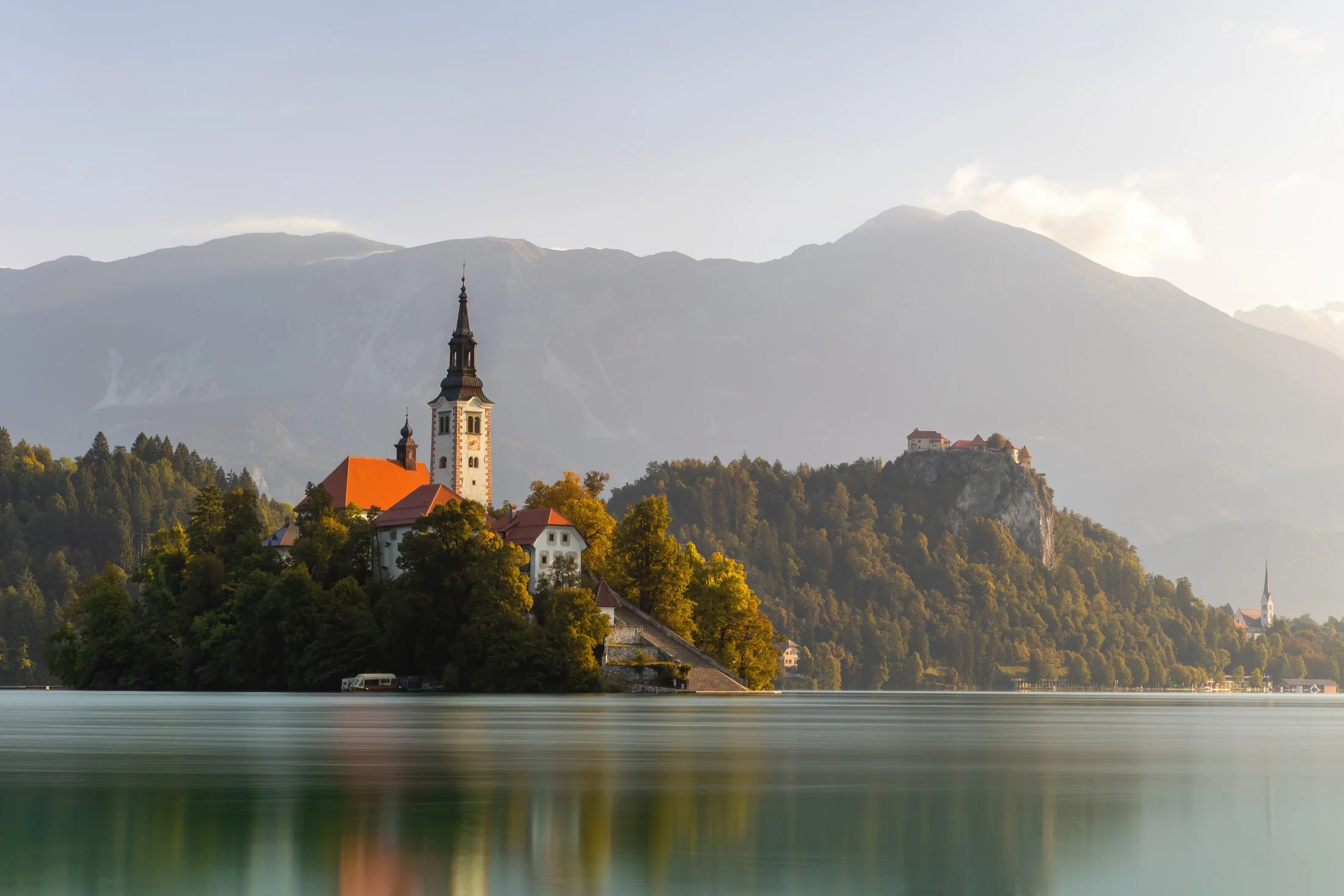
Slovenia Country Profile:
A 50% Top Rate, a Tapering Capital Gains Tax and a New Digital Nomad Permit in the EU's Quietest Corner
Slovenia is a modest source of internationally mobile professionals and HNW families who have outgrown a small, high-tax, high-contribution economy, and a limited destination for EU nationals and, since late 2025, remote workers on a one-year permit. Safe, orderly, alpine and expensive to earn a salary in.
🇸🇮 Key Facts (2026):
Currency: Euro (EUR); roughly 1.17 to USD
Personal income tax: progressive, five bands of 16%, 26%, 33%, 39% and 50%; the 50% band starts at roughly EUR 78,000 of taxable income
Capital income: dividends, interest and rent taxed at a flat, final 25% outside the progressive schedule
Social contributions on salary: employee 22.1%, employer 16.1%, uncapped
Corporate tax: 22% for 2024 to 2028 (a temporary three-point increase from 19% to fund flood reconstruction), reverting to 19% from 2029 unless extended
VAT: 22% standard; reduced rates 9.5% and 5%; registration threshold EUR 60,000
Capital gains: 25% on disposals within five years, 20% after five, 15% after ten, 0% after fifteen years of holding
Wealth tax: none
Estate/inheritance tax: spouse and descendants exempt; parents and siblings 5%–14%; grandparents 8%–17%; unrelated persons 12%–39%, progressive by value
Tax residency trigger: registered permanent residence, habitual residence or centre of personal and economic interests in Slovenia, or 183 days in a tax year
Headline visa thresholds: digital nomad permit on foreign remote income of roughly twice the average net salary, one year, non-renewable; self-employment permit through a Slovenian company with EUR 50,000 invested; EU Blue Card at 1.5 times the average gross wage
Corporate setup: d.o.o. with EUR 7,500 minimum paid-in capital; EUR 0–2,000 (USD 0–2,350) in fees depending on whether the free SPOT point or a notary is used. Annual maintenance: EUR 1,500–4,000 (USD 1,750–4,700)
Personal bank account minimum: nil; monthly fees EUR 3–10
Private banking threshold: roughly EUR 250,000–500,000 investable at NLB, OTP and UniCredit
Cost of living, comfortable professional household in Ljubljana: EUR 4,000–6,000 a month (USD 4,700–7,000)
CRS: participating; early adopter, first exchanges 2017 on 2016 data
FATCA: Model 1 IGA, signed June 2014
Treaties: roughly 60 comprehensive; no treaty with Panama
Population: ~2.1 million
Time zone: UTC+1 (UTC+2 summer)
Last edited: 2 September 2026 by Joe Martin Hanson (Director & Global Partner) with advice from FTR’s Slovenian Tax Partners
Why Slovenia Matters
Slovenia matters to FTR mainly as a source. It is small, wealthy by regional standards, and taxes labour harder than almost anywhere in Central Europe: a professional earning EUR 120,000 gives up roughly half of it between the 50% top band and uncapped contributions. That pushes its engineers, founders, doctors and the second generation of its family businesses to Austria, Switzerland, Dubai and, increasingly, to remote arrangements that need proper cross-border structuring. Slovenian HNW families, many of whom built wealth in the privatisation and export boom since independence, are now dealing with succession, second residences on the Croatian coast and children abroad. That group is FTR's Slovenian client.
It matters second, modestly, as a destination. EU nationals from Austria, Italy and Germany move in for Ljubljana's quality of life and a house in the Julian Alps, and the digital nomad permit introduced in November 2025 opened a one-year door for non-EU remote workers who want the same. None of these people come for the tax.
It matters third as a demonstration of how a capital gains regime that tapers to zero after fifteen years, a 25% flat rate on investment income and no inheritance tax within the family combine to make Slovenia a much better place to hold capital than to earn a salary, which shapes everything FTR builds for a client who stays.
Visa and Residency Routes
EU, EEA and Swiss nationals register at the local administrative unit (upravna enota) within three months on proof of employment, self-employment or sufficient funds and health cover, receive a five-year registration certificate, and qualify for permanent residence after five years. This is the route for most inbound clients.
Non-EU nationals apply for a temporary residence permit at a Slovenian consulate or, where entry is lawful, at the administrative unit. The routes that matter:
The digital nomad permit, available since 21 November 2025, admits a remote worker employed by or contracted to a foreign company, or running a foreign-registered business, with income of roughly twice the Slovenian average net salary, for twelve months. It cannot be extended, the holder cannot work for Slovenian clients, and a fresh application requires six months outside the permit. It is a way to live in Ljubljana for a year and nothing more; it leads nowhere.
The self-employment and business route requires the applicant to have registered a Slovenian company or sole trade for at least six months, or to have invested at least EUR 50,000 in a Slovenian company of which they are a representative, with a business plan and funds to live on. Permits run one year and are renewable, and lead to permanent residence after five. This is the route FTR uses for a non-EU founder who genuinely operates from Slovenia.
The single permit for employment and the EU Blue Card at 1.5 times the average gross wage, roughly EUR 3,500 a month, are the routes for someone hired by a Slovenian employer; the labour market test is waived for shortage occupations and Blue Card holders. Family reunification is routine but slow.
There is no investor visa, no golden visa and no retirement route.
Permanent residence follows five years' continuous legal residence. Citizenship by naturalisation requires ten years' residence, the last five continuous, Slovene at B1 level, and generally renunciation of the previous citizenship; Slovenia is restrictive on dual nationality for naturalised citizens. The route that matters in practice is citizenship by descent for the children and grandchildren of Slovenian emigrants, and a facilitated route for people of Slovenian origin who have lived in Slovenia for a year; for a client with a Slovenian grandparent in Cleveland, Buenos Aires or Melbourne, that is an EU passport with dual citizenship permitted.
Tax Peculiarities and Traps
Registered residence is residence. A person with a registered permanent address in Slovenia is tax resident on that fact alone, before any day count. Slovenians who leave routinely keep their registration for convenience, healthcare or a parent's address, and remain resident on worldwide income for years after moving. Leaving Slovenia for tax purposes means deregistering the permanent address, filing the residency status application with the Financial Administration (FURS) and getting a decision confirming non-residence from a stated date. Without that decision, FURS treats the person as resident, and CRS data from the new country arrives at an authority that is entitled to tax it.
The capital gains taper. Gains on securities, real estate and company shares are taxed at 25% if sold within five years of acquisition, 20% after five, 15% after ten and nothing after fifteen. The rates were cut and then restored between 2022 and 2023, so a client's holding period and acquisition date determine the outcome, and a sale one month short of an anniversary can cost five points. A principal residence occupied for three years is exempt regardless of holding period. Losses are offsettable against gains in the same year only.
Flat 25% on capital income, but no relief for the 50% earner. Dividends, interest and rent are taxed at a final 25% outside the progressive schedule, with rental income reduced by a 10% notional expense deduction. This is the reason owner-managers of a d.o.o. draw the minimum salary and the rest as dividends: a salary above EUR 78,000 attracts 50% tax plus 22.1% contributions, a dividend attracts 25% and nothing else.
The normalised sole trader. A full-time sole trader (normirani s.p.) may deduct 80% of revenue as notional expenses up to a revenue ceiling of EUR 60,000, with a 40% deduction on revenue above that, and pays a flat 20% on the remainder. That is an effective 4% on the first EUR 60,000, plus social contributions. It is the most-used regime for Slovenian freelancers and developers, and its thresholds were tightened in 2025; the part-time variant has lower ceilings.
Uncapped contributions. Employee and employer social contributions of 38.2% combined apply to every euro of salary with no ceiling. There is no equivalent of the Austrian or German contribution cap, and a high salary in Slovenia is the most expensive form of pay in the region.
Inheritance and gift tax outside the family. Transfers to a spouse, partner or descendants are exempt, but a transfer to a sibling, a partner's child, a foundation or a friend is taxed at up to 39%. A Panamanian foundation receiving Slovenian assets by gift is a third-class donee.
No exit tax for individuals, CFC for companies only. Slovenia's ATAD exit tax and CFC rules apply to corporate taxpayers. An individual leaves without a deemed disposal, and a Panamanian company held by a Slovenian resident is not attributed under a CFC rule, though its dividends are taxed at 25% when paid and FURS may treat a company managed from Ljubljana as Slovenian-resident.
The Structural Layer
For a Slovenian resident who stays, FTR's default of a Panamanian Private Interest Foundation over a Panamanian SA with a modest director's salary paid in Slovenia works on the CFC point, since there is no personal attribution, and fails on management: an SA directed from a Ljubljana desk is a Slovenian tax resident at 22%. The build that works has a Slovenian d.o.o. as the operating company for the client's own work, dividends drawn at 25%, and the Panamanian layer above holding international assets and non-Slovenian business with management genuinely outside Slovenia. Distributions from the foundation to a Slovenian resident have no clean category and risk being taxed as other income at the progressive rates, so value flows through the SA as dividends at 25%. The fifteen-year capital gains taper makes holding appreciating assets personally attractive for a client with a long horizon, and FTR models both before recommending the foundation for growth assets.
For a Slovenian leaving, which is the larger segment, the sequence is deregistration first and structure second: cancel the registered address, obtain the FURS non-residence decision, establish residence in the new country under its rules and the treaty tie-breaker, and only then build the Panamanian structure from that residence. A foundation established while the client is still registered in Slovenia is reported back through CRS to an authority that can tax it.
Succession: with the immediate family exempt from inheritance tax, the foundation earns its keep on continuity and forced heirship. Slovenian law reserves half of the intestate share for descendants and the spouse, and a third for parents; a foundation holding non-Slovenian assets sits outside the estate, and a Slovenian will handles domestic property and the business.
Info-Sharing Reality (CRS and FATCA)
Slovenia was an early CRS adopter and has exchanged since 2017. Slovenian banks report non-resident account holders to FURS, which exchanges with roughly a hundred jurisdictions including Austria, Italy, Germany, Croatia, Switzerland, the UAE and Panama. Under the Model 1 IGA, US persons' accounts go to the IRS through Ljubljana.
The consequences follow the registration rule. A Slovenian who moved to Dubai or Zug but kept the Ljubljana address is reported to FURS as a foreign account holder of a Slovenian resident, and FURS has used CRS matching in audit selection since 2019; undeclared foreign dividends and interest at 25% are the usual starting point. An Austrian professional living in Ljubljana with accounts in Vienna is reported to FURS. A Slovenian emigrant in Australia with a Slovenian account is reported to the ATO.
Slovenia has never been marketed as a privacy jurisdiction and is not one. The beneficial ownership register is operational and public to those with legitimate interest, the banking sector is dominated by NLB and by Hungarian, Italian and Austrian groups, and compliance is EU-standard. For Chinese HNW families, Slovenia has no residency product and no discretion to offer.
Banking Reality
NLB is the largest bank and the most used by residents; OTP Slovenia (the merged Nova KBM and SKB), UniCredit, Intesa Sanpaolo Bank, Gorenjska banka, Delavska hranilnica and Addiko complete the market. A resident with a permit and a Slovenian tax number (davčna številka) opens an account in a day. A non-resident can open at NLB and most others with a passport and a tax number, which is obtained from FURS in a day, in person; there is no remote onboarding for non-residents. Corporate accounts for a d.o.o. take two to four weeks and are required to deposit the share capital before registration; the bank will ask why a foreign owner wants a Slovenian company and will expect an answer involving Slovenia.
Slovenia is on no blacklist or grey list, correspondent access is full and SWIFT is unrestricted. The banking sector was recapitalised by the state in 2013 and is now well capitalised and dull. Russian and Belarusian nationals meet enhanced review; US citizens are accepted by the larger banks.
Cost of Doing Business
A d.o.o. needs EUR 7,500 of paid-in capital, which is high for the region and is working capital once registered. A simple single-shareholder company can be formed free of charge at a SPOT point (the one-stop business portal) in a few days; anything with multiple shareholders, a foreign parent or a non-standard constitution goes through a notary at EUR 500–2,000 (USD 600–2,350). Annual accounting, payroll and filings run EUR 1,500–4,000 (USD 1,750–4,700), with e-invoicing to the public sector compulsory and the general regime tightening.
Against the set: a Panamanian SA costs USD 1,500–2,500 to establish and USD 1,000–1,800 a year; Singapore roughly three times the Panamanian setup at USD 4,500–7,500 with USD 4,000–8,000 annual compliance; a Croatian d.o.o. USD 500–1,500 and USD 1,800–4,500; an Austrian GmbH USD 3,500–7,000 and USD 5,000–10,000. Slovenia is cheap to run and expensive to capitalise, and at 22% corporate tax and 25% on dividends it is not where a business goes to save tax.
Cost of Living
Monthly, for Ljubljana; Maribor runs 25%–35% below, and the coast and the Alpine towns match or exceed Ljubljana on housing in season.
Lean, single or couple: EUR 1,800–2,400 (USD 2,100–2,800): one-bedroom in Center, Trnovo or Šiška EUR 800–1,200 in a market with a severe shortage, groceries EUR 400–550, transit pass EUR 37, supplementary health insurance EUR 35–40.
Comfortable, family of four: EUR 4,000–6,000 (USD 4,700–7,000): three-bedroom apartment or house in Rožna Dolina, Bežigrad or Vič EUR 1,600–2,800, one car, supplementary and private cover EUR 200–350, one international school place at EUR 8,000–20,000 a year at Danila Kumar International School, the British International School of Ljubljana or QSI Ljubljana, amortised monthly.
HNW: EUR 9,000 and up (USD 10,500 and up): house in Rožna Dolina or on the Bled or Bohinj lakes, two international school places, help, and a coastal apartment in Piran or across the border in Istria.
Cultural and Practical Considerations
Language. Slovene is a South Slavic language with dual number and a formidable grammar; Croatian or Serbian speakers understand it, nobody else does without study. English is near universal among the under-50s and in business, German widespread near the Austrian border and Italian on the coast. FURS, the administrative units, courts and notaries operate in Slovene, and the B1 requirement for citizenship is a real hurdle. A resident can live in Ljubljana in English for years; dealing with officials without a Slovene speaker is slow.
Bureaucracy. Formal, paper-heavy and slow, with the administrative unit as the gatekeeper for every permit and the davčna številka and EMŠO personal number as prerequisites for everything. Things happen, correctly, later than promised, and the summer closes the system. Corruption is low by regional standards; the more common complaint is rigidity.
Pace, security and scale. Slovenia is one of the safest and quietest countries in Europe: Ljubljana has 300,000 people, a car-free centre, a river and hills within walking distance, and a social life that ends early. Violent crime is rare; the practical risks are burglary of second homes and mountain accidents. Someone who needs a metropolis, anonymity and a nightlife will find it stifling; someone who wants order, nature and a bicycle commute will find it hard to leave.
Women. No legal or practical constraint on women travelling, residing, owning property or doing business alone; female labour participation is among the highest in the EU and women are well represented in the professions. Family law is no-fault with community of property by default.
LGBT residents. Same-sex marriage and joint adoption have been legal since 2022 following a Constitutional Court ruling, and Slovenia is the most liberal country in its region on this measure; Ljubljana is comfortable, rural areas are conservative but not hostile.
Politics and volatility. Slovenian politics alternates between centre-left coalitions and Janez Janša's conservative SDS, and the rhetoric is louder than the policy differences that reach a resident. The 2023 floods, the worst in the country's history, produced the temporary corporate tax increase and a reconstruction programme that is still running. A resident feels politics as periodic tax changes and long-running arguments over healthcare and pensions rather than instability.
Religion, diet, climate. Catholic and moderately observant, with no dietary or dress constraints. Alpine and continental climate with proper winters and hot summers; the Mediterranean coast is forty-five minutes from a ski slope. Air quality in the Ljubljana basin is poor in winter inversions.
Healthcare and schooling. Public healthcare is universal, funded through a compulsory supplementary contribution, and has serious waiting lists for specialists and family doctors; residents use private clinics for speed. State schools teach in Slovene and are good; the international schools in Ljubljana are small and adequate rather than outstanding.
For Retirees
No route without EU citizenship or Slovenian descent; an EU retiree gets a safe, beautiful, well-run base with foreign pensions taxed at progressive rates to 50% and a healthcare system they will supplement privately.
For Digital Nomads and Remote Professionals
The digital nomad permit above: twelve months, no extension, no Slovenian clients, and a six-month gap before another.
For Online Business Owners and Entrepreneurs
A normalised s.p. at an effective 4% on the first EUR 60,000 for a freelancer, or a d.o.o. at 22% with dividends at 25%, with the Panamanian layer above holding non-Slovenian business and managed from outside Slovenia.
For Multinational Business Owners
A Slovenian d.o.o. for a Balkan or Alpine regional operation with strong engineering and pharmaceutical talent; the holding layer sits elsewhere.
For High Net Worth (HNW) Families and Investors
For Slovenian HNW families leaving, the deregistration sequence under The Structural Layer and a hard look at the fifteen-year capital gains taper before selling anything; Slovenia offers no inbound Plan-B product, no privacy and no product for Chinese families.
Common Traps
Leaving Slovenia while keeping the registered permanent address. Establishing a Panamanian foundation before the FURS non-residence decision. Paying yourself a real salary from your own d.o.o. at 50% plus 38.2% contributions. Running a Panamanian company from Ljubljana, which makes it Slovenian. Selling an appreciated asset a month before a five-, ten- or fifteen-year anniversary. Gifting assets to a foundation or a sibling without pricing the inheritance and gift tax.
Slovenia also does not work for anyone who needs an investor or retirement route, for a non-EU nomad who wants more than a year, for a business that wants low tax on profits or salary, or for anyone who needs a large city and a late night.
Next Steps
If you are Slovenian and preparing to leave, or holding appreciated assets and weighing when and where to sell, book a scoping call. The registration rule and the taper are where the money is saved or lost.
Important note: General information. Not personal tax, legal, or financial advice. Speak to a qualified adviser at FTR or elsewhere before acting.
Continue reading
Suggested next, chosen by our partners.


