
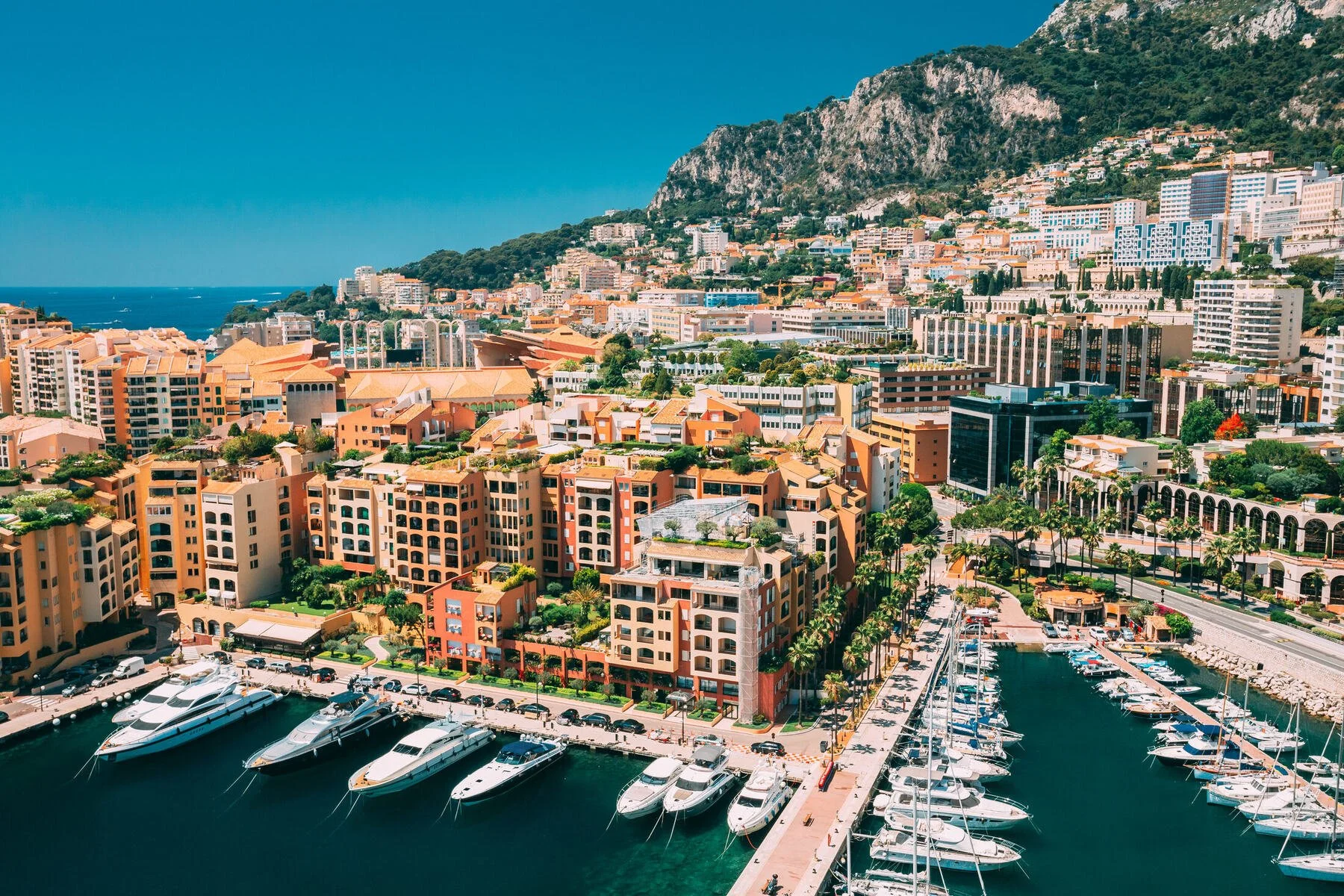
Monaco Country Profile:
The Original Zero-Tax European Address, Priced Accordingly
Monaco is a genuine zero-personal-tax residence for non-French nationals who can show a Monaco bank at least half a million euros and pay the highest rents in the world. It is small, safe, expensive and fully transparent, and for the right HNW family it remains the cleanest tax residency in Europe.
🇲🇨 Key Facts (2026):
Currency: Euro (EUR); ~1.16 USD per EUR (mid-market, September 2026)
Personal income tax: 0% for residents; French nationals taxed by France under the 1963 Franco-Monégasque convention
Capital gains tax on individuals: 0%
Wealth tax: 0%
Estate/inheritance and gift tax: 0% between spouses and in the direct line; 8% between siblings, 10% for uncles, aunts, nephews and nieces, 13% for other relatives and 16% for unrelated beneficiaries; levied only on Monaco-situs assets
Corporate profits tax (ISB): 25% on companies deriving more than 25% of turnover outside Monaco, and on companies earning income from patents and literary or artistic rights; 0% otherwise
VAT: French system applies under the customs union; 20% standard
Property registration duties: 4.5% for transparent purchasers (individuals and civil companies); 7.5% for opaque entities such as offshore companies
Tax residency trigger: residence card holder with principal home in Monaco; a tax residence certificate is issued to those residing more than 183 days a year or whose main home is in the Principality
Residency requirements: accommodation in Monaco (owned, rented or hosted), a Monaco bank reference for sufficient means (in practice EUR 500,000 or more on deposit, many banks asking EUR 1 million), clean criminal record, and for non-EEA nationals a French long-stay visa first
Residency processing time: 4–8 months typical, faster for EEA nationals
Corporate setup and annual maintenance: SARL from EUR 15,000 capital, SAM EUR 150,000; formation EUR 8,000–20,000 (~USD 9,300–23,200) and 3–6 months including government authorisation; annual EUR 8,000–20,000 (~USD 9,300–23,200)
Personal bank account minimum: EUR 500,000–1,000,000 to open a relationship that supports a residency application
Private banking threshold: EUR 1–3 million for a full private banking relationship; some houses lower for residents
Cost of living, comfortable professional household: EUR 15,000–25,000 monthly (~USD 17,400–29,000), housing dominant
Total cost of HNW residency: typically EUR 1 million or more a year including property carrying costs, professional fees and lifestyle
CRS: participating; first exchanges 2018 on 2017 data, under the 2016 EU–Monaco automatic exchange agreement
FATCA: no intergovernmental agreement; Monaco banks comply directly as participating foreign financial institutions
FATF status: placed under increased monitoring (the grey list) in June 2024 following a critical Moneyval evaluation
Treaties: roughly ten comprehensive double tax treaties (France, Luxembourg, Guernsey, Liechtenstein, Mauritius, Qatar, Seychelles, Mali, Montenegro, St Kitts and Nevis), plus around thirty tax information exchange agreements
Population: ~38,000, of whom roughly 9,000 are Monégasque nationals
Time zone: CET, UTC+1 (UTC+2 summer)
Last edited: 30 September 2026 by Joe Martin Hanson (Director & Global Partner) with advice from FTR’s Monaco Tax Partners
Why Monaco Matters
Monaco is the original European zero-tax residency and remains the most exclusive. No personal income tax since 1869, no capital gains tax, no wealth tax, and no inheritance tax between spouses and children. For a British, American, Italian, German, Russian, Swiss or Scandinavian family that genuinely relocates, the zero rate is real, durable and not dependent on any special regime that a future government might repeal: it is the ordinary law of the Principality, protected by the fact that the state funds itself from VAT, corporate tax on outward-facing businesses, real estate duties and the casino and hotel economy.
It matters second for what it offers alongside the tax outcome: a Mediterranean address with Nice airport forty minutes away, the densest private banking sector per head in Europe, a police presence that makes it one of the safest places on earth, and a social environment in which extreme wealth is unremarkable. Switzerland offers a negotiated lump-sum tax, the UAE offers zero tax at lower cost and with faster residency, Panama offers zero tax on foreign income at a fraction of the price; Monaco offers zero tax in Europe with prestige, and charges for it.
It is selective by design. The Principality accepts residents with proven financial capability and a clean background, and the bank reference letter at the heart of the application is the real gate. Monaco is not for the professional earning USD 150,000 a year; it is for the family with a liquid seven-figure sum that wants a European base with no personal tax, and for whom a two-bedroom flat at EUR 10,000 a month is a rounding error.
Visa and Residency Routes
Monaco has one residency route, the carte de séjour, with the same substantive requirements for everyone; what varies is the paperwork depending on nationality.
The residence card. The applicant must show accommodation in Monaco (a purchased property, a lease of at least twelve months, or accommodation with a spouse, parent or partner), sufficient financial means, and good character. Means are evidenced by a letter from a Monaco bank confirming a deposit relationship; the law sets no figure, but banks will not write the letter below EUR 500,000 and several now expect EUR 1 million or more. Character is evidenced by criminal record extracts from the last two countries of residence within the preceding five years, references, and an interview at the Sûreté Publique's residents section. Non-EEA nationals must first obtain a French long-stay visa (type D) from the French consulate in their home country, which adds two to four months; EEA nationals apply directly. Total processing runs four to eight months for non-EEA nationals and two to four for EEA nationals.
Card progression. The temporary card is valid one year and renewed annually for three years; the ordinary card then runs three years; after ten years of residence the privileged card runs ten years. Renewal requires evidence that the holder actually lives in Monaco, and the tax residence certificate that the former home country will ask for is issued only to those who spend more than 183 days a year in the Principality or whose principal home is demonstrably there.
Citizenship. Naturalisation is possible after ten years of residence, at the Sovereign's discretion, and requires renunciation of other nationalities. It is granted rarely and should not feature in any client's plan; Monaco residency is a residence for life, not a passport route.
Business routes. There is no separate investor or entrepreneur visa. A person who wants to run a business in Monaco applies for government authorisation for the activity and for residency in parallel; the business must be genuinely operated from Monaco premises.
FTR uses the residence card for HNW families and successful founders after an exit, with the Monaco bank relationship opened first and the lease signed second. The route that looks good on paper but fails is the marginal one: a client who can just reach the EUR 500,000 deposit and then cannot carry a EUR 6,000-a-month lease, private health cover and school fees will be turned down at renewal or leave within two years.
Tax Peculiarities and Traps
The French-national exclusion. Under the 1963 convention, French nationals who take up residence in Monaco are taxed by France as if they lived in France, on income, wealth and gains, and French inheritance rules follow French nationals too. Only French nationals who have lived continuously in Monaco since before October 1962 are exempt. This is a permanent structural exclusion that cannot be planned around by holding a second passport: France looks to the French nationality, not the other one. Dual French nationals are French for this purpose.
The French inheritance convention. A separate 1950 convention governs inheritance between the two countries. Monaco levies no tax on the direct line, but assets situated in France, and French-resident heirs, fall under French inheritance tax regardless of the deceased's Monaco residence. A Monaco resident with a Paris flat or French-resident children has not left French succession tax behind.
Corporate tax on outward-facing businesses. Monaco has no corporate tax on companies whose activity is local, but companies deriving more than 25% of turnover from outside Monaco pay the impôt sur les bénéfices at 25%. Almost every business an FTR client runs is outward-facing, so a Monaco operating company is taxed at a full European rate, and every business activity requires prior government authorisation, which takes months. The pattern is therefore personal residence in Monaco and the operating company elsewhere. Administrative offices of foreign groups, which perform management or coordination functions without trading, are taxed on a cost-plus basis at a small percentage of their running costs.
Real estate through opaque entities. Since 2011, property bought through a non-transparent entity (an offshore company, a trust, a foundation) pays 7.5% registration duty rather than 4.5%, must appoint a Monaco representative, and must file an annual declaration confirming whether the beneficial ownership changed; an undisclosed change triggers the duty again. Buying through a Panamanian company to hide the owner is expensive and pointless.
Italian and other departure-country presumptions. Italy's tax code presumes that an Italian citizen who moves to a listed low-tax jurisdiction, of which Monaco is one, remains Italian-resident unless the citizen proves otherwise, and the Guardia di Finanza has pursued Monaco residents on the evidence of Italian mobile phone records, cars and children's schools. The UK's statutory residence test, Germany's extended limited tax liability for ten years after departure to a low-tax country, and France's exit tax on substantial shareholdings all bite on the move to Monaco. The zero rate is only as good as the departure.
US citizens. The United States taxes its citizens wherever they live; Monaco gives a US citizen a pleasant address and no tax benefit beyond the foreign earned income exclusion.
The Structural Layer
Monaco has no CFC rules, no exit tax, no wealth tax and no tax on personal investment income, so the structure underneath a Monaco resident exists for succession, asset protection and departure-country management rather than for Monaco tax. FTR's default, a Panamanian Private Interest Foundation owning a Panamanian SA, works in Monaco in its ordinary form: the foundation holds the family's shareholdings, the SA or another operating vehicle sits in a jurisdiction where the business is actually run, and the Monaco resident receives dividends and distributions untaxed.
Two adaptations. First, the operating company should not be managed from a Monaco flat if the business is substantial: a foreign company effectively run from Monaco can be treated as having a Monaco establishment and taxed at 25% on its outward-facing profits, and a Monaco resident running a business without authorisation is in breach of Monaco law. Boards, decisions and staff should be where the company is, typically Panama for Americas operations, the UK, Luxembourg or Ireland for European ones, with the Monaco resident as shareholder rather than day-to-day manager. Second, Monaco real estate should be held personally or through a Monaco civil company (SCI), never through the Panamanian SA, because of the 7.5% opaque-entity duty and the annual declaration regime.
Succession is the reason the foundation earns its place. Monaco applies its own private international law to a resident's estate, allowing a foreign national to elect the law of nationality, and it levies no tax on the direct line, but a family with assets across several countries still needs one vehicle above them that survives the founder without probate in each. The Panamanian foundation does that; for a family with predominantly European assets and European heirs, a Liechtenstein foundation does the same at higher cost with stronger recognition in Germany and Austria. Where the default plainly does not fit is the French national, for whom the foundation is transparent under French rules and the Monaco residence changes nothing, and the US citizen, for whom the foundation is a foreign grantor trust with annual reporting.
Info-Sharing Reality (CRS and FATCA)
Monaco was a discreet banking centre until roughly 2009 and is not one now. It signed the multilateral competent authority agreement, concluded an automatic exchange agreement with the EU in 2016, and made its first CRS exchanges in 2018 on 2017 data. A Monaco bank reports non-resident account holders, and the controlling persons of entities that hold accounts, to the Monaco tax authority, which forwards the data to the account holder's country of residence: the UK, Italy, Germany, Switzerland, Russia where exchange still operates, and the rest of the CRS network including Panama and Colombia. A Monaco resident who has genuinely relocated has nothing reported abroad, because there is no foreign residence to report to; the point is that the residence must be genuine, because the departure country will receive nothing and will look harder as a result.
There is no FATCA intergovernmental agreement. Monaco banks registered directly with the IRS as participating foreign financial institutions and report US persons' accounts under the FATCA regulations; several will not open accounts for US citizens at all because of the compliance cost.
The June 2024 FATF grey-listing changed the practical picture. Moneyval found Monaco's supervision, prosecution and confiscation of money-laundering weak relative to the volume of foreign wealth it hosts; the Principality created a new financial intelligence and supervisory authority, the AMSF, in 2023 and has been working through an action plan since. For clients the effect is heavier onboarding, deeper source-of-wealth questions, slower correspondent handling of large transfers, and occasional friction from foreign banks receiving funds from Monaco. Chinese HNW families should assume that a Monaco account is reported to Beijing under CRS in the same way as one in Switzerland, and that Monaco banks are cautious about Chinese source-of-funds documentation.
Banking Reality
Around thirty banks operate in the Principality, licensed under French banking law through the ACPR and supervised locally by the CCAF and the AMSF. The main names for private clients are CFM Indosuez Wealth (Crédit Agricole), CMB Monaco (Mediobanca), Barclays Private Bank Monaco, Société Générale Private Banking, BNP Paribas Wealth Management, UBS, Julius Baer, Edmond de Rothschild, EFG, Andbank, Banque Havilland and Rothschild & Co. All are correspondent-connected through their French, Swiss or Italian parents; SWIFT and euro clearing are unremarkable.
Opening a relationship as a residency applicant means a first meeting in person, source-of-wealth documentation to the transaction level, a deposit of EUR 500,000 to 1 million or more, and four to twelve weeks before the bank issues the reference letter. Onboarding is thorough but efficient for a client with a clean, documented history; it is slow or impossible for a client whose wealth is recent, crypto-derived without an exchange record, or from a sanctioned or high-risk country. Nationality restrictions in practice: Russian and Belarusian clients face EU sanctions screening applied through the French licence; US citizens are accepted by some houses and declined by others; Chinese clients are accepted with full documentation. Full private banking service starts around EUR 1–3 million. Retail accounts exist at the same banks and at Crédit Agricole and Banque Populaire branches for residents with employment, but there is no low-cost retail sector.
Cost of Doing Business
A Monaco SARL needs EUR 15,000 of capital and a SAM EUR 150,000; both need government authorisation before they can trade, which takes three to six months and requires premises in Monaco, a rare and expensive commodity. Formation costs EUR 8,000–20,000 (~USD 9,300–23,200) with lawyers, notary and registration; annual running costs of EUR 8,000–20,000 (~USD 9,300–23,200) cover accounting, audit where required, the registered office and filings, before rent and staff. Against the set, a Panamanian SA costs roughly USD 1,500–2,500 to establish and USD 1,000–1,800 a year; Singapore runs around three times the Panamanian setup at USD 4,500–7,500 with USD 4,000–8,000 annual compliance; Switzerland sits between Singapore and Monaco. Monaco is among the most expensive places in the set to incorporate and the least useful, because the company pays 25% on outward-facing profits, so FTR does not put operating companies here. The exceptions are a Monaco family office under the 2017 family office law, which can be licensed to manage a single family's affairs, and an SCI to hold the residence.
Cost of Living
Monthly, in Monaco itself; Beausoleil, Cap d'Ail and Menton across the French border are half the price but living there makes the resident French-resident for tax, which defeats the purpose.
Lean, single: EUR 6,000–8,000 (USD 7,000–9,300): a studio or small one-bedroom at EUR 3,000–4,500, private health insurance EUR 200–400, groceries and eating out at French Riviera prices, no car needed.
Comfortable, family of four: EUR 15,000–25,000 (USD 17,400–29,000): a two- or three-bedroom apartment at EUR 8,000–15,000, International School of Monaco at EUR 25,000–40,000 a year per child or the free French-curriculum state schools, private family health cover EUR 500–1,000, a car and a parking space at EUR 300–600 a month.
HNW: EUR 40,000 and up (USD 46,400 and up): a three- or four-bedroom apartment in Monte-Carlo, Larvotto or Fontvieille at EUR 20,000–50,000 a month or purchase at EUR 50,000–100,000 per square metre, staff, boat berth and club memberships; the EUR 1 million-a-year all-in figure is typical rather than extreme.
Healthcare is excellent: the Princess Grace Hospital, a French-standard system next door, and CCSS social insurance for employees; passive residents insure privately.
Cultural and Practical Considerations
Monaco is two square kilometres of apartment towers between a cliff and the sea, with 38,000 residents of whom four in five are foreign, a permanent construction programme, and a Grand Prix that closes the streets each May. It is orderly, formal, French-speaking and safe to a degree found nowhere else: one police officer for every seventy residents, cameras on every corner, and a woman walking home alone at three in the morning is in no danger. It is also crowded, noisy with building works, and socially stratified in a way that new arrivals notice quickly.
Language. French is the official language and the language of the Sûreté Publique, the courts, the tax office and state schools; English is universal in banking, wealth management and the international community; Italian is widely spoken. A resident can run their affairs in English but will deal with officialdom in French.
Integration. Monégasque nationals are a fifth of the population, hold the civil service and protected housing, and do not mix much with the foreign community. Social life for residents runs through the Yacht Club, the Monte-Carlo Country Club, the golf club, the international school parents and the professional community; it is easy to enter with money and hard to enter without, and the expat community substitutes for local integration entirely.
Women, LGBT residents and family law. No legal or practical constraint on women living, travelling or doing business alone. Same-sex civil partnership (the contrat de vie commune) exists since 2020; there is no same-sex marriage or adoption, and Roman Catholicism is the state religion, but neither has any practical effect on daily life or business. Family law follows the French civil tradition; a matrimonial contract before a notary is worth having.
Bureaucracy, pace and climate. Formal, paper-based and slow by Anglo-Saxon standards, but predictable: appointments happen, documents are processed, and the residents section of the Sûreté knows every file. Renewal requires showing up. The climate is Mediterranean, mild in winter, hot and crowded in July and August.
Schooling. State schools follow the French curriculum, free for residents and strong; the International School of Monaco teaches an English and French bilingual programme to the IB. Older children commonly board in Switzerland or the UK.
Politics. A constitutional monarchy under Prince Albert II with a National Council of limited powers; stable, conservative and dependent on France for customs, currency and defence. A resident feels politics as planning decisions and the FATF action plan, not as volatility.
For Retirees
The residence card above suits a retired couple with a liquid seven-figure sum and no French nationality; the state pension and investment income arrive untaxed, healthcare is excellent, and the costs are the only obstacle.
For Digital Nomads and Remote Professionals
No route and no sense: the residence card demands a lease and a bank deposit, and the person must live here more than half the year to hold a tax certificate worth having.
For Online Business Owners and Entrepreneurs
Live in Monaco and keep the company elsewhere, with the tax and authorisation points in Tax Peculiarities; the arrangement suits a founder after a substantial exit rather than one still building.
For Multinational Business Owners
Personal residence here, operating companies and boards abroad, and a Monaco family office if the family's affairs justify a licensed vehicle; the 25% rate on outward-facing Monaco companies rules out the operating company itself.
For High Net Worth (HNW) Families and Investors
The core market. A European or Commonwealth family relocating for zero personal tax and a safe European base, with the Panamanian foundation above the assets for succession. For Chinese HNW families, Monaco is a possible residence with full CRS reporting home and cautious banks; it is not a passport route and it is not private.
Common Traps
French nationals. The 1963 convention makes Monaco tax-neutral for them, and no second passport changes that.
Anyone who cannot comfortably place EUR 1 million with a Monaco bank and carry EUR 10,000 a month or more in living costs; the marginal applicant is refused or leaves.
Italians, Britons, Germans or French residents who take a Monaco card and keep living at home. The departure country's residence test, not Monaco's card, decides where tax is paid, and Monaco is the first place those authorities look.
US citizens seeking a tax outcome; the address is pleasant and the benefit is nil.
Businesses that need to operate from Monaco: authorisation takes months, premises are scarce, and outward-facing profits are taxed at 25%.
Anyone expecting privacy. CRS since 2018, an FATF action plan, and banks that document every transfer.
Anyone who needs space, quiet, nature or a garden; Monaco is a dense, vertical city-state and the countryside is in France.
Next Steps
If you are a non-French HNW family or a founder after an exit, with liquid assets well into seven figures and a wish for a zero-tax European base, book a scoping call. FTR will sequence the Monaco bank relationship, the lease, the residence application and the departure from your current country so that the zero rate is real on both ends.
Important note: General information. Not personal tax, legal, or financial advice. Speak to a qualified adviser at FTR or elsewhere before acting.
Continue reading
Suggested next, chosen by our partners.


