
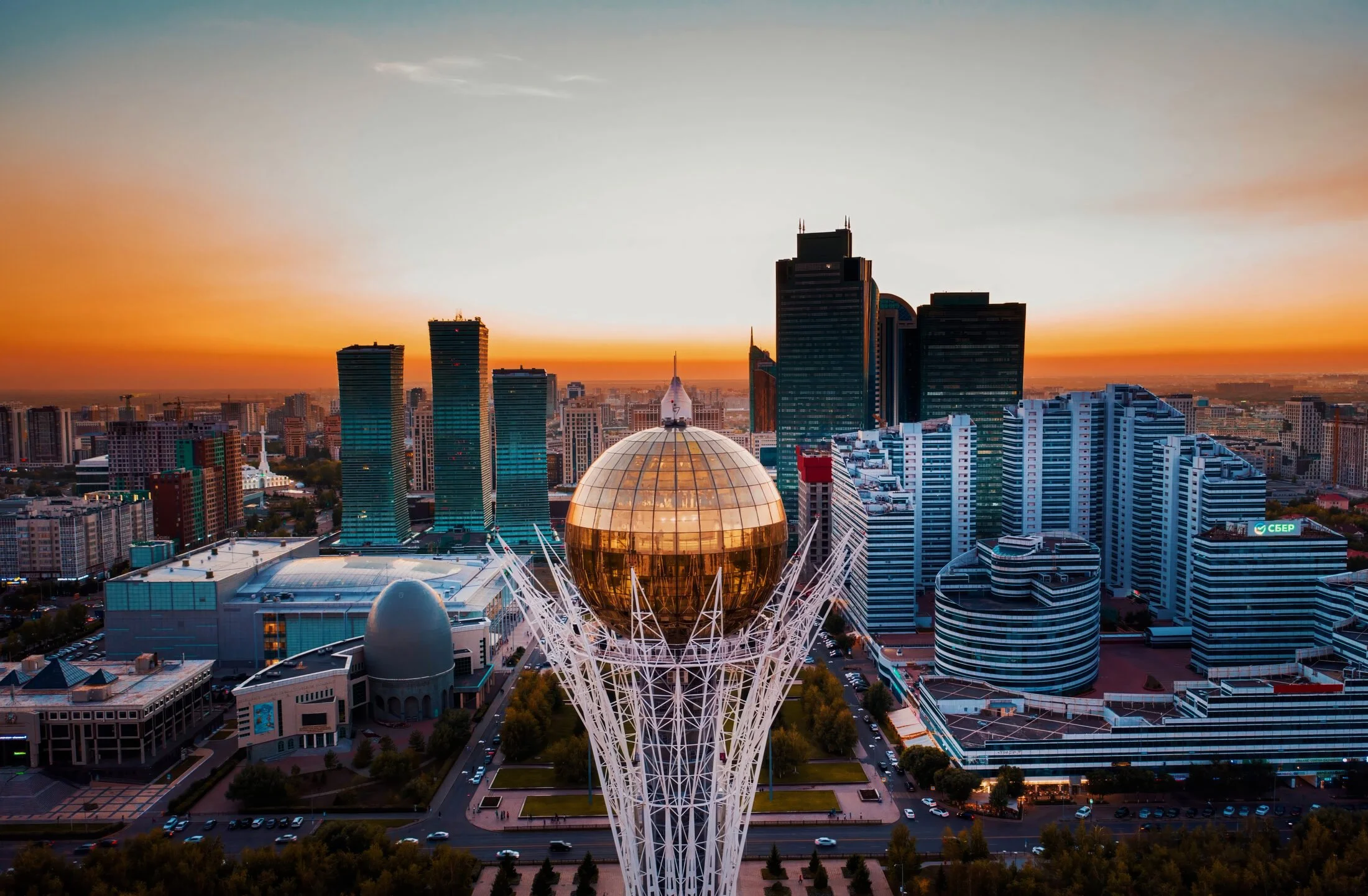
Kazakhstan Country Profile:
Central Asia's Wealth Source, the AIFC, and Where Kazakh Money Actually Goes
Kazakhstan is the largest economy in Central Asia and holds substantial concentrated HNW wealth. Cross-border planning for Kazakh clients turns on the 2026 Tax Code, the no-dual-citizenship rule, CFC and declaration regimes, currency and banking access, and a predictable set of destinations: the UAE, the United Kingdom, the United States, Switzerland and Turkey.
🇰🇿 Key Facts (2026):
Currency: Kazakh Tenge (KZT); ~451 to USD (mid-market, September 2026)
Personal income tax: progressive from 1 January 2026 under the new Tax Code: 10% on annual income up to 8,500 MCI, 15% on the portion above. At the 2026 MCI of KZT 4,325 the threshold is about KZT 36.8 million (~USD 81,500)
Dividends and investment income: dividends generally 5% for residents; gains on securities listed on KASE or AIX exempt; residential property held over one year exempt; other gains at the general rate
Social charges: employee 10% mandatory pension and 2% health; employer social tax, mandatory employer pension contributions rising toward 5%, and health contributions, together roughly 15%–20% on top of salary
Corporate tax: 20% standard; 25% for banks and certain financial and gambling activities; reduced rates for agriculture and social sectors
VAT: 16% standard from 2026 (up from 12%); 5% on medicines and medical devices, rising to 10% from 2027; registration threshold lowered under the new Code
Wealth tax: none; annual property and land taxes at low rates
Estate and inheritance tax: none for residents; inheritance received by non-residents from Kazakh sources can be taxed at the non-resident rate
Tax residency trigger: 183 days in any consecutive twelve-month period, or centre of vital interests (citizenship or residence permit, family and a home in Kazakhstan)
Dual citizenship: prohibited; acquiring another citizenship terminates Kazakh citizenship and must be notified
AIFC (Astana International Financial Centre): English-common-law jurisdiction within Kazakhstan with its own court, arbitration centre and regulator; corporate and personal tax exemptions for participants and their employees legislated to 1 January 2066
Headline visa thresholds: visa-free 30 days for most Western and Chinese nationals; Neo Nomad remote-worker visa at USD 3,000 monthly income; investor residence at USD 300,000 in Kazakh securities or company capital; AIFC investor tax residency programme at USD 60,000 in AIX securities or AIFC participants; citizenship after five years' permanent residence with renunciation of other citizenships
Corporate setup and maintenance: LLP (TOO) ~USD 500–1,500 to establish, ~USD 2,500–6,000 a year; AIFC company registration fees in the low hundreds of USD, ~USD 1,500–4,000 a year with a registered office and AFSA fees
Personal bank account minimum: none; an Individual Identification Number (IIN) is required
Private banking threshold: roughly USD 300,000–1 million investable at Halyk, Jusan and Freedom
Cost of living, comfortable professional household in Almaty or Astana: KZT 1/8–2.6 million a month (~USD 4,000–5,750)
CRS: participating; first exchanges from around 2021
FATCA: Model 1 IGA treated as in effect
Treaties: around 55 comprehensive treaties
Population: ~20.3 million
Time zone: UTC+5 nationwide since March 2024
Last edited: 11 September 2026 by Joe Martin Hanson (Director & Global Partner) with advice from FTR’s Kazakh Tax Partners
Why Kazakhstan Matters
Kazakhstan is Central Asia's largest economy and the source of most of the region's private wealth: oil, gas, uranium, metals, banking, telecoms and, more recently, technology and logistics between China and Europe. That wealth is concentrated in a few thousand families and a larger tier of professionals and business owners, and the demand for cross-border planning from it is notable and rising. It matters to FTR as a source jurisdiction whose clients are already leaving for a well-established set of destinations and who need the Kazakh side of the departure handled properly.
Those destinations are predictable. The UAE for proximity, a welcoming visa regime and an established Russian-speaking and Kazakh community; the United Kingdom as the traditional choice for education and property; the United States, increasingly; Switzerland for banking; and Turkey, which offers accessible citizenship by investment and cultural familiarity. FTR's role is usually to coordinate the Kazakh exit, the destination residency and the structure between them.
The AIFC is the second reason Kazakhstan matters. Since 2018 the Astana International Financial Centre has operated as an English-common-law jurisdiction inside a civil-law country, with its own court staffed by English judges, its own arbitration centre, its own regulator and long-dated tax exemptions. It is used for international financial services, holding companies, private funds, trusts and foundations, and it is the only place in the region where a family office can be built on common-law documents without leaving the country. That makes it a structuring option for Kazakh families who want to keep control at home while holding assets in a familiar legal form.
The third reason is that the rules changed on 1 January 2026. The new Tax Code replaced the flat 10% personal rate with a progressive scale, raised VAT from 12% to 16%, and sits alongside CFC rules, a foreign-asset declaration regime and a ban on dual citizenship that together make a Kazakh departure more technical than the old headline rates suggested.
Visa and Residency Routes
Kazakhstan is visa-free for 30 days for nationals of the EU, the United Kingdom, the United States, Australia, Canada and most OECD countries, and, under the 2023 mutual waiver, for Chinese nationals. Longer stays require a visa and, for most purposes, registration of the foreigner by the host within days of arrival.
The Neo Nomad visa, launched in 2024, admits remote workers employed or contracted outside Kazakhstan with income of at least USD 3,000 a month, for a year at a time; it does not itself lead to permanent residence and is the right tool for a professional testing Almaty rather than settling.
Work permits and business visas are employer-led and sector-quota driven; a foreign specialist hired by a Kazakh company or an AIFC participant obtains a work visa through the employer, and AIFC participants benefit from a simplified regime without quota.
The investor visa grants a multi-year stay and a route to permanent residence for a foreigner investing at least USD 300,000 in securities of Kazakh companies or in the charter capital of a Kazakh entity. The AIFC investor tax residency programme is narrower and more interesting: an investment of USD 60,000 in AIX-listed securities or AIFC participants produces a multi-year investor visa and access to Kazakh tax residency status on a reduced physical-presence basis. For a client who wants a Kazakh tax residency certificate without relocating full-time, this is the route FTR would examine, with the caveat that a certificate obtained on light presence will not survive a home-country tie-breaker challenge if the client's life is demonstrably elsewhere.
Permanent residence requires proof of solvency and a period of temporary residence, and citizenship follows five years' permanent residence, or three for those married to Kazakh citizens, on condition of renouncing any other citizenship. Kazakhstan enforces the single-citizenship rule: a Kazakh who takes another passport loses Kazakh citizenship and is obliged to notify the authorities, and a person who conceals it faces penalties and loss of the right to hold Kazakh property on preferential terms. This single rule shapes every Plan-B conversation with a Kazakh client.
What looks good on paper and fails: using the Neo Nomad visa as a residence pathway, and treating the AIFC investor certificate as a substitute for actually moving.
Tax Peculiarities and Traps
The 8,500 MCI threshold. The progressive scale is expressed in Monthly Calculation Indices, not tenge, and the MCI is reset by each year's budget law; the threshold therefore moves annually. A departing Kazakh executive with a large final-year bonus or a founder receiving a salary above the threshold is now at 15% on the excess, not 10%.
CFC rules bite individuals. Kazakhstan applies its controlled foreign company rules to individuals as well as companies. A foreign company or structure in which a Kazakh tax resident holds 25% or more, directly or through related parties, is a CFC where its jurisdiction has an effective tax rate below 10% or is on Kazakhstan's list of preferential-tax jurisdictions, and its profit is attributed to the resident and taxed as their income whether or not distributed. Panama and the usual Caribbean centres are on that list. An offshore company held by a Kazakh resident is not deferring anything.
Foreign asset and account declarations. The universal declaration programme, rolled out in stages from 2021, was narrowed in 2025 so that ordinary citizens no longer file, but it remains mandatory for civil servants, managers of state and quasi-state entities, founders and participants of legal entities, individual entrepreneurs and their spouses. That definition captures nearly every HNW client. The declaration covers foreign bank accounts above 1,000 MCI, foreign real estate, securities, shares in foreign companies, digital assets and beneficial interests in foreign trusts and foundations.
Departure formalities. A Kazakh citizen leaving for permanent residence abroad goes through a formal exit-for-permanent-residence procedure, including a tax clearance, and a resident who keeps a Kazakh home, family and registration remains resident under the centre-of-vital-interests test whatever the day count. Kazakhstan has no exit tax, but the clearance and the final declaration are where undeclared foreign assets surface.
Non-resident withholding. Kazakh-source income paid to non-residents attracts 20% withholding generally, 15% on dividends and capital gains, and treaty rates only with a residency certificate and, for passive income, evidence that the recipient is the beneficial owner. Payments to entities in preferential-tax jurisdictions attract 20% regardless of character.
Currency. The tenge is managed and volatile; it has lost roughly half its dollar value over a decade and moves with oil and the rouble. Kazakh clients think in dollars and hold in tenge only what they must, and a structure that leaves reserves in tenge is a structure that loses value.
The Structural Layer
For a Kazakh tax resident, FTR's default, a Panamanian Private Interest Foundation owning a Panamanian SA with a modest director's salary paid in Kazakhstan, does not fit. The SA is a CFC on both the low-tax and the listed-jurisdiction limb and its profit is attributed to the resident at 10%/15% as it arises; the foundation is a foreign structure without legal-entity status, which the Code treats the same way, and both are reportable on the annual declaration. Layering does not help; the look-through follows the beneficial owner.
Two adaptations work. The first is the AIFC: a holding company, private fund or foundation registered in the Centre, governed by AIFC common-law rules, with AFSA oversight and the tax exemptions to 2066 on qualifying income. It keeps the family's structure inside Kazakhstan, which matters politically for some families and is the only version that avoids the CFC rules by design rather than by leaving. Its limits are that the exemptions are for qualifying AIFC activity, not a general shelter for a domestic operating business, and that AIFC substance and reporting are real.
The second is departure. Once a client has genuinely ceased Kazakh tax residency, completed the exit-for-permanent-residence procedure and established residency in the UAE, Turkey, the United Kingdom or Switzerland, the default becomes usable on the destination's terms: operating company where the substance sits, foundation above it for succession, director's salary taxed where the client now lives. The order of operations matters. Structures created while resident are declared, attributed and visible; structures created after a clean exit are the destination's business.
For a Kazakh who is staying, the practical structure is a Kazakh LLP for domestic operations, an AIFC holding above it where the group has international assets, and personal wealth in AIX-listed or foreign listed securities where the exemptions apply.
Info-Sharing Reality (CRS and FATCA)
Kazakhstan participates in the Common Reporting Standard, with exchanges running since around 2021, and is a FATCA Model 1 jurisdiction. Kazakh banks report non-resident account holders to the State Revenue Committee for exchange with partners, and the accounts of Kazakh tax residents in the UAE, the United Kingdom, Switzerland, Turkey, Singapore and the EU are reported back to Astana. The belief among Kazakh HNW families that a Dubai or Zurich account is outside the state's view is wrong; the account is reported, and the declaration regime is the domestic instrument that makes use of the data.
The wider point V2 established for the whole set applies here. Every serious destination for Kazakh wealth, including Singapore, Hong Kong, Switzerland, the UAE, Malta, Cyprus, the Cayman Islands, the BVI, the Bahamas and Panama, exchanges under CRS. The United States is the only major jurisdiction outside CRS, and it exchanges with Kazakhstan only to the limited extent FATCA reciprocity allows, which is why the United States appears increasingly on Kazakh clients' lists. What actually removes home-country visibility is a genuine change of tax residency, breaking Kazakh residency and establishing residency elsewhere, not holding accounts abroad and not setting up structures. That is the honest answer for Kazakh families, and for the Chinese families they often sit alongside in Dubai.
Banking Reality
Halyk Bank, Kaspi, ForteBank, Bank CenterCredit, Freedom Bank, Jusan and Eurasian Bank are the domestic names; Citibank Kazakhstan and Bank of China serve corporates. Kaspi is the daily rail for payments and most of urban commerce and is effectively compulsory for living in Kazakhstan. Opening an account requires an IIN, obtainable by a non-resident at a public service centre within days, and identity documents; residents are onboarded in a day, non-residents within a week or two at banks that accept them, with source-of-funds questions asked early. The 2022 arrival of several hundred thousand Russians opening accounts led to tightened onboarding for Russian passport holders and a general wariness about sanctions exposure, which persists.
Dollar and euro accounts are available; currency controls on individuals are light, though large outbound transfers attract documentation requests and export proceeds are subject to repatriation rules. Kazakhstan is on no FATF grey list and no EU blacklist. SWIFT access is normal, but Western correspondent banks apply enhanced scrutiny to Central Asian flows because of Russia re-export concerns, and a payment from a Kazakh bank to Europe can take longer and attract more questions than its size warrants. Private banking exists at Halyk, Jusan and Freedom from roughly USD 300,000, but the wealth that matters is booked in Zurich, Geneva, London and Dubai, and AIFC-licensed private banks and brokers are the domestic alternative for those who want it onshore.
Cost of Doing Business
A Kazakh LLP registers online in days with no minimum capital for small enterprises, at USD 500–1,500 including legal; annual running cost for a small company, with local accounting, VAT and the corporate return, is USD 2,500–6,000. An AIFC company registers with AFSA for fees in the low hundreds of dollars and runs at USD 1,500–4,000 a year with a registered office, more where a regulated activity is involved.
Against the set: a Panamanian SA runs roughly USD 1,500–2,500 to establish and USD 1,000–1,800 a year; Singapore roughly three times the Panamanian setup at USD 4,500–7,500 and USD 4,000–8,000 a year; the UAE moderate, between the two. Kazakhstan is cheap on the entity and expensive on the compliance, because the CFC, declaration and currency rules put the real cost in professional time rather than fees.
Cost of Living
Monthly, for Almaty; Astana runs similar on housing and higher on heating, and both are far above the rest of the country.
Lean, single or couple: KZT 700,000–900,000 (USD 1,550–2,000): one-bedroom in central Almaty KZT 300,000–450,000, groceries KZT 120,000–180,000, transport KZT 20,000, private health cover KZT 25,000–50,000.
Comfortable, family of four: KZT 1.8–2.6 million (USD 4,000–5,750): three-bedroom in Almaty's upper districts or Astana's Left Bank KZT 600,000–1,000,000, one car with a driver's costs KZT 200,000–350,000, private family health cover KZT 80,000–150,000, Kazakh or Russian-language public schooling free, help and activities KZT 250,000–400,000.
HNW: KZT 5 million and up (USD 11,000+): a house in Almaty's foothills, two international school places at USD 20,000–30,000 each per year (Haileybury Almaty or Astana, KIS, QSI, Miras), staff, security, a driver and medical travel to Turkey, Germany or Korea for anything serious.
Cultural and Practical Considerations
Almaty is a green, mountain-backed, Russian-speaking city with a European rhythm and terrible winter air; Astana is a planned capital on the steppe, glass and marble in a wind that reaches minus 30. Kazakh society is hospitable, family-centred and hierarchical, and business runs on relationships and patience. A foreigner who works for an AIFC participant, an international firm or the extractive sector slots into an established expat community that substitutes comfortably for integration; a foreigner outside those channels finds the country friendly, opaque and slow.
Language. Russian is the working language of the cities, banks and business; Kazakh is the state language, growing in use and required for anything official in the regions, with a transition to Latin script under way. English is usable inside the AIFC, in international firms and in the better hotels, and not much beyond. Tax offices, migration police and notaries work in Kazakh and Russian, and a client who has neither needs an agent for everything.
Women, LGBT residents and family law. Kazakhstan is a secular state with a Muslim majority, and women face no legal constraint on travelling, residing, owning property or doing business alone; no guardianship rules apply, dress is unrestricted, and women are prominent in banking, government and the professions. Domestic violence law was substantially strengthened in 2024 after a high-profile murder trial, but enforcement outside the cities remains uneven. Homosexuality has been legal since 1998 with no recognition of partnerships; social hostility is significant, and a 2025 law restricting "propaganda" of non-traditional sexual relations narrows public life further. A same-sex couple can live discreetly in Almaty; they should not expect to live openly. Family law is civil-law with joint marital property by default and enforceable marital contracts.
Religion, diet and conduct. Alcohol and pork are freely available; Ramadan is observed by some and imposed on no one; religious dress in public institutions is restricted rather than required. Bribery is a background feature of permits, traffic policing and construction rather than daily life, and a foreign professional will rarely be asked directly.
Bureaucracy. The eGov portal is genuinely good and most citizen services are digital; foreigners' migration registration, work permits and anything involving a notary are slower and paper-heavy. Deadlines in the tax system are enforced; deadlines everywhere else are approximate.
Climate, health and security. Almaty sits in a major earthquake zone and its winter smog is among the worst in the region; someone with a respiratory or cardiac condition should take that seriously. Astana's winter is extreme continental and its summer short. Violent crime against foreigners is rare; road deaths are not. Public healthcare is patchy, private clinics in the two cities are adequate for routine care, and the wealthy fly out for anything complex.
Politics. Kazakhstan is a stable authoritarian state that had a violent shock in January 2022, when fuel-price protests became nationwide unrest with over two hundred dead and an internet shutdown, and has since consolidated under President Tokayev with constitutional reforms and a managed political opening. Residents feel it as an absence of opposition, a controlled media, occasional internet restrictions and a sense that the rules are set from above. Relations with Russia and China are managed with care, and sanctions pressure on Russia-linked trade is a live business risk. Property rights for foreigners are generally respected, with restrictions on agricultural and border land.
Schooling. Public schools teach in Kazakh or Russian and are of uneven quality; Almaty and Astana have good international schools at prices below London or Dubai.
For Retirees
Not a retirement destination for FTR's readers; the flow is outward.
For Digital Nomads and Remote Professionals
The Neo Nomad visa above for a year in Almaty; the trap is the 183-day and centre-of-vital-interests tests, which a nomad with a Kazakh partner or flat will trip.
For Online Business Owners and Entrepreneurs
For Kazakh founders, the CFC and declaration analysis in Tax Peculiarities, and the choice between an AIFC holding and departure set out in The Structural Layer.
For Multinational Business Owners
A Kazakh LLP for domestic operations, an AIFC entity for regional treasury and holding, and careful attention to the preferential-jurisdiction withholding rules on intra-group payments.
For High Net Worth (HNW) Families and Investors
The core segment. Political and geopolitical concern drives substantial diversification out of Kazakhstan, with the UAE and Turkey the most common landing points and the United Kingdom, the United States and Switzerland close behind. The AIFC is the onshore alternative for families who want to keep control at home. Two rules shape everything: dual citizenship is prohibited, so a Turkish or Caribbean passport means giving up the Kazakh one or concealing it; and CRS plus the declaration regime mean the foreign accounts are visible unless residency genuinely changes. Chinese HNW families in the same Dubai buildings face the same arithmetic; V2's conclusion for them holds for Kazakh families too.
Common Traps
Offshore companies held from Almaty. The CFC rules attribute their profit to the resident at 10%/15% as it arises and the declaration regime reports them; the structure adds cost and removes nothing.
The quiet second passport. Kazakhstan does not permit dual citizenship, and a client who acquires Turkish or Caribbean citizenship and says nothing is committing an offence at home and building a Plan-B on a concealed fact.
Assuming the old 10% flat rate and 12% VAT. Both changed on 1 January 2026, and any planning document carrying them is wrong.
Treating an AIFC investor certificate as tax residency for home-country purposes without moving. The certificate is real; the tie-breaker will still look at where the family sleeps.
Keeping reserves in tenge. The currency has halved against the dollar in a decade and structures that leave working capital in tenge lose value quietly.
Next Steps
Kazakhstan-connected cross-border planning benefits from specialist advisers on both the Kazakh and the destination side, and the order of operations, exit procedure first and structures second, sets the outcome. Book a scoping call.
Important note: General information. Not personal tax, legal, or financial advice. Speak to a qualified adviser at FTR or elsewhere before acting.
Continue reading
Suggested next, chosen by our partners.


