
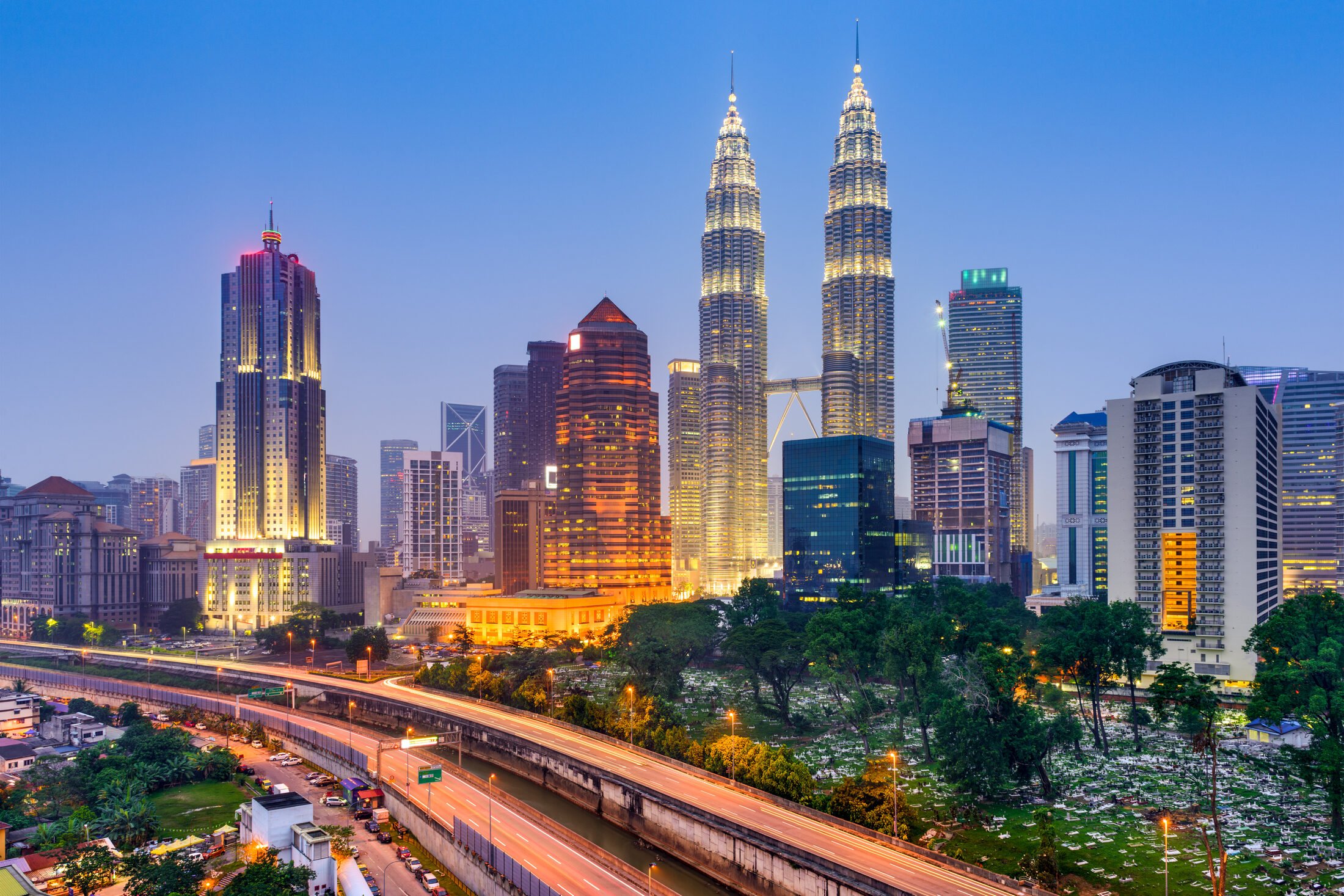
Malaysia Country Profile:
The English-Speaking Asian Base With a Tiered MM2H and a Territorial Tax System
Kuala Lumpur is a serious international city at a fraction of Singapore's cost, with English as a working language and no tax on individuals' foreign income until at least 2036. MM2H is now three tiers, and the question for each client is which tier, or a different pass entirely.
🇲🇾 Key Facts (2026):
Currency: Malaysian Ringgit (MYR); ~4.06 to USD (mid-market, September 2026)
Personal income tax, residents: 0% to 30% progressive, 28% between MYR 1 million and 2 million, 30% above MYR 2 million
Non-residents: flat 30% on Malaysian-source income; employment under 60 days exempt
Foreign-source income, individuals: exempt when received, except partnership business income, under an exemption order to 31 December 2036, subject to Inland Revenue Board conditions
Dividend tax: 2% on an individual's Malaysian dividend income above MYR 100,000 a year from 2025
Corporate tax: 24%; resident SMEs 15% on the first MYR 150,000 and 17% to MYR 600,000, lost where foreign shareholding exceeds 20%; petroleum higher; Labuan trading 3%
Sales and Service Tax: sales tax 5% or 10% by class of goods; service tax 8%, or 6% for food and beverage, telecoms, parking and logistics; scope widened 1 July 2025
Capital gains: 0% for individuals on shares; companies 10% on unlisted Malaysian shares since 2024; Real Property Gains Tax 30% within three years for citizens tapering to 0% after five; non-citizens 30% within five years, then 10%
Wealth tax: none. Estate or inheritance tax: none
Tax residency trigger: 182 days in a calendar year, or 90 days plus residence in three of the four preceding years, or linked periods under Section 7 of the Income Tax Act 1967
MM2H (2024 rules): Silver, fixed deposit USD 150,000, five-year pass, property of at least MYR 600,000; Gold, USD 500,000, fifteen years, property MYR 1 million; Platinum, USD 1 million, twenty years, property MYR 2 million, with work rights; SEZ/SFZ track at lower deposits; 90 days a year minimum stay under 50
Premium Visa Programme (PVIP): MYR 1 million (~USD 246,000) fixed deposit, offshore income MYR 40,000 (~USD 9,850) a month, fee MYR 200,000, twenty years with work rights
DE Rantau Nomad Pass: launched 2022; USD 24,000 minimum income, three to twelve months, renewable once
Employment Pass: Category I from MYR 10,000 a month; Residence Pass-Talent ten years after three years at MYR 15,000 or more
Foreign property floor: MYR 1 million (~USD 246,000) in Kuala Lumpur, MYR 2 million for Selangor landed, lower in Penang and Johor
Corporate setup, Sdn Bhd: MYR 3,000–8,000 (~USD 750–2,000); annual maintenance MYR 8,000–20,000 (~USD 2,000–4,900); Labuan USD 3,000–5,000 setup, USD 3,000–6,000 a year
Personal bank account minimum: MYR 250–1,000, with a long-term pass
Private banking threshold: MYR 3–5 million (~USD 740,000–1.2 million) investable
Cost of living, comfortable professional household in Kuala Lumpur: MYR 15,000–25,000 monthly (~USD 3,700–6,200) before schooling
CRS: participating; MCAA signed 2016, first exchanges 2018 on 2017 data
FATCA: Model 1 IGA, signed 2021, treated as in effect since 2014
Treaties: 70+ comprehensive; no treaty with Panama or Colombia
Population: ~34 million
Time zone: UTC+8, no daylight saving
Last edited: 28 September 2026 by Joe Martin Hanson (Director & Global Partner) with advice from FTR’s Malaysian Tax Partners
Why Malaysia Matters
Kuala Lumpur does something no other Southeast Asian capital does at its price: it functions in English. Banks, hospitals, lawyers, landlords and international schools work in English; the population is Malay, Chinese and Indian; healthcare is sophisticated; and a comfortable life costs well under half of Singapore's, forty minutes away by air. For a client whose business is in Asia and whose budget is not Singapore's, it is the base.
It matters second because its tax system is territorial for individuals and stayed that way when others tightened: foreign-source income received by a resident individual is exempt until at least the end of 2036, with no capital gains tax on shares, no estate duty and no wealth tax. Thailand's 2024 remittance reform pushed part of the Asia-based structuring crowd here.
It matters third as the long-running retirement programme. MM2H has been one of the most accessible long-term residence routes in Asia and one of the most frequently reformed, which has created uncertainty; the 2021 tightening nearly killed it and the 2024 relaunch replaced the single deposit with Silver, Gold and Platinum tiers. Against Thailand, Malaysia has the language advantage and Thailand the larger retiree infrastructure; against Singapore, Malaysia is dramatically cheaper and Singapore holds the higher standard in everything from courts to air.
Visa and Residency Routes
MM2H, 2024 rules. Three tiers at the deposits and property floors in Key Numbers, each a renewable social visit pass with no work right below Platinum. Half the deposit can be withdrawn after a year for property, healthcare or education in Malaysia; the property must be bought within a year and held for ten. Applicants must be 21 or over, dependants and parents can be included, and participants under 50 must spend 90 cumulative days a year in Malaysia; applications go through a licensed agent. The SEZ/SFZ track for the Johor–Singapore zone carries lower deposits, and Sarawak and Sabah run their own variants.
MM2H does not lead to permanent residence or citizenship; it is renewable residence for as long as the deposit stays. Gold is where FTR places most retirees who can lock up USD 500,000, because fifteen years removes the renewal risk that has dogged the programme; Silver suits the modest retiree; Platinum the client who will run a Malaysian business.
Premium Visa Programme (PVIP). Launched 2022 for wealthy individuals who want work rights without an employer, at the figures above; uptake is thin because Platinum MM2H does the same job.
DE Rantau Nomad Pass. The digital nomad route, administered by MDEC: USD 24,000 minimum income for freelancers, a higher tier for foreign employees, three to twelve months renewable once. The 182-day residency rule applies, which in Malaysia is a benefit.
Employment Pass and Residence Pass-Talent. A Malaysian company, including a 100% foreign-owned one with MYR 1 million paid-up capital (MYR 500,000 where Malaysians hold at least 49%), sponsors an EP; Category I at MYR 10,000 a month is a five-year pass, and after three years at MYR 15,000 a month the Residence Pass-Talent gives ten years without a sponsor. A Labuan company director can instead hold a two-year visa.
Permanent residence and citizenship. PR is discretionary and rarely granted, naturalisation effectively unavailable, dual citizenship not permitted. Nobody comes to Malaysia for a passport.
Tax Peculiarities and Traps
The individual foreign-source income exemption and its conditions. From 2022 Malaysia began taxing foreign-source income received in Malaysia, then exempted individuals for all categories except partnership business income, first to 2026 and then to 31 December 2036. The exemption is subject to conditions in the Inland Revenue Board's guidelines, including a requirement for certain categories that the income has borne tax at source; a dividend from a company that paid no tax at source is the case that needs reading carefully, and it is the case FTR's clients present. Companies get no blanket relief: foreign dividends must meet the subject-to-tax condition and foreign gains have been taxable since 2024.
Residence by linked periods. Section 7 of the Income Tax Act treats a person as resident on 182 days in a year, on 90 days plus residence in three of the four preceding years, or where a short period at a year-end links to 182 days across the boundary; a client counting to 181 days is often caught the following year. A non-resident part-year arrival pays 30% flat on Malaysian employment income with no reliefs.
Real Property Gains Tax and the foreign floor. Non-citizens pay 30% RPGT on property gains within five years and 10% thereafter, against a citizen's 0% after five, may only buy above the state-set floors, and cannot buy Malay reserve land or Bumiputera-quota units. MM2H's mandatory purchase lands the participant in a condominium market with poor resale liquidity.
Management and control. A foreign company whose board decisions are taken in Malaysia is Malaysian tax resident under Section 8 and pays 24% on worldwide income; this decides whether an offshore structure survives a Kuala Lumpur address. Smaller items: 2% on Malaysian dividends above MYR 100,000, and service tax on private healthcare and education for non-Malaysians.
Dual family law. Muslims, which by constitution includes all ethnic Malays, are governed by state Sharia enactments in marriage, divorce, custody and inheritance under faraid; non-Muslims are under civil law with testamentary freedom. A foreigner marrying a Malaysian Muslim must convert, the children are Muslim, and a later dispute is heard in the Sharia court; conversion of one spouse during a civil marriage has produced custody outcomes the civil courts could not undo.
The Structural Layer
FTR's default, a Panamanian Private Interest Foundation owning a Panamanian SA with a modest director's salary paid in Malaysia, works here with two adaptations. Malaysia has no controlled foreign company rules and does not tax individuals' foreign income until 2036, so the SA's dividends to a resident individual are exempt on receipt provided the exemption conditions are met, with no remittance test. The director's salary for work done in Malaysia is Malaysian-source, declared and taxed, and kept modest.
The first adaptation is management and control. The SA's board must meet, decide and sign outside Malaysia, with the director in Kuala Lumpur executing rather than deciding; a resident sole director running it from home makes it Malaysian at 24%. Where the business must be run from Malaysia, the operating company should be a Labuan company, taxed at 3% on audited trading profits with substance of two staff and MYR 50,000 of annual local spending, or a Sdn Bhd at 24% if it sells into Malaysia, held from above.
The second is the exemption condition on dividends from a company that paid no tax at source. Where counsel concludes the SA's dividend does not qualify, the client lives on salary and capital, dividends accumulate in the SA, and distributions are timed to years of non-residence or routed through a taxed intermediate.
The foundation does its usual job; for a Muslim client its distribution rules must be reconciled with faraid or the assets kept outside the Malaysian estate. Malaysian HNW families leaving carry no exit tax; the work is RPGT timing, the 30% non-resident rate on retained Malaysian income, and building the offshore layer before Singapore residence begins.
Info-Sharing Reality (CRS and FATCA)
Malaysia has been a full CRS participant since its first exchanges in 2018. Banks report non-resident account holders to the Inland Revenue Board, which exchanges with the full partner list: Singapore, the UK, Australia, China, Hong Kong, Japan, Korea and the rest. Labuan is inside the perimeter; its discretion is history rather than law.
A Chinese HNW family buying into Forest City or an MM2H Gold tier is reported to Beijing on every Malaysian account; a Korean family using MM2H for schooling is reported to Seoul. Malaysia is a comfortable, cheap, English-speaking place to hold assets openly, not, since 2018, a place to hold them quietly. FATCA runs under a Model 1 IGA formally signed in 2021 after years of in-substance compliance. Nobody should sell Malaysia as a privacy jurisdiction; the pitch is territorial tax and cost.
Banking Reality
Maybank, CIMB, Public Bank, RHB and Hong Leong cover the domestic market; HSBC, Standard Chartered, OCBC and UOB serve the international end. A full account needs a long-term pass (MM2H, EP, DE Rantau or PVIP), passport, local address and a Malaysian phone number; opening is same-day in person in English. Minimums are MYR 250–1,000; premier tiers start around MYR 200,000–300,000 and private banking at MYR 3–5 million.
The ringgit is the constraint. It is not internationalised: it cannot be traded or held offshore, foreign currency accounts follow Bank Negara rules, and residents with ringgit borrowing face a MYR 1 million annual limit on investment abroad. MM2H deposits sit in ringgit and carry the currency risk.
Malaysia is on no blacklist or grey list and has full correspondent and SWIFT access. Scam-related freezes have grown since 2024, and an account tied to a lapsed pass can be frozen. Labuan offers a parallel international banking centre, inside CRS, useful for holding-company banking rather than privacy.
Cost of Doing Business
A Sendirian Berhad (Sdn Bhd) costs MYR 3,000–8,000 (~USD 750–2,000) to incorporate, with 100% foreign ownership permitted in most sectors and restricted in retail and wholesale, which need a WRT licence and MYR 1 million capital. Annual secretary, audit and tax compliance runs MYR 8,000–20,000 (~USD 2,000–4,900); a Labuan company costs USD 3,000–5,000 to set up and USD 3,000–6,000 a year, plus substance.
Against the set: a Panamanian SA costs USD 1,500–2,500 to establish and USD 1,000–1,800 a year; Singapore runs about three times Panama on setup, USD 4,500–7,500, with USD 4,000–8,000 annual compliance. A Sdn Bhd sits close to Panama on cost and carries 24% tax; Labuan is priced like Singapore and taxed at 3%, which is why it exists.
Cost of Living
Monthly, for Kuala Lumpur; Penang runs 20%–30% below, Johor Bahru similar because of Singapore commuters.
Lean, single or couple: MYR 6,000–8,000 (USD 1,500–2,000): one-bedroom in Bangsar, KLCC or Mont Kiara MYR 2,500–4,000, health insurance MYR 3,000–6,000 a year under 60, car or Grab MYR 800–1,500, food MYR 1,500–2,500.
Comfortable, family of four: MYR 15,000–25,000 (USD 3,700–6,200) before schooling: three-bedroom condominium in Mont Kiara or Bangsar MYR 5,000–9,000, two cars MYR 2,500–4,000, family health insurance MYR 10,000–20,000 a year, full-time help MYR 2,000–2,500; international schools add MYR 40,000–130,000 per child per year (USD 10,000–32,000).
HNW: MYR 40,000 and up (USD 10,000+): a bungalow in Damansara Heights or Kenny Hills, two top-tier school places, staff.
Private healthcare at Gleneagles, Prince Court, Pantai and Sunway is excellent and a third of Singapore's cost.
Cultural and Practical Considerations
Malaysia is the easiest country in Asia for an English-speaking foreigner, and one whose legal dualism creates real exposure for specific clients.
Language. English is a working language in Kuala Lumpur, Penang and Johor Bahru; Malay is needed at government counters and on forms, which an agent handles. A resident with only English lives fully.
Integration. Malaysian society is plural rather than integrated: Malay, Chinese and Indian communities live alongside one another with distinct institutions, and a foreigner joins the large international layer above them. Bumiputera preference in housing quotas, government contracts, university places and some licences is constitutional and permanent, and shapes what a foreigner can buy.
Religion and conduct. Islam is the official religion and Sharia applies to Muslims in personal matters and morality offences; non-Muslims are outside it in law and mostly in practice. Alcohol is legal, expensive and restricted in Kelantan and Terengganu; pork is sold in designated sections; dress is relaxed in the cities and conservative on the east coast.
Women. No legal constraints on non-Muslim women travelling, residing, holding assets or running businesses alone; KL is safe by regional standards, with snatch theft the main risk. A Muslim woman, including a foreigner who has converted to marry, is under Sharia family law, which permits polygamy for the husband and applies faraid to inheritance.
LGBT residents. Same-sex conduct is criminalised under Sections 377A and 377B of the Penal Code with up to twenty years and corporal punishment, and under state Sharia enactments for Muslims; no same-sex relationship is recognised. Enforcement against foreigners is rare and against Muslims sporadic but real, and the climate has hardened. An LGBT client lives quietly in KL with no legal protection and no derived immigration status for a spouse. FTR says this plainly because the marketing for MM2H does not.
Pace, security and climate. KL is hot, sprawling and traffic-bound, calmer than Bangkok, and a car is needed. Violent crime is low; property crime is not, and Sabah's east coast carries a standing kidnapping advisory. Haze from Indonesian burning settles over the Klang Valley from August to October, a respiratory hazard in bad years.
Bureaucracy and politics. Government works, slowly, through agents; MM2H processing was opaque for years and the 2024 relaunch has improved it. A unity government since late 2022 is stable, under pressure from a conservative Islamic opposition that governs several states; race and religion are the axis of politics, felt as policy, not violence.
Schooling. The Klang Valley has over a hundred international schools across the price range, several among the best value in Asia; Mandarin-medium options draw Chinese families. Public schools are Malay-medium.
For Retirees
MM2H Gold or Silver above, with the property hold and ringgit deposit priced in; no tax on foreign pensions. See The Cross-Border Retirement Playbook.
For Digital Nomads and Remote Professionals
DE Rantau above; Malaysia is nomad-relevant because 182 days of residence costs nothing on foreign income, unlike Thailand. See Article B20.
For Online Business Owners and Entrepreneurs
The default structure with the two adaptations above, or a Labuan operating company where the business must be run from Malaysia.
For Multinational Business Owners
A Sdn Bhd for Malaysian operations under the Panamanian or Singapore holding layer; Labuan for regional trading with real substance.
For High Net Worth (HNW) Families and Investors
Platinum MM2H or PVIP for an Asian base with work rights and no passport. Chinese HNW families are the largest MM2H cohort, drawn by Mandarin schooling, the Chinese-Malaysian community and Forest City, and every Malaysian account they hold is reported to China; a good second home, not a privacy leg.
Common Traps
Coming for a passport or permanent residence: neither is realistically available, and MM2H ends when the deposit leaves. Running the offshore company from a Mont Kiara apartment and expecting it to stay foreign. Assuming the foreign-income exemption covers every dividend from every zero-tax company without reading the guidelines. Buying MM2H property as an investment; the floor, the ten-year hold and the resale market make it a cost of residence.
Entering a Muslim marriage without understanding that conversion, custody and inheritance then run under Sharia. Living openly as a same-sex couple expecting legal protection; the law criminalises you and mostly looks away.
Anyone who wants Singapore's order at Malaysia's price, or cannot manage heat, haze and a car-dependent city, will be disappointed whatever the tax outcome.
Next Steps
If Malaysia fits as your Asian base or MM2H destination, book a scoping call. The tier, the offshore company's management-and-control design and the exemption conditions are the three things to settle before the deposit is placed.
Important note: General information. Not personal tax, legal, or financial advice. Speak to a qualified adviser at FTR or elsewhere before acting.
Continue reading
Suggested next, chosen by our partners.


