
Guatemala Country Profile:
Territorial Tax, Thin Treaties and a Security Question That Has to Be Answered First
Guatemala produces outbound HNW flow to the US and Panama and a small foreign retirement community in Antigua and the highlands. Its territorial tax system is unusually friendly to offshore structures; its security picture is the reason most clients never consider it.
🇬🇹 Key Facts (2026):
Currency: Guatemalan Quetzal (GTQ); ~7.7 to USD, managed by the central bank within a narrow band for over a decade
Personal income tax, employment: 5% on taxable income to GTQ 300,000 (~USD 39,000), 7% above
Personal income tax, business and professional: election between 25% on net profit and the simplified regime of 5% on gross to GTQ 30,000 a month and 7% above
Corporate tax: 25% on net profit, or the simplified 5%/7% gross-receipts regime; 1% solidarity tax (ISO) on assets or gross income for taxpayers on the net-profit regime
VAT (IVA): 12%
Capital gains: 10% flat
Dividend withholding: 5%
Non-resident withholding: 5% dividends, 10% interest, 15% royalties and services, 25% other
Wealth tax: none
Estate/inheritance tax: progressive by amount and relationship, to 25%
Tax system: territorial; only Guatemalan-source income is taxed, for residents and non-residents alike
Tax residency trigger: 183 days in a calendar year, or centre of economic interests in Guatemala
Treaties: no comprehensive double tax convention in force that a client should plan around; party to the OECD Multilateral Convention on Mutual Administrative Assistance since 2017
Guatemala–Colombia treaty: no. Guatemala–Panama treaty: no
Residency thresholds: pensionado or rentista USD 1,000 per month; investor routes discretionary; CA-4 tourist stay 90 days, extendable once
Corporate setup (Sociedad Anónima): USD 1,500–3,000. Annual maintenance: USD 2,000–5,000 including accountant and monthly filings
Personal bank account minimum: GTQ 500–2,000 (~USD 65–260); USD accounts available
Private banking threshold: ~USD 250,000–500,000 at Banco Industrial or G&T Continental
Cost of living, comfortable professional household: USD 2,500–4,500 per month in Antigua or Guatemala City
CRS: not yet exchanging; Global Forum member with no automatic exchange in place
FATCA: no intergovernmental agreement; Guatemalan banks comply directly with the IRS as registered foreign financial institutions
US travel advisory: Level 3, Reconsider Travel (12 March 2026)
Population: ~18 million
Time zone: UTC-6, no daylight saving
Last edited: 2 September 2026 by Joe Martin Hanson (Director & Global Partner) with advice from FTR’s Guatemalan Tax Partners
Why Guatemala Matters
Guatemala matters to FTR first as a source country. It has the largest economy in Central America, a concentrated business elite in agro-industry, banking, construction and consumer goods, and a growing HNW class that diversifies out of the country as a matter of course: property and accounts in Miami, structures and banking in Panama, second residences in Spain and Mexico. That flow is driven by security and institutional risk rather than tax, because Guatemalan tax is light and territorial.
It matters second as one of Latin America's largest labour diasporas. Between two and three million Guatemalans live in the United States, and remittances are close to a fifth of GDP. The planning needs are inheritance of Guatemalan land, property held for parents, and the US tax position of a second generation that has inherited or been gifted assets at home.
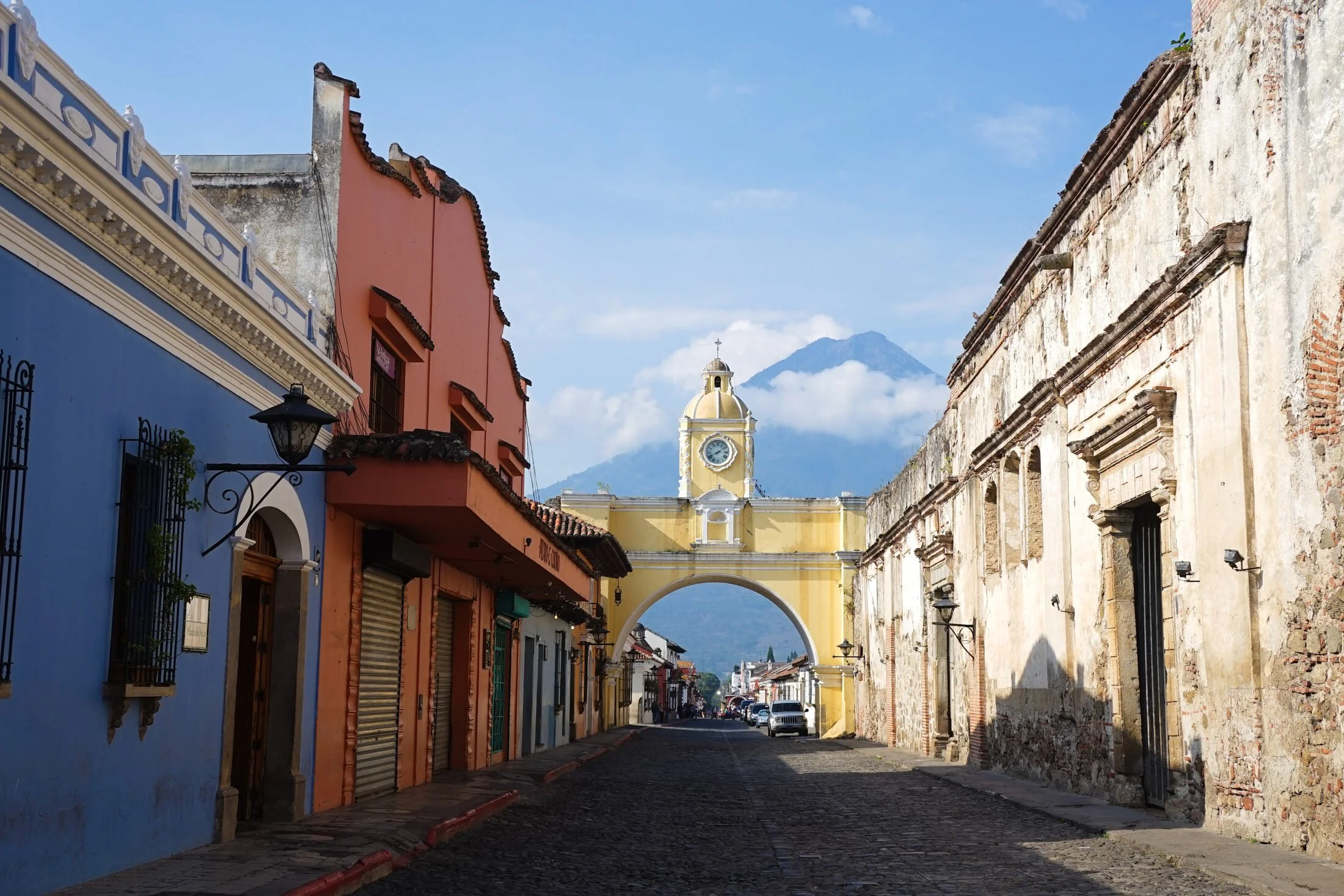
It matters third, and marginally, as a destination. Antigua, the villages around Lake Atitlán and the highland towns host a small foreign retirement and remote-work community drawn by a spring climate at 1,500 metres, colonial architecture, low costs and a large Spanish-school industry. The tax system does not tax their foreign income. The security picture, discussed candidly below, is why this community stays small.
Visa and Residency Routes
Residency is governed by the 2016 Migration Code and administered by the Instituto Guatemalteco de Migración. Every route requires apostilled, sworn-translated documents and a police certificate, and processing is slow: six to twelve months is normal, longer when the file is queried.
Pensionado and rentista. Proof of stable foreign income of at least USD 1,000 a month from a pension or from investments. This is the route for retirees and for anyone living on investment income. It permits residence without local employment, can be converted to permanent residence, and is the route FTR would use for the Antigua retiree.
Temporary residence for work or investment. Granted on a Guatemalan employment contract or on ownership of a Guatemalan business; there is no published capital threshold and approval is discretionary. Renewable, converting to permanent residence after five years.
Permanent residence and citizenship. Permanent residence follows five years of temporary residence, or one year of marriage to a Guatemalan. Naturalisation requires five years of residence, reduced to two for Central Americans and Spaniards under reciprocity rules, with a Spanish language requirement. Dual nationality is tolerated in practice for Central Americans and Spaniards and is otherwise a grey area; few FTR clients would want the passport.
Tourists. Guatemala is part of the CA-4 zone with El Salvador, Honduras and Nicaragua: 90 days across all four countries, extendable once by 90 days, after which a border run to Mexico or Belize resets the clock. Much of the foreign community lives this way for years; it is tolerated, not endorsed, and provides no tax or legal standing. There is no dedicated digital nomad visa.
Routes that look good on paper and fail: any plan that depends on Guatemalan officialdom meeting a deadline, and any client who needs residence quickly for a treaty tie-breaker, because there is no treaty to tie-break.
Tax Peculiarities and Traps
Territoriality. Under the Ley de Actualización Tributaria (Decree 10-2012), Guatemala taxes Guatemalan-source income only. Foreign dividends, foreign capital gains, foreign pensions and foreign rental income received by a Guatemalan resident are simply outside the tax. There are no CFC rules and no foreign trust attribution. For structuring this is the most favourable setting in the region; the trap is assuming it extends to income that is in fact Guatemalan-source, such as fees for services performed in Guatemala or billed to Guatemalan clients, which are taxed and, when paid to a non-resident entity, suffer 15% withholding.
The regime election. Businesses and professionals choose between 25% on net profit, with the 1% solidarity tax on top, and the simplified regime of 5% on the first GTQ 30,000 of monthly gross and 7% above. The simplified regime is attractive for high-margin services and ruinous for low-margin trade, and the election is not freely reversible. Get it wrong and a distribution business pays 7% of turnover on a 10% margin.
The SAT and monthly compliance. The Superintendencia de Administración Tributaria is a modern, aggressive collector with electronic invoicing (FEL) mandatory for essentially everyone. Monthly VAT returns and withholding filings are required from the first month; a foreigner registered as a taxpayer who stops filing accumulates penalties and blocks on future transactions with SAT, including exit stamps on property.
Inheritance and gift tax. Levied under Decree 431 on Guatemalan-situs assets, with rates that rise with the amount and with distance of relationship, to 25% for unrelated beneficiaries. It is a meaningful cost on land and real estate passing within Guatemalan families, and the reason foreign-held property is commonly owned through a Guatemalan company or a foreign entity. Probate is court-based and slow.
Land title. Rural land title in Guatemala is often contested, with overlapping registrations and community claims. Foreigners face restrictions on owning land near borders and coasts. Every purchase needs a registry search at the Registro General de la Propiedad and a Guatemalan lawyer.
The Structural Layer
For a Guatemalan resident, FTR's default fits well. A Panamanian Private Interest Foundation owning a Panamanian SA, with a modest director's salary paid in Guatemala, faces no CFC rule, no attribution, no wealth tax and no tax on the foreign dividends the structure eventually pays. The salary is Guatemalan-source and taxed at 5%/7%, which is nearly the cheapest employment tax in the hemisphere. The foundation does succession work that Guatemalan probate and the inheritance tax would otherwise make slow and expensive, and it keeps assets outside a jurisdiction where kidnapping, extortion and litigation risk make public ownership records dangerous.
Two adaptations. First, the SA should not be the vehicle for Guatemalan-source business; that belongs in a local Sociedad Anónima on the appropriate regime, with the Panamanian layer holding the shares. Second, the foundation should hold the Guatemalan real estate through a local company rather than directly, so that succession is a share transfer rather than a land registry event.
For the US-connected diaspora, the picture inverts. A US person inheriting a Guatemalan finca or a share of the family company has Form 3520, 5471 and FBAR exposure, and a Guatemalan foundation-style arrangement created by parents can be a foreign trust for US purposes. The structure has to be designed from the US side first.
Guatemalan entities have no role in a structure for anyone who is not Guatemalan.
Info-Sharing Reality (CRS and FATCA)
Guatemala is, for now, one of the few countries in FTR's set that does not exchange account information automatically. It joined the Global Forum and ratified the Multilateral Convention on Mutual Administrative Assistance, so exchange on request works and Guatemala can be, and is, asked for information by treaty partners' authorities. But it has not implemented CRS reporting, and Guatemalan banks do not send bulk data to Colombia, Mexico, Spain or anywhere else.
That is not a planning opportunity, and FTR does not treat it as one. The direction of travel is toward joining, Guatemalan banks already comply with FATCA directly as registered foreign financial institutions, reporting US persons to the IRS, and a Guatemalan account held by a resident of a CRS country is undeclared income waiting to be found, not sheltered income. More to the point, the flow runs the other way: Guatemalan HNW families hold their money in Panama, Miami and Madrid, and all three report or are reportable. Panama reports Guatemalan-resident account holders to SAT once Guatemala reciprocates; the US does not exchange under CRS at all, which is why Miami rather than Panama City has become the quiet destination for Guatemalan capital. That should be understood as US policy, not as a Guatemalan planning feature.
Banking Reality
The system is concentrated in a handful of well-capitalised banks: Banco Industrial (the largest), Banrural, G&T Continental, BAM (Bancolombia-owned), Banco Promerica and BAC Credomatic. Guatemala is not on the FATF grey list or the EU list, correspondent access through US banks is stable and SWIFT works normally.
A foreigner can open a personal account with a passport, proof of local address, a local reference and evidence of income, in person and usually in one to three weeks; without a residency card the process is discretionary and some branches refuse. USD accounts are routine. Business accounts need the company's registration, tax number and beneficial ownership declaration, and the compliance interview is thorough. Banks are conservative with cash, wary of remittance-heavy accounts and quick to freeze on SAT enquiry. Private banking at Banco Industrial and G&T Continental starts around USD 250,000–500,000 and offers custody in Guatemala and through Panama and Miami affiliates; most HNW clients bank the serious money offshore and use Guatemala for operations.
Cost of Doing Business
A Guatemalan Sociedad Anónima costs USD 1,500–3,000 to form with a notary and lawyer, requires only nominal capital since the 2018 commercial code reform, and takes two to six weeks including registration with the Registro Mercantil and SAT. Annual maintenance is USD 2,000–5,000 for an accountant handling monthly VAT and withholding filings, electronic invoicing, the annual return and the solidarity tax. The 2018 Sociedad de Emprendimiento is cheaper to form but rarely used.
Against the set: a Panamanian SA costs USD 1,500–2,500 to set up and USD 1,000–1,800 a year, with a fraction of the filing load and no monthly returns. Singapore runs roughly three times Panama's setup, USD 4,500–7,500, with USD 4,000–8,000 annual compliance. Guatemala is Panama's price with a Colombian-style compliance burden, justified only for a business that actually operates in Guatemala.
Cost of Living
Antigua and the better zones of Guatemala City (10, 14, 15, 16) cost more than the country's reputation suggests; Lake Atitlán and the highland towns cost much less and offer much less.
Lean, single or couple, Atitlán or Quetzaltenango: USD 1,200–1,800: rent USD 400–800, groceries USD 300–450, local private clinic cover, chicken buses and tuk-tuks.
Comfortable, couple or family, Antigua or Guatemala City: USD 2,500–4,500: rent USD 900–2,000 for a good two- or three-bedroom, international health insurance USD 250–500, a car with driver-for-hire or a second vehicle, private security or a gated development USD 100–300, school fees where applicable.
HNW: USD 8,000–15,000 and up: a house in Zona 14 or 16 or a finca outside Antigua, Colegio Maya or the American School of Guatemala at USD 10,000–16,000 per child per year, armed driver and household staff, and regular Miami travel.
Healthcare in Guatemala City is good at Hospital Herrera Llerandi, Centro Médico and Hospital Universitario Esperanza, at a fraction of US cost; outside the capital and Antigua it drops sharply, and Atitlán is two to three hours from a hospital. Medevac and out-of-country cover are standard for HNW clients.
Cultural and Practical Considerations
Guatemala carries a US State Department Level 3 advisory, Reconsider Travel, issued 12 March 2026, citing gang violence, carjacking, robbery and low arrest and conviction rates, with specific warnings for San Marcos, Huehuetenango, Guatemala City Zone 18 and Villa Nueva. Those named areas are not where foreigners live, and Antigua, the lake villages and the affluent zones of the capital are materially safer than the national picture. But the national picture is what shapes daily life: gated compounds, armed guards at shops and banks, no night driving on highways, and an extortion economy that touches any visible business. A client who has lived in Mexico City or Bogotá will recognise the routines; one from Auckland or Vancouver will find them oppressive.
Language. Spanish is the floor for everything: banks, SAT, the migration institute, landlords and doctors outside the top private hospitals. Antigua's Spanish-school industry exists for this reason. Twenty-two Mayan languages are spoken in the highlands, and around the lake Kaqchikel or Tz'utujil is the first language of most neighbours.
Women, LGBT residents and family law. There are no legal restrictions on women residing, owning property or running businesses alone, and many foreign women do so in Antigua. Femicide and sexual violence rates are among the highest in the hemisphere, and single women plan movement and housing around that. Same-sex relations are legal, there is no recognition of same-sex partnerships, the 2022 "Protection of Life and Family" bill was shelved after international pressure rather than defeated on the merits, and violence against transgender people is a documented problem. Guatemala is conservative and heavily religious, split between Catholicism and a fast-growing evangelical movement; social life for gay residents is confined to Antigua and a few zones of the capital. Family law follows the civil-law community-property default.
Bureaucracy and institutions. Slow, paper-heavy and personalised. Migration and SAT run on the calendar they choose. The institutional story matters more than the paperwork: the Arévalo government elected in 2023 took office in January 2024 against open resistance from the attorney general's office and parts of the judiciary, road blockades closed the country for weeks in late 2023, and the contest between reformers and the entrenched network the press calls the "pacto de corruptos" is unresolved. A resident feels this as periodic unrest, unpredictable enforcement and a legal system not to be relied on in a dispute with a connected local party.
Climate, environment and health. Guatemala City and Antigua sit at around 1,500 metres with a mild climate that suits older residents. Volcán de Fuego erupts periodically and killed several hundred people in 2018; earthquakes are a fact of life; the May-to-October rains bring landslides and road closures. Dengue is endemic in the lowlands.
Integration and schooling. Guatemalan elite society is closed and family-based; foreigners socialise with other foreigners and with the internationally educated professional class. The Antigua expat community is large enough to be self-contained. International schools in the capital are good and expensive; outside it, options thin to home-schooling or Spanish-language private schools.
For Retirees
The pensionado route above, Antigua or the lake, foreign income untaxed, and a hard conversation about security and distance from a hospital before any property is bought.
For Digital Nomads and Remote Professionals
The CA-4 tourist stamp and Antigua's co-working scene; no tax standing, no visa, and no reason to establish residence when Panama offers the same territoriality with a real programme.
For Online Business Owners and Entrepreneurs
Not a base. If Guatemalan-resident anyway, the Panamanian structure above with the salary at 5%/7%.
For Multinational Business Owners
Guatemalan family groups expanding into Central America use a Panamanian holding above local operating companies; the territorial system and the absence of CFC rules make that unusually clean.
For High Net Worth (HNW) Families and Investors
Guatemala is a source, not a Plan-B. The work is the outbound structure, Panamanian residency or US pre-immigration planning for the next generation, and succession of Guatemalan land and companies through a foundation. There is no Chinese HNW lens here.
Common Traps
Coming to Guatemala for tax. The system is light, but Panama is lighter on friction with a fraction of the security cost, and Guatemala offers no treaty network, no CRS reciprocity to trade on and no banking a Panamanian account does not beat.
Treating the absence of CRS as a place to hide. It is temporary, it does not cover the US, and the Guatemalan banks already report Americans.
Any client, of any nationality, who is uncomfortable with armed security as a feature of daily life, or who needs a functioning court system to enforce a contract against a local counterparty.
Buying rural land or lakeside property on a handshake, or on a title nobody searched.
Next Steps
Guatemalan HNW families structuring outbound, diaspora members inheriting at home, and the occasional retiree set on Antigua: book a scoping call. The first decision is usually whether the money should be in Panama or Miami and what each of those reports.
Important note: General information. Not personal tax, legal, or financial advice. Speak to a qualified adviser at FTR or elsewhere before acting.
Continue reading
Suggested next, chosen by our partners.


