
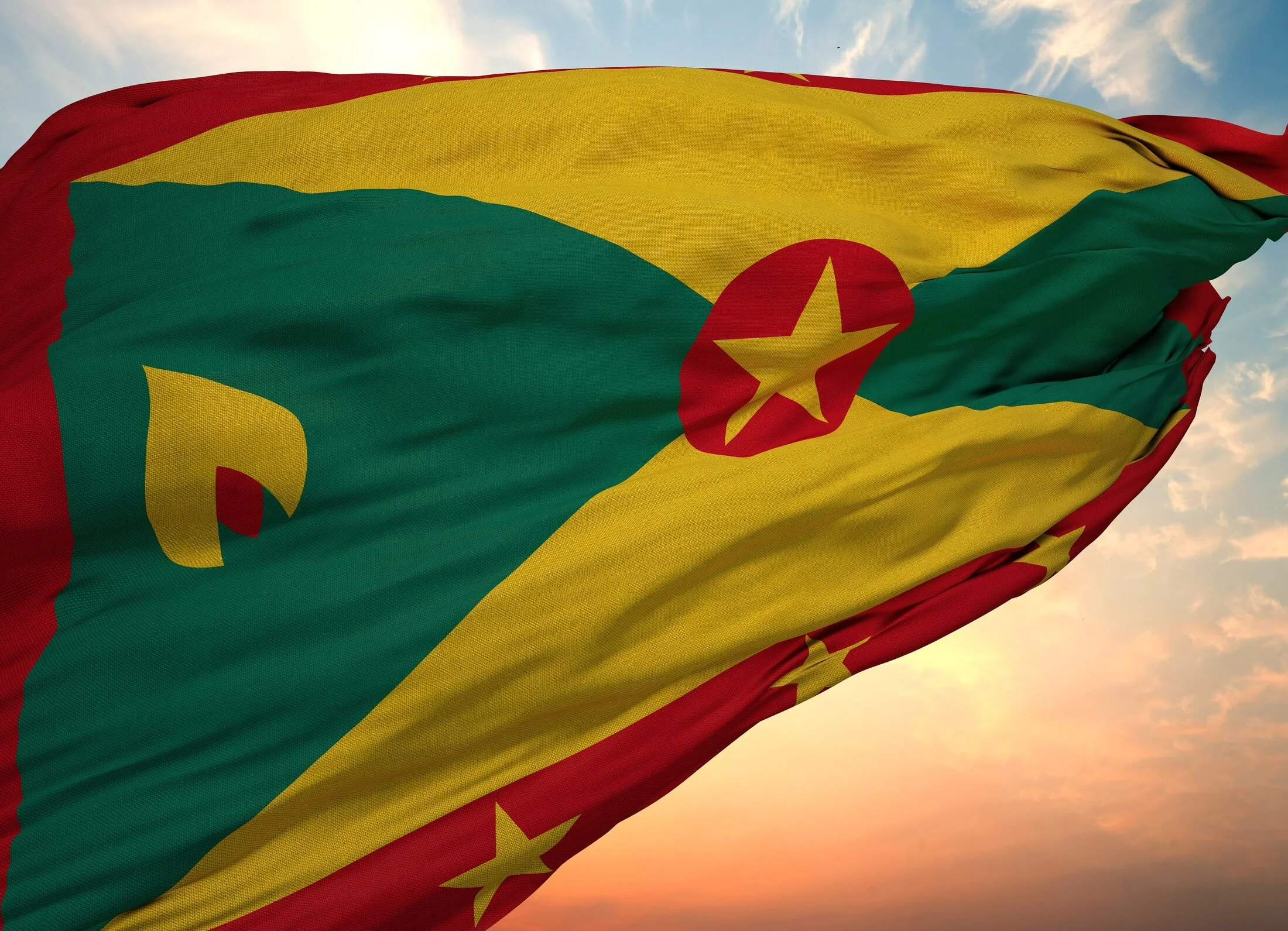
Grenada Country Profile:
The Passport With a US E-2 Treaty Behind It, and the Three-Year Catch
The only Caribbean citizenship-by-investment programme whose passport is backed by a US E-2 investor-visa treaty, and one of the few that reaches China visa-free. Since 2022, US law makes a citizen-by-investment wait three years domiciled in Grenada before the E-2 works, which changes the pitch entirely.
🇬🇩 Key Facts (2026):
Currency: Eastern Caribbean Dollar (XCD); pegged since 1976 at XCD 2.70 = USD 1
Personal income tax: 10% to 28% progressive; first XCD 36,000 (about USD 13,300) exempt, 10% to XCD 60,000, 28% above
Corporate tax: 28%
VAT: 15% standard; 10% on hotel accommodation
Capital gains tax: 0%
Wealth tax: 0%
Estate/inheritance tax: 0%
Property: annual property tax of roughly 0.2%–0.5% of market value; property transfer tax of 5% for citizen vendors and 15% for non-citizen vendors; Alien Landholding Licence of 10% of value for non-national purchasers, waived for approved CBI property
Payroll: national insurance roughly 5% employee and 6% employer
Tax residency trigger: 183 days
CBI, National Transformation Fund: USD 235,000 for a single applicant or family of up to four, since July 2024
CBI, real estate: USD 270,000 for a share in an approved development, held five years, plus a government fee of about USD 50,000 for a family of up to four
CBI due diligence and fees: USD 5,000 main applicant and per dependant aged 17 and over, plus application and processing fees
CBI processing: four to eight months; mandatory interview
CBI presence: none in force; the five Eastern Caribbean programmes agreed in 2025 to move toward a 30-day minimum
Passport: visa-free or visa-on-arrival access to roughly 145 destinations including the Schengen area, the UK, China and Russia; visa required for the US and Canada
US E-2 treaty: in force since 1989; citizens by investment must be domiciled in Grenada for three continuous years before applying, under US law since December 2022
Digital nomad visa: none
Corporate setup: USD 1,500–3,000. Annual maintenance: USD 1,000–2,000
Personal bank account minimum: USD 300–1,000 for residents; USD 5,000–10,000 for non-residents
Private banking threshold: none; there is no private banking on the island
Cost of living, comfortable professional household: USD 4,500–7,000 a month
CRS: participating; first exchanges 2018
FATCA: Model 1 IGA, signed October 2016
Treaties: the CARICOM multilateral agreement and a legacy UK arrangement; nothing useful with the US, Canada, Australia or the EU
EU and FATF lists: on neither; on the FATF non-cooperative list 2001–2003
Population: roughly 113,000, including Carriacou and Petite Martinique
Time zone: UTC-4, no daylight saving
Last edited: 25 July 2026 by Joe Martin Hanson (Director & Global Partner) with advice from FTR’s Grenada Tax Partners
Why Grenada Matters
Grenada's programme sells one thing its Caribbean rivals cannot: a passport backed by a US treaty of commerce and navigation, which makes Grenadian nationals eligible for the E-2 investor visa. E-2 lets a treaty-country national live in the United States while running a substantial business there, renewable indefinitely, with a working spouse and school-age dependants, and without the EB-5 capital and queue. Nationals of India, China, Vietnam, Russia, Brazil and most of the Gulf have no E-2 treaty of their own, and Grenada has been their workaround.
The workaround was narrowed in December 2022. US law now requires a treaty-country national who acquired that nationality by financial investment to have been domiciled in the treaty country for at least three continuous years before applying for E status. A client buying the passport for E-2 today is buying a three-year residence in Grenada first, which is a different product at a different cost, and most of the E-2 marketing has not caught up.
Grenada also reaches China without a visa, which for Chinese HNW families who have taken foreign nationality is the more practical benefit, and it retains UK and Schengen access that Dominica has lost. The island is prosperous by Eastern Caribbean standards, with St George's University and its American medical students underwriting a real rental market and a service economy. It is a better place to live than Dominica or St Kitts, and a passport product first all the same.
Visa and Residency Routes
Citizenship by Investment. Two routes. A non-refundable contribution to the National Transformation Fund of USD 235,000 for a single applicant or a family of up to four, raised from USD 150,000 in July 2024 under the five-state regional agreement on a USD 200,000 floor. Or USD 270,000 for a share in a government-approved development, held five years, with a government fee of about USD 50,000 for a family of up to four on top. Due diligence is USD 5,000 for the main applicant and each dependant aged 17 and over, with application and processing fees on top; interviews are mandatory and processing runs four to eight months. Dual nationality is unrestricted, no residence or visit is required today, and the regional 30-day agreement should be treated as the working assumption. Nationals of Russia and Belarus have been suspended since 2022.
The passport reaches the Schengen area, the UK, Hong Kong, Singapore, China, Russia and most of Latin America without a visa. It does not reach the US or Canada. The US extended its visitor-visa bond regime to Caribbean citizenship-by-investment countries in January 2026, and a Grenadian applicant for a B visa should assume a refundable bond of USD 5,000 to 15,000 applies. Schengen and UK access are policy decisions in Brussels and London, not rights.
The E-2 route. With three years' domicile in Grenada behind it, a Grenadian passport supports an E-2 application: a substantial investment in a real US business the client will direct, typically USD 150,000 or more, a business plan, and a consular interview. E-2 is renewable indefinitely while the business operates, does not lead to a green card, and makes the holder a US tax resident on worldwide income from the day they meet the substantial presence test.
Ordinary residence. A person of independent means can obtain a residence permit with proof of income and accommodation; permanent residence follows discretionary long residence. Work permits are employer-sponsored. There is no digital nomad visa.
FTR would use the programme for a client from a non-treaty country who genuinely plans a US business and will spend three years living in Grenada first, or for a Chinese family that needs a second nationality with China access. The E-2 pitch as sold, buy the passport this year and open the Miami business next year, no longer works and should not be promised. The real estate route fails in practice for the usual reason: the approved resorts are priced for the programme and the share is illiquid.
Tax Peculiarities and Traps
The passport does not move your tax residency. A Grenadian citizen living in Mumbai, Dubai or Shanghai is tax resident there on the same facts as before. Self-certifying to a bank as Grenadian tax resident on the strength of a passport is a false CRS declaration; the bank sees the home address and reports there.
Three years' domicile is a real residence. A client meeting the E-2 domicile rule by living in Grenada is a Grenadian tax resident for those years: salary and business income are taxed at 10% and 28%, with no exemption for foreign residents or retirees. Grenada's absence of capital gains, wealth and estate tax is genuine, but the island is not a zero-tax residence for someone earning a salary.
E-2 makes you a US taxpayer. The E-2 visa is a non-immigrant visa; the tax outcome is not. A holder living in the US is a US tax resident under the substantial presence test, taxed on worldwide income, with FBAR and FATCA reporting on every foreign account and entity, including the Panamanian structure. Exit from the US later is a separate planning exercise.
Property. A non-citizen buying outside an approved CBI project needs a landholding licence at 10% of value and, on resale, pays a 15% transfer tax as a non-citizen vendor against 5% for a citizen. Approved CBI property is exempt from the licence, which is part of its premium.
The Structural Layer
FTR's default is a Panamanian Private Interest Foundation owning a Panamanian SA, with a modest director's salary paid where the client lives. For a Grenadian citizen who lives elsewhere, the passport changes nothing: the structure is built for the country of residence, and its CFC, management-and-control and foreign-trust rules apply in full.
For a client living in Grenada through the three-year domicile period, the default works: Grenada has no CFC rules, the SA's retained profits are not attributed to a resident shareholder, the director's fee is kept modest and taxed at 10% to 28%, and board decisions stay in Panama. Succession through the foundation is unaffected by any Grenadian estate tax or forced heirship, because there is neither.
Where it needs rebuilding: the moment the client lands in the US on the E-2. A US resident who owns a Panamanian SA through a foundation holds a controlled foreign corporation with GILTI, Subpart F and Form 5471 exposure, and the foundation is likely a foreign trust for US purposes with Forms 3520 and 3520-A. The structure that suited Grenada is restructured before the US move, not after. A Grenadian domestic company as an operating entity for a non-Grenadian business does not fit at all; it pays 28%, banks poorly, and the offshore-company regime Grenada once ran was dismantled after the 2001 banking scandal.
Info-Sharing Reality (CRS and FATCA)
Grenada is a CRS participant and has exchanged since 2018. Its banks report foreign tax residents' accounts, and the controlling persons of Grenadian entities, to the Inland Revenue Division for onward exchange with the account holder's country of residence, including China and India. Under the Model 1 FATCA IGA signed in 2016, US persons' accounts, which will include every E-2 holder living in the US, go to the IRS.
The OECD publicly named Grenada among the residence and citizenship-by-investment schemes posing a high risk of CRS circumvention, and banks elsewhere treat a Grenadian passport presented as evidence of tax residency with suspicion. Grenada also carries the memory of the First International Bank of Grenada fraud and the country's 2001 to 2003 spell on the FATF non-cooperative list, after which it closed most of its offshore sector. Chinese HNW families have bought Grenadian citizenship for the E-2 and for China access; the passport travels, it does not change CRS residency, and a client living in Shanghai is reported to Beijing whatever passport was shown at onboarding.
Grenada is a passport jurisdiction with a US treaty attached. It is not a privacy jurisdiction and should not be sold as one.
Banking Reality
Domestic banking is regulated by the Eastern Caribbean Central Bank and is thin but functional. Grenada Co-operative Bank, the local market leader, Republic Bank, which absorbed Scotiabank's business, and ACB Grenada Bank, which took over the CIBC FirstCaribbean operation, serve residents; a resident with a permit or CBI certificate opens an account with USD 300–1,000, local proof of address and a reference, in two to six weeks, in person. Non-resident accounts are possible at USD 5,000–10,000 but slow. There is no private banking and no international banking sector to speak of.
Correspondent banking is fragile, as everywhere in the Eastern Caribbean; wires are slow and occasionally refused by US intermediaries, and card and online banking are basic. FTR clients hold a Grenadian account for local spending and bank in Panama, Miami or Switzerland. Grenada is on neither the EU non-cooperative list nor the FATF grey list; the international attention is directed at the passport programme's due diligence.
Cost of Doing Business
A domestic Grenadian company costs USD 1,500–3,000 to establish through a local agent and USD 1,000–2,000 a year, plus 28% on local profits and VAT registration once turnover crosses the threshold. A Panamanian SA is USD 1,500–2,500 to establish and USD 1,000–1,800 a year, with a Private Interest Foundation above it at a similar order; a BVI BC is USD 1,000–3,000 and USD 1,000–2,500 a year; Singapore runs roughly three times Panama and is the benchmark for a substantive operating company. Grenada is priced like Panama with a higher tax rate and none of Panama's acceptance abroad; incorporate here only for a local business, a villa or the E-2 domicile years.
Cost of Living
St George's, Grand Anse, Lance aux Epines and True Blue, monthly. The SGU student population keeps rents on the southern peninsula higher than elsewhere in the Eastern Caribbean and services better.
Lean, single: USD 2,500–3,500: one-bedroom apartment in Grand Anse USD 800–1,400, private cover with evacuation USD 250–400, groceries USD 450–650, a used car and fuel USD 350–500.
Comfortable, family of four: USD 4,500–7,000: three-bedroom house in Lance aux Epines or Westerhall USD 1,800–3,000, family cover with air evacuation USD 700–1,200, private school places USD 400–800 each a month, two cars, electricity USD 250–450.
HNW: USD 12,000 and up: a villa at a CBI-approved resort, staff, boat, and regular travel to Barbados or Miami for medical care.
Healthcare is basic. St George's General Hospital handles routine and emergency care and the SGU clinic supplements it; serious cases are flown to Barbados, Trinidad or Miami. Evacuation cover is not optional.
Cultural and Practical Considerations
The Spice Island: green, hilly, English-speaking, churchgoing, and livelier than its neighbours because of the university. Three years here, which is what the E-2 route now requires, is a genuine commitment and not a formality.
Women. No legal or practical constraint on women travelling, residing, owning property or doing business alone. Domestic violence is a recognised problem and support services are limited.
LGBT residents. Grenada still criminalises consensual same-sex conduct between men under its Criminal Code, with a ten-year maximum. Prosecutions are rare and the law is under challenge, but it has not been struck down as in Antigua, St Kitts and Dominica. There is no recognition of same-sex relationships. A gay couple planning three years of domicile here should weigh this seriously.
Language and integration. English throughout, with a local creole. Integration is warm but shallow; the foreign community is dominated by SGU faculty and students who rotate through, with a small permanent layer of retirees and CBI investors on the south coast.
Pace, security and bureaucracy. Slow pace, slower government; permits and land transactions take months. Crime is moderate, with burglary and theft the main exposure and occasional violent crime in St George's; safer than St Lucia or St Kitts.
Climate and health. Hot, humid, and at the southern edge of the hurricane belt, which is protection until it is not: Ivan destroyed most of the island in 2004 and Beryl flattened Carriacou and Petite Martinique in July 2024. Power and water are less reliable than the cost suggests.
Schooling. No full international school. Westmorland and a handful of private schools offer a Caribbean curriculum to secondary level; families with older children plan on boarding abroad.
Politics. Stable parliamentary democracy, with a change of government in 2022 that passed without incident. The CBI programme is a diplomatic issue with the US and EU, and its terms change with little notice.
For Retirees
The residence permit above, for someone who wants a livelier island than Dominica with better services, and whose pension is modest enough that the 28% rate does not bite hard.
For Digital Nomads and Remote Professionals
No permit; the passport does not change where a nomad pays tax.
For Online Business Owners and Entrepreneurs
The Panamanian default, unchanged, unless the client is spending the E-2 domicile years here, in which case the Structural Layer above applies and the US restructuring is planned early.
For Multinational Business Owners
Nothing here beyond the E-2 as a personal US access route for a founder from a non-treaty country, three years and a US tax residency later.
For High Net Worth (HNW) Families and Investors
A genuine Plan-B document with UK, Schengen and China access, and the E-2 as a long-dated US option. Chinese HNW families are its largest market; it travels, it does not alter tax residency, and CRS reports to Beijing on the facts.
Common Traps
Buying the passport for a quick E-2: US law requires three years' domicile in Grenada first, and a consular officer will ask for proof of it. Buying it to change your tax residency: it does not, and self-certifying on the strength of it is a false declaration the bank will see through. Buying it for US or Canadian visitor access: both require visas, and the US may want a bond.
Taking the E-2 without US tax planning: the visa is temporary, the worldwide tax residency is not, and an unrestructured Panamanian foundation becomes a US reporting problem. Buying CBI real estate as an investment: it is a resort share priced for the programme. Incorporating locally for a foreign business: 28% and thin banking.
Moving a gay couple here for three years without understanding the criminal law. Moving a professional household here expecting an international school or a serious hospital: there is neither.
Next Steps
If you are a national of a country without a US E-2 treaty and genuinely want to run a US business, or your family needs a second nationality with China and Schengen access, book a scoping call. Bring the timeline: whether you can spend three years domiciled in Grenada decides whether the E-2 pitch is real for you, and the home-country residency position decides the rest.
Important note: General information. Not personal tax, legal, or financial advice. Speak to a qualified adviser at FTR or elsewhere before acting.
Continue reading
Suggested next, chosen by our partners.


