
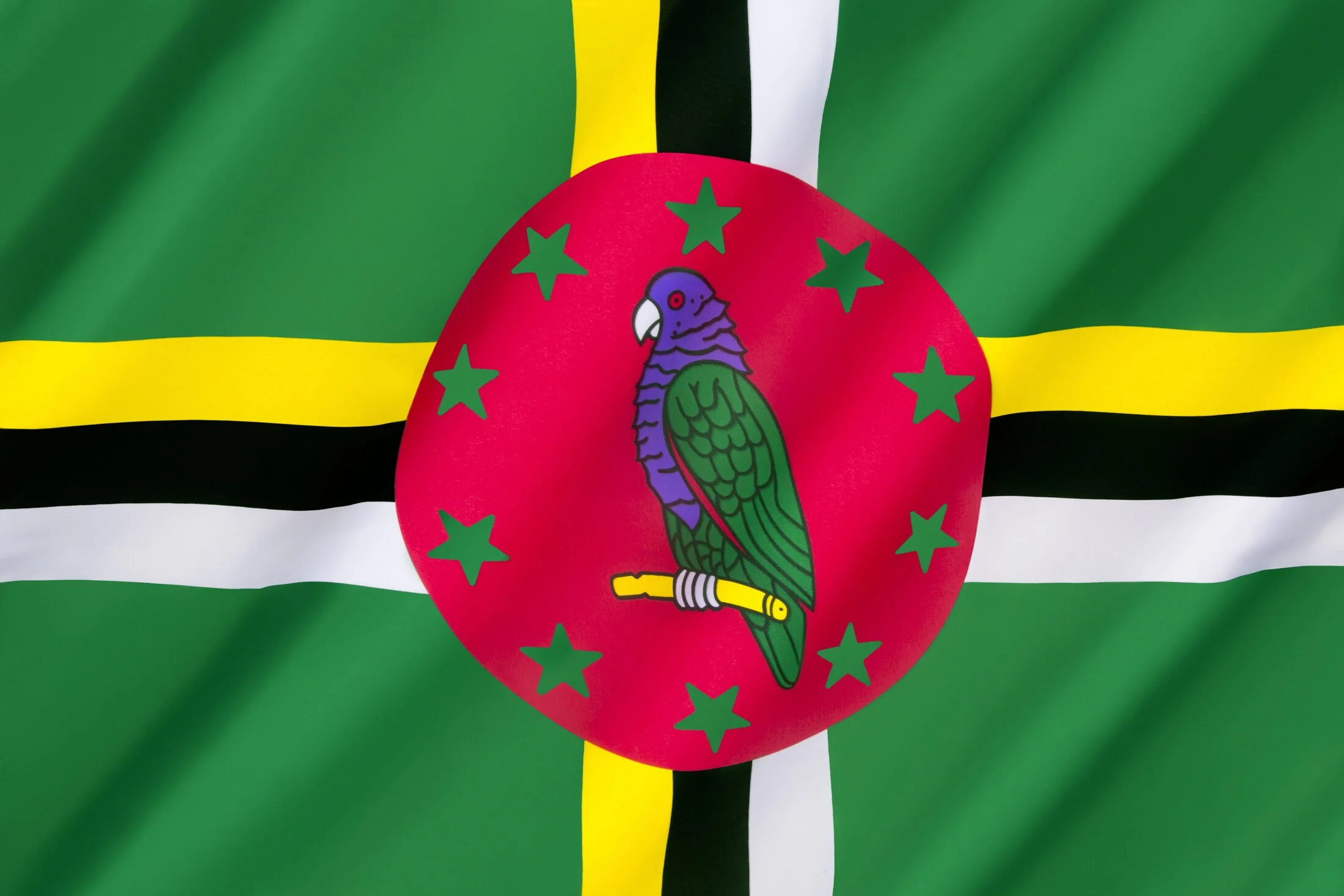
Dominica Country Profile:
The Cheapest Caribbean Passport, and What It No Longer Opens
The lowest-priced of the five Eastern Caribbean citizenship programmes, on a rugged volcanic island with no income-tax advantage, no UK visa-free access any more, and almost no infrastructure for a professional household. A document purchase, priced accordingly.
🇩🇲 Key Facts (2026):
Currency: Eastern Caribbean Dollar (XCD); pegged since 1976 at XCD 2.70 = USD 1
Personal income tax: 0% to 35% progressive; first XCD 30,000 (about USD 11,100) exempt, then 15%, 25% and 35% bands
Corporate tax: 25%; the International Business Company exemption was dismantled from 2019
VAT: 15% standard; 10% on hotel accommodation
Capital gains tax: 0%
Wealth tax: 0%
Estate/inheritance tax: 0%
Property: no general annual property tax outside the Roseau municipal levy; transfer stamp duties and fees of roughly 10% of value split between vendor and purchaser; Alien Landholding Licence of 10% of value for non-nationals, waived for approved CBI property
Payroll: social security roughly 6% employee and 7% employer
Tax residency trigger: 183 days
CBI, Economic Diversification Fund: USD 200,000 for a single applicant since July 2024; USD 250,000 for a family of up to four
CBI, real estate: USD 200,000 in an approved development, held three years, five if resold to another CBI applicant
CBI due diligence and fees: USD 7,500 main applicant, USD 4,000 per dependant aged 16 and over, plus processing fees
CBI processing: three to six months; mandatory interview
CBI presence: none in force; the five Eastern Caribbean programmes agreed in 2025 to move toward a 30-day minimum
Passport: visa-free or visa-on-arrival access to roughly 140 destinations including the Schengen area, China and Russia; visa required for the UK since July 2023, the US (with a visa bond of USD 5,000–15,000 since 21 January 2026) and Canada
Work in Nature extended-stay visa: 18 months, income of USD 50,000 a year, fee USD 800 single, USD 1,200 family
Corporate setup: USD 1,200–2,500. Annual maintenance: USD 800–1,800
Personal bank account minimum: USD 300–1,000 for residents; USD 5,000–10,000 for non-residents
Private banking threshold: none; there is no private banking on the island
Cost of living, comfortable professional household: USD 3,500–6,000 a month
CRS: participating; first exchanges 2018
FATCA: Model 1 IGA, signed June 2018
Treaties: the CARICOM multilateral agreement; nothing useful with the US, Canada, Australia or the EU
EU and FATF lists: on neither
Population: roughly 72,000
Time zone: UTC-4, no daylight saving
Last edited: 10 August 2026 by Joe Martin Hanson (Director & Global Partner) with advice from FTR’s Dominica Tax Partners
Why Dominica Matters
Dominica runs the cheapest of the five Eastern Caribbean citizenship-by-investment programmes and has done since it opened in 1993. At USD 200,000 for a single applicant it undercuts Antigua, St Kitts, Grenada and St Lucia by USD 30,000–50,000, and its processing has been the fastest in the region. That is the whole commercial case. Not to be confused with the Dominican Republic, a different country with a different programme and ten times the population.
The passport has been losing value. The UK withdrew visa-free access in July 2023, citing abuse of the scheme, and the US added Dominica to its visa-bond regime from January 2026. What remains is Schengen, most of Latin America, and, unusually, visa-free entry to China and Russia, which is why Dominica has been a volume seller to Chinese and Russian families for two decades and why its programme attracts the scrutiny it does.
The island itself is the Caribbean's least developed and most beautiful: volcanic, forested, wet, with no beach-resort economy and a government that depends on CBI revenue for roughly half its budget. It suits a retiree who wants quiet and rainforest and can live with one hospital and no direct long-haul flights. It does not suit a working professional household, and FTR would not move one here.
Visa and Residency Routes
Citizenship by Investment. Two routes. A non-refundable contribution to the Economic Diversification Fund of USD 200,000 for a single applicant, raised from USD 100,000 on 1 July 2024 under the five-state regional agreement on a USD 200,000 floor, or USD 250,000 for a family of up to four with additional dependants priced individually. Or USD 200,000 in a government-approved real estate development, typically a share in a resort, held three years, or five if sold on to another CBI applicant. Due diligence is USD 7,500 for the main applicant and USD 4,000 per dependant aged 16 and over, with processing fees on top. Interviews have been mandatory since 2023 and processing runs three to six months. No residence or visit is required today; the regional 30-day agreement should be treated as the working assumption. Nationals of Russia, Belarus, Iran, North Korea and several other countries are excluded.
The passport reaches the Schengen area, Hong Kong, Singapore, China, Russia and most of Latin America. It no longer reaches the UK without a visa, and the US requires a visa and, since 21 January 2026, a refundable bond of USD 5,000, 10,000 or 15,000 for visitor-visa applicants. Canada requires a visa. Schengen access is a policy decision in Brussels under the EU's investor-citizenship suspension mechanism, and Dominica is the programme most often named when that mechanism is discussed.
Work in Nature. An 18-month extended-stay visa for remote workers earning USD 50,000 or more from outside Dominica, fee USD 800 for a single applicant and USD 1,200 for a family. No local tax on the foreign income, no path to permanent residency.
Ordinary residence. A person of independent means can obtain a residence permit with proof of income and accommodation; permanent residence follows after five years, and naturalisation is discretionary. Work permits are employer-sponsored and slow.
FTR would use the CBI programme only for a client who needs a second nationality at the lowest cost and does not need the UK or US, typically a family from a country with a weak passport and China or Russia on its travel map. For a client who wants a Caribbean home, Antigua or St Lucia are better islands and St Kitts a better zero-tax one. The real estate route fails in practice: the approved resorts are priced for the programme and the share is illiquid until the hold expires.
Tax Peculiarities and Traps
The passport does not move your tax residency. A Dominican citizen living in Toronto, Frankfurt or Shanghai is tax resident there on the same facts as before. Self-certifying to a bank as Dominican tax resident on the strength of a passport is a false CRS declaration; the bank sees the home address and reports there.
Dominica has an income tax. Unlike Antigua or St Kitts, a client who actually becomes resident pays up to 35% on income once resident, and the top band arrives at about USD 30,000 of taxable income. There is no special regime for foreign residents or retirees; a pension or director's salary paid to a Dominican resident is taxed at Dominican rates. The absence of capital gains, wealth and estate tax is real, but it does not make Dominica a low-tax residence for someone earning a salary.
The 2019 reforms. Under EU pressure Dominica dismantled the exemption that made International Business Companies tax-free for twenty years by statute. An IBC formed before then may still be inside a grandfathering window; a new entity with local management is a domestic company at 25%. The Dominican IBC is no longer a product.
The Alien Landholding Licence. A non-national buying land outside an approved CBI project needs a licence at 10% of value, on top of transfer duties of roughly 10% split between the parties. Approved CBI property is exempt, which is a large part of its premium.
The Structural Layer
FTR's default is a Panamanian Private Interest Foundation owning a Panamanian SA, with a modest director's salary paid where the client lives. For a Dominican citizen who lives elsewhere, which is almost all of them, the passport changes nothing: the structure is built for the country of residence, and its CFC, management-and-control and foreign-trust rules apply in full.
For the rare client actually tax resident in Dominica, the default still works but the salary is taxed at Dominican rates up to 35%, so the director's fee is kept modest and the retained profits stay in the SA. Dominica has no CFC rules, so undistributed SA profits are not attributed to a resident shareholder, and no estate tax or forced heirship interferes with the foundation's succession function. Board decisions stay in Panama to keep the SA outside Dominican management-and-control.
What does not fit: a Dominican domestic company as the operating entity for a non-Dominican business, or any expectation that a Dominican entity is accepted abroad. It pays 25%, banks poorly, and the exempt regime it replaced is gone.
Info-Sharing Reality (CRS and FATCA)
Dominica is a CRS participant and has exchanged since 2018, later and less smoothly than its neighbours. Its banks report foreign tax residents' accounts, and the controlling persons of Dominican entities, to the Inland Revenue Division for onward exchange with the account holder's country of residence, including China. Under the Model 1 FATCA IGA signed in 2018, US persons' accounts go to the IRS.
The OECD publicly named Dominica among the residence and citizenship-by-investment schemes posing a high risk of CRS circumvention, and the programme's history, including diplomatic passports sold to people later prosecuted abroad, is why the UK withdrew visa-free access and why banks elsewhere look hard at a Dominican passport presented as evidence of residency. Chinese HNW families have bought Dominican citizenship in volume, for Schengen and for a second document; the passport travels, it does not change CRS residency, and a Chinese resident's accounts are reported to Beijing whatever passport was shown at onboarding.
Dominica is not a privacy jurisdiction and, unlike Nevis, does not even offer creditor protection. It offers a passport.
Banking Reality
Domestic banking is regulated by the Eastern Caribbean Central Bank and is minimal. National Bank of Dominica, the government-owned market leader that has absorbed departing foreign banks' operations, and Republic Bank, which took over Scotiabank's business, serve residents; a resident with a permit or CBI certificate opens an account with USD 300–1,000, local proof of address and a reference, in two to six weeks, in person. Non-resident accounts are possible at USD 5,000–10,000 but slow and reluctantly given. The small offshore banking sector licensed in the late 1990s has largely closed.
Correspondent banking is fragile; wires route through a shrinking number of US intermediaries and are slow, and card acceptance and online banking are basic. There is no private banking. FTR clients who hold a Dominican passport bank in Panama, Switzerland or Singapore and never open a Dominican account. Dominica is on neither the EU non-cooperative list nor the FATF grey list; the international attention is directed at the passport programme.
Cost of Doing Business
A domestic Dominican company costs USD 1,200–2,500 to establish and USD 800–1,800 a year, plus 25% on local profits and VAT registration once turnover crosses the threshold. A Panamanian SA is USD 1,500–2,500 to establish and USD 1,000–1,800 a year, with a Private Interest Foundation above it at a similar order; a BVI BC is USD 1,000–3,000 and USD 1,000–2,500 a year; a Nevis LLC, the asset-protection comparison, USD 3,000–8,000 and USD 2,000–5,000 a year; Singapore runs roughly three times Panama. Dominica is cheap on paper and expensive in practice, because a Dominican entity is accepted almost nowhere and needs a foreign bank that will take it. There is no reason to incorporate here except for a local business.
Cost of Living
Roseau and the Portsmouth area, monthly. Cheaper than the resort islands, with less to buy. Access is via Antigua, Barbados, Guadeloupe or Martinique; a new international airport funded by CBI revenue is under construction.
Lean, single: USD 2,000–2,800: one-bedroom apartment USD 500–900, private cover with evacuation USD 250–400, groceries USD 400–600, a used four-wheel drive and fuel USD 350–500.
Comfortable, family of four: USD 3,500–6,000: three-bedroom house in Roseau's hills or Portsmouth USD 1,200–2,500, family cover with air evacuation USD 700–1,200, private school places USD 200–500 each a month, two vehicles, electricity USD 250–400.
HNW: USD 10,000 and up: a villa at a CBI-approved resort or a private estate, staff, and regular travel to Martinique, Barbados or Miami for medical care and most other things.
Healthcare is basic: the Chinese-built Dominica-China Friendship Hospital in Roseau handles routine and emergency care and serious cases go to Martinique, Barbados or Miami. Evacuation cover is not optional.
Cultural and Practical Considerations
The Nature Island: mountainous, rain-soaked, largely unspoilt, with a population of 72,000 that has shrunk since Hurricane Maria and a pace of life that makes Antigua look brisk. It is the right island for a small number of people and the wrong one for most.
Women. No legal or practical constraint on women travelling, residing, owning property or doing business alone. Domestic violence is a recognised problem and support services are thin.
LGBT residents. The High Court struck down the colonial-era criminalisation of consensual same-sex conduct in April 2024. There is no recognition of same-sex relationships, churches are influential, and discretion is expected.
Language and integration. English is official; Kwéyòl, a French-based creole, is widely spoken outside Roseau and matters for daily life in villages. Integration is warm and slow; the expat community is a few hundred people, mostly retirees and volunteers, and thinner still since the Ross University medical school left Portsmouth after Maria.
Pace, security and bureaucracy. Very slow. Government runs on personal relationships, permits and land transactions take months, and things do not happen on time. Crime is low by Caribbean standards; burglary and opportunistic theft are the main exposure.
Climate and health. Hot, humid and very wet; Hurricane Maria destroyed most of the island's housing in September 2017 and Erika did serious damage in 2015. Roads, power and water fail after storms and take months to recover. Mosquito-borne illness is a routine risk.
Schooling. No international school. A few small private schools offer a Caribbean curriculum; families with children beyond primary age plan on boarding abroad.
Politics. A parliamentary democracy under one prime minister and party since 2004, with an opposition that boycotted the 2022 election and recurring protests over electoral reform. The CBI programme is the state's main revenue and its main controversy; policy changes arrive with little notice, and the programme's standing with the EU and US is a permanent risk to what the passport is worth.
For Retirees
The residence permit above, for someone who wants rainforest and quiet, can live with one hospital and no direct flights, and has pension income modest enough that Dominican rates up to 35% do not bite hard.
For Digital Nomads and Remote Professionals
Work in Nature above; it does not change where a nomad pays tax.
For Online Business Owners and Entrepreneurs
The Panamanian default, unchanged; Dominica is not the residence.
For Multinational Business Owners
Nothing here.
For High Net Worth (HNW) Families and Investors
The passport is the cheapest genuine Plan-B document in the set for a family that does not need the UK or US and values Schengen plus China and Russia access. Chinese HNW families have been its largest market; it travels, it does not alter tax residency, and CRS reports to Beijing on the facts.
Common Traps
Buying the passport to change your tax residency: it does not, and self-certifying on the strength of it is a false declaration the bank will see through. Buying it for UK, US or Canadian access: the UK withdrew visa-free entry in 2023, the US wants a visa and a bond, Canada wants a visa. Assuming Schengen access is permanent: Dominica is the programme the EU's suspension mechanism was written with in mind.
Moving here to save tax: Dominica has a 35% top rate that starts low, and no retiree or foreign-resident regime. Buying CBI real estate as an investment: it is a resort share priced for the programme and illiquid until the hold expires. Incorporating locally: the exempt regime is gone.
Moving here for a comfortable professional life: no international school, one hospital, no direct long-haul flights, hurricane recovery measured in years, and a pace that most people who have not lived on a small island underestimate.
Next Steps
If your home passport restricts your travel and you need a second nationality at the lowest cost without UK or US access, book a scoping call. Bring the list of countries you actually need to reach and the home-country residency position; between them they decide whether Dominica, one of its dearer neighbours, or no passport at all is the right purchase.
Important note: General information. Not personal tax, legal, or financial advice. Speak to a qualified adviser at FTR or elsewhere before acting.
Continue reading
Suggested next, chosen by our partners.


