
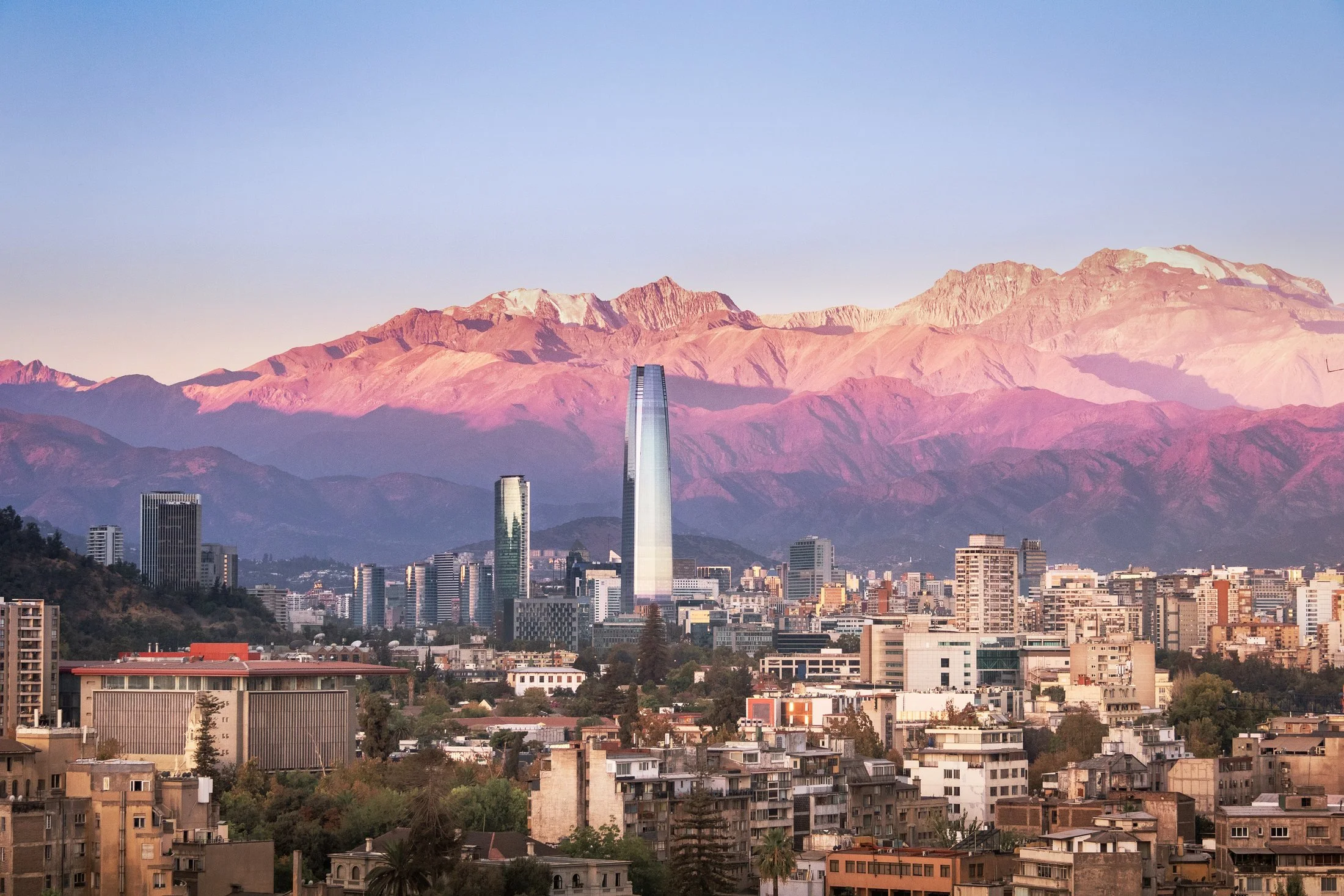
Chile Country Profile:
The Region's Most Institutional Jurisdiction, With a Three-Year Window Most Arrivals Waste
Chile is the most stable, most OECD-shaped economy in South America and the regional headquarters choice for firms that want rule of law with a Spanish-speaking market. For FTR it is both a source of internationally diversified HNW families and a destination for professionals who want Latin America without improvisation, and its three-year exemption on foreign income is the planning event.
🇨🇱 Key Facts (2026):
Currency: Chilean Peso (CLP); ~910 to USD (mid-2026, floating)
Personal income tax: Impuesto Global Complementario and Segunda Categoría, 0% to 40% across eight bands indexed in UTM/UTA; the 40% band begins at 310 UTA, roughly USD 280,000
Corporate tax: 27% general regime (Article 14 A, semi-integrated); Pro-Pyme regime 12.5% for 2025 to 2027, rising to 15% in 2028, for businesses averaging under UF 75,000 turnover (roughly USD 3.2 million)
Dividend withholding to non-residents (Impuesto Adicional): 35%, with credit for corporate tax paid: full credit for treaty residents (35% all-in), 65% credit otherwise (44.45% all-in)
VAT (IVA): 19%, including on imported digital services
Capital gains: ordinary income at marginal rates for most assets; 10% single tax on shares with stock-market presence since September 2022; individual real estate gains exempt up to UF 8,000 lifetime (roughly USD 350,000), excess at 10% or marginal rates
Wealth tax: none; the 2022 proposal was rejected by Congress in March 2023
Estate and gift tax: 1% to 25% progressive under Ley 16.271, on worldwide assets of Chilean-domiciled decedents
Tax residency trigger: presence over 183 days in any twelve-month period, or domicile established by intent and circumstances, whichever comes first
New-resident exemption: first three years taxed on Chilean-source income only (Article 3, Ley de la Renta), extendable by the SII
Exit tax: none
Headline visa thresholds: no published statutory minimum for the rentista or investor subcategories; adjudicated on documented income and business plan through SERMIG
Corporate setup: SpA through Empresa en un Día, USD 500 to 1,500 in professional fees. Annual maintenance: USD 2,000 to 5,000
Personal bank account minimum: none formal; a RUT and cédula de identidad are the real requirement
Private banking threshold: roughly USD 500,000 to 1 million investable
Cost of living, comfortable professional family, eastern Santiago: USD 5,000 to 7,500 monthly
CRS: participating; first exchanges 2018 on 2017 data
FATCA: Model 2 IGA, signed March 2014
Treaties: 37 comprehensive treaties in force, including the United States (effective 2024), Colombia, Peru, Spain, Portugal, United Kingdom, Canada, Australia, China, Mexico and Uruguay; none with Panama
Population: roughly 19.7 million on INE projections; the 2024 census counted 18.5 million
Time zone: UTC-4, UTC-3 in summer; Magallanes UTC-3 year-round; Easter Island UTC-6
Last edited: 22 September 2026 by Joe Martin Hanson (Director & Global Partner) with advice from FTR’s Chilean Tax Partners
Why Chile Matters
Chile has the most sophisticated financial sector in Latin America: deep local capital markets, a fully digital tax authority (the SII) that functions, OECD membership since 2010 that shows in the drafting of its tax law, and a banking system that clears in dollars without drama. Chilean HNW families have long held internationally diversified portfolios and are experienced with cross-border planning; for them FTR coordinates a second residency, a holding structure and a succession plan rather than introducing the concept.
It matters second as a destination. Regional executives and families who want Latin America with working institutions choose Santiago over Bogotá, Lima or Mexico City, and the first three years of residence are taxed on Chilean-source income only. Used properly, that window lets a client with offshore income and a well-built structure live in Chile at close to zero effective tax on that income while deciding whether to stay.
It matters third as a source. The unrest of 2019, two failed constitutional rewrites, the wealth-tax debate of 2022 and a visible rise in organised crime have pushed a slice of Chilean wealth towards Miami, Madrid, Lisbon, Dubai and, increasingly, Panama. The base is smaller than the Argentine or Venezuelan outflows and the money better organised, but the direction is the same.
It is not, and has never been, a privacy jurisdiction.
Visa and Residency Routes
The 2021 Migration Law (Ley 21.325, in force since February 2022) and its regulation replaced the old Department of Foreigners with the Servicio Nacional de Migraciones (SERMIG), and made one change that catches everyone: temporary residence must now be applied for from abroad through a Chilean consulate. A tourist can no longer arrive on 90 days and convert in-country, which was the route half the expat population used a decade ago.
Temporary residence subcategories run for one year, renewable once. The ones FTR uses: work with a Chilean contract for employees of a local subsidiary; investor and trader for a client putting capital into a Chilean company or business, where there is no published minimum and the file is judged on the business plan, capital actually transferred and jobs; rentista for those living on income from abroad, again with no statutory figure, though a documented USD 1,500 to 2,000 a month per adult is the practical floor consultants work to; retiree for pension income; and family reunification. There is no dedicated digital nomad visa in the Colombian or Costa Rican sense; a remote worker applies as a rentista on the strength of foreign contracts, which works but is slower than it should be.
Permanent residence (residencia definitiva) is available after 24 months of temporary residence, or twelve for some contract holders. Citizenship is available after five years' residence, without a formal language test; dual nationality has been permitted since 2005. Permanent residence lapses after a continuous absence of a year unless extended, so a Plan-B client who does not intend to live in Chile must manage the calendar.
Processing is the weakness. Consular temporary residence commonly takes six to twelve months; residencia definitiva twelve to twenty-four. Applicants in-country hold a residence-in-process certificate that lets them stay and work, so the backlog is a nuisance rather than a bar, but the cédula needed for banking arrives on SERMIG's timetable. Start-Up Chile, CORFO's accelerator, still offers a grant and a visa to selected founders.
For a professional with a Santiago employer, the work visa. For a retiree or remote worker, rentista. For a business owner moving real activity, investor, provided the capital is genuinely deployed; the investor visa funded with a nominal deposit and no operating plan looks good on paper and is now routinely refused.
Tax Peculiarities and Traps
The three-year window (Article 3, Ley de la Renta). A foreigner who becomes domiciled or resident is taxed only on Chilean-source income for the first three years, extendable on application to the SII. Foreign dividends, interest, rents and gains are outside Chilean tax entirely during that period. It is the single most valuable feature of the system for FTR's clients and the most commonly wasted: dividends from an offshore company deferred "until things settle" are then taken in year four at up to 40%. Plan distributions, realisations and restructurings inside the window.
Residency by intent as well as days. Since 2020, residence arises from more than 183 days in any twelve-month period (Article 8 No. 8, Código Tributario), but domicile arises earlier from the facts: a lease, a spouse and children in a Santiago school, a local job. The three-year clock and worldwide taxation run from whichever comes first, and the SII can and does argue domicile back to the day of arrival.
The semi-integrated system. A Chilean company pays 27%; when it distributes, the shareholder pays personal or additional tax with a credit for the corporate tax. Treaty-country residents get full credit and an all-in 35%; everyone else, including a shareholder resident in Panama, gets 65% of the credit and an all-in 44.45%. That nine-point difference decides where the parent of a Chilean company should sit.
CFC rules (Article 41 G) and preferential regimes (Article 41 H). A Chilean resident controlling a foreign entity attributes its passive income annually, with a de minimis exemption where aggregate passive income of controlled entities does not exceed UF 2,400 (roughly USD 105,000). Entities in a preferential regime are presumed controlled and their income presumed passive; payments to them attract 35% withholding and deductibility restrictions. Panama's territorial system and its lack of a treaty or exchange agreement with Chile put a Panamanian SA at real risk of that classification.
Inheritance and gift tax on the worldwide estate. Ley 16.271 taxes a Chilean-domiciled person's worldwide assets at 1% to 25% by value and kinship, and a foreign-domiciled person's Chilean assets. There is no spouse exemption of the kind Anglo systems assume. Lifetime planning matters and takes years, because gifts are taxed on the same scale.
Reporting. Foreign investments and foreign-source income are reported on annual sworn declarations, foreign trusts and similar arrangements separately, and the 2024 tax compliance law (Ley 21.713) sharpened the general anti-avoidance rule and the SII's information powers. Undisclosed foreign holdings are a criminal exposure, not a filing lapse.
Social security on salary. An employee pays 10% to an AFP plus roughly 7% for health (Fonasa or an Isapre), with a further employer contribution phasing in under the 2025 pension reform. A foreign professional covered abroad can opt out of the AFP under Ley 18.156, which is worth doing on a director's salary.
Capital gains. Listed shares with market presence attract a flat 10% single tax for individuals since September 2022, after decades of exemption. An individual's real estate gains are exempt up to UF 8,000 over a lifetime and then taxed at 10% or marginal rates; property held through a company gets none of that.
The Structural Layer
FTR's default, a Panamanian Private Interest Foundation owning a Panamanian SA with a modest director's salary paid where the client lives, fits Chile in one configuration and fails in another.
For a foreign professional or business owner arriving in Chile, it fits for three years. The SA's profits and distributions are foreign-source and outside Chilean tax until the Article 3 window closes; the director's salary paid in Chile is Chilean-source and taxed at progressive rates, which is the point. The adaptation is timing: use the window to take distributions, reset basis and decide whether the client stays. Past year three the SA is a CFC under Article 41 G, its passive income is attributed, and a Panamanian entity will be argued to be in a preferential regime. Then the operating company either acquires real substance where it operates, or is replaced by a treaty-jurisdiction holding company, or the client accepts full Chilean taxation at the 40% top rate.
For a Chilean HNW family, the default does not fit while they remain domiciled. The CFC regime, the preferential-regime presumptions and the worldwide inheritance tax reach every layer, and a Panamanian foundation with Chilean-resident beneficiaries is a reportable arrangement with no deferral. The structure earns its place only after a genuine change of domicile, usually to Madrid, Lisbon, Miami or Panama City. Then the standard architecture works: Chilean operating assets held through a treaty-country company to secure the 35% rather than 44.45% all-in rate, the foundation above it for succession, and personal residency wherever the family lives.
Chile is an excellent place for the operating company of a Latin American business, because of the treaty network, the SpA's flexibility and the credibility of Chilean accounts with banks and buyers, and a poor place for the holding layer. FTR's usual answer for a Chilean-connected multinational owner is a Chilean SpA operating, a treaty-jurisdiction holding company above it, and the family foundation above that.
Info-Sharing Reality (CRS and FATCA)
Chile is a fully participating CRS jurisdiction and has exchanged automatically since 2018. Chilean banks and brokers report non-resident account holders to the SII, which exchanges with more than a hundred partners including Panama, Colombia, Peru, Spain, Portugal, the United States' CRS-equivalents through FATCA, Switzerland, Singapore and the UAE. Under the Model 2 IGA, Chilean institutions report US persons' accounts directly to the IRS, and the 2024 US treaty added exchange-on-request on top.
A Chilean who has moved to Panama but kept Chilean accounts is reported to Panama; a Panamanian resident's Chilean brokerage account is reported home; a Spaniard living in Santiago is reported to the AEAT. Chinese HNW families who hold Chilean real estate through local companies are visible to Chinese authorities through CRS on the bank accounts those companies hold. Nothing about Chile is private, and V2's summary was right: this is a stable destination, not a Plan-B privacy jurisdiction.
Banking Reality
Banco de Chile, Santander Chile, BCI, Scotiabank Chile, Itaú Chile and the state-owned BancoEstado are the main names. A full current account requires a RUT and a Chilean cédula de identidad, which means residency; a tourist RUT allows tax registration and property purchase but not, in practice, a chequing account. BancoEstado's CuentaRUT is the standard first account for any resident with a RUT. Minimums are nominal; onboarding takes days once the cédula exists and is impossible until it does, which is why the SERMIG backlog matters.
Private banking through Banchile, LarrainVial, BTG Pactual, Credicorp Capital and the international arms of Santander and Itaú starts around USD 500,000 to 1 million investable, and is competent and dollar-fluent. Chile is on no FATF or EU list, has full correspondent and SWIFT access, and moves dollars in and out without exchange control; the Central Bank requires statistical reporting of foreign investment and loans above USD 10,000, not permission. A Panamanian entity opening a Chilean account will be asked for beneficial ownership, source of funds and the reason it exists.
Cost of Doing Business
A Chilean SpA can be registered online through the Empresa en un Día portal in a day at no state fee; the real cost is professional fees for drafting, a resident legal representative and tax registration, USD 500 to 1,500. Annual compliance is the expense: monthly VAT and withholding returns (Formulario 29), mandatory electronic invoicing through the SII, an annual income return (Formulario 22) and accounts, USD 2,000 to 5,000 for a small operation and materially more for anything with employees and cross-border payments.
Against the set: a Panamanian SA costs roughly USD 1,500 to 2,500 to establish and USD 1,000 to 1,800 a year including resident agent and franchise tax. Singapore runs about three times the Panamanian setup, USD 4,500 to 7,500, with USD 4,000 to 8,000 annual compliance. A Colombian SAS costs USD 800 to 1,500 to form and USD 2,500 to 5,000 a year. Chile is the cheapest of the four to open and, once the 27% rate and 19% VAT on nearly everything are counted, the most expensive to run as a profit centre; that is why it is the operating company, not the holding company.
Cost of Living
Monthly, for Santiago's eastern comunas (Providencia, Las Condes, Vitacura, Lo Barnechea), where FTR's clients actually live; Viña del Mar and Concepción run 25% to 35% lower on housing.
Lean, single or couple: USD 1,800 to 2,600: one-bedroom in Providencia or Ñuñoa CLP 650,000 to 900,000 (USD 700 to 1,000), groceries USD 400 to 550, Metro and Bip! card USD 50, Fonasa contribution on salary or a basic private plan USD 100 to 150.
Comfortable, family of four: USD 5,000 to 7,500: three-bedroom in Las Condes or Vitacura CLP 1.6 to 2.6 million (USD 1,750 to 2,850), Isapre or international health cover USD 400 to 800, one car with insurance and fuel USD 500 to 700, a good bilingual private school USD 700 to 1,200 per child per month.
HNW: USD 15,000 to 25,000 and up: a house in Lo Barnechea or La Dehesa, two places at Nido de Aguilas, The Grange, Santiago College or Craighouse at USD 15,000 to 28,000 a year each, Clínica Alemana or Clínica Las Condes cover, staff, two cars and travel.
Cultural and Practical Considerations
Chile works, by the standards of the continent, and that is the reason to choose it. Contracts are enforced, the SII's online systems are better than several European tax authorities', the Metro runs, and utilities and internet are reliable. The friction is elsewhere.
Language and integration. Chilean Spanish is fast, clipped and slang-heavy, widely regarded as the hardest in Latin America for a learner; English is workable in corporate Santiago and rare in banks, SERMIG and the Registro Civil. Chilean society is formal, private and more class-conscious than its neighbours, and social life runs through family and school networks that are hard for an outsider to enter. Expats describe a courteous distance that persists for years; the international-school community substitutes for it for families and not for single professionals. Someone who found Colombia or Mexico warm and easy should expect Chile to be cooler and slower.
Security. Chile remains one of the safest countries in the region, but the change since 2019 is real: street robbery and vehicle theft in Santiago have risen, organised crime from outside the country has arrived in the northern regions and parts of the capital, and public anxiety about crime now dominates politics. Eastern Santiago is calm; the perception of decline is nonetheless a real cost for arrivals who expected Switzerland.
Women and LGBT residents. No legal constraint on women travelling, residing, holding property or doing business alone; femicide legislation, a gender identity law (2018), same-sex marriage with adoption rights (2022) and the anti-discrimination Ley Zamudio (2012) are in force. Divorce was legal only from 2004, abortion is lawful only on three grounds, and the culture outside professional Santiago remains conservative. Family law is community-property by default unless separation of property is chosen at marriage, and Chilean courts look at worldwide assets.
Climate, geography and health. Santiago sits in a basin, and winter air pollution from May to August is a documented health issue for anyone with asthma or a cardiac condition. Earthquakes are a fact of life; building codes are among the strictest in the world and the 2010 magnitude 8.8 event caused remarkably little structural loss. Private healthcare in Santiago is excellent; public healthcare is stretched and slow.
Politics. A decade of volatility that the institutions absorbed: the 2019 unrest, two rejected constitutions, a failed wealth-tax proposal, and a change of government in March 2026 with a corporate-rate cut on its programme and nothing yet enacted. Policy swings between administrations are wider than the country's reputation suggests; expect tax rules to be debated loudly and changed slowly.
Bureaucracy and schooling. SERMIG and the Registro Civil are slow; everything else is efficient. Public schools are weak, the private and bilingual sector is strong, and the best international schools have waiting lists and entry fees.
For Retirees
The retiree or rentista subcategory above, the three-year window on foreign pensions and investment income, and then a decision at year three between staying at full rates and moving on; Chile is a fine place to spend those three years and an expensive one to spend twenty.
For Digital Nomads and Remote Professionals
No bespoke visa; rentista on foreign contracts, with the 183-day rolling count as the trap for anyone drifting between Santiago and Buenos Aires.
For Online Business Owners and Entrepreneurs
The default structure works for the three-year window and needs rebuilding at the end of it; take distributions early and decide by month thirty.
For Multinational Business Owners
Chile as operating base and regional headquarters, a treaty-jurisdiction parent above it to secure the 35% all-in rate, the foundation above that; never Panama directly over a Chilean SpA.
For High Net Worth (HNW) Families and Investors
Chilean families exiting need a genuine change of domicile before any structure helps. Foreign and Chinese HNW families buying Chile as a stability Plan-B get rule of law, a strong passport after five years and full transparency at full tax; that trade is rational, the expectation of privacy is not.
Common Traps
Arriving on a tourist stamp and expecting to sort out residence in Santiago; since 2022 the application is made abroad, and the person who did not know that loses a year.
Sitting on offshore income through the three-year window and then discovering the 40% marginal rate and CFC attribution in year four.
A Panamanian SA or foundation directly over a Chilean operating company: 44.45% on distributions instead of 35%, preferential-regime presumptions on every payment, and a beneficial-ownership conversation with every Chilean bank.
Chile as a tax destination for anyone planning to stay more than three years; the top personal rate is 40%, there is a worldwide inheritance tax with no spouse exemption, and every foreign holding is reported.
A Chilean HNW client who wants a foreign structure while keeping Santiago domicile, a Chilean cédula and the family in a Chilean school; the CFC and inheritance-tax rules follow the domicile, not the paperwork.
Anyone who needs warmth, informality and easy social entry; Chile offers order and distance, and those who chose it for the tax outcome rather than the temperament tend to leave.
Next Steps
If you are moving to Chile with offshore income or a business, the planning must be done before day one, because the three-year window and the domicile clock both start then. If you are a Chilean family considering a change of domicile, the sequence of exit, structure and destination decides the inheritance-tax and CFC outcome for a generation. Book a scoping call with an adviser who has worked both sides.
Important note: General information. Not personal tax, legal, or financial advice. Speak to a qualified adviser at FTR or elsewhere before acting.
Continue reading
Suggested next, chosen by our partners.


