
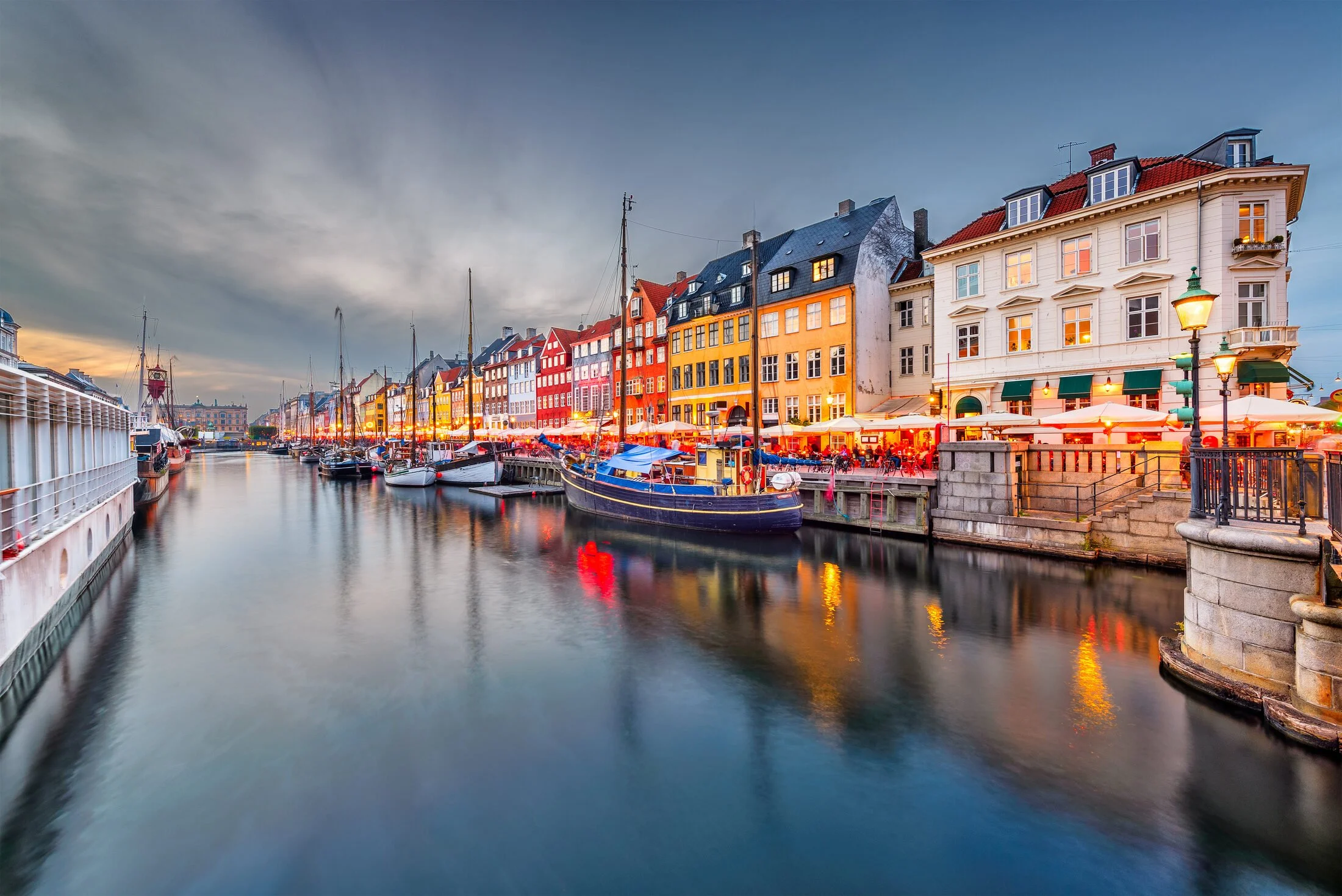
Denmark Country Profile:
The Highest Marginal Rate in the Set and a Deemed Sale at the Border
Denmark taxes salary at up to 60.5%, share income at 42% and the estate at up to 36.25%, then deems your shares sold on the day you leave. A source country whose emigrants need a two-year plan, not a departure date.
🇩🇰 Key Facts (2026):
Currency: Danish Krone (DKK); pegged to the euro at about DKK 7.46; ~6.45 DKK per USD (mid-market, September 2026)
Personal income tax: 8% labour market contribution on all earned income, then bottom tax of about 12%, municipal tax averaging about 25%, a middle tax of 7.5% above roughly DKK 640,000, a top tax of a further 7.5% above roughly DKK 780,000, and from 2026 a top-top tax of 5% on personal income plus positive net capital income above DKK 2,818,152
Combined top marginal rate: 60.5% including the labour market contribution (about 57% before it), the statutory ceiling for 2026
Corporate tax: 22%
VAT (moms): 25%, no reduced rate
Capital gains and dividends (share income): 27% up to roughly DKK 79,000 a year (double for married couples), 42% above
Other capital income: interest and similar taxed with ordinary income, capped at about 42%
Wealth tax: 0% (abolished 1997)
Estate/inheritance tax (boafgift): 15% on the estate above an allowance of roughly DKK 345,000, spouses exempt; beneficiaries outside the close family pay a further 25% on what remains after the 15%, a combined 36.25%; 10% on qualifying family-business succession
Gift tax: 15% on gifts to close family above an annual allowance of roughly DKK 79,000; gifts outside the close family are taxed as income
Exit tax: deemed disposal of shares, claims and financial contracts on emigration where the portfolio exceeds DKK 100,000 and the person was resident seven of the last ten years; deferral available
Tax residency trigger: a home available in Denmark plus taking up stay, or any continuous stay of six months; residency continues after departure while a Danish home remains available unless it is let unconditionally for at least three years
Expat scheme: 27% flat tax plus 8% labour market contribution, 32.84% all-in, for up to 84 months, at a monthly salary of roughly DKK 80,000 or above
Headline visa thresholds: Pay Limit Scheme at roughly DKK 514,000 a year; Supplementary Pay Limit Scheme roughly DKK 415,000; Positive Lists and Fast-track for certified employers; no investor, retirement or nomad route
Corporate setup (ApS): DKK 20,000 minimum share capital plus DKK 670 registration and DKK 5,000–15,000 adviser cost (~USD 800–2,300 excluding capital). Annual maintenance: DKK 15,000–60,000 (~USD 2,300–9,300)
Personal bank account minimum: nil; CPR number and MitID expected
Private banking threshold: roughly DKK 3–5 million investable (Danske, Nordea, Nykredit, Jyske, Sydbank)
Cost of living, comfortable professional household: DKK 50,000–70,000 a month in Copenhagen (~USD 7,800–10,900)
CRS: participating; early adopter, first exchanges 2017 on 2016 data
FATCA: Model 1 IGA, signed November 2012
Treaties: roughly 80 comprehensive, including the US, UK, Canada, Australia and the Nordic multilateral convention; none with Colombia; an information exchange agreement with Panama since 2012 but no comprehensive treaty; none with Spain since Denmark terminated it in 2009; a new treaty with France in effect from 2024
Population: ~6.0 million
Time zone: CET, UTC+1 (UTC+2 summer)
Last edited: 10 September 2026 by Joe Martin Hanson (Director & Global Partner) with advice from FTR’s Danish Tax Partners
Why Denmark Matters
Denmark has the highest statutory marginal rate on earned income in this set. The 2026 reform that added a 5% top-top tax above DKK 2.8 million lifted the ceiling from the long-standing 55.9% to 60.5%, while cutting the middle of the scale, which tells you where Danish politics sits on high earners. Share income is taxed at 42% above a low threshold, an estate passing outside the close family loses 36.25%, and shares are deemed sold on the way out. For an owner-manager the arithmetic of staying is heavier than in Sweden, which taxes capital lightly and has no inheritance tax.
It matters second because Denmark does not let go easily. Full tax liability turns on having a home available, and the practical test on departure is whether the house has been sold or let unconditionally for three years. The section 38 exit tax is real money on a founder's shares, and its deferral comes with a running account that dividends and sales draw down. The emigrant who wants a clean break needs the house, the shares and the pension dealt with before the flight.
Third, Denmark is a modest inbound destination: EU and Nordic citizens arrive freely, and the 27% scheme makes a senior inbound role workable for seven years. It is a very good place to live and an expensive place to earn, and FTR does not sell it as anything else. The people who leave go to Switzerland on a lump-sum ruling, to the UAE, to Portugal while the non-habitual resident regime was open, to the UK before the non-dom reform, and in smaller numbers to Panama.
Visa and Residency Routes
EU and EEA citizens have the right of residence and register for a CPR number at the municipality; Nordic citizens move under the Nordic passport union with no permit. Non-EU routes are employment-led and administered by SIRI.
Pay Limit Scheme. A job offer at roughly DKK 514,000 a year or above, paid to a Danish account on market terms; about a month to process. The route for senior hires and the one FTR would use for an inbound executive.
Supplementary Pay Limit Scheme. The same mechanism at roughly DKK 415,000, available only while national unemployment is low and through employers meeting collective-agreement conditions. It can be suspended when unemployment rises.
Positive Lists and Fast-track. Shortage occupations for skilled work and higher education, updated twice a year with no salary floor beyond market terms; certified employers, generally with twenty or more staff, can bring staff in within days.
Researcher and key-employee tax scheme. Not a visa but the reason senior inbound roles work: 27% plus 8% for up to 84 months, provided the person was not Danish-taxable in the previous ten years and earns above roughly DKK 80,000 a month. Researchers are exempt from the salary floor.
Start-up Denmark. A business plan approved by an expert panel, self-support funds and a two-year permit. Approval rates are low and the panel favours scalable technology. Not a route FTR would plan around.
Family reunification. Among the strictest in Europe: both spouses generally 24 or over, a financial guarantee of roughly DKK 120,000, an attachment and integration points test, a Danish language test for the arriving spouse within months, no public benefits, and a year of processing.
Permanent residence needs eight years of legal residence, or four with supplementary conditions, plus Prøve i Dansk 2, three and a half years of full-time work in the last four and no benefits in the qualifying years. Citizenship needs nine years of continuous residence (two for Nordic citizens), Prøve i Dansk 3, the citizenship test, self-support, no public debt, a clean record with a permanent bar for custodial sentences, passage by Act of Parliament and a constitutional ceremony with a handshake. Dual citizenship has been allowed since 2015, so Danes who leave keep the passport.
There is no investor visa, no retirement route and no digital nomad visa. Anyone offering one is selling a work permit in disguise.
Tax Peculiarities and Traps
Full tax liability and the home (Kildeskatteloven section 1). A person becomes fully liable when they have a home available in Denmark and take up stay there; holidays do not count, but a stay of more than three consecutive months, or 180 days in any twelve, does, and a person with no home becomes liable after six months' continuous stay. On the way out the rule runs in reverse: a Danish home that remains available keeps the person fully liable however long they are abroad. The accepted break is to sell, or to let the property unconditionally for at least three years with no right to terminate. Letting the Copenhagen flat to a friend on a month's notice is not a departure.
The exit tax (Aktieavancebeskatningsloven section 38, Kursgevinstloven section 37). On the day full liability ends, shares, claims and financial contracts are deemed sold at market value and the gain is taxed as share income at 27% and 42%, where the person was fully liable for seven of the last ten years and the portfolio exceeds DKK 100,000. Deferral is available on application: a deferral account is opened for the tax, and each later dividend, sale or distribution triggers a payment from it. Security is required for moves outside the EU and EEA, which includes Panama and the UAE. A founder who sells the company three years after leaving pays the Danish tax then, at Danish rates, wherever they live.
Share income and the 42% band. Dividends and gains are taxed together at 27% up to roughly DKK 79,000 per person and 42% above. For an owner-manager taking DKK 1 million of dividends the effective rate is close to 40%, on top of 22% at company level.
The top-top tax. From 2026 the 5% top-top tax base includes positive net capital income as well as personal income, so a high earner with interest income pays the extra 5% on that too. The ceiling is 60.5% including the labour market contribution.
Estate tax on non-family heirs. The 15% boafgift applies to the estate above a modest allowance, spouses exempt. Where the heir is not a child, descendant, stepchild, parent or cohabitant of two years, a further 25% is charged on the value after the 15%, giving 36.25%. For an unmarried partner of under two years, a sibling, a nephew or a friend, more than a third goes to the state. Gifts follow the same lines: 15% to close family above the annual allowance, income tax for anyone else.
Pensions. Returns inside Danish pension schemes are taxed at 15.3% a year, payouts are taxable in Denmark, and Denmark negotiates hard to keep source taxation in its treaties; it terminated the French and Spanish treaties in 2008 precisely because they gave the residence state the right. A Danish retiree in Spain today pays full Danish tax on a Danish pension with only a Spanish credit to soften it.
Foreign foundations and trusts. A Danish resident who settles assets into a foreign trust or foundation is taxed on its income under Ligningsloven section 16K unless the settlement is irrevocable and the settlor has no influence, and a 20% entry tax under Fondsbeskatningsloven section 3A can apply to capital transferred to foundations in low-tax jurisdictions. A Panamanian foundation established while Danish-resident is taxed through and taxed on entry.
The Structural Layer
For a client still resident in Denmark, FTR's default of a Panamanian Private Interest Foundation owning a Panamanian SA does not fit. Ligningsloven section 16H taxes a Danish resident currently on the income of a controlled foreign company whose income is mainly financial and whose tax burden is materially below Denmark's, and a Panamanian SA with non-Panamanian income is caught; the foundation is worse, because section 16K attributes its income to the founder and section 3A can charge 20% on the way in. An SA run from a desk in Aarhus is a Danish taxpayer at 22% before any of this applies. A Danish-resident owner is left with a Danish ApS under a holding ApS, which gives tax-free dividends and gains on subsidiary shares of 10% or more, a perfectly good domestic structure with 42% at the personal level whenever money comes out.
After a genuine departure the default works in its ordinary form, with two adaptations. First, the Danish shares must be dealt with: sold before departure, held under a deferral with security lodged for a non-EEA destination, or kept in the Danish holding with dividends flowing to the new residence under Denmark's 27% withholding, reduced only by treaty. There is no treaty with Panama, so a Panamanian SA receiving Danish dividends pays the full 27% unless an EU or treaty-country holding is interposed, and the anti-abuse rules will test that. Second, the foundation should be settled after full tax liability ends, never before, and succession for Danish-situs assets planned with the 36.25% rate in mind for any beneficiary outside the close family.
For the inbound specialist, the structure is salary through the Danish employer under the 27% scheme, a plan for month 85, and no Danish-resident directorship of a foreign holding company in the meantime.
Info-Sharing Reality (CRS and FATCA)
Denmark is fully CRS-participating and was among the early adopters, exchanging with well over a hundred jurisdictions including Panama, Colombia, Portugal, Spain, Switzerland, the UAE, Singapore and Hong Kong. Danish banks report non-resident account holders to the Tax Agency, which forwards the data; under the Model 1 FATCA IGA, signed in 2012 as the second in the world, US persons' accounts go to the IRS. Denmark has never shown any interest in banking privacy.
An emigrant whose Danish home is still available, and who is therefore still fully liable, will find the destination's banks reporting the new accounts straight back to Copenhagen, and the Tax Agency matches that data against exit-tax deferral accounts. Foreign residents holding Danish accounts are reported home, including Chinese account holders to Beijing. Unlike its Nordic neighbours, Denmark does not publish individual tax returns, which is a small mercy and the only one.
Banking Reality
Danske Bank, Nordea, Jyske Bank, Sydbank, Nykredit and Spar Nord hold the market, with Arbejdernes Landsbank and the regional savings banks behind them and Lunar and Revolut for the phone-first. A resident with a CPR number and a Danish address opens a basic account in days; every resident is entitled to one, and it becomes the NemKonto into which the state pays everything. MitID, issued through the bank or the municipality, is the key to the Tax Agency, the health system and every contract. Denmark is close to cashless; MobilePay and card are the payment system.
Without a CPR number, banking is slow and thin. A foreign-owned ApS with no Danish-resident director or Danish activity can wait weeks for a corporate account and be refused; since the Danske Bank Estonia case, Danish banks are among the most compliance-conservative in Europe and treat inbound payments from Panama, the Caribbean and Latin America as documentation events. Emigrants can normally keep accounts if the address is updated, though banks review non-resident customers and some close accounts for residents of jurisdictions they consider high-risk. Private banking begins at roughly DKK 3–5 million investable at Danske, Nordea, Nykredit, Jyske and Sydbank, with Formuepleje and the independents alongside. Denmark is on no blacklist or grey list and has full correspondent and SWIFT access.
Cost of Doing Business
A Danish anpartsselskab needs DKK 20,000 of share capital, which stays in the business, and costs DKK 670 to register plus DKK 5,000–15,000 (~USD 800–2,300) with an adviser; formation online takes a day. Annual compliance runs DKK 15,000–60,000 (~USD 2,300–9,300), and audit is not required for small companies. The aktieselskab needs DKK 400,000 of capital. Employer social costs are unusually low for Europe, a few thousand kroner per employee a year, because the welfare state is funded through income tax rather than payroll.
Against the set: a Panamanian SA costs roughly USD 1,500–2,500 to establish and USD 1,000–1,800 a year including resident agent and franchise tax; Singapore runs around three times the Panamanian setup, USD 4,500–7,500, with USD 4,000–8,000 annual compliance; a Swedish AB is comparable to the Danish ApS. Denmark is cheap to form and reasonable to run at 22%; the cost that matters is 42% on the dividend and 60.5% on the salary.
Cost of Living
Monthly, for Copenhagen; Aarhus and Odense run 20%–30% below on housing.
Lean, single or couple: DKK 20,000–28,000 (USD 3,100–4,300): a one-bedroom at DKK 10,000–14,000, public healthcare free at the point of use, groceries DKK 3,500–5,000, a bicycle and a Rejsekort at about DKK 800.
Comfortable, family of four: DKK 50,000–70,000 (USD 7,800–10,900): a three-bedroom at DKK 20,000–30,000, public school and near-free healthcare, subsidised childcare of about DKK 3,000–4,000 per child, a car at DKK 5,000–8,000 all-in after a registration tax that runs up to 150% of value, or none, since Copenhagen is built for bicycles.
HNW: DKK 120,000–200,000 and up (USD 18,600–31,000): a house in Hellerup, Klampenborg or Frederiksberg at DKK 45,000–80,000 rent or the mortgage equivalent, international school places at roughly DKK 150,000–200,000 per child per year, help and winter travel south.
Cultural and Practical Considerations
Denmark works, and it works on trust. Institutions are clean, public services excellent, the 37-hour week is taken seriously, and a family that values order, safety for children and time at home will find few better places. The costs are social, climatic and, for a non-EU resident, political.
Integration. English is universal in professional life and at banks and agencies; Danish is nonetheless the floor for belonging and a condition of permanent residence and citizenship. Social life runs through circles formed at school, sport and the workplace, and Danes are warm inside them and politely closed outside. The Jante law is a cliché with a real referent: visible ambition, wealth and self-promotion are read as bad manners, and a client who arrives from Dubai or Miami and behaves accordingly will be tolerated and not liked. Foreigners without Danish and without children in a local school routinely report loneliness after several years; Copenhagen's expat community is substantial and does not substitute.
Women, LGBT residents and family law. Denmark is as far along on gender equality and LGBT rights as any country in the set: the first to recognise same-sex partnerships in 1989, marriage since 2012, strong anti-discrimination law, and no guardianship, dress or conduct issues. Family law divides deferred community property equally on divorce by default and the courts consider worldwide assets; a marriage contract must be registered to be effective, and an unmarried partner of under two years is a stranger for estate tax.
Immigration politics. Denmark has run one of Europe's strictest immigration policies under governments of both left and right for twenty years. Family reunification rules, the parallel-societies legislation on housing, and the tightening of permanent residence and citizenship are settled policy. A non-EU resident should expect the conditions for staying to become stricter, not looser, and should not expect public sympathy.
Climate, security and bureaucracy. Copenhagen has around seven hours of daylight in December and wind and rain from November to March; seasonal depression is a real health variable. Violent crime is low, gang conflict is contained to a few districts, and personal security is not a planning variable. The bureaucracy is digital and efficient once the CPR number and MitID exist, and slow before that. Copenhagen housing is tight, and a newcomer usually pays market rent for a newer flat outside the regulated older stock.
Schooling. Public schools are free and good, private schools cheap by international standards, and the international schools are the option for children who will move again. Danish schools expect children to be independent and social; parents from more directive systems sometimes find them too loose.
For Retirees
A Danish pension is taxed in Denmark wherever the pensioner lives, subject to treaty, and a move to Spain gets no treaty relief at all. Deal with the house under the three-year rule and take the pension analysis to counsel before choosing a destination. No inbound retirement route.
For Digital Nomads and Remote Professionals
A Danish citizen travelling year-round with a flat in Copenhagen has not left. No inbound visa.
For Online Business Owners and Entrepreneurs
The section 38 exit tax and the 42% band are the departure problems; sell, restructure or lodge the deferral before leaving, then apply the default structure from the destination.
For Multinational Business Owners
A good place for a subsidiary at 22% with the holding-company exemptions and low employer costs; an expensive place for the owner to live. Inbound senior hires use the 27% scheme.
For High Net Worth (HNW) Families and Investors
A poor place to arrive for a passive family: 42% on capital returns, 36.25% on the estate outside the close family, full transparency and no investor route. Chinese and other HNW families should assume every Danish account is reported home. Danish families leaving should settle any foundation after the exit, not before.
Common Traps
The half-departure. Keeping the house available, leaving a spouse in Denmark, letting the flat on a short lease; each keeps full tax liability alive at the top rates.
Ignoring the exit tax. Leaving with a founder's shareholding, not applying for deferral, and receiving an assessment at 42% on a paper gain with no cash to pay it.
Moving to a non-EEA destination with a deferral and no plan for the security the Tax Agency will require.
Settling a foundation or trust while still resident, and meeting section 16K and the 20% entry tax.
Retiring to Spain on a Danish pension and expecting a treaty to help.
Coming to Denmark for tax: 60.5% on salary, 42% on dividends, 25% VAT with no reduced rate, and registration tax on the car.
Assuming the family will follow easily on a non-EU passport. Family reunification is the hardest door in the country.
Next Steps
If you are a Danish resident within 24 months of leaving, hold shares in a Danish company or a portfolio above DKK 100,000, own a Danish home you intend to keep, or draw a Danish pension abroad, book a scoping call. The three-year home rule and the section 38 exit tax are the whole of the Danish exit, and both reward planning that starts before the departure date.
Important note: General information. Not personal tax, legal, or financial advice. Speak to a qualified adviser at FTR or elsewhere before acting.
Continue reading
Suggested next, chosen by our partners.


